Foundations · August 3, 2026 · Andrew Wilson · 11 min read
Healthspan vs Lifespan: What Longevity Really Means After 50
Living longer is not the goal. Living well for longer is. Here is the one gap that decides which one you get.
You have done the things. The checkups. The bloodwork. Maybe a pill or two to keep the numbers in line. And still, somewhere past 50, a quiet worry sets in. Not the fear of dying young. The fear of the slow fade. The knees that ache getting out of the car. The friends who spend their 70s in waiting rooms. You are not scared of the finish line. You are scared of the last long stretch before it, and whether it will be lived or just endured.
Here is the part almost no one says out loud: that fear is rational, and the health system is not built to fix it.
The goal everyone gets wrong
Ask most people what longevity means and they will say “living longer.” More years. A bigger number on the last page.
I think that is the wrong goal, and chasing it is exactly why so many people over 50 end up disappointed.
Longevity is not lifespan, the total number of years you are alive. Longevity, the kind worth wanting, is healthspan: the number of years you live strong, sharp, and independent. Lifespan is how long your heart beats. Healthspan is how long you get to be you.
The two are not the same. And the distance between them is the whole ballgame.
The gap nobody measures
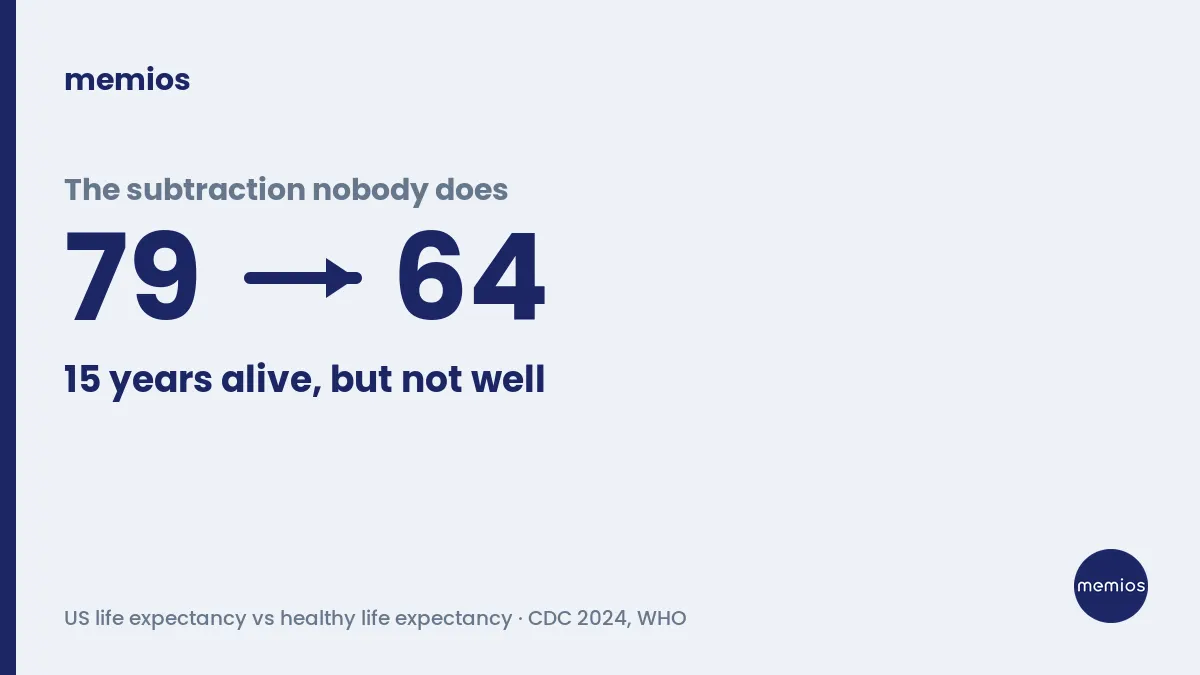
In 2024, life expectancy in the United States hit an all-time high of 79 years. 1 Good news, on the surface.
Now the number that should stop you. Healthy life expectancy in the US, the years a person can expect to live in full health, is only about 64 years. 2 Do the subtraction. The average American spends roughly 15 years alive but not well. 1 2
Fifteen years. That is not a rounding error. That is a decade and a half of life lived inside limitations.
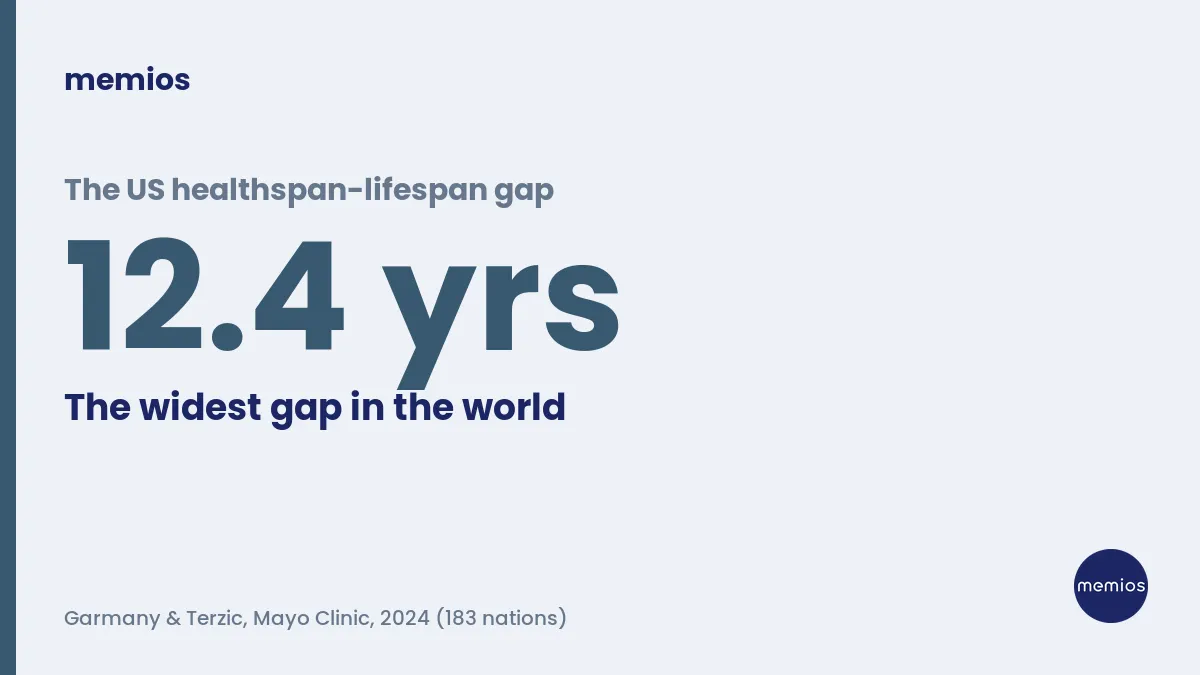
And it is getting worse. A 2024 Mayo Clinic study looked at all 183 World Health Organization member states and measured this exact gap between how long people live and how long they live healthy. The United States had the largest gap in the world: 12.4 years, up from 10.9 years at the turn of the century, and 29 percent worse than the global average. 3
The US has the widest healthspan-lifespan gap on Earth. We are not failing to add years. We are failing to make the years worth living.
Read that twice. We are, by one measure, the best in the world at the wrong thing.
Why this is personal for me
I am 59. I am not training for a marathon. I am training for my 90s. And I did not arrive at that goal from a textbook.
In 2018 I lost my father to cancer. In 2021 my best friend Brad was diagnosed with Stage IV melanoma, and he passed in April 2026. In 2022 the diagnosis came for me. Melanoma, caught early.
When serious illness sits that close, you stop counting years and start counting good days. I watched people I loved get sent home after treatment with no plan to rebuild their strength, as if surviving were the finish line instead of the starting one. I lived that gap. It is the reason I built Memios.
I still have a long list of things I want to do, and every one of them needs a strong body. More travel. More time on the boat. More mornings on the water with a fly rod. I want to be strong in body and mind for as long as I am here.
What I do not want is the slow version. I have watched it up close. People fading in nursing homes. People I love disappearing inside memory units. Friends like Brad, gone too young. Bodies so broken they shrink a whole life down to a single room. That is the future I am training against.
My goal is blunt, and I mean it kindly toward myself: live strong, then go quickly. Compress the hard part. Stretch the good part as far as it will go. That is what healthspan means when it stops being a word and becomes a plan.
So when I tell you healthspan is the number that matters, I am not selling optimism. I am telling you what I decided to organize the rest of my life around.
What actually drives the gap
Here is the hopeful turn, and it is a big one.
The healthspan-lifespan gap is not fate. In the US, the leading contributors to those unhealthy years are not exotic. They are largely chronic, and largely modifiable: cardiometabolic disease, musculoskeletal decline, and mental health. 3 The things that steal your good years are, to a meaningful degree, the things you can push back on.
And the single most powerful lever is the one the fitness industry makes look complicated: movement.
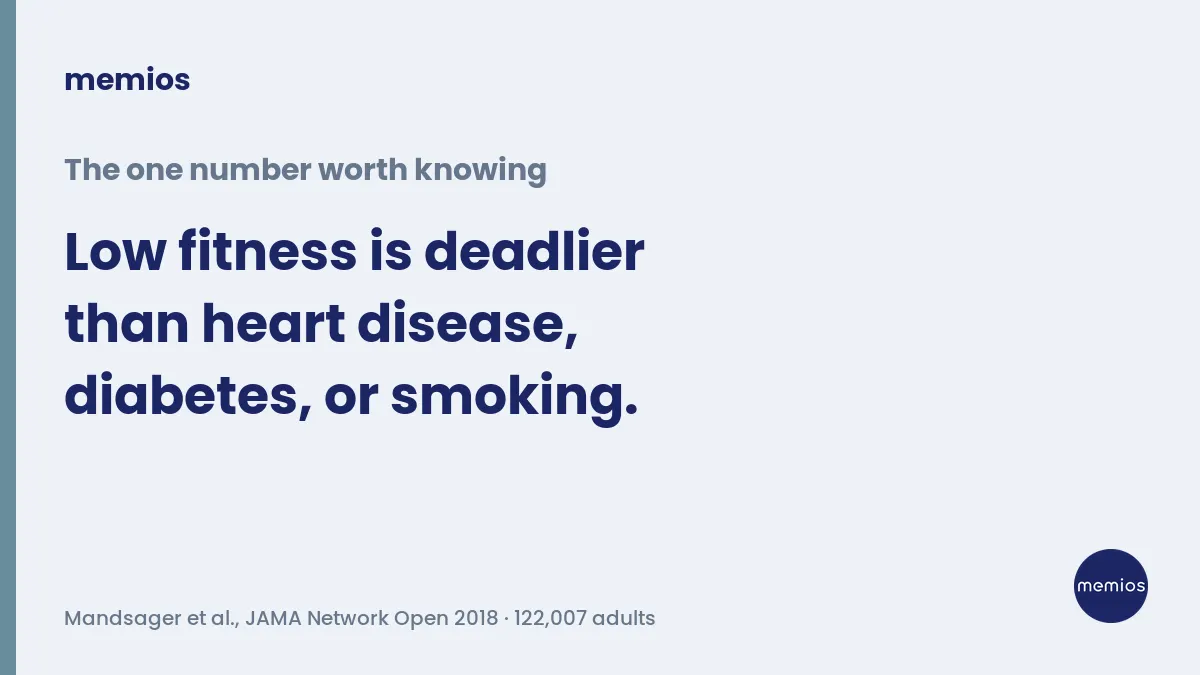
Consider cardiorespiratory fitness, measured as VO2max, how well your body uses oxygen. In a study of more than 122,000 adults, low fitness carried a greater risk of death than coronary artery disease, diabetes, or smoking. 4 The most fit had roughly an 80 percent lower risk of death than the least fit, and the benefit never plateaued. 4 Fitness is trainable at any age. 5 And more than half of the survival benefit shows up just moving from the least-fit group to the next one up. 6
That last point is the one to hold onto. If you feel like you are starting from zero, you are not behind. You are holding the most valuable ticket in the room, because you have the most to gain from the least work.
The levers of a longer healthspan: body, mind, and spirit
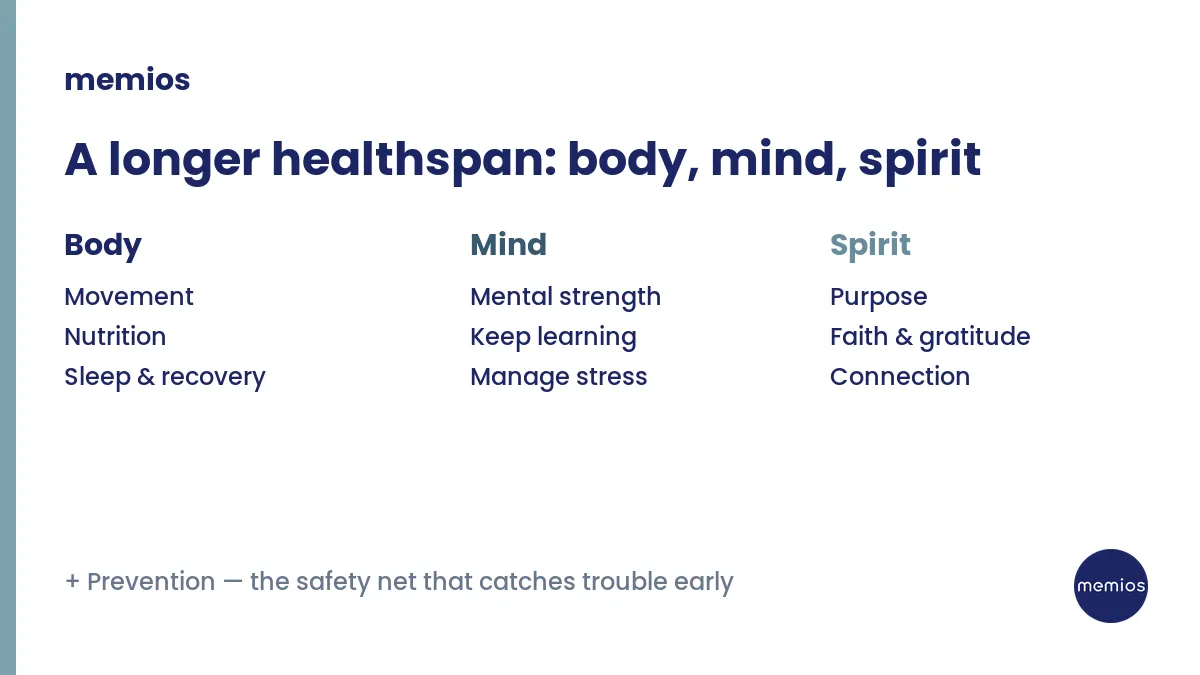
Longevity after 50 is not a single heroic act. It is a handful of ordinary levers, pulled consistently, across body, mind, and spirit. Strong in one is not enough. You want all three.
Body
· Movement. The foundation. Aerobic work for your heart and VO2max, and strength work to protect the muscle that keeps you independent. Movement is the closest thing we have to a longevity drug, and the research behind why movement is medicine is overwhelming. The World Health Organization target is 150 to 300 minutes of moderate activity a week plus strength twice a week, but the biggest gains come from simply moving more than you do now. 7
· Nutrition. Enough protein to hold muscle, enough fiber and whole food to steady your metabolism and your gut. Food that fuels, not food that merely fills.
· Sleep and recovery. The unglamorous multiplier. Deep sleep is when the brain clears itself and the body repairs.
Mind
· Mental strength. The brain ages like a muscle: use it or lose it. Keep learning, manage stress, and take your mental health as seriously as your blood pressure. Movement is one of the best things you can do for your brain, and mental health conditions are among the largest drivers of America’s unhealthy years. 3 Staying sharp is not luck. It is trained.
Spirit
· Purpose, faith, and connection. A reason to get up in the morning is a health intervention. Loneliness raises your risk of dying early; purpose lowers it. Gratitude, prayer or meditation, and real relationships are not soft extras. After my own diagnosis and everything that came with it, they became the center of how I live, not the decoration.
The safety net
· Prevention. The screenings and numbers that catch trouble while it is still small. My melanoma was Stage 0 because someone looked. That is the whole difference.
None of these require a gym you dread or a diet you cannot live on. They require a direction and a first step.
The system is not coming to save you
I want to be honest about the thing that makes this hard. The evidence for all of this is settled. The delivery is not.
The science that movement extends healthy life has been proven across thousands of studies. Yet most people are never shown how, never referred, never given a plan. The gap between what works and who actually receives it is the reason a country can lead the world in life expectancy and still lead the world in unhealthy years. 3
That is the gap Memios exists to close, and it is the reason I write this letter. Not to add noise. To hand you the plan the system forgets to.
What it means for you
Stop chasing lifespan. You do not get to pick the last number anyway. What you can influence, starting today, is how many of those years you spend strong.
The shift is simple to say and powerful to live: measure the right thing. Not “how long will I live,” but “how well, and for how long.” Track your fitness. Protect your muscle. Move most days. Sleep. Stay connected. Catch problems early.
You are not too old, and you are not too late. The research could not be clearer that the lowest starting point carries the largest payoff. Your best decade can still be ahead of you.
Related from The Longevity Letter
· Why Movement Is Medicine — the research behind the single biggest lever on your healthspan.
· Strength Training After 50 — how to protect the muscle that keeps you independent.
· Move Your Body — the simplest place to start today.
· Debunking the Top 10 Health Myths People Over 50 Still Believe — why it is never too late to begin.
Your next step
The Longevity Letter is where I share the science, the stories, and one or two things you can do this week to close your own gap. It is free, and it is written by someone living this, not lecturing about it.
Frequently Asked Questions
What is the difference between healthspan and lifespan?
Lifespan is the total number of years you are alive. Healthspan is the number of years you live in good health, strong and independent, before chronic illness or disability sets in. Longevity worth wanting means widening your healthspan, not just your lifespan.
How big is the healthspan-lifespan gap in the US?
About 12.4 years, the largest of any country in the world, according to a 2024 Mayo Clinic analysis of 183 nations. 3 On average, Americans live to about 79 but stay in full health only to about 64. 1 2
Can I still improve my healthspan after 50?
Yes, and the data says the lower your starting point, the larger your gain. More than half the survival benefit of fitness comes from moving out of the least-fit group. 6 It is rarely too late to add strong years.
Is this medical advice?
The Longevity Letter shares education, not diagnosis or treatment. Memios goes further than words. Our certified providers in exercise, nutrition, weight loss, and longevity work alongside your existing healthcare team to build holistic wellness plans that grow your healthspan and your lifespan. For diagnosis or treatment, always start with your physician.
References
1 Centers for Disease Control and Prevention, National Center for Health Statistics. Mortality in the United States, 2024. US life expectancy at birth reached 79.0 years in 2024. https://www.cdc.gov/nchs/products/databriefs/db548.htm
2 World Health Organization, Global Health Observatory. Healthy life expectancy (HALE) at birth. US HALE is approximately 63.9 years (men 62.8, women 65.1). https://www.who.int/data/gho/data/themes/mortality-and-global-health-estimates/ghe-life-expectancy-and-healthy-life-expectancy
3 Garmany A, Terzic A. Global Healthspan-Lifespan Gaps Among 183 World Health Organization Member States. JAMA Network Open / Mayo Clinic, 2024. The US had the largest healthspan-lifespan gap at 12.4 years; the global gap grew from 8.5 years (2000) to 9.6 years (2019). https://www.ncbi.nlm.nih.gov/pmc/articles/PMC11635540/
4 Mandsager K, Harb S, Cremer P, et al. Association of cardiorespiratory fitness with long-term mortality among adults undergoing exercise treadmill testing. JAMA Network Open. 2018;1(6):e183605. In 122,007 adults, low fitness carried a mortality risk greater than coronary artery disease, diabetes, and smoking, with no observed plateau. https://jamanetwork.com/journals/jamanetworkopen/fullarticle/2707428
5 Poon ET-C, et al. High-intensity interval training and cardiorespiratory fitness in adults: an umbrella review. Scand J Med Sci Sports. 2024;34(1):e14652. VO2max improves reliably with training across ages. https://onlinelibrary.wiley.com/doi/10.1111/sms.14652
6 Ross R, Blair SN, Arena R, et al. Importance of assessing cardiorespiratory fitness in clinical practice: a case for fitness as a clinical vital sign. Circulation. 2016;134(24):e653-e699. More than half the mortality reduction occurs moving from the least-fit group to the next-least-fit group. https://www.ahajournals.org/doi/10.1161/CIR.0000000000000461
7 Bull FC, et al. World Health Organization 2020 guidelines on physical activity and sedentary behaviour. Br J Sports Med. 2020;54(24):1451-1462. 150 to 300 minutes of moderate activity a week plus muscle strengthening on 2 or more days; some activity is better than none. https://bjsm.bmj.com/content/54/24/1451