Movement · September 9, 2025 · Andrew Wilson · 12 min read
Strength Training Over 50
The Key to Living Longer, Stronger, and Pain-Free
Why building muscle after 50 isn’t optional—it’s essential for living long, healthy, and with purpose
Introduction
If you’re over 50 and looking to stay strong, active and vital into your 70s, 80s and beyond, then strength training for longevity over 50 is one of the smartest moves you’ll make. In this guide we’ll explain what it means, why it matters now more than ever, how to begin safely, what to expect, and how to build a routine that works. You’ll walk away understanding how resistance training after 50 can help you maintain muscle, keep bones strong, support brain health, reduce chronic-disease risk, and preserve independence.
Why Strength Training for Longevity Over 50 Matters
The challenge of aging
- After age 30, muscle mass tends to decline gradually; this accelerates after 50.
- Conditions such as sarcopenia (age-related loss of muscle mass) and dynapenia (loss of muscle strength) become risks.
- Loss of muscle and strength is linked to increased frailty, falls, fractures, dependence and mortality.
The power of strength training
When you engage in strength training for longevity over 50, you’re doing more than lifting weights. You’re addressing key aging-related vulnerabilities.
- Muscle strength and mass: Studies show older adults who do strength or resistance training can build or preserve muscle mass, improve recruitment of muscle fibres, and improve motor unit function.
- Bone health: Resistance training places load on bones, which triggers bone-building responses.
- Brain and cognition: Resistance training supports cognitive function, memory and brain health in older adults.
- Longevity and reduced mortality: Evidence shows resistance training is associated with lower risk of death and improved life-span.
Specific data you need
- A review of 16 global studies found just 30-60 minutes of muscle-strengthening exercise per week increased life expectancy by 10-17%.
- A meta-analysis found resistance exercise contributed to a 21 % reduction in all-cause mortality, and when combined with other activity the reduction reached 40%.
- In an observational US national sample, those who did about 90 minutes per week of strength training had telomeres (cellular aging markers) that suggested almost 4 years less biological aging.
What this means for you
If you want to live strong and independent into your 70s, 80s and beyond, then dedicating time to strength training is no longer optional—it’s foundational. It means fewer falls, better mobility, more energy, better chronic-disease resistance, and more freedom.
Principles of Strength Training for Longevity Over 50
Here’s what you need to know to train smart, safe and effective.
1. Frequency & volume
- For older adults, guidelines generally recommend resistance/strength training 2 times per week.
- Some evidence suggests even once per week can produce meaningful strength gains in older adults.
- Focus on major muscle groups (legs, back, chest, shoulders, core) rather than exotic isolation only.
2. Intensity & progression
- Strength training intensity (percentage of one-rep max) matters. Older adults doing training at 60-85 % of max showed good gains.
- Use the principle of progressive overload: gradually increase resistance, reps or difficulty over time.
- Even moderate loads with consistent progression matter more than chasing heavy weights unsafely.
3. Safety, form & recovery
- Before starting, especially if you have existing health conditions (arthritis, osteoporosis, cardiovascular disease), get clearance from a healthcare provider.
- Focus on proper form to avoid injury. It’s better to lift less with good form than more with poor technique.
- Allow adequate recovery: older adults may need more recovery time than they did at age 30.
- Include warm-up and cool-down: dynamic movement to activate, static/stretching to relax.
4. Complementary practices
- Combine strength training with aerobic activity for best overall health.
- Address nutrition: sufficient protein intake supports muscle repair and growth.
- Prioritize sleep, good hydration, and manage stress—they all affect recovery and muscle health.
How to Start Strength Training for Longevity Over 50
Here’s a practical step-by-step to begin your programme.
Step 1: Get baseline and set goals
- Measure your current strength (chair stand test, ability to lift or push certain weight, mobility).
- Define what “strong and independent” means for you: fewer falls, better stamina for travel/RVing/outdoors, keeping up with grandchildren — link to your purpose.
- Set a realistic start goal: e.g., two sessions per week of 25-40 minutes with 6-8 exercises.
Step 2: Choose your equipment and setting
- Body-weight, resistance bands, dumbbells, machines all work.
- If new to strength training, bands or body-weight are excellent.
- Consider working with a trainer experienced with older adults for initial sessions.
Step 3: Sample beginner routine (2 × per week)
Here is a simple routine you can do (adjust based on mobility, health conditions):
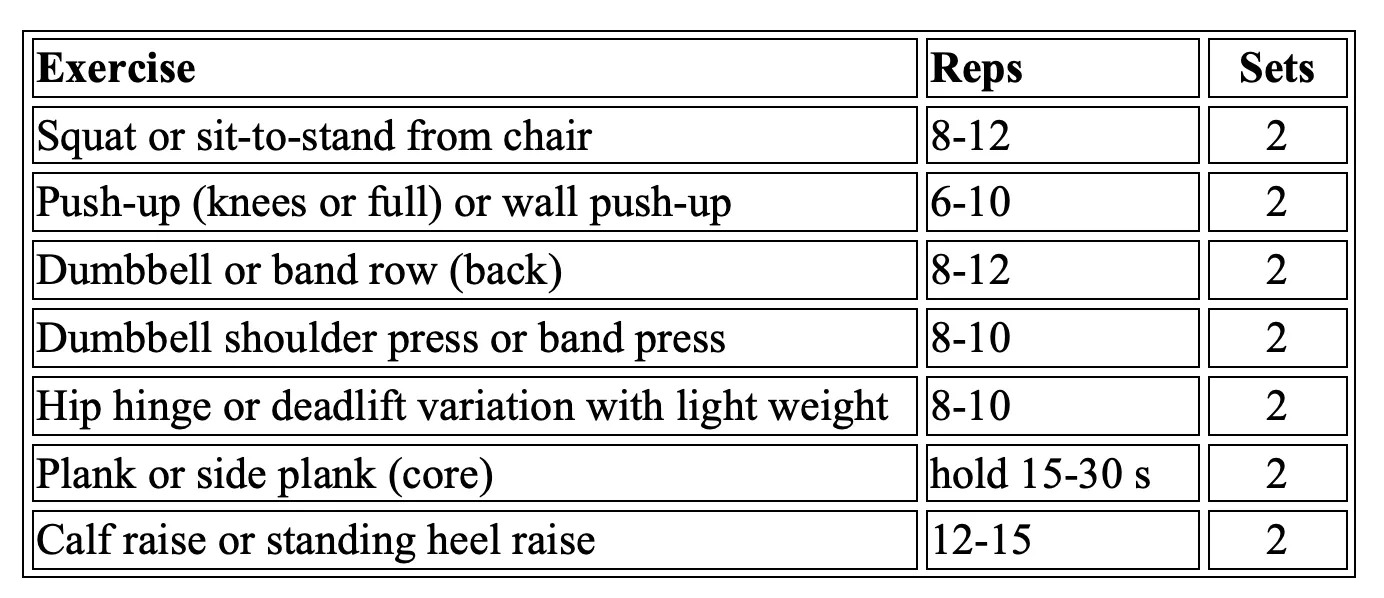
- Warm-up: 5-10 minutes light cardio/movement
- Cool-down: stretching major muscles, 5 minutes
Step 4: Progress over time
- After 4-6 weeks, increase either the weight/resistance or reps.
- Aim for gradual progression: increase 1-2 reps per set, or go from 2 sets to 3 sets, or increase resistance band strength.
- Evaluate your routine every 3-4 months and adjust.
Step 5: Monitor your health, mobility and enjoyment
- Monitor changes: strength, mobility, how you feel day to day.
- Track whether you feel more stable, confident in movement, more adventurous.
- If you experience pain (other than normal muscle soreness), consult a professional and adjust.
Key Benefits of Strength Training for Longevity Over 50
Benefit 1: Improve muscle strength and preserve muscle mass
- Muscle mass tends to decline with age. Strength training reverses or slows that process.
- Less muscle means less mobility, more fat, more weakness, and higher risk of falls.
- More muscle means better ability to do everyday tasks, travel, hike, enjoy life.
Benefit 2: Improve bone density and reduce fracture risk
- Resistance training applies load to bones, triggers bone-building cells (osteoblasts).
- For people over 50, avoiding osteoporosis or severe bone loss is critical.
Benefit 3: Support metabolic health and reduce chronic-disease risk
- Stronger muscles help regulate blood sugar, support insulin sensitivity, reduce diabetes risk.
- Also linked to lower blood pressure, better cardiovascular health.
Benefit 4: Improve brain health, cognition and independence
- Resistance training supports neuromuscular function and brain health.
- This helps with memory, executive function, balance, coordination — all key to staying independent.
Benefit 5: Increase longevity and reduce mortality risk
- As noted earlier, strength training is associated with 10-17 % longer life expectancy, and large reductions in all-cause mortality.
- If you want to aim for a long, active life, strength training is one of your best investments.
Overcoming Common Barriers for Those Over 50
“I’m afraid of injury.”
- Choose appropriate resistance (bands, light dumbbells).
- Focus on form and move at your pace.
- Warm up and cool down properly.
- Consider professional guidance early on.
“I don’t have much time.”
- Even 1 session per week has benefits in older adults.
- Do 20-30 minutes twice per week and it adds up.
- Pick compound moves (multiple muscle groups) for best efficiency.
“I’m not sure how to start.”
- Use the sample routine above.
- Use body-weight or bands if new.
- Progress slowly and steadily.
“I have health conditions (arthritis, heart disease, etc).”
- Get clearance from your doctor.
- Choose exercises that respect joint limitations (e.g., sit-to-stand rather than heavy squats).
- Use controlled, slow movements; avoid high-impact until you’re ready.
“I don’t like gyms.”
- Strength training can be done at home with bands or dumbbells.
- Use community senior-fitness classes.
- Outdoor resistance (hill walks, carrying bags) also counts.
Designing Your Long-Term Strength Training Plan
Phase 1 (Weeks 1-8): Foundation
- 2 sessions/week, 25-40 minutes each.
- Focus on major muscle groups, lighter load, higher reps (8-12).
- Good form, learn movement patterns (squat, hinge, push, pull).
- Track your progress (reps, ease of movement, how you feel).
Phase 2 (Weeks 9-24): Build strength and confidence
- 2-3 sessions per week if comfortable.
- Increase load/resistance gradually.
- Introduce variety: unilateral moves (one leg/one arm), core & balance.
- Consider adding moderate weights or heavier bands.
Phase 3 (6-12+ months): Maintenance and growth
- 2-3 sessions/week consistently.
- Periodize: alternating heavier weeks (8-10 reps) and lighter weeks (12-15 reps) for variety.
- Focus on lifestyle integration: resistance work that supports hobbies (hiking, RV trips, boating, travels).
- Reassess every 3-6 months: measure strength, mobility, function.
Integration with other wellness areas
Since your goal is holistic health (physical, mental, spiritual, purpose), integrate:
- Mobility/flexibility sessions (yoga, stretching).
- Aerobic activity (walking, biking, swimming) for cardiovascular health.
- Mind-body practices (meditation, journaling) to support mental resilience.
- Purposeful movement: use strength to support meaningful life activities — travel, volunteering, outdoor hobbies.
Case-In-Point: A Realistic Example
Andrew is 58 and recently diagnosed with melanoma. He wants to stay active into his 90s. He starts a routine:
- Two strength sessions per week for 30 minutes each using resistance bands and body-weight.
- After 8 weeks he can perform 12 squats with ease, 10 push-ups from knees, rows with a band.
- He progresses into 3 sessions/week at week 12, adds dumbbells for shoulder press and hip hinge.
- Six months in, he notices: better posture, more confidence walking his dog, fewer aches, stronger carry for his RV camping gear.
- Twelve months later, he uses strength as a foundation to support his travel, boating and outdoor life.
That’s exactly what strength training for longevity over 50 looks like in practice: steady, purposeful, meaningful.
FAQs — Strength Training for Longevity Over 50
Q: How many times per week should I do strength training?
A: For most older adults, 2 sessions per week is a good target. Some evidence suggests even 1 session per week shows benefit.
As you gain strength and experience you might move to 3 sessions/week based on your fitness, recovery and goals.
Q: Do I need heavy weights to benefit?
A: No. Older adults benefit from moderate loads, bands or body-weight. The key is consistent progression.
What matters most is that you challenge your muscles in a safe way, with progressive overload.
Q: How quickly will I see results?
A: You may see functional improvements (ease of movement, less fatigue) within 4-8 weeks. Strength gains and muscle changes often occur in 3-6 months.
Longevity and reduced mortality effects are cumulative over years of consistent training.
Q: I have arthritis/osteoporosis — can I still do strength training?
A: Yes — and you should. But you’ll want to tailor the movements, perhaps work with a physical therapist or trainer experienced with older clients. Focus on joint-friendly modifications, good form, controlled movements.
Q: What about diet and recovery?
A: Excellent question. Strength training requires fuel and recovery. Make sure you:
- Get enough protein (older adults may benefit from ~0.45-0.59 g per pound of body weight)
- Sleep well
- Stay hydrated
- Include mobility/stretching
- Listen to your body and allow rest when needed
Q: Can I still do cardio and flexibility work?
A: Absolutely. Strength training complements aerobic work and mobility/flexibility. For best results in longevity you’ll want a balanced program: strength + cardio + flexibility.
Additional Considerations & Tips
- Track your baseline and progress: measure strength, mobility, how daily tasks feel easier.
- Make strength training part of your lifestyle identity: “I’m someone who lifts for life” not just “doing exercise”.
- Leverage your “why”: If your purpose is living into your 90s strong, helping family, traveling without limits — let that motivate you when the weights get challenging.
- Build community: Training with others over 50 or joining a class makes it more social and sustainable.
- Keep it fun: Choose movements you enjoy or that support your hobbies (e.g., carrying gear for RV trips, lifting paddles for boating, etc.).
- Be patient: Changes happen gradually. But over time the payoff is large — more independence, less disease risk, better quality of life.
Summary
If you’re over 50 and committed to living not just longer but stronger, more capable and with meaning, then strength training for longevity over 50 is a core pillar. It addresses the twin challenges of muscle loss and chronic-disease risk. It supports mobility, brain health, bone strength and independence. The science shows clear benefit. Your action plan? Start with 2 sessions/week, focus on major muscle groups, progress steadily, pair with sound nutrition and recovery—and build the routine around your life purpose. This is not about becoming a bodybuilder — it’s about preserving your strength, health and freedom as you age well.
Please click on the like button, follow Memios and visit Memios.ai for more strategies like this across physical health, mental wellness, spiritual growth, and personal development.
Additional Information
References & further reading:
- “The benefits of strength training for older adults” – PubMed review.https://pubmed.ncbi.nlm.nih.gov/14552938/?utm_source=chatgpt.com
- “The many benefits of resistance training as you age” – Mayo Clinic article.https://mcpress.mayoclinic.org/healthy-aging/the-many-benefits-of-resistance-training-as-you-age/?utm_source=chatgpt.com
- “How can strength training build healthier bodies as we age?” – National Institute on Aging.https://www.nia.nih.gov/news/how-can-strength-training-build-healthier-bodies-we-age?utm_source=chatgpt.com
- “How much resistance exercise is beneficial for healthy aging and mortality?” – PMC meta-analysis.https://pmc.ncbi.nlm.nih.gov/articles/PMC10199130/?utm_source=chatgpt.com
- “Telomere length and biological aging: the role of strength training” – MDPI study.https://www.mdpi.com/2079-7737/13/11/883?utm_source=chatgpt.com
- “Why strength training is important – especially over age 50” – Cary Orthopaedics article.https://www.caryortho.com/why-strength-training-is-important/?utm_source=chatgpt.com
- “Recommended Exercises for Adults 50+” – Stanford Longevity blog.https://longevity.stanford.edu/lifestyle/2024/07/02/recommended-exercises-for-adults-50/?utm_source=chatgpt.com
Other related resources you may find useful:
- The CDC’s “Growing Stronger: Strength Training for Older Adults” guide.https://www.cdc.gov/physicalactivity/downloads/growing_stronger.pdf?utm_source=chatgpt.com
- AARP’s article “7 Reasons Why Strength Training Is Key to a Long Life”.https://www.aarp.org/health/healthy-living/strength-training-and-longevity/?utm_source=chatgpt.com
- For sample routines specially for women over 50: Stanford Longevity’s “Strength Training for Women 50+”.https://longevity.stanford.edu/lifestyle/2025/03/06/strength-training-for-women-50/?utm_source=chatgpt.com
- Consider working with a certified personal trainer who specializes in training older adults — especially if you have health conditions or haven’t trained recently.
Your body is the vessel through which you’ll live your next decades of purpose, adventure and growth. Give it the strength, support and investment it deserves. Please click on the like button, follow Memios and visit Memios.ai for more strategies like this across physical health, mental wellness, spiritual growth, and personal development.
Disclaimer:
The information provided in this article is for educational and entertainment purposes only and should not be considered medical advice. Memios and its contributors are not medical professionals. Always consult with your physician or a qualified healthcare provider before starting any new exercise program, supplement, or wellness practice—especially if you have existing health conditions, are taking medication, or have concerns about your physical capabilities. Use this information responsibly and at your own discretion.