Supplements · September 29, 2026 · Memios · 10 min read
Vitamin B6
B6 in its coenzyme forms takes part in more than 100 enzyme reactions, mostly in protein metabolism.
TLDR
- Limited evidence. B6 in its coenzyme forms takes part in more than 100 enzyme reactions, mostly in protein metabolism.
- What it is: Vitamin B6 is a water-soluble vitamin found naturally in many foods, added to others and sold as a supplement.
- Main use, supported: Compared with placebo, vitamin B6 preparations generally reduced nausea in pregnancy, especially in women with more severe symptoms. (low certainty)
- Claim NOT supported by research: In a trial of 5,442 women, B6 50 mg/day with folic acid and B12 had no effect on cardiovascular disease risk. (moderate certainty)
- Another claim NOT supported: A Cochrane review (as summarised by NIH ODS) found no evidence that short-term B6 improves cognitive function or mood. (low certainty)
- Recommended dose (official position): RDA 1.3 mg/day for adults 19-50; 1.7 mg for men and 1.5 mg for women 51 and older; 1.9 mg in pregnancy, 2.0 mg in lactation (US Food and Nutrition Board, Institute of Medicine, 1998).
- Studied dose (a trial dose, not a recommendation): 30 to 75 mg/day oral pyridoxine in two placebo-controlled trials in pregnant women with nausea. No finding here cites that trial.
- Upper limit: UL 100 mg/day for adults (US Food and Nutrition Board, 1998).
- What goes wrong: 5 findings on harm. In 90 spontaneous reports of neuropathy to the Dutch pharmacovigilance centre, B6 content ranged from 1.4 to 100 mg per tablet.
- Common myth: Because B6 is water-soluble, any excess is simply excreted and harmless.
What it is
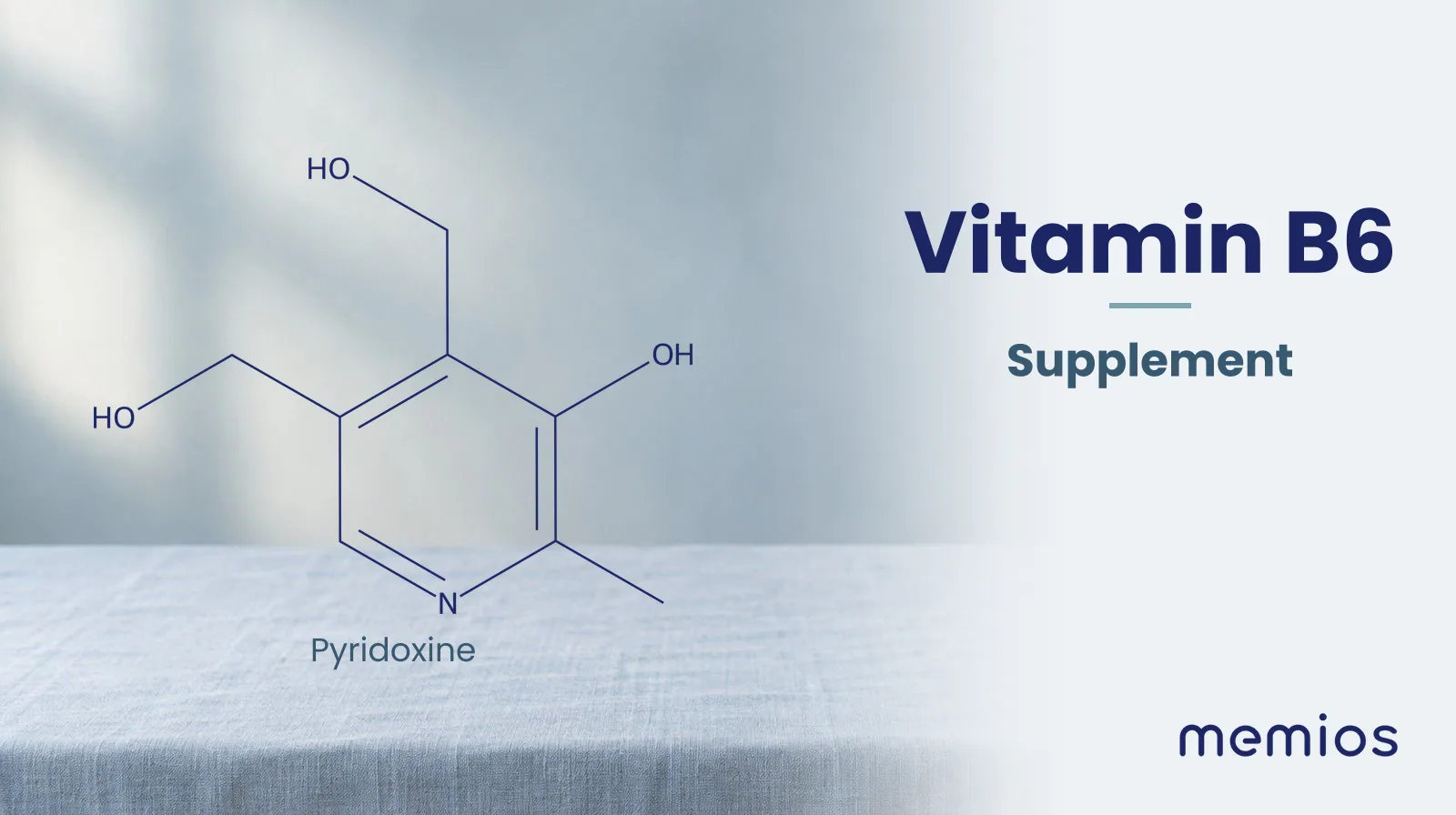
Vitamin B6 is a water-soluble vitamin found naturally in many foods, added to others and sold as a supplement. The name covers six related compounds (vitamers): pyridoxine, pyridoxal and pyridoxamine and their 5'-phosphate esters.
What the research says
B6 in its coenzyme forms takes part in more than 100 enzyme reactions, mostly in protein metabolism. For nausea in pregnancy, reviews find some evidence that B6 reduces nausea compared with placebo, with a call for more studies. Evidence does not support B6 for cognition (short-term trials) or cardiovascular prevention. The best-documented harm is sensory peripheral neuropathy: long known at gram doses, and now reported in case series and regulator databases at doses of 100 mg per tablet or less, with risk that 'cannot be excluded' below 50 mg/day. EFSA lowered its adult upper limit to 12 mg/day in 2023, and Australia's TGA is restricting higher-dose products.
Evidence grade: Limited evidence.
What goes wrong
In 90 spontaneous reports of neuropathy to the Dutch pharmacovigilance centre, B6 content ranged from 1.4 to 100 mg per tablet. (Source 1)
- Case series, Low certainty.
- Size: 90 reports.
- Who: Users of B6-containing supplements in the Netherlands.
- How long: not stated.
- Result: B6 content 1.4-100 mg per tablet; mean serum B6 907 nmol/L in 36 cases with levels.
- Funding: Independent (pharmacovigilance centre)
The amount of vitamin B6 in the products varied between 1.4 and 100 mg per tablet.
Causality assessment judged B6 supplements plausibly caused neuropathies, especially at higher doses and prolonged use, without excluding doses under 50 mg/day. (Source 2)
- Case series, Low certainty.
- Size: 90 reports.
- Who: Supplement users in the Netherlands.
- How long: not stated.
- Result: Plausible causality.
- Funding: Independent.
This is especially the case with higher dosages and prolonged use, but dosages <50 mg/day also cannot be excluded.
NIH ODS states that long-term intake of 1 to 6 g pyridoxine per day for 12 to 40 months can cause severe, progressive sensory neuropathy, while high B6 intakes from food have not been reported to cause adverse effects. (Source 3)
- Official position, Certainty not rated.
- Size: not applicable.
- Who: People taking gram doses of pyridoxine.
- How long: 12 to 40 months.
- Result: Severe progressive sensory neuropathy with ataxia.
- Funding: Government.
However, chronic administration of 1–6 g oral pyridoxine per day for 12–40 months can cause severe and progressive sensory neuropathy characterized by ataxia (loss of control of bodily movements).
EFSA (2023) treats peripheral neuropathy as well established and the critical effect for its upper limit. (Source 4)
- Official position, Certainty not rated.
- Size: not applicable.
- Who: General population.
- How long: not applicable.
- Result: Reference point 50 mg/day from a case-control study; UL 12 mg/day.
- Funding: Government / EU agency.
The relationship between excess vitamin B6 intakes and the development of peripheral neuropathy is well established and is the critical effect on which the UL is based.
Australia's TGA (safety update following its final decision of 25 November 2025) states B6 can cause peripheral neuropathy and the risk cannot be excluded below 50 mg/day. (Source 5)
- Official position, Certainty not rated.
- Size: 250 neuropathy reports to the TGA database as of 31 October 2025.
- Who: Australian users of B6-containing products.
- How long: not applicable.
- Result: not applicable.
- Funding: Government.
Vitamin B6 can cause peripheral neuropathy, and while the risk is greatest for higher intakes of vitamin B6, it cannot be excluded for doses less than 50 mg/day.
What the evidence supports
Compared with placebo, vitamin B6 preparations generally reduced nausea in pregnancy, especially in women with more severe symptoms. (Source 6)
- Systematic review, Low certainty.
- Size: not recorded in fetched text.
- Who: Pregnant women with nausea and vomiting.
- How long: not recorded.
- Result: Reduction in nausea symptoms versus placebo; review calls for more studies.
- Funding: Independent (NIHR HTA)
Comparisons of vitamin B6 preparations with placebo generally reported evidence of a reduction in symptoms of nausea, especially in women with more severe symptoms, and vomiting.
What the evidence does not support
A Cochrane review (as summarised by NIH ODS) found no evidence that short-term B6 improves cognitive function or mood. (Source 7)
- Systematic review, Low certainty.
- Size: 2 studies.
- Who: Adults.
- How long: 5 to 12 weeks.
- Result: No improvement in cognition or mood.
- Funding: not stated.
A Cochrane Review found no evidence that short-term vitamin B6 supplementation (for 5–12 weeks) improves cognitive function or mood in the two studies that the authors evaluated.
In a trial of 5,442 women, B6 50 mg/day with folic acid and B12 had no effect on cardiovascular disease risk. (Source 8)
- Randomized trial, Moderate certainty.
- Size: 5,442 women.
- Who: Women aged 42 or older.
- How long: not recorded.
- Result: No effect on cardiovascular disease risk.
- Funding: not stated.
A randomized clinical trial in 5,442 women age 42 or older found no effect of vitamin B6 supplementation (50 mg/day) in combination with 2.5 mg folic acid and 1 mg vitamin B12 on cardiovascular disease risk.
Where the evidence is mixed
The same review judged the overall evidence only a 'suggestion' of benefit and called for more studies. (Source 9)
- Systematic review, Low certainty.
- Size: not stated.
- Who: Pregnant women.
- How long: not stated.
- Result: not stated.
- Funding: Independent (NIHR HTA)
Overall, there is a suggestion that vitamin B6 might be better than placebo in reducing the severity of symptoms especially at higher doses, but more studies are required using a range of comparators.
Where the research disagrees
The dose above which B6 supplements carry a neuropathy risk
- US Food and Nutrition Board (1998), via NIH ODS, Case series and treated-patient studies: Based on limitations in the data on potential harms from long-term use, the FNB halved the dose used in these studies to establish a UL of 100 mg/day for adults. (Source 10)
- EFSA NDA Panel (2023), Case-control study, case reports and vigilance data: From the midpoint of the range of these two ULs and rounding down, a UL of 12 mg/day is established by the Panel for vitamin B6 for adults (including pregnant and lactating women). (Source 11)
- Therapeutic Goods Administration, Australia (safety update, undated; final decision 25 November 2025), Adverse event reports and scheduling review: Vitamin B6 can cause peripheral neuropathy, and while the risk is greatest for higher intakes of vitamin B6, it cannot be excluded for doses less than 50 mg/day. (Source 5)
How much
- Reference intake: RDA 1.3 mg/day for adults 19-50; 1.7 mg for men and 1.5 mg for women 51 and older; 1.9 mg in pregnancy, 2.0 mg in lactation (US Food and Nutrition Board, Institute of Medicine, 1998). (Source 12)
- Upper limit: UL 100 mg/day for adults (US Food and Nutrition Board, 1998). EFSA set a lower UL of 12 mg/day for adults, including in pregnancy and lactation, in 2023. (Source 10)
- Studied: 30 to 75 mg/day oral pyridoxine in two placebo-controlled trials in pregnant women with nausea. (Source 13)
- Studied: 50 mg/day pyridoxine with 2.5 mg folic acid and 1 mg B12 in 5,442 women (cardiovascular prevention trial). (Source 8)
A common belief, and what the research shows
The belief: Because B6 is water-soluble, any excess is simply excreted and harmless.
What the research shows: EFSA states 'The relationship between excess vitamin B6 intakes and the development of peripheral neuropathy is well established', and a Dutch case series found causality 'especially the case with higher dosages and prolonged use, but dosages <50 mg/day also cannot be excluded.'
Questions and answers
What is it?
Vitamin B6 is a water-soluble vitamin. The name covers six related compounds: pyridoxine, pyridoxal and pyridoxamine, and their phosphate forms. (Source 14)
What does it do in the body?
In its active coenzyme forms, B6 takes part in more than 100 enzyme reactions, mostly in protein metabolism. (Source 15)
Is it good or bad for you?
B6 supplements can cause peripheral neuropathy. Australia's medicines regulator says the risk is greatest at higher intakes but cannot be excluded at doses below 50 mg/day. (Source 5)
How do you get more of it?
From food and supplements. In two placebo-controlled pregnancy trials, 30 to 75 mg/day of oral pyridoxine reduced nausea. (Source 13)
If it is harmful, what reduces it?
The harm comes from excess supplemental B6, so the relevant factor is total intake from products. Australia's TGA notes consumers can find it hard to estimate total B6 intake because B6 is in many medicines and supplements and is labelled in different ways. (Source 5)
Why might someone be low in it or missing it?
Low levels are more common in people with malabsorptive autoimmune conditions such as coeliac disease, Crohn's disease, ulcerative colitis and inflammatory bowel disease. (Source 16)
Which whole foods contain it or feed it?
The richest sources include fish, beef liver and other organ meats, potatoes and other starchy vegetables, and non-citrus fruit. (Source 17)
What happens if you do not have it?
Deficiency is associated with microcytic anemia, abnormal brain-wave (EEG) patterns, dermatitis with cracked lips, swollen tongue, depression and confusion, and weakened immunity. (Source 18)
How can you test for it?
Plasma pyridoxal 5'-phosphate (PLP) is the most common measure of B6 status. We did not record a statement on its reliability, and adequacy cut-offs differ between sources. (Source 19)
References
- Drug Safety. Vitamin B6 in Health Supplements and Neuropathy: Case Series Assessment of Spontaneously Reported Cases. 2018. PMID 29737502, DOI 10.1007/s40264-018-0664-0. Read the source
- Drug Safety. Vitamin B6 in Health Supplements and Neuropathy: Case Series Assessment of Spontaneously Reported Cases. 2018. PMID 29737502, DOI 10.1007/s40264-018-0664-0. Read the source
- NIH Office of Dietary Supplements. Vitamin B6 - Fact Sheet for Health Professionals. n.d. (fetched 2026-09-21). Read the source
- EFSA Journal (EFSA Panel on Nutrition, Novel Foods and Food Allergens). Scientific opinion on the tolerable upper intake level for vitamin B6. 2023. PMID 37207271, DOI 10.2903/j.efsa.2023.8006. Read the source
- Therapeutic Goods Administration (Australia). Medicines containing vitamin B6 (pyridoxine, pyridoxal or pyridoxamine) - Medicines Safety Update. n.d. (page undated; final decision released 25 November 2025; fetched 2026-09-21). Read the source
- NIHR Health Technology Assessment (NCBI Bookshelf). Treatments for hyperemesis gravidarum and nausea and vomiting in pregnancy: a systematic review and economic assessment. Clinical effectiveness: vitamin B6 (pyridoxine). 2016. DOI 10.3310/hta20740. Read the source
- NIH Office of Dietary Supplements. Vitamin B6 - Fact Sheet for Health Professionals. n.d. (fetched 2026-09-21). Read the source
- NIH Office of Dietary Supplements. Vitamin B6 - Fact Sheet for Health Professionals. n.d. (fetched 2026-09-21). Read the source
- NIHR Health Technology Assessment (NCBI Bookshelf). Treatments for hyperemesis gravidarum and nausea and vomiting in pregnancy: a systematic review and economic assessment. Clinical effectiveness: vitamin B6 (pyridoxine). 2016. DOI 10.3310/hta20740. Read the source
- NIH Office of Dietary Supplements. Vitamin B6 - Fact Sheet for Health Professionals. n.d. (fetched 2026-09-21). Read the source
- EFSA Journal (EFSA Panel on Nutrition, Novel Foods and Food Allergens). Scientific opinion on the tolerable upper intake level for vitamin B6. 2023. PMID 37207271, DOI 10.2903/j.efsa.2023.8006. Read the source
- NIH Office of Dietary Supplements. Vitamin B6 - Fact Sheet for Health Professionals. n.d. (fetched 2026-09-21). Read the source
- NIH Office of Dietary Supplements. Vitamin B6 - Fact Sheet for Health Professionals. n.d. (fetched 2026-09-21). Read the source
- NIH Office of Dietary Supplements. Vitamin B6 - Fact Sheet for Health Professionals. n.d. (fetched 2026-09-21). Read the source
- NIH Office of Dietary Supplements. Vitamin B6 - Fact Sheet for Health Professionals. n.d. (fetched 2026-09-21). Read the source
- NIH Office of Dietary Supplements. Vitamin B6 - Fact Sheet for Health Professionals. n.d. (fetched 2026-09-21). Read the source
- NIH Office of Dietary Supplements. Vitamin B6 - Fact Sheet for Health Professionals. n.d. (fetched 2026-09-21). Read the source
- NIH Office of Dietary Supplements. Vitamin B6 - Fact Sheet for Health Professionals. n.d. (fetched 2026-09-21). Read the source
- NIH Office of Dietary Supplements. Vitamin B6 - Fact Sheet for Health Professionals. n.d. (fetched 2026-09-21). Read the source