Supplements · September 29, 2026 · Memios · 9 min read
Vitamin A
Vitamin A is needed for vision, immune function, growth and reproduction. In children at risk of deficiency, a meta-analysis of 43 trials found supplementation cut all-cause mortality by about 24%.
TLDR
- Well established. Vitamin A is needed for vision, immune function, growth and reproduction. In children at risk of deficiency, a meta-analysis of 43 trials found supplementation cut all-cause mortality by about 24%.
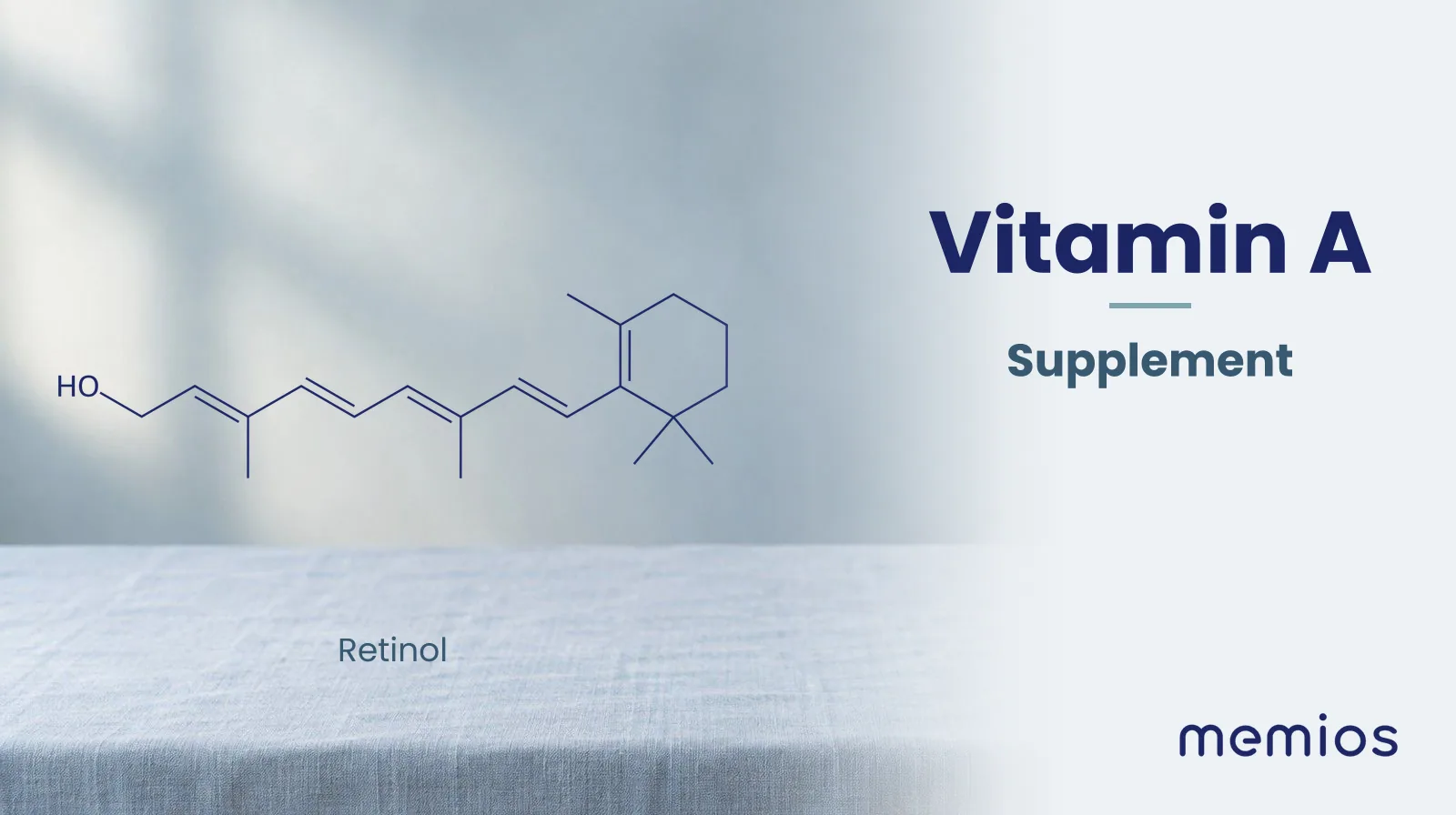
- What it is: Vitamin A is a group of fat-soluble retinoids, mainly retinol and retinyl esters (preformed vitamin A).
- Main use, supported: In children aged 6 months to 5 years, vitamin A supplementation was associated with a 24% reduction in all-cause mortality and less diarrhoea, measles and night blindness. (high certainty)
- Claim NOT supported by research: In the Physicians' Health Study, 12 years of beta-carotene 50 mg on alternate days had no effect on cancer, cardiovascular disease or death. (high certainty)
- Recommended dose (official position): NIH ODS (fact sheet updated 2025, from the Food and Nutrition Board) lists an RDA of 900 ug RAE/day for adult men and 700 ug RAE/day for adult women.
- Studied dose (a trial dose, not a recommendation): ATBC: beta-carotene 20 mg/day for 5 to 8 years. Findings citing that trial: 1 on harm.
- Upper limit: NIH ODS (2025) lists a UL of 3,000 ug/day of preformed vitamin A for adults; the Food and Nutrition Board has set no UL for beta-carotene.
- What goes wrong: 5 findings on harm. In the ATBC trial, male smokers given beta-carotene 20 mg/day had more lung cancer and higher total mortality than those who did not receive it.
- Common myth: Beta-carotene pills give the protection seen in people who eat lots of vegetables.
What it is
Vitamin A is a group of fat-soluble retinoids, mainly retinol and retinyl esters (preformed vitamin A). Plants supply provitamin A carotenoids such as beta-carotene, which the body can convert to vitamin A.
What the research says
Vitamin A is needed for vision, immune function, growth and reproduction. In children at risk of deficiency, a meta-analysis of 43 trials found supplementation cut all-cause mortality by about 24%. In adults, supplements have not prevented disease and have caused harm: beta-carotene raised lung cancer in smokers in the ATBC (18%) and CARET (28%) trials, and made no difference in the Physicians' Health Study. High preformed vitamin A in early pregnancy was associated with birth defects, and chronic high doses can injure the liver. Cohort meta-analysis links higher retinol intake to more hip fractures, which is an association, not a proven cause.
Evidence grade: Well established.
What goes wrong
The same meta-analysis found vitamin A supplementation increased vomiting in the first 48 hours. (Source 1)
- Meta-analysis, Moderate certainty.
- Size: 3 trials.
- Who: Children 6-59 months.
- How long: 48 hours.
- Result: Rate ratio 2.75 (1.81-4.19)
- Funding: Not captured.
Three trials reported an increased risk of vomiting within the first 48 hours of supplementation (2.75, 1.81 to 4.19).
In the ATBC trial, male smokers given beta-carotene 20 mg/day had more lung cancer and higher total mortality than those who did not receive it. (Source 2)
- Randomized trial, High certainty.
- Size: 29,133 men.
- Who: Male smokers aged 50-69, Finland.
- How long: 5 to 8 years.
- Result: Lung cancer incidence +18% (95% CI 3 to 36%); total mortality +8% (1 to 16%)
- Funding: Not captured in abstract.
Unexpectedly, we observed a higher incidence of lung cancer among the men who received beta carotene than among those who did not (change in incidence, 18 percent; 95 percent confidence interval, 3 to 36 percent).
In CARET, beta-carotene 30 mg plus retinyl palmitate 25,000 IU daily raised lung cancer and lung cancer deaths in smokers and asbestos workers, and the trial was stopped early. (Source 3)
- Randomized trial, High certainty.
- Size: 18,314 participants.
- Who: Smokers, former smokers and asbestos-exposed workers, US.
- How long: Mean 4.0 years.
- Result: Lung cancer RR 1.28 (1.04-1.57); death from lung cancer RR 1.46 (1.07-2.00); all-cause death RR 1.17 (1.03-1.33)
- Funding: Not captured in abstract.
The active-treatment group had a relative risk of lung cancer of 1.28 (95 percent confidence interval, 1.04 to 1.57; P=0.02), as compared with the placebo group.
In a cohort of pregnant women, supplemental preformed vitamin A above 10,000 IU/day was associated with a higher prevalence of birth defects of cranial-neural-crest origin. (Source 4)
- Cohort study, Moderate certainty.
- Size: 22,748 pregnant women.
- Who: Pregnant women, US.
- How long: First trimester exposure.
- Result: Prevalence ratio 4.8 (95% CI 2.2-10.5) for supplement intake over 10,000 IU/day vs 5,000 IU or less.
- Funding: Not captured.
For vitamin A from supplements alone, the ratio of the prevalence among the babies born to women who consumed more than 10,000 IU per day to that among the babies whose mothers consumed 5000 IU or less per day was 4.8 (95 percent confidence interval, 2.2 to 10.5).
LiverTox (updated 2020), summarising case reports, states that chronic moderately high vitamin A doses can cause liver fibrosis and portal hypertension, even before cirrhosis. (Source 5)
- Official position, Moderate certainty.
- Size: Case reports summarised by LiverTox.
- Who: People taking high-dose vitamin A.
- How long: Generally over 1 to 8 years.
- Result: Not applicable.
- Funding: US government (NIDDK)
Chronic, moderately high doses of vitamin A (generally over 1 to 8 years) can lead to portal hypertension with ascites and esophageal varices
What the evidence supports
In children aged 6 months to 5 years, vitamin A supplementation was associated with a 24% reduction in all-cause mortality and less diarrhoea, measles and night blindness. (Source 1)
- Meta-analysis, High certainty.
- Size: About 215,000 children in 43 trials; mortality from 17 trials.
- Who: Children 6-59 months, mostly low and middle income countries.
- How long: Varied.
- Result: All-cause mortality rate ratio 0.76 (95% CI 0.69-0.83); night blindness 0.32 (0.21-0.50)
- Funding: Not captured from the page read.
Seventeen trials including 194 483 participants reported a 24% reduction in all cause mortality (rate ratio=0.76, 95% confidence interval 0.69 to 0.83).
What the evidence does not support
In the Physicians' Health Study, 12 years of beta-carotene 50 mg on alternate days had no effect on cancer, cardiovascular disease or death. (Source 6)
- Randomized trial, High certainty.
- Size: 22,071 male physicians.
- Who: US male physicians aged 40-84.
- How long: 12 years.
- Result: Any malignant neoplasm RR 0.98 (0.91-1.06)
- Funding: Not captured in abstract.
12 years of supplementation with beta carotene produced neither benefit nor harm in terms of the incidence of malignant neoplasms, cardiovascular disease, or death from all causes.
Where the evidence is mixed
A meta-analysis of cohort studies associated higher dietary retinol intake with more hip fractures, though slightly fewer total fractures; the authors called for trials to confirm this. (Source 7)
- Meta-analysis, Low certainty.
- Size: 319,077 participants.
- Who: Adults over 20 in cohort studies.
- How long: Varied.
- Result: Hip fracture RR 1.40 (1.02-1.91) for higher retinol intake; total fracture RR 0.95 (0.91-1.00)
- Funding: Independent (National Natural Science Foundation of China)
and increase hip fracture risk (RR with 95% CI: 1.40 (1.02, 1.91) and 1.29 (1.06, 1.57), respectively)
Where the research disagrees
Whether beta-carotene protects against lung cancer
- Observational epidemiology, as summarised by the ATBC investigators, diet and blood-level cohort studies: "Epidemiologic evidence indicates that diets high in carotenoid-rich fruits and vegetables, as well as high serum levels of vitamin E (alpha-tocopherol) and beta carotene, are associated with a reduced risk of lung cancer." (Source 2)
- CARET investigators, 1996, RCT, 18,314 participants: "The active-treatment group had a relative risk of lung cancer of 1.28 (95 percent confidence interval, 1.04 to 1.57; P=0.02), as compared with the placebo group." (Source 3)
How much
- Reference intake: NIH ODS (fact sheet updated 2025, from the Food and Nutrition Board) lists an RDA of 900 ug RAE/day for adult men and 700 ug RAE/day for adult women. (Source 8)
- Upper limit: NIH ODS (2025) lists a UL of 3,000 ug/day of preformed vitamin A for adults; the Food and Nutrition Board has set no UL for beta-carotene. (Source 8)
- Studied: ATBC: beta-carotene 20 mg/day for 5 to 8 years. (Source 2)
- Studied: CARET: beta-carotene 30 mg/day plus 25,000 IU retinyl palmitate/day. (Source 3)
- Studied: Physicians' Health Study: beta-carotene 50 mg on alternate days for 12 years. (Source 6)
A common belief, and what the research shows
The belief: Beta-carotene pills give the protection seen in people who eat lots of vegetables.
What the research shows: When tested in trials, beta-carotene did not protect smokers and increased lung cancer: "Unexpectedly, we observed a higher incidence of lung cancer among the men who received beta carotene than among those who did not".
Questions and answers
What is it?
Vitamin A is a family of fat-soluble compounds. Preformed vitamin A (retinol and retinyl esters) comes from animal foods; plant pigments such as beta-carotene can be converted into it. (Source 8)
What does it do in the body?
It is needed for vision (as part of the light-sensing protein rhodopsin), immune function, growth, reproduction, and the formation of the heart, lungs, eyes and other organs. (Source 8)
Is it good or bad for you?
In deficient children, supplements reduce deaths. In adults, high-dose supplements have caused harm: beta-carotene raised lung cancer in smokers, high preformed vitamin A in pregnancy is linked to birth defects, and chronic high doses can damage the liver. (Source 1)
How do you get more of it?
Preformed vitamin A is highest in liver, fish, eggs and dairy; provitamin A comes mainly from leafy greens, orange and yellow vegetables, tomato products and fruits. Trials in children gave periodic vitamin A supplements. (Source 8)
If it is harmful, what reduces it?
The sources we read describe no specific treatment for excess vitamin A beyond the fact that toxicity follows high intake. Excess is stored in the liver's stellate cells, which is how it causes damage. (Source 5)
Why might someone be low in it or missing it?
Preterm (premature) infants start with low liver stores; children and pregnant women in low- and middle-income countries are at risk from low intake; and people with cystic fibrosis often absorb fat-soluble vitamins poorly. (Source 8)
Which whole foods contain it or feed it?
Liver, fish, eggs and dairy provide preformed vitamin A; leafy green vegetables, orange and yellow vegetables, tomato products and fruits provide provitamin A. (Source 8)
What happens if you do not have it?
Deficiency first causes night blindness and can progress to xerophthalmia, damage to the cornea that can end in permanent blindness. In children at risk, it is also linked to higher mortality. (Source 8)
How can you test for it?
Blood (serum or plasma) retinol is the usual test, but it is not a reliable guide: it only falls once liver stores are nearly exhausted, and infections can also lower it. (Source 8)
References
- BMJ. Vitamin A supplements for preventing mortality, illness, and blindness in children aged under 5: systematic review and meta-analysis. 2011. DOI 10.1136/bmj.d5094. Read the source
- New England Journal of Medicine. The effect of vitamin E and beta carotene on the incidence of lung cancer and other cancers in male smokers. 1994. PMID 8127329, DOI 10.1056/nejm199404143301501. Read the source
- New England Journal of Medicine. Effects of a combination of beta carotene and vitamin A on lung cancer and cardiovascular disease. 1996. PMID 8602180, DOI 10.1056/nejm199605023341802. Read the source
- New England Journal of Medicine (copy hosted at jeffreydachmd.com). Teratogenicity of High Vitamin A Intake. 1995. DOI 10.1056/NEJM199511233332101. Read the source
- NIDDK / NCBI Bookshelf. Vitamin A (LiverTox: Clinical and Research Information on Drug-Induced Liver Injury), last updated November 4, 2020. 2020. Read the source
- New England Journal of Medicine. Lack of effect of long-term supplementation with beta carotene on the incidence of malignant neoplasms and cardiovascular disease. 1996. PMID 8602179, DOI 10.1056/nejm199605023341801. Read the source
- International Journal of Environmental Research and Public Health. The Effect of Vitamin A on Fracture Risk: A Meta-Analysis of Cohort Studies. 2017. DOI 10.3390/ijerph14091043. Read the source
- NIH Office of Dietary Supplements. Vitamin A and Carotenoids: Fact Sheet for Health Professionals (updated March 10, 2025). 2025. Read the source