Supplements · September 30, 2026 · Memios · 14 min read
Valerian
Disputed. The honest summary is that the evidence is weak and contradictory.
TLDR
- Disputed. The honest summary is that the evidence is weak and contradictory.
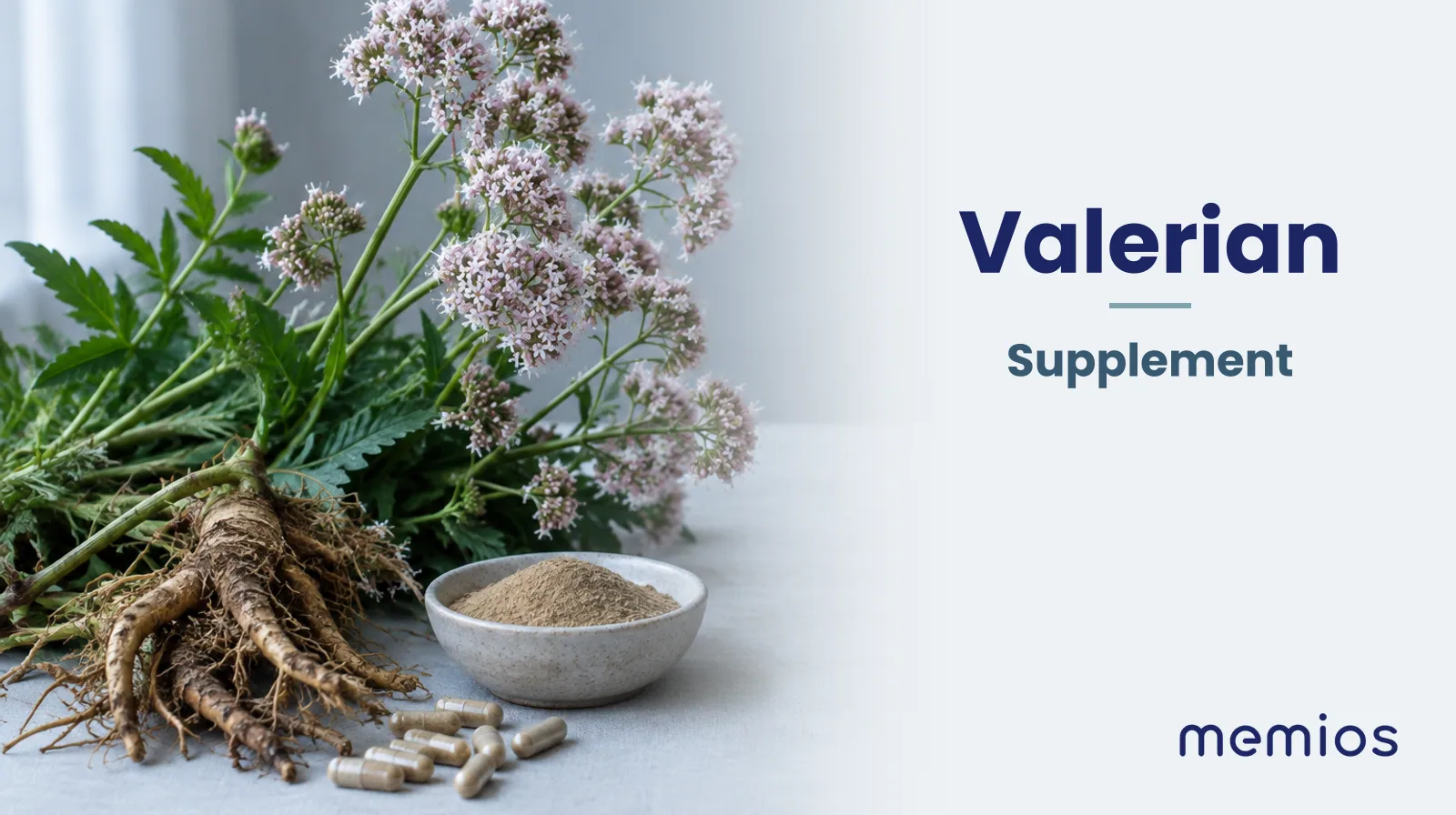
- What it is: Valerian is a herbal preparation made from the root and rhizome of the plant Valeriana officinalis L. It is sold as capsules of dried root, as concentrated extracts and as tea, and is one of the most widely used herbal products taken for sleep. Preparations differ substantially in how the extract is made.
- Main use, supported: A meta-analysis of randomised placebo-controlled trials found a statistically significant benefit on self-rated sleep quality, but the same summary measure showed evidence of publication bias. (low certainty)
- Claim NOT supported by research: A randomised, double-blind, crossover trial in older women with insomnia found no benefit of valerian on self-reported, polysomnographic or actigraphic sleep. (moderate certainty)
- Another claim NOT supported: In a controlled human phenotyping study, 28 days of valerian supplementation did not change CYP1A2, CYP2D6, CYP2E1 or CYP3A4/5 activity, arguing against valerian as a broad cause of cytochrome-P450 drug interactions. (low certainty)
- Recommended dose: not established. No reference intake (RDA or AI) exists for valerian. It is a herbal preparation used as a sleep aid, not a nutrient the body requires.
- Studied dose (a trial dose, not a recommendation): A randomised crossover trial gave older women with insomnia 300 mg of concentrated valerian extract 30 minutes before bedtime for 2 weeks. Findings citing that trial: 1 against.
- Upper limit: No tolerable upper intake level or ADI has been set for valerian in the sources searched.
- What goes wrong: 4 findings on harm. Valerian has been implicated in rare cases of clinically apparent liver injury, usually in products combined with other botanicals.
- Common myth: Valerian is a proven natural sleeping pill that measurably improves sleep.
What it is
Valerian is a herbal preparation made from the root and rhizome of the plant Valeriana officinalis L. It is sold as capsules of dried root, as concentrated extracts and as tea, and is one of the most widely used herbal products taken for sleep. Preparations differ substantially in how the extract is made, and reviewers have linked the inconsistent trial results to that variability.
What the research says
The honest summary is that the evidence is weak and contradictory. A 2006 meta-analysis of randomised placebo-controlled trials found a statistically significant benefit on self-rated sleep quality, but the authors reported publication bias in that same figure and significant methodological problems in most trials. A 2024 umbrella review of eight systematic reviews, all judged at high risk of bias and seven rated critically low quality, found no evidence of efficacy for insomnia, and a randomised crossover trial in older women using polysomnography found no difference from placebo. Serious harms appear rare: LiverTox records a small number of liver-injury cases, usually in products that combined valerian with other botanicals.
Evidence grade: Disputed.
What goes wrong
Valerian has been implicated in rare cases of clinically apparent liver injury, usually in products combined with other botanicals. (Source 1)
- Expert review, not systematic, Low certainty.
- Size: a small number of published cases.
- Who: people taking valerian, usually in multi-herb products.
- How long: latency to onset ranged from 3 to 12 weeks.
- Result: hepatocellular or mixed hepatocellular-cholestatic enzyme pattern; mild-to-moderate injury with recovery within 2 to 4 months of stopping; likelihood score C.
- Funding: not stated.
Valerian has been implicated in a small number of cases of clinically apparent liver injury, but usually in combination with other botanicals such as skullcap or black cohosh.
Position: NCCIH reports that some people experience withdrawal symptoms, including rare hallucinations, if valerian is stopped abruptly after chronic use. (Source 2)
- Official position, Certainty not rated.
- Size: not applicable.
- Who: adults using valerian chronically.
- How long: not stated; NCCIH page carries the label Last Updated: May 2025.
- Result: no rates given; symptoms listed qualitatively.
- Funding: US government agency.
Some may experience withdrawal symptoms, including anxiety, irritability, heart disturbances, insomnia, and in rare cases, hallucinations, if stopped abruptly after chronic use.
Position: NCCIH states that because it is possible, though not proven, that valerian might have a sleep-inducing effect, it should not be taken along with alcohol or sedatives. (Source 2)
- Official position, Certainty not rated.
- Size: not applicable.
- Who: adults taking valerian alongside alcohol or sedative medicines.
- How long: not stated; NCCIH page carries the label Last Updated: May 2025.
- Result: no rates given; a conditional caution, which NCCIH itself marks as unproven.
- Funding: US government agency.
Because it is possible (though not proven) that valerian might have a sleep-inducing effect, it should not be taken along with alcohol or sedatives.
Position: NCCIH states that the safety of long-term valerian use is unknown and that liver injury has been reported in very rare cases, most often when valerian was taken with other herbals. (Source 2)
- Official position, Certainty not rated.
- Size: not applicable.
- Who: adults taking valerian, including in combination with other herbal products.
- How long: long-term use; NCCIH page carries the label Last Updated: May 2025.
- Result: no rates or case counts given; NCCIH describes the reports as very rare and states the long-term effect on liver function is unknown.
- Funding: US government agency.
In very rare cases, liver injury was reported when taking valerian, most often in combination with other herbals; however, valerian's long-term effect on liver function is unknown.
What the evidence supports
A meta-analysis of randomised placebo-controlled trials found a statistically significant benefit on self-rated sleep quality, but the same summary measure showed evidence of publication bias. (Source 3)
- Meta-analysis, Low certainty.
- Size: 16 eligible studies examining a total of 1093 patients; 6 studies in the pooled sleep-quality estimate.
- Who: adults in randomised, placebo-controlled trials of valerian for sleep.
- How long: varied between trials; length of treatment varied considerably.
- Result: relative risk of improved sleep = 1.8, 95% confidence interval, 1.2-2.9, from 6 studies reporting a dichotomous sleep-quality outcome; evidence of publication bias in this summary measure.
- Funding: not stated.
Limit of this finding: The authors report publication bias in this pooled figure, which means trials with disappointing results were probably never published. A reader should treat the 1.8 relative risk as an upper bound on any benefit, not as a measured effect.
showed a statistically significant benefit (relative risk of improved sleep = 1.8, 95% confidence interval, 1.2-2.9), but there was evidence of publication bias in this summary measure.
What the evidence does not support
An umbrella review of systematic reviews found no evidence that valerian is effective for insomnia on objective or quantitative measures, and rated the underlying reviews as critically low quality and at high risk of bias. (Source 4)
- Review of reviews, Very low certainty.
- Size: 70 records screened; 8 systematic reviews included.
- Who: adults with insomnia in systematic reviews of valerian.
- How long: not stated at umbrella level.
- Result: AMSTAR 2: seven reviews (87.5%) critically low, one (12.5%) low; ROBIS: all eight at high risk of bias.
- Funding: not stated.
no evidence of efficacy for the treatment of insomnia
The umbrella review reported that any apparent benefit was confined to subjective ratings and was not demonstrated objectively. (Source 4)
- Review of reviews, Very low certainty.
- Size: 8 systematic reviews.
- Who: adults with insomnia.
- How long: not stated.
- Result: Seven of the reviews (87.5 %) were rated as critically low and 1 review (12.5 %) rated as low.
- Funding: not stated.
its effectiveness has not been demonstrated with quantitative or objective measurements
A randomised, double-blind, crossover trial in older women with insomnia found no benefit of valerian on self-reported, polysomnographic or actigraphic sleep. (Source 5)
- Randomized trial, Moderate certainty.
- Size: 16 older women (mean age = 69.4 ± 8.1 years)
- Who: older women with insomnia.
- How long: 2 weeks nightly dosing per treatment phase, crossover.
- Result: no statistically significant differences on sleep latency, WASO, sleep efficiency or self-rated sleep quality; WASO increased after 2 weeks of valerian (+17.7 ± 25.6 min, p = .02) versus baseline.
- Funding: not stated.
There were no statistically significant differences between valerian and placebo after a single dose or after 2 weeks of nightly dosing on any measure of sleep latency, wake after sleep onset (WASO), sleep efficiency, and self-rated sleep quality.
In a controlled human phenotyping study, 28 days of valerian supplementation did not change CYP1A2, CYP2D6, CYP2E1 or CYP3A4/5 activity, arguing against valerian as a broad cause of cytochrome-P450 drug interactions. (Source 6)
- Blood level study, Low certainty.
- Size: Twelve healthy volunteers (6 women)
- Who: healthy adult volunteers.
- How long: 28 days per supplement with 30-day washout.
- Result: No significant changes in phenotypic ratios were observed for valerian.
- Funding: not stated.
No significant changes in phenotypic ratios were observed for valerian.
Position: the US National Center for Complementary and Integrative Health states the sleep evidence is inconsistent and notes the American Academy of Sleep Medicine's 2017 recommendation against valerian for chronic insomnia. (Source 7)
- Official position, Certainty not rated.
- Size: not applicable.
- Who: adults with chronic insomnia.
- How long: guideline dated 2017; NCCIH page carries the label Last Updated: May 2025.
- Result: no pooled effect reported; a recommendation against use.
- Funding: US government agency.
In its 2017 clinical practice guidelines, the American Academy of Sleep Medicine recommended against using valerian for chronic insomnia in adults.
Where the evidence is mixed
The same meta-analysis stated its pooled sleep-quality result was affected by publication bias and that most included studies had methodological problems. (Source 3)
- Meta-analysis, Low certainty.
- Size: 16 studies, 1093 patients.
- Who: adults in placebo-controlled valerian trials.
- How long: varied.
- Result: publication bias detected in the summary measure; doses, preparations and treatment length varied.
- Funding: not stated.
Most studies had significant methodologic problems, and the valerian doses, preparations, and length of treatment varied considerably.
A large systematic review with meta-analysis of valerian for sleep and associated disorders attributed inconsistent results to variable extract quality and reported no severe adverse events. (Source 8)
- Systematic review, Low certainty.
- Size: meta-analyses of subjective sleep quality (10 studies, n=1,065) and anxiety (8 studies, n=535)
- Who: participants aged 7 to 80 years in controlled and observational studies.
- How long: varied between included studies.
- Result: pooled analyses performed for subjective sleep quality and anxiety; authors attributed inconsistency to extract quality.
- Funding: not stated.
Results suggested that inconsistent outcomes were possibly due to the variable quality of herbal extracts and that more reliable effects could be expected from the whole root/rhizome.
The same systematic review states that it included both controlled trials and observational studies irrespective of their potential risk of bias, so its pooled picture is not restricted to high-quality trials. (Source 9)
- Systematic review, Low certainty.
- Size: 60 studies, n=6,894.
- Who: participants in controlled and observational studies of valerian.
- How long: varied between included studies.
- Result: no effect estimate; a stated inclusion rule covering studies at any risk of bias.
- Funding: not stated.
both controlled trials and observational studies were included for reviewing, irrespective of potential risk of bias
The umbrella review rated the quality of the systematic reviews it pooled as critically low for seven of the eight, and low for the remaining one. (Source 10)
- Review of reviews, Very low certainty.
- Size: 8 systematic reviews.
- Who: systematic reviews of valerian for sleep.
- How long: not applicable.
- Result: AMSTAR 2: 7 of the reviews (87.5 %) critically low, 1 review (12.5 %) low.
- Funding: not stated.
7 of the reviews (87.5 %) were rated as critically low and 1 review (12.5 %) rated as low.
Where the research disagrees
Whether valerian improves sleep at all, and whether subjective improvement counts as efficacy
- Bent and colleagues, American Journal of Medicine 2006, meta-analysis of 16 randomised placebo-controlled trials, with publication bias reported: The available evidence suggests that valerian might improve sleep quality without producing side effects. (Source 3)
- Authors of the 2024 umbrella review, umbrella review of 8 systematic reviews, all rated high risk of bias: no evidence of efficacy for the treatment of insomnia (Source 4)
How much
- Reference intake: No reference intake (RDA or AI) exists for valerian. It is a herbal preparation used as a sleep aid, not a nutrient the body requires. (Source 8)
- Upper limit: No tolerable upper intake level or ADI has been set for valerian in the sources searched. NCCIH (page labelled Last Updated: May 2025) describes apparent safety at 300 to 600 milligrams daily for up to 6 weeks, and states that the safety of long-term use is unknown; that is a description of use rather than a limit. (Source 2)
- Studied: A randomised crossover trial gave older women with insomnia 300 mg of concentrated valerian extract 30 minutes before bedtime for 2 weeks. (Source 5)
- Studied: NCCIH describes use at 300 to 600 milligrams daily for up to 6 weeks. (Source 2)
A common belief, and what the research shows
The belief: Valerian is a proven natural sleeping pill that measurably improves sleep.
What the research shows: Objective sleep measurement does not show this. A randomised crossover trial using polysomnography in older women reported that "There were no statistically significant differences between valerian and placebo after a single dose or after 2 weeks of nightly dosing on any measure of sleep latency, wake after sleep onset (WASO), sleep efficiency, and self-rated sleep quality." and an umbrella review concluded there was "no evidence of efficacy for the treatment of insomnia".
Questions and answers
What is it?
Valerian is a preparation of the root and rhizome of Valeriana officinalis L., a flowering plant. It is sold as capsules, liquid extracts and tea. Products differ a lot in how the extract is made. Reviewers say that variability is one reason trial results conflict. (Source 8)
What does it do in the body?
Valerian is taken in the hope of shortening the time to fall asleep and improving sleep quality. Laboratory work points to activity at GABA-A receptors, the same family of receptors benzodiazepines act on. In people, an umbrella review found benefit has only ever appeared on subjective ratings and not on objective measurement. (Source 4)
Is it good or bad for you?
Neither clearly. NCCIH says the sleep evidence is inconsistent, and a sleep-medicine guideline recommends against valerian for chronic insomnia; a 2006 meta-analysis found improved self-rated sleep while a 2024 umbrella review found no efficacy. On safety, short-term use looks well tolerated in trials, but NCCIH states the safety of long-term use is unknown. (Source 7)
How do you get more of it?
Valerian is only obtained from the plant, as dried root capsules, extracts or tea. Trials have used a 300 mg concentrated extract before bedtime, and NCCIH describes use of 300 to 600 milligrams daily for up to 6 weeks. This is what was studied, not a recommendation. (Source 2)
If it is harmful, what reduces it?
Valerian is cleared from the body after the product is stopped; there is no procedure for removing it. What the literature describes instead is withdrawal: NCCIH reports that some people have anxiety, irritability, heart disturbances, insomnia and, rarely, hallucinations if they stop abruptly after chronic use. (Source 2)
Why might someone be low in it or missing it?
Does not apply. Valerian is not a nutrient or a resident of the body, so there is no deficiency state and nothing to be low in. Someone simply either takes a valerian product or does not. (Source 8)
Which whole foods contain it or feed it?
No ordinary whole food contains valerian. It reaches people as root and rhizome preparations: dried root capsules, tinctures and infusions. A systematic review suggested the whole root or rhizome may behave more consistently than processed extracts. (Source 8)
What happens if you do not have it?
Nothing happens from not taking valerian; there is no valerian deficiency. People who stop taking it lose whatever subjective sleep benefit they experienced, and an umbrella review found no objective efficacy to lose in the first place. (Source 4)
How can you test for it?
No validated clinical test for valerian status or response exists in the literature we searched. Trials measure outcomes instead, using sleep diaries, actigraphy and polysomnography; the umbrella review notes that benefit has never been shown on those objective measures. (Source 4)
We searched: Searched for valerian biomarkers, valerenic acid assays and validated tests via WebSearch and within the 2024 umbrella review, the 2020 systematic review and the LiverTox record; no validated status or response test was described.
References
- National Institute of Diabetes and Digestive and Kidney Diseases (NCBI Bookshelf). Valerian - LiverTox: Clinical and Research Information on Drug-Induced Liver Injury. 2020. Read the source
- National Center for Complementary and Integrative Health (NIH). Valerian (safety section: "What Do We Know About Safety?"). 2025. Read the source
- The American Journal of Medicine. Valerian for sleep: a systematic review and meta-analysis. 2006. PMID 17145239, DOI 10.1016/j.amjmed.2006.02.026. Read the source
- European Neuropsychopharmacology (Elsevier). Does valerian work for insomnia? An umbrella review of the evidence. 2024. Read the source
- Sleep Medicine (Elsevier). A randomized clinical trial of valerian fails to improve self-reported, polysomnographic, and actigraphic sleep in older women with insomnia. 2009. PMID 18482867. Read the source
- Clinical Pharmacology & Therapeutics (abstract reproduced by DrugBank). In vivo effects of goldenseal, kava kava, black cohosh, and valerian on human cytochrome P450 1A2, 2D6, 2E1, and 3A4/5 phenotypes (abstract, RESULTS section). 2005. PMID 15900287, DOI 10.1016/j.clpt.2005.01.009. Read the source
- National Center for Complementary and Integrative Health (NIH). Valerian (effectiveness section: "What Have We Learned?"). 2025. Read the source
- Journal of Evidence-Based Integrative Medicine (SAGE). Valerian Root in Treating Sleep Problems and Associated Disorders - A Systematic Review and Meta-Analysis. 2020. PMID 33086877, DOI 10.1177/2515690X20967323. Read the source
- Journal of Evidence-Based Integrative Medicine (SAGE). Valerian Root in Treating Sleep Problems and Associated Disorders - A Systematic Review and Meta-Analysis (Methods section). 2020. PMID 33086877, DOI 10.1177/2515690X20967323. Read the source
- European Neuropsychopharmacology (Elsevier). Does valerian work for insomnia? An umbrella review of the evidence (quality appraisal of included reviews). 2024. Read the source