Supplements · September 30, 2026 · Memios · 8 min read
Turkey tail
Most evidence concerns the PSK extract given with chemotherapy after cancer surgery in Japan. A meta-analysis of 8,009 gastric cancer patients found a modest survival advantage.
TLDR
- Limited evidence. Most evidence concerns the PSK extract given with chemotherapy after cancer surgery in Japan. A meta-analysis of 8,009 gastric cancer patients found a modest survival advantage, and a 2022 Cochrane review in colorectal cancer found low-certainty evidence of a small five-year survival benefit.
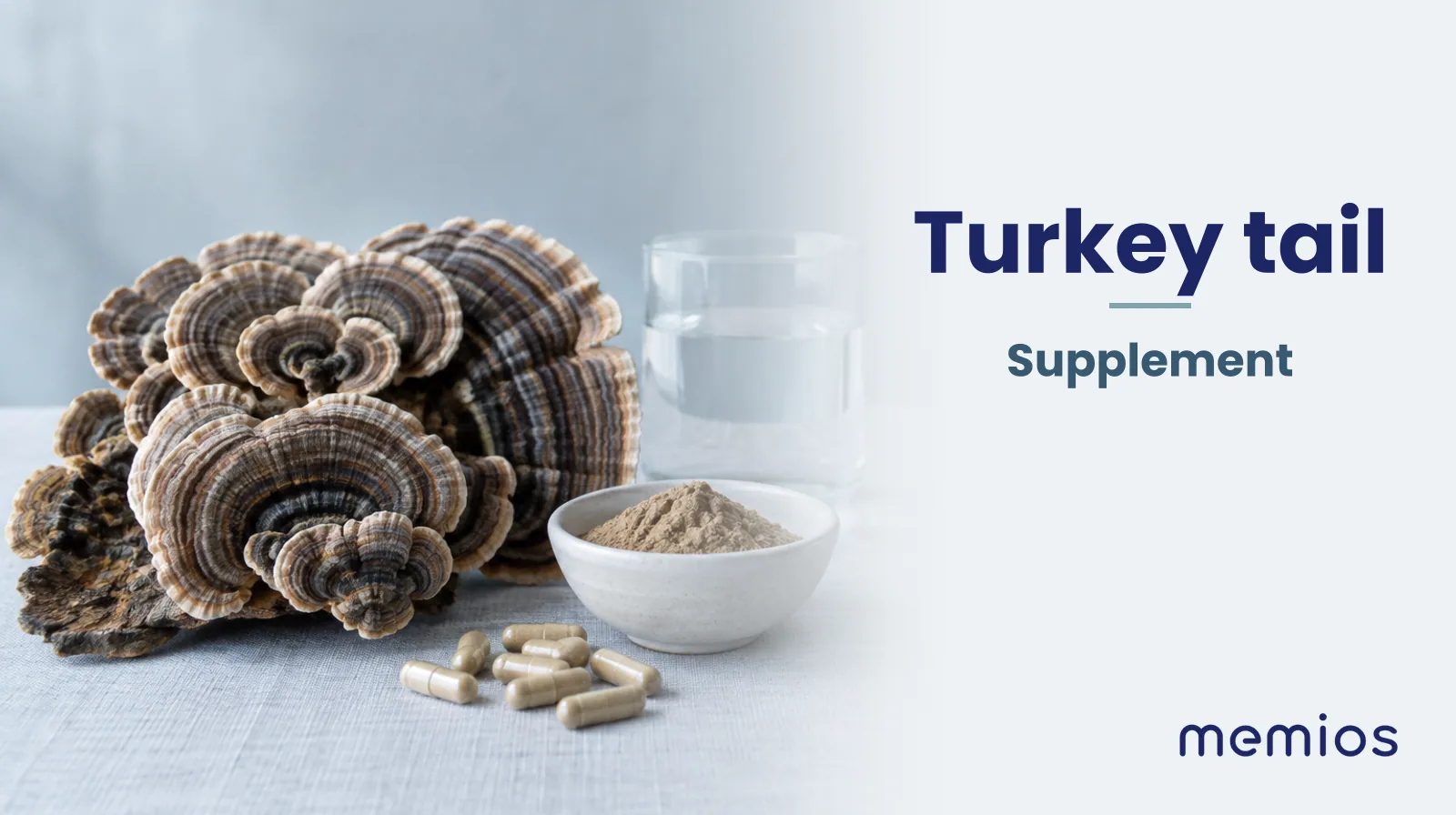
- What it is: Turkey tail is a bracket fungus that grows on dead logs worldwide and is named for its brown and tan rings.
- Main use, supported: A meta-analysis of randomised trials found PSK added to chemotherapy after gastric cancer surgery was associated with a modest improvement in survival. (low certainty)
- Other use, supported: A Cochrane review found low-certainty evidence of a small improvement in five-year survival when Coriolus (PSK) was added to colorectal cancer chemotherapy. (low certainty)
- Claim NOT supported by research: The same Cochrane review found very low-certainty evidence of little to no effect of PSK on stopping treatment because of side effects, and uncertainty about its effect on chemotherapy side effects. (very low certainty)
- Recommended dose: not established. No recommended intake exists; turkey tail is not an essential nutrient, and no reference intake was found in the NCI, MSKCC or Cochrane sources searched.
- Studied dose (a trial dose, not a recommendation): 3, 6 or 9 g a day of a Trametes versicolor preparation for 6 weeks in women after breast cancer radiotherapy (Torkelson et al. 2012). Findings citing that trial: 1 mixed.
- Upper limit: No tolerable upper limit has been set by any body in the sources searched.
- What goes wrong: 3 findings on harm. Memorial Sloan Kettering lists rare dark stools, darkened fingernails, and low-grade blood and gut toxicity when used with chemotherapy, and says data for breast, liver cancer and leukaemia are mixed.
- Common myth: Turkey tail is a proven cancer treatment.
What it is
Turkey tail is a bracket fungus that grows on dead logs worldwide and is named for its brown and tan rings. Its best studied extract is PSK (Krestin), a proprietary product of the Kureha Corporation used alongside cancer treatment in Japan since the mid-1970s; PSP is a related Chinese extract.
What the research says
Most evidence concerns the PSK extract given with chemotherapy after cancer surgery in Japan. A meta-analysis of 8,009 gastric cancer patients found a modest survival advantage, and a 2022 Cochrane review in colorectal cancer found low-certainty evidence of a small five-year survival benefit, with very low-certainty evidence about side effects and trial regimens that no longer reflect current practice. A small phase 1 trial in breast cancer survivors found doses up to 9 g a day tolerable. Reported harms include dark stools, darkened nails, low blood counts and raised liver enzymes, and caution is advised with blood thinners and immunosuppressants.
Evidence grade: Limited evidence.
What goes wrong
Memorial Sloan Kettering lists rare dark stools, darkened fingernails, and low-grade blood and gut toxicity when used with chemotherapy, and says data for breast, liver cancer and leukaemia are mixed. (Source 1)
- Official position, Certainty not rated.
- Size: not applicable.
- Who: Cancer patients using Coriolus.
- How long: not applicable.
- Result: Described as rare; no rates.
- Funding: independent.
Rare: Dark colored stools not originating from occult blood, darkening of fingernails, and low-grade hematological and gastrointestinal toxicities when used in conjunction with chemotherapy.
CancerChoices notes an association with low platelet counts and advises caution with anticoagulant, antiplatelet and immunosuppressant drugs, and reports worse outcomes when PSK was combined with tegafur/uracil in colorectal cancer. (Source 2)
- Official position, Certainty not rated.
- Size: not applicable.
- Who: People with cancer.
- How long: not applicable.
- Result: No rates given.
- Funding: independent (non-profit)
Turkey tail mushroom should be used cautiously with anticoagulant or antiplatelet agents, as it has been associated with low platelet counts (thrombocytopenia).
CancerChoices reports that combining PSK with tegafur/uracil (UFT) was linked to slightly higher recurrence and lower survival in colorectal cancer. (Source 2)
- Official position, Certainty not rated.
- Size: not applicable.
- Who: People with colorectal cancer.
- How long: not applicable.
- Result: Described as slightly higher risk; no figures in fetched text.
- Funding: independent (non-profit)
The use of PSK with adjunct tegafur/uracil (UFT) has shown a slightly higher risk of recurrence and lower survival among people with colorectal cancer.
What the evidence supports
A meta-analysis of randomised trials found PSK added to chemotherapy after gastric cancer surgery was associated with a modest improvement in survival. (Source 3)
- Meta-analysis, Low certainty.
- Size: 8,009 patients across 8 RCTs.
- Who: Japanese patients after curative gastric cancer resection.
- How long: trial follow-up.
- Result: Overall HR 0.88 (95% CI 0.79-0.98; P = 0.018), no significant heterogeneity.
- Funding: not stated in the fetched abstract.
The meta-analysis included 8,009 patients from eight randomized controlled trials after central randomization.
A Cochrane review found low-certainty evidence of a small improvement in five-year survival when Coriolus (PSK) was added to colorectal cancer chemotherapy. (Source 4)
- Systematic review, Low certainty.
- Size: 1,094 participants in 3 studies (7 RCTs, 1,569 overall)
- Who: People with colorectal cancer, mainly in Japan and China.
- How long: 5 years.
- Result: RR 1.08 (95% CI 1.01 to 1.15); NNTB 16 (95% CI 9 to 70)
- Funding: not stated.
We found low-certainty evidence of a small effect of adjunctive Coriolus on improved survival at five years compared with no adjunctive care (RR 1.08, 95% CI 1.01 to 1.15; 1094 participants; 3 studies; number needed to benefit (NNTB) = 16 (95% Cl 9 to 70).
What the evidence does not support
The same Cochrane review found very low-certainty evidence of little to no effect of PSK on stopping treatment because of side effects, and uncertainty about its effect on chemotherapy side effects. (Source 4)
- Systematic review, Very low certainty.
- Size: 703 participants in 3 studies.
- Who: People with colorectal cancer.
- How long: during chemotherapy.
- Result: Withdrawal due to adverse events RR 1.03 (95% CI 0.45 to 2.34)
- Funding: not stated.
We found very low-certainty evidence of little to no effect of adjunctive treatment with Coriolus (in the form of an extract, polysaccharide-Krestin, PSK) on withdrawal from treatment due to adverse events
Where the evidence is mixed
The Cochrane authors noted that the chemotherapy regimens studied do not reflect current practice, limiting how far the survival result applies today. (Source 4)
- Systematic review, Low certainty.
- Size: 7 RCTs.
- Who: People with colorectal cancer.
- How long: not applicable.
- Result: Not applicable.
- Funding: not stated.
In addition, chemotherapy regimens used in assessing this outcome do not reflect current preferred practice.
In a phase 1 dose-escalation trial in women after breast cancer treatment, a Trametes versicolor preparation up to 9 g a day was tolerated, with one severe adverse event among nine reported. (Source 5)
- Case series, Very low certainty.
- Size: 9 women completed (11 recruited)
- Who: Women with breast cancer after radiotherapy.
- How long: 6 weeks.
- Result: 9 adverse events (7 mild, 1 moderate, 1 severe); immune trends only, no control group.
- Funding: NIH National Center for Complementary and Alternative Medicine grant U19 AT001998 (per Europe PMC record)
Nine adverse events were reported (7 mild, 1 moderate, and 1 severe), suggesting that Tv was well tolerated.
How much
- Reference intake: No recommended intake exists; turkey tail is not an essential nutrient, and no reference intake was found in the NCI, MSKCC or Cochrane sources searched. (Source 6)
- Upper limit: No tolerable upper limit has been set by any body in the sources searched. (Source 6)
- Studied: 3, 6 or 9 g a day of a Trametes versicolor preparation for 6 weeks in women after breast cancer radiotherapy (Torkelson et al. 2012). (Source 5)
- Studied: PSK added to chemotherapy after gastric cancer surgery in 8 trials (Oba et al. 2007). (Source 3)
A common belief, and what the research shows
The belief: Turkey tail is a proven cancer treatment.
What the research shows: The data concern a specific extract (PSK) used alongside chemotherapy, not instead of it, and the best recent review rates the survival benefit low certainty: "We found low-certainty evidence of a small effect of adjunctive Coriolus on improved survival at five years compared with no adjunctive care". It also notes "chemotherapy regimens used in assessing this outcome do not reflect current preferred practice."
Questions and answers
What is it?
Turkey tail (Trametes versicolor) is a bracket mushroom that grows on dead wood around the world. The extract PSK, made from it, has been used alongside cancer treatment in Japan for decades. (Source 6)
What does it do in the body?
Its extracts are thought to act on the immune system. In cancer patients receiving chemotherapy, pooled trials link PSK to a modest survival gain, rated low certainty. (Source 4)
Is it good or bad for you?
Side effects in trials are usually mild, but reported problems include dark stools, dark nails, low platelet or white cell counts and raised liver enzymes. Its use alongside some chemotherapy combinations and blood thinners needs medical oversight. (Source 2)
How do you get more of it?
Trials gave standardised extracts (PSK) with chemotherapy, or a powdered preparation of 3 to 9 g a day in a breast cancer safety study. (Source 5)
If it is harmful, what reduces it?
Does not apply. Turkey tail is not produced by the body. MSKCC advises that pregnant or breastfeeding women avoid it until safety data exist. (Source 1)
Why might someone be low in it or missing it?
Does not apply. Turkey tail is not a nutrient or part of the body, so there is no deficiency. (Source 7)
Which whole foods contain it or feed it?
No whole food in the sources searched supplies it; turkey tail is a tough bracket fungus used as extracts and teas rather than eaten as a food. (Source 7)
We searched: NCI PDQ, MSKCC, CancerChoices and Cochrane; none list dietary food sources.
What happens if you do not have it?
Nothing is known to happen. It is not essential and no study links not taking it to disease. (Source 7)
We searched: NCI PDQ and Cochrane; no deficiency concept exists.
How can you test for it?
No test measures turkey tail in the body, and no validated test for it was found in the literature searched. (Source 6)
We searched: NCI PDQ, MSKCC, Cochrane 2022 review
References
- Memorial Sloan Kettering Cancer Center. Coriolus versicolor (About Herbs). 2026. Read the source
- CancerChoices. Turkey Tail Mushroom for Cancer: Safety & Side Effects. 2026. Read the source
- Cancer Immunology, Immunotherapy. Efficacy of adjuvant immunochemotherapy with polysaccharide K for patients with curative resections of gastric cancer. 2007. PMID 17106715, DOI 10.1007/s00262-006-0248-1. Read the source
- Cochrane Database of Systematic Reviews. Coriolus (Trametes) versicolor mushroom to reduce adverse effects from chemotherapy or radiotherapy in people with colorectal cancer. 2022. DOI 10.1002/14651858.CD012053.pub2. Read the source
- ISRN Oncology. Phase 1 Clinical Trial of Trametes versicolor in Women with Breast Cancer. 2012. PMID 22701186, DOI 10.5402/2012/251632. Read the source
- National Cancer Institute. Medicinal Mushrooms (PDQ) - Health Professional Version. 2024. Read the source
- National Cancer Institute. Medicinal Mushrooms (PDQ) - Patient Version. 2024. Read the source