Supplements · September 29, 2026 · Memios · 17 min read
Tribulus terrestris
Disputed. Despite the marketing, the evidence for a testosterone effect is essentially absent.
TLDR
- Disputed. Despite the marketing, the evidence for a testosterone effect is essentially absent.
- What it is: Tribulus terrestris is a low-growing weed of dry habitats found across Asia, Africa, Australia and the Americas.
- Main use, supported: The same meta-analysis found no difference in adverse events between Tribulus terrestris and placebo in the trials it pooled. (low certainty)
- Claim NOT supported by research: A 2025 systematic review found no robust evidence that Tribulus terrestris raises testosterone, and rated the evidence for erectile function as low level. (low certainty)
- Another claim NOT supported: The same systematic review reported that half the included studies were of low methodological quality on the Jadad score. (low certainty)
- Recommended dose: not established. No reference intake such as an RDA or AI exists for Tribulus terrestris. It is a herbal plant sold as a supplement ingredient, not an essential nutrient.
- Studied dose (a trial dose, not a recommendation): A 2025 systematic review reports trials giving 400 to 750 mg per day for one to three months. Findings citing that trial: 2 against.
- Upper limit: We found no tolerable upper intake level or acceptable daily intake set by any body.
- What goes wrong: 7 findings on harm. LiverTox rates Tribulus terrestris an unproven but possible rare cause of clinically apparent liver injury at high doses or in people with existing liver disease.
- Common myth: Tribulus is a natural testosterone booster.
What it is
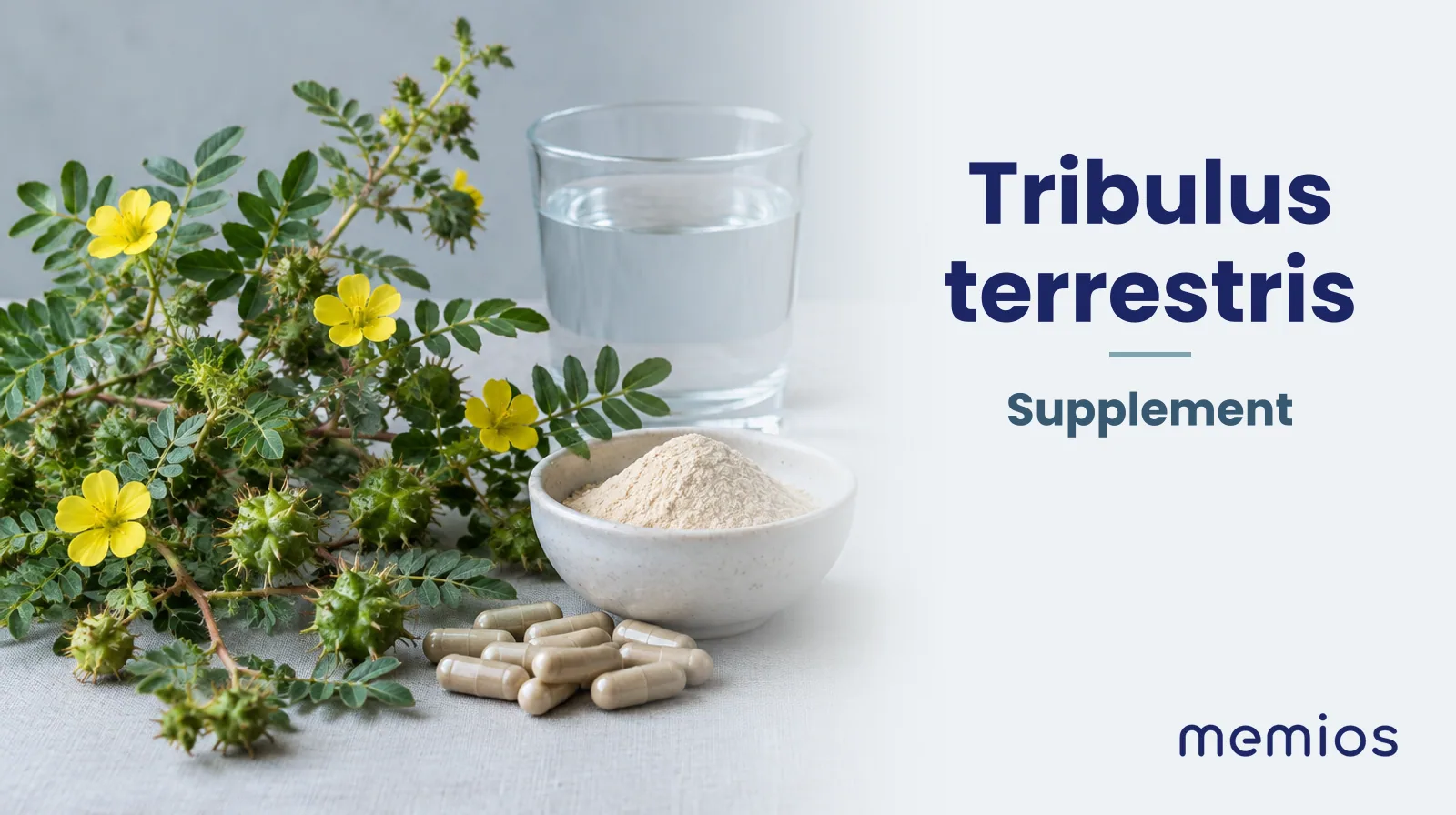
Tribulus terrestris is a low-growing weed of dry habitats found across Asia, Africa, Australia and the Americas. Supplement ingredients are prepared from its leaves, root and fruit, and the constituents thought to be active are steroidal saponins such as protodioscin, dioscin and diosgenin. It is sold to raise testosterone and improve sexual and athletic performance. The plant itself is known to poison grazing animals, causing a distinctive liver injury in sheep.
What the research says
Despite the marketing, the evidence for a testosterone effect is essentially absent. A randomised trial in young men found no change in testosterone, androstenedione or luteinising hormone at either of two doses, and a 2025 systematic review found that eight of ten studies reported no significant change in androgen profile. For erectile function the picture is contested: a 2025 meta-analysis reported improved erectile function scores versus placebo, while a systematic review of the same field judged the evidence low quality. Case reports describe severe liver and kidney injury and priapism.
Evidence grade: Disputed.
What goes wrong
LiverTox rates Tribulus terrestris an unproven but possible rare cause of clinically apparent liver injury at high doses or in people with existing liver disease. (Source 1)
- Expert review, not systematic, Very low certainty.
- Size: isolated case reports; no prospective monitoring studies exist.
- Who: people taking Tribulus herbal extract.
- How long: not stated.
- Result: likelihood score E*; no rates available because no prospective liver-test monitoring has been done.
- Funding: independent (US National Institutes of Health)
Likelihood score: E* (unproven but possible rare cause of clinically apparent liver injury when taken in high doses or in persons with pre-existing liver disease).
LiverTox notes that no prospective study has monitored liver tests in people taking Tribulus, so the absence of reported enzyme elevations is not evidence of safety. (Source 2)
- Expert review, not systematic, Very low certainty.
- Size: not applicable.
- Who: people taking Tribulus herbal extract.
- How long: not applicable.
- Result: no data; the gap itself is the finding.
- Funding: independent (US National Institutes of Health)
has been not been reported to cause serum enzyme elevations in persons taking the herbal extract, but prospective studies with regular monitoring of liver tests have not been done
The Tribulus terrestris plant causes a distinctive liver injury in grazing sheep, with crystals found in bile ducts and renal tubules. (Source 2)
- Animal study, Certainty not rated.
- Size: not stated.
- Who: sheep that fed on the leaves.
- How long: not stated.
- Result: hepatogenous photosensitivity known as geeldikkop; crystals in bile ducts and renal tubules on histology.
- Funding: independent (US National Institutes of Health summary)
Histology of the liver from sheep dying after feeding upon the leaves of Tribulus terrestris demonstrates crystals in bile ducts and renal tubules.
A single uncontrolled case report describes toxin-induced liver failure in a 31-year-old woman who drank Tribulus terrestris as a herbal tea several times a day for two to three months; one case cannot establish that Tribulus causes liver failure. (Source 3)
- Case report, Very low certainty.
- Size: 1 patient (single case report, no control or comparison group)
- Who: a 31-year-old Iranian woman using it for weight loss.
- How long: 2-3 months of daily use.
- Result: generalised icterus with elevated transaminases, PT and INR; viral and autoimmune hepatitis excluded; the authors' only probable diagnosis was toxin-induced liver failure. Quoted from the article abstract.
- Funding: not stated.
Limit of this finding: This is one person's case, written up after the fact. Reports like this can show that something is biologically possible, but they cannot show how often it happens or prove the supplement was the cause, because there is no comparison group and other exposures can never be fully ruled out. Note also that the wording quoted here comes from the paper's abstract; the body of the same paper describes the case in different words.
She had been consuming Tribulus terrestris as an herbal tea , several times a day for 2-3 months, in order to lose weight.
A cancer centre monograph summarises case reports of acute renal failure, seizures with aminotransferases above 40 times the upper limit of normal, and 72-hour priapism after Tribulus use. (Source 4)
- Case series, Very low certainty.
- Size: three individual cases summarised.
- Who: a 30-year-old male bodybuilder, a 28-year-old man, and a 36-year-old man.
- How long: a few months of daily tablets in one case; large quantities in another.
- Result: acute renal failure with bile-containing casts; hypertension, seizures and aminotransferases >40x ULN; priapism for 72 hours requiring a cavernoglandular shunt with poor sexual outcome.
- Funding: not stated.
Neuro-, hepatic, and renal toxicity suggestive of acute tubular necrosis (ATN): In a 28-year-old man who consumed large quantities of tribulus extract for its antiurolithiatic properties. Additionally, he developed hypertension, seizures, and markedly elevated serum aminotransferases (>40x ULN).
The same monograph lists interactions with diuretics, antihypertensives, antidiabetics, clopidogrel and P-glycoprotein substrate drugs, with clinical relevance unknown. (Source 5)
- Expert review, not systematic, Very low certainty.
- Size: not stated.
- Who: people taking Tribulus with prescription medicines.
- How long: not stated.
- Result: stent thrombosis reported with concurrent clopidogrel and a tribulus-containing herbal formula; other interactions theoretical.
- Funding: not stated.
Clopidogrel: May increase the risk of blood clots. Stent thrombosis has been reported in patients following concurrent use of clopidogrel and an herbal formula containing tribulus.
The same programme states that safety research in humans is limited and that severe liver and kidney damage has been reported after Tribulus-containing supplements. (Source 6)
- Official position, Certainty not rated.
- Size: not stated.
- Who: supplement users.
- How long: short-term studies up to 3 months.
- Result: stomach cramps and nausea in short-term studies; sleep disturbance, exhaustion, fatigue and elevated heart rate above 1,000 mg per day; a few cases of severe liver and renal damage; page updated 12 June 2024.
- Funding: independent (US Department of Defense)
A few cases of severe liver and renal (kidney) damage have been reported after individuals consumed supplements containing Tribulus.
What the evidence supports
The same meta-analysis found no difference in adverse events between Tribulus terrestris and placebo in the trials it pooled. (Source 7)
- Meta-analysis, Low certainty.
- Size: 8 studies included.
- Who: patients with erectile dysfunction.
- How long: not stated in the abstract.
- Result: no difference in incidence of adverse events reported between groups; no rates given in the abstract.
- Funding: not stated.
We observed no difference in the incidence of adverse events between Tribulus terrestris and placebo.
What the evidence does not support
A 2025 systematic review found no robust evidence that Tribulus terrestris raises testosterone, and rated the evidence for erectile function as low level. (Source 8)
- Systematic review, Low certainty.
- Size: 483 participants across 10 studies (9 clinical trials and 1 quasi-experimental study)
- Who: men aged 16 to 70, healthy or with oligozoospermia, erectile dysfunction, hypogonadism or unexplained infertility.
- How long: 1 to 3 months.
- Result: 8 of 10 studies reported no significant change in androgen profile; the 2 positive studies showed intra-group testosterone rises of low clinical magnitude (60-70 ng/dL) in men with hypogonadism.
- Funding: not stated.
Eight out of ten studies did not report significant changes in androgen profile following TT supplementation, but the subjects in the neutral studies did not have low androgen levels at baseline.
The same systematic review reported that half the included studies were of low methodological quality on the Jadad score. (Source 8)
- Systematic review, Low certainty.
- Size: 10 studies.
- Who: men in the included trials.
- How long: 1 to 3 months.
- Result: Jadad score indicated low methodological quality for 50% of studies.
- Funding: not stated.
The Jadad score revealed low methodological quality for 50% of the studies.
A randomised placebo-controlled trial in young men found Tribulus terrestris extract did not change testosterone, androstenedione or luteinising hormone at either dose tested. (Source 9)
- Randomized trial, Low certainty.
- Size: 21 healthy young men in three groups of 7.
- Who: healthy men aged 20-36, body weight 60-125 kg.
- How long: 4 weeks.
- Result: testosterone TT1 15.75 ± 1.75 nmol/l, TT2 16.32 ± 1.57 nmol/l, controls 17.74 ± 1.09 nmol/l (p > 0.05); androstenedione and LH also non-significant.
- Funding: not stated.
There was no significant difference between Tribulus terrestris supplemented groups and controls in the serum testosterone
The authors of that trial concluded the steroidal saponins in Tribulus terrestris have no androgen-increasing properties. (Source 9)
- Randomized trial, Low certainty.
- Size: 21 healthy young men.
- Who: healthy men aged 20-36.
- How long: 4 weeks.
- Result: all hormone results within the normal range and not different from placebo.
- Funding: not stated.
The findings in the current study anticipate that Tribulus terrestris steroid saponins possess neither direct nor indirect androgen-increasing properties.
The US Department of Defense supplement safety programme states that studies of Tribulus in athletes show no significant improvement in body composition, strength or exercise performance. (Source 6)
- Official position, Certainty not rated.
- Size: not stated; small-scale studies in rugby players and CrossFit athletes.
- Who: athletes.
- How long: not stated.
- Result: no significant improvements reported; page updated 12 June 2024.
- Funding: independent (US Department of Defense)
Overall, these studies do not show any significant improvements in body composition (muscle or body mass), strength, or exercise performance.
Where the evidence is mixed
A meta-analysis of randomised trials reported that Tribulus terrestris improved erectile function scores relative to placebo but did not change total testosterone. (Source 7)
- Meta-analysis, Low certainty.
- Size: 8 studies included.
- Who: patients with erectile dysfunction.
- How long: not stated in the abstract.
- Result: IIEF-5 MD 3.23 (95% CI 1.89, 4.58), p < 0.00001; IIEF-15 MD 14.44 (95% CI 5.75, 23.14), p = 0.001; no significant difference in total testosterone.
- Funding: not stated.
on both the IIEF-5 [MD 3.23 (95%CI 1.89, 4.58), p < 0.00001] and IIEF-15 [MD 14.44 (95%CI 5.75, 23.14), p = 0.001], Tribulus terrestris outperformed placebo. However, the two groups were not significantly different in terms of total testosterone levels.
A letter in Nephrology Dialysis Transplantation disputes the Danish authorities' reliance on a single case report to justify action against Tribulus supplements. (Source 10)
- Expert review, not systematic, Very low certainty.
- Size: not applicable.
- Who: not applicable.
- How long: not applicable.
- Result: no effect size; a dispute about causal attribution.
- Funding: not stated; two of the authors are affiliated with herbal medicine organisations.
To date, this adverse effect was entirely hypothetical, but the Danish authorities appear to consider the case report of Talasaz et al. as the definitive proof and justification of action taken against Tribulus supplements.
Where the research disagrees
Whether Tribulus terrestris improves erectile function
- Meta-analysis in International Journal of Impotence Research, meta-analysis of 8 studies, many pre- versus post-supplementation: Tribulus terrestris supplementation may offer benefits in improving erectile function among patients with ED with a relatively good safety profile. (Source 7)
- Systematic review in Nutrients, systematic review of 10 studies with Jadad quality scoring: TT supplementation has a low level of evidence regarding its effectiveness in improving erectile function in men with erectile dysfunction, and no robust evidence was found for increasing testosterone levels. (Source 8)
Whether the reported cases of organ injury should be attributed to Tribulus
- LiverTox, US National Institutes of Health, narrative safety review of published case reports and animal toxicology: For these reasons, high doses should be considered potentially injurious, particularly in patients with preexisting liver disease or cirrhosis. (Source 2)
- Schmidt, Thomsen and Bone, letter in Nephrology Dialysis Transplantation, correspondence disputing causal attribution: To date, this adverse effect was entirely hypothetical, but the Danish authorities appear to consider the case report of Talasaz et al. as the definitive proof and justification of action taken against Tribulus supplements. (Source 10)
How much
- Reference intake: No reference intake such as an RDA or AI exists for Tribulus terrestris. It is a herbal plant sold as a supplement ingredient, not an essential nutrient. (Source 11)
- Upper limit: We found no tolerable upper intake level or acceptable daily intake set by any body. The US Department of Defense supplement safety programme states only that human safety research is limited and that sleep disturbance, exhaustion, fatigue and raised heart rate have been reported above 1,000 mg per day (page updated 12 June 2024). (Source 6)
- Studied: A 2025 systematic review reports trials giving 400 to 750 mg per day for one to three months. (Source 8)
- Studied: A randomised trial gave 20 and 10 mg per kg of body weight per day of Tribulus terrestris extract, split into three daily intakes for four weeks. (Source 12)
A common belief, and what the research shows
The belief: Tribulus is a natural testosterone booster.
What the research shows: Controlled human data do not support this. A randomised trial in young men reported that "There was no significant difference between Tribulus terrestris supplemented groups and controls in the serum testosterone", and its authors concluded that "The findings in the current study anticipate that Tribulus terrestris steroid saponins possess neither direct nor indirect androgen-increasing properties." A 2025 systematic review agreed that "Eight out of ten studies did not report significant changes in androgen profile following TT supplementation, but the subjects in the neutral studies did not have low androgen levels at baseline." Even the meta-analysis most favourable to Tribulus for erectile function noted that "the two groups were not significantly different in terms of total testosterone levels."
Questions and answers
What is it?
Tribulus terrestris is a low-growing weed, also called puncture vine or caltrop, that grows in dry regions worldwide. Supplement ingredients are made from its leaves, root and fruit. Its main constituents of interest are steroidal saponins, plant-derived steroid-like compounds such as protodioscin. (Source 11)
What does it do in the body?
Tribulus is sold on the premise that it raises testosterone, but controlled human data do not show that. A randomised trial in healthy young men found no change in testosterone, androstenedione or luteinising hormone after four weeks at either of two doses, and the authors concluded the saponins have no androgen-raising action. Some trials report better erectile function scores, but a systematic review judged that evidence low quality. (Source 9)
Is it good or bad for you?
On current evidence the case for benefit is weak and the safety record is not clean. A 2025 systematic review found low-level evidence for erectile function and no robust evidence for raising testosterone. Against that sit published case reports of acute liver failure, acute renal failure, seizures and prolonged priapism, and a LiverTox likelihood rating of unproven but possible rare liver injury at high doses or in people with existing liver disease. (Source 8)
How do you get more of it?
Tribulus is taken as a capsule or tablet extract, or as a herbal tea. The trials collected in a 2025 systematic review used 400 to 750 mg per day for one to three months; a separate randomised trial used 10 or 20 mg per kg of body weight daily for four weeks. This describes what studies gave people and is not advice. (Source 8)
If it is harmful, what reduces it?
Tribulus is not made in the body, so exposure only comes from consuming it and stops when the product is stopped. In the published case reports, discontinuation accompanied recovery. LiverTox flags dose and pre-existing liver disease as the circumstances in which injury is most plausible. (Source 2)
Why might someone be low in it or missing it?
This question does not apply. Tribulus terrestris is a plant used as a supplement ingredient, not a substance the body makes or requires, so there is no deficiency state and nothing to be low in. We searched the systematic reviews, the LiverTox monograph and the Department of Defense supplement safety summary and none describes a Tribulus requirement or deficiency. (Source 11)
We searched: PubMed and Europe PMC via WebSearch for Tribulus terrestris systematic reviews and deficiency; LiverTox NBK583201; the Operation Supplement Safety monograph; the 2025 Nutrients systematic review
Which whole foods contain it or feed it?
Tribulus is not a food crop. It is a weed, known as caltrop or puncture vine, consumed only as a prepared extract or herbal tea rather than as part of a normal diet. Its toxicity to grazing livestock is one reason it is not eaten as a vegetable. (Source 11)
What happens if you do not have it?
Nothing happens. Tribulus is not essential to human physiology and there is no described consequence of never consuming it. The reviews we read assess whether taking it adds anything, and conclude the evidence for benefit is low level. (Source 8)
We searched: the 2025 Nutrients systematic review of Tribulus in men, the 2026 International Journal of Impotence Research meta-analysis, LiverTox NBK583201 and the Operation Supplement Safety monograph; none describes a deficiency or absence state
How can you test for it?
There is no validated clinical test for Tribulus status in a person, and none is described in the literature we searched. What can be tested is the product rather than the person: without laboratory analysis there is no way to know how much of the plant, or what else, is in a supplement. Blood tests used in the trials measured hormones such as testosterone, not Tribulus itself. (Source 6)
We searched: the 2025 Nutrients systematic review, the 2026 IJIR meta-analysis, LiverTox NBK583201 and the Operation Supplement Safety monograph, plus WebSearch for Tribulus terrestris supplement analysis and adulteration
References
- National Institute of Diabetes and Digestive and Kidney Diseases, National Institutes of Health. Tribulus - LiverTox: Clinical and Research Information on Drug-Induced Liver Injury. 2022. Read the source
- National Institute of Diabetes and Digestive and Kidney Diseases, National Institutes of Health. Tribulus - LiverTox: Clinical and Research Information on Drug-Induced Liver Injury. 2022. Read the source
- Asia Pacific Journal of Medical Toxicology (abstract; the article's body text tells the same story in different words, so the quoted wording will not be found in the body). Hepatic Failure in a Young Woman Following Ingestion of Tribulus Terrestris (quoted from the Case presentation part of the published ABSTRACT). unknown. Read the source
- Memorial Sloan Kettering Cancer Center, About Herbs. Tribulus terrestris (Adverse Reactions and Case Reports sections). 2023. Read the source
- Memorial Sloan Kettering Cancer Center, About Herbs. Tribulus terrestris (Herb-Drug Interactions section). 2023. Read the source
- Operation Supplement Safety, Consortium for Health and Military Performance, US Department of Defense. Tribulus terrestris as an ingredient in dietary supplements (safety and athletic performance sections). 2024. Read the source
- International Journal of Impotence Research. Tribulus terrestris for management of patients with erectile dysfunction: a systematic review and meta-analysis of randomized trials. 2026. PMID 40360723, DOI 10.1038/s41443-025-01086-7. Read the source
- Nutrients. Effects of Tribulus (Tribulus terrestris L.) Supplementation on Erectile Dysfunction and Testosterone Levels in Men—A Systematic Review of Clinical Trials. 2025. PMID 40219032, DOI 10.3390/nu17071275. Read the source
- Journal of Ethnopharmacology. The aphrodisiac herb Tribulus terrestris does not influence the androgen production in young men (Results). 2005. PMID 15994038, DOI 10.1016/j.jep.2005.05.017. Read the source
- Nephrology Dialysis Transplantation. Tribulus terrestis-induced nephrotoxicity?. 2011. PMID 21712491, DOI 10.1093/ndt/gfr325. Read the source
- Operation Supplement Safety, Consortium for Health and Military Performance, US Department of Defense. Tribulus terrestris as an ingredient in dietary supplements (opening sections). 2024. Read the source
- Journal of Ethnopharmacology. The aphrodisiac herb Tribulus terrestris does not influence the androgen production in young men (Design and methods). 2005. PMID 15994038, DOI 10.1016/j.jep.2005.05.017. Read the source