Supplements · September 30, 2026 · Memios · 7 min read
Tremella
Limited evidence. Most research on tremella is in cells and animals.
TLDR
- Limited evidence. Most research on tremella is in cells and animals.
- What it is: Tremella fuciformis, known as snow fungus, is a white jelly-like fungus eaten and used as a traditional medicine in Asia for centuries.
- Main use, supported: In an 8-week randomised double-blind trial in 75 adults with subjective memory complaints, tremella extract improved memory complaint scores more than placebo. (low certainty)
- Other use, supported: In a 12-week double-blind trial of 56 overweight adults with prediabetes, the tremella drink group showed small within-group drops in HbA1c and waist circumference; the authors called it exploratory. (low certainty)
- Claim NOT supported by research: A 2025 review states that most tremella polysaccharide research is limited to preclinical cell and animal studies. (very low certainty)
- Recommended dose: not established. No RDA or Adequate Intake exists. Tremella is a food fungus, not an essential nutrient, and no body in the sources searched sets a reference intake.
- Studied dose (a trial dose, not a recommendation): Tremella fuciformis extract 600 mg/day or 1200 mg/day for 8 weeks. Findings citing that trial: 1 for, 1 mixed.
- Upper limit: No tolerable upper limit has been set by any body in the sources searched.
- What goes wrong: 2 findings on harm. Spoiled tremella is a recognised source of bongkrekic acid, a toxin with no specific antidote and high mortality.
- Common myth: Tremella's many health benefits are well proven.
What it is
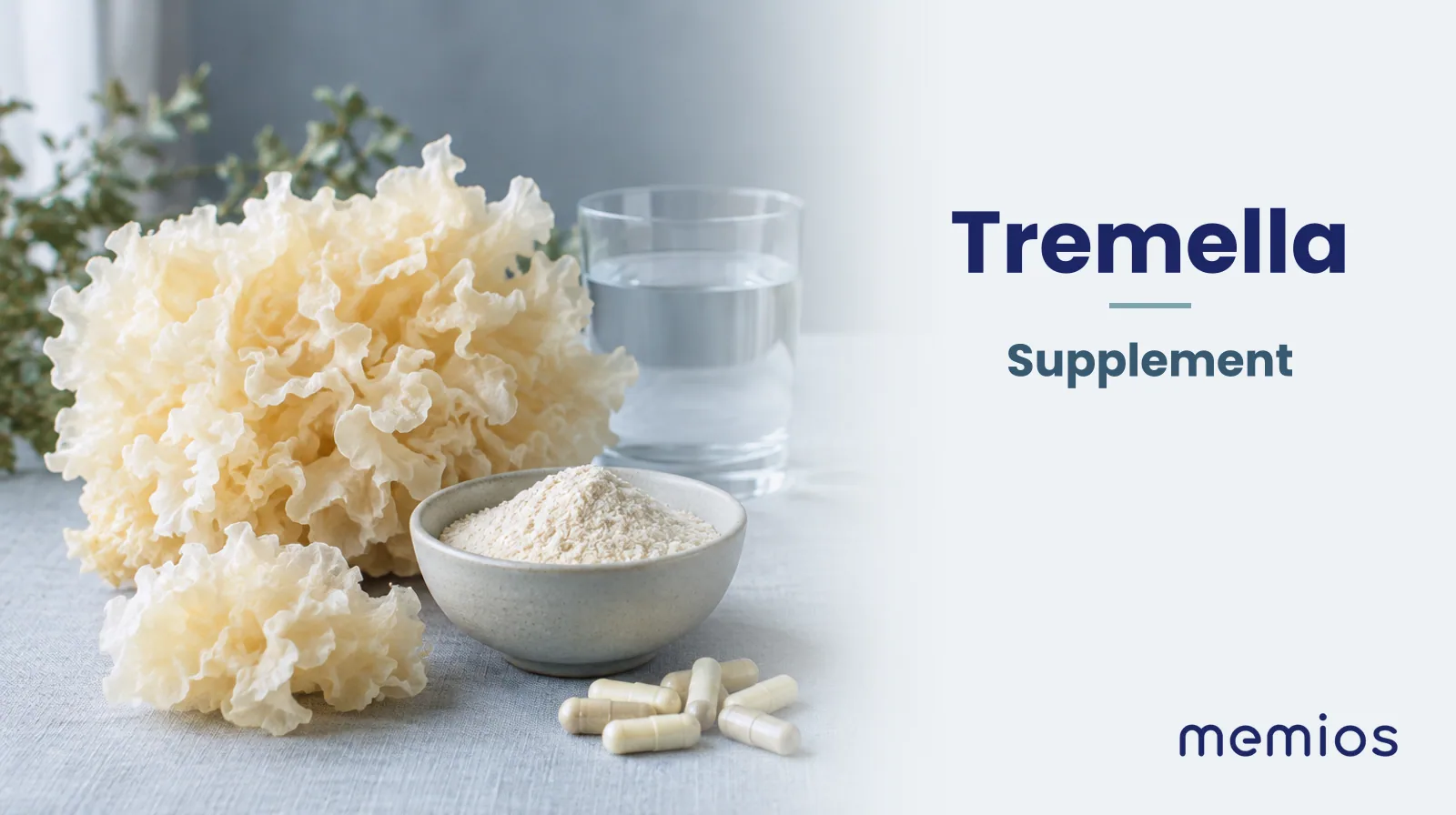
Tremella fuciformis, known as snow fungus, is a white jelly-like fungus eaten and used as a traditional medicine in Asia for centuries. Its polysaccharides are used in food, cosmetics and medicine.
What the research says
Most research on tremella is in cells and animals. Two small human trials report benefits: one on memory complaints over 8 weeks and one on blood sugar (HbA1c) and waist size over 12 weeks, both needing confirmation. Spoiled tremella can carry bongkrekic acid, a deadly food-poisoning toxin.
Evidence grade: Limited evidence.
What goes wrong
Spoiled tremella is a recognised source of bongkrekic acid, a toxin with no specific antidote and high mortality. (Source 1)
- Expert review, not systematic, Low certainty.
- Size: not stated in the abstract.
- Who: Autopsy cases and literature on bongkrekic acid deaths.
- How long: not applicable.
- Result: No specific antidote; mortality remains high; damages liver, kidney and brain.
- Funding: not stated.
It exists in common foods such as fermented edible grain products, potato products, spoiled tremella fuciformis and auricularia polytricha, as well as auricularia polytricha that has been soaked too long.
The same review reports that there is no specific antidote to bongkrekic acid and deaths remain high. (Source 1)
- Expert review, not systematic, Low certainty.
- Size: not stated.
- Who: Bongkrekic acid poisoning cases.
- How long: not applicable.
- Result: High mortality; often misdiagnosed.
- Funding: not stated.
Therefore, BA poisoning is easy to be misdiagnosed or missed diagnosed, and its mortality rate remains high.
What the evidence supports
In an 8-week randomised double-blind trial in 75 adults with subjective memory complaints, tremella extract improved memory complaint scores more than placebo. (Source 2)
- Randomized trial, Low certainty.
- Size: 75 participants (30 at 600 mg, 30 at 1200 mg, 15 placebo)
- Who: Adults with subjective cognitive impairment.
- How long: 8 weeks.
- Result: Greater improvement in subjective memory complaint questionnaire totals, short-term memory and executive function vs placebo.
- Funding: not stated.
The individuals in the TF group showed greater improvements in the total scores on the subjective memory complaint questionnaire compared with those in the placebo group.
In a 12-week double-blind trial of 56 overweight adults with prediabetes, the tremella drink group showed small within-group drops in HbA1c and waist circumference; the authors called it exploratory. (Source 3)
- Randomized trial, Low certainty.
- Size: 56 participants (28 per group)
- Who: Overweight or obese adults with prediabetes, Thailand.
- How long: 12 weeks.
- Result: HbA1c 6.03% to 5.96% (p = 0.047, Cohen's d = 0.39); waist 95.2 to 93.46 cm (p = 0.022, d = 0.45); within the intervention group.
- Funding: not stated.
Conclusion This exploratory study demonstrated that Tremella fuciformis beverage consumption may improve HbA1C and waist circumference in overweight/obese prediabetic individuals.
What the evidence does not support
A 2025 review states that most tremella polysaccharide research is limited to preclinical cell and animal studies. (Source 4)
- Expert review, not systematic, Very low certainty.
- Size: not applicable.
- Who: Tremella polysaccharide literature.
- How long: Literature to 2025.
- Result: Evidence mainly preclinical; clinical validation needed.
- Funding: not stated.
However, most research on Tremella fuciformis polysaccharides is limited to preclinical studies using in vivo and in vitro animal models.
Where the evidence is mixed
In that trial, adverse events were common and occurred at similar rates with tremella and placebo; the reported percentages do not match the group sizes, so only the overall pattern can be relied on. (Source 2)
- Randomized trial, Low certainty.
- Size: 75 participants.
- Who: Adults with subjective cognitive impairment.
- How long: 8 weeks.
- Result: Adverse events 40.4% high dose, 35.1% low dose, 41.4% placebo.
- Funding: not stated.
Limit of this finding: The published abstract's side-effect percentages do not fit its own group sizes: 40.4%, 35.1% and 41.4% cannot be whole numbers of people out of 30, 30 and 15 (for example, 41.4% of 15 is 6.2 people). The authors probably used a different count, which the abstract does not give. Read these as rough rates showing side effects were similar across groups, and do not work out numbers of people from them.
Overall frequency of adverse events did not differ among high-dose TF (40.4%), low-dose TF (35.1%), and placebo groups (41.4%).
How much
- Reference intake: No RDA or Adequate Intake exists. Tremella is a food fungus, not an essential nutrient, and no body in the sources searched sets a reference intake. (Source 4)
- Upper limit: No tolerable upper limit has been set by any body in the sources searched. (Source 4)
- Studied: Tremella fuciformis extract 600 mg/day or 1200 mg/day for 8 weeks. (Source 2)
- Studied: A once-daily Tremella fuciformis beverage for 12 weeks (beta-glucan dose not captured from the abstract). (Source 3)
A common belief, and what the research shows
The belief: Tremella's many health benefits are well proven.
What the research shows: Most of the evidence is from cells and animals. A 2025 review states: "However, most research on Tremella fuciformis polysaccharides is limited to preclinical studies using in vivo and in vitro animal models."
Questions and answers
What is it?
Tremella fuciformis, or snow fungus, is a white, jelly-like edible fungus. It has been eaten and used as a traditional medicine in Asia for centuries. (Source 4)
What does it do in the body?
Its polysaccharides show many effects in cells and animals, but human evidence is limited to two small trials, on memory complaints and on blood sugar. Most research remains preclinical. (Source 4)
Is it good or bad for you?
Fresh, properly stored tremella is a traditional food, and an extract caused no more side effects than placebo in an 8-week trial. Spoiled tremella, however, can carry bongkrekic acid, a toxin that causes often fatal food poisoning. (Source 1)
How do you get more of it?
Tremella is eaten as a food, often in soups and desserts, and taken as extracts. A trial gave 600 mg or 1200 mg of extract a day for 8 weeks. (Source 2)
If it is harmful, what reduces it?
Does not apply to tremella itself. The hazard is the toxin bongkrekic acid in spoiled tremella, for which no specific antidote exists. (Source 1)
Why might someone be low in it or missing it?
Does not apply. Tremella is not an essential nutrient or a gut organism, so no deficiency is described. (Source 4)
We searched: WebSearch for tremella reviews and human trials
Which whole foods contain it or feed it?
Tremella is itself a food, a traditional edible fungus widely used in Asian cooking. (Source 4)
What happens if you do not have it?
Nothing is known to happen. No literature we searched describes any effect of not eating tremella. (Source 4)
We searched: WebSearch for tremella reviews and human trials
How can you test for it?
No test for tremella intake exists in the literature we searched. For the toxin in spoiled tremella, the review notes there is still no complete detection method. (Source 1)
References
- Journal of Forensic Medicine (Fa Yi Xue Za Zhi), vol 41, issue 2. Forensic Research Progress on Bongkrekic Acid Poisoning. 2025. Read the source
- Journal of Medicinal Food. Efficacy and Safety of Tremella fuciformis in Individuals with Subjective Cognitive Impairment: A Randomized Controlled Trial. 2018. PMID 29319408, DOI 10.1089/jmf.2017.4063. Read the source
- BMC Nutrition. Tremella fuciformis beverage improves glycated hemoglobin A1c and waist circumference in overweight/obese prediabetic subjects: a randomized controlled trial. 2024. PMID 38439104, DOI 10.1186/s40795-024-00842-0. Read the source
- Frontiers in Nutrition. Recent advances in polysaccharides from Tremella fuciformis: isolation, structures, bioactivities and application. 2025. DOI 10.3389/fnut.2025.1663327. Read the source