Medications · September 29, 2026 · Memios · 11 min read
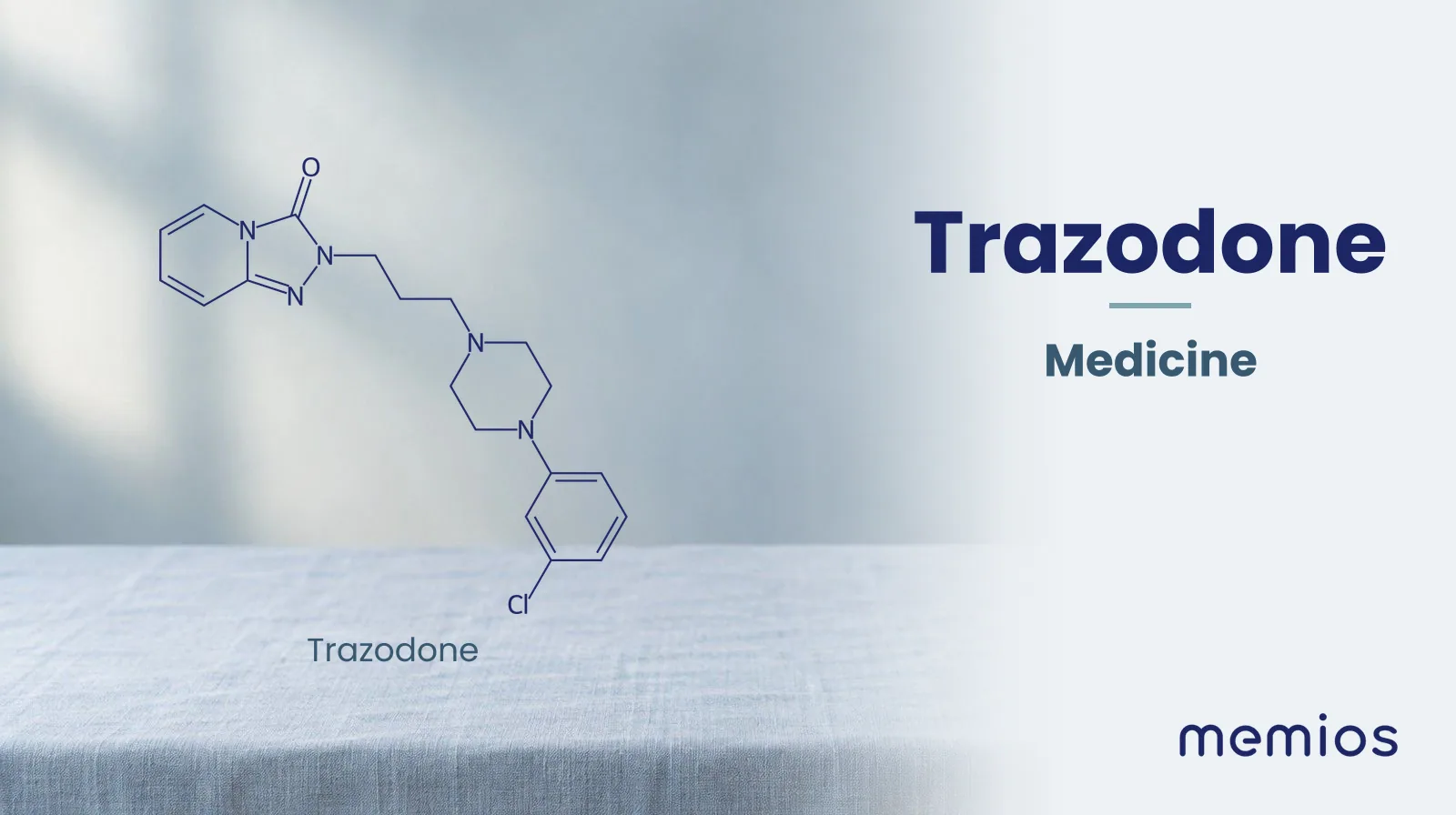
Trazodone
Limited evidence. Its effects depend on dose.
TLDR
- Boxed warning: Trazodone hydrochloride tablet is not approved for use in pediatric patients.
- Limited evidence. Its effects depend on dose.
- What it is: Trazodone is a prescription antidepressant.
- Main use: Major depressive disorder (adults) (well supported).
- Off-label uses (not on the FDA label): Insomnia (limited evidence); Sleep disturbance in dementia (limited evidence).
- Recommended dose (official position): Dosing is set by the prescriber. As a position, the 2025 label suggests an initial 150 mg/day in divided doses for depression.
- Studied dose (a trial dose, not a recommendation): The Cochrane-reviewed dementia sleep trial gave 50 mg at night for two weeks. Findings citing that trial: 1 for.
- Upper limit: The 2025 label, as a position, says the outpatient maximum usually should not exceed 400 mg/day in divided doses.
- What goes wrong: 4 findings on harm. Daytime drowsiness and decreased appetite were more common on trazodone than on control in insomnia trials.
- Interactions: 5 recorded, including Ritonavir and other strong CYP3A4 inhibitors, Alcohol and other sedatives (barbiturates, CNS depressants), St John's wort, tryptophan and other serotonergic products, Blood pressure medicines.
- Common myth: Low-dose trazodone is a safer sleeping pill than benzodiazepines for older people.
What it is
Trazodone is a prescription antidepressant. The US label approves it only for major depressive disorder in adults. At low doses it is widely prescribed off-label as a sleep aid.
What the research says
Its effects depend on dose. At low doses it blocks 5-HT2A, histamine H1 and alpha-1 receptors, which makes people sleepy. At higher doses it also blocks serotonin reuptake and acts as an antidepressant. Pooled trials show it beats placebo for depression, but it ranked among the least effective antidepressants and had high dropout rates. For insomnia, meta-analyses show fewer night awakenings and better perceived sleep, but no reliable gain in sleep efficiency, and the evidence certainty is low. Harms include sleepiness, dizziness, orthostatic hypotension, QT prolongation, priapism, and in older adults a fall-injury risk similar to benzodiazepines.
Evidence grade: Limited evidence.
How it works
Drug class: Serotonin antagonist and reuptake inhibitor (SARI) antidepressant
At low doses, trazodone blocks 5-HT2A serotonin receptors, H1 histamine receptors and alpha-1 adrenergic receptors, which causes sedation. At higher doses it also blocks the serotonin transporter, which is thought to explain its antidepressant effect. (Source 1)
Boxed warning
Antidepressants increased the risk of suicidal thoughts and behaviors in pediatric and young adult patients in short-term studies.
(Source 2)
What it is used for
- In a 522-trial network meta-analysis, every antidepressant including trazodone beat placebo. In head-to-head trials trazodone was among the least effective, and it had some of the highest dropout rates. Evidence: established. (Source 3)
- Meta-analyses of small trials found fewer awakenings and better perceived sleep quality. One found no gain in sleep efficiency, and another found more total sleep time. Certainty ranges from very low to moderate, and daytime drowsiness was more common. Evidence: limited. (Source 4)
- One 30-person, two-week trial in moderate-to-severe Alzheimer's disease found about 42 more minutes of night-time sleep, rated low-certainty by Cochrane. Evidence: limited. (Source 5)
Interactions
- Ritonavir and other strong CYP3A4 inhibitors (pharmacokinetic study): Ritonavir roughly halved trazodone clearance and doubled its half-life. This increased sedation, and one volunteer fainted. (Source 6)
- Alcohol and other sedatives (barbiturates, CNS depressants) (label): Trazodone may increase the effects of alcohol and other sedatives. (Source 2)
- St John's wort, tryptophan and other serotonergic products (label): The label lists these as raising the risk of serotonin syndrome when combined with trazodone. (Source 2)
- Blood pressure medicines (label): Trazodone can cause low blood pressure on standing and fainting, so blood pressure medicine doses may need lowering. (Source 2)
- Food (label): The label says to take it shortly after a meal or light snack. (Source 2)
Stopping it
- The label reports discontinuation reactions after serotonergic antidepressants, particularly after abrupt stops. These include nausea, dizziness, sensory disturbances, anxiety, insomnia and, rarely, seizures. It recommends a gradual reduction. (Source 2)
- Trazodone is not a controlled substance. Clinical studies showed no drug-seeking behaviour, although abuse potential was never formally studied. (Source 2)
What goes wrong
Daytime drowsiness and decreased appetite were more common on trazodone than on control in insomnia trials. (Source 7)
- Meta-analysis, Low certainty.
- Size: 466 participants in 11 RCTs.
- Who: Insomnia disorder.
- How long: At least 1 week.
- Result: Daytime drowsiness OR 2.53 (1.14-5.64); decreased appetite OR 2.81 (1.14-6.92)
- Funding: Not stated.
Daytime drowsiness (OR = 2.53, 95% CI 1.14–5.64, P = 0.02) and decreased appetite (OR = 2.81, 95% CI 1.14–6.92, P = 0.02) occurred with greater frequency in the trazodone group
In nursing-home residents, new low-dose trazodone users had fall-related injuries at about the same rate as new benzodiazepine users. (Source 8)
- Cohort study, Low certainty.
- Size: 7,791 matched pairs.
- Who: Nursing home residents aged 66+ in Ontario.
- How long: 90 days.
- Result: Fall-related injury 5.7% trazodone vs 6.0% benzodiazepines.
- Funding: Not stated on page read (ICES, public funding)
New use of low‐dose trazodone was no safer with respect to a risk of a fall‐related injury than new use of benzodiazepines
In label trials, trazodone caused more drowsiness, dizziness, dry mouth and blurred vision than placebo. (Source 2)
- Official position, Certainty not rated.
- Size: Label outpatient trials.
- Who: Adults with depression in label trials.
- How long: About 6 weeks.
- Result: Label table as transcribed from the fetched page (verify): drowsiness 41% vs 20%; dizziness/light-headedness 28% vs 15%; dry mouth 34% vs 20%; headache 20% vs 16%; blurred vision 15% vs 4%.
- Funding: Manufacturer label.
Common Adverse Reactions Occurring in ≥ 2% of Trazodone Hydrochloride-treated Patients and Greater than the Rate of Placebo-Treated Patients
Priapism (a prolonged, painful erection) is a rare but serious reported harm that can permanently damage erectile tissue. (Source 2)
- Official position, Certainty not rated.
- Size: Post-marketing reports.
- Who: Men taking trazodone.
- How long: Any.
- Result: Frequency not given in the text read.
- Funding: Manufacturer label.
Priapism, if not treated promptly, can result in irreversible damage to the erectile tissue.
What the evidence supports
All antidepressants in the 522-trial network meta-analysis, trazodone included, beat placebo for acute adult depression. (Source 3)
- Meta-analysis, Moderate certainty.
- Size: 116,477 participants in 522 trials.
- Who: Adults with major depressive disorder.
- How long: Acute treatment.
- Result: Efficacy OR against placebo 1.38 to 2.13 across drugs.
- Funding: Not stated in the abstract read.
In terms of efficacy, all antidepressants were more effective than placebo
People with insomnia who took trazodone rated their sleep quality slightly better than those on placebo. (Source 4)
- Meta-analysis, Low certainty.
- Size: 429 patients in 7 RCTs.
- Who: Adults with insomnia.
- How long: Short-term.
- Result: Sleep quality SMD -0.41 (-0.82 to -0.00), P=0.05.
- Funding: Not stated.
patients receiving trazodone perceived better SQ than those receiving the placebo (SMD = −0.41, 95% CI −0.82 to −0.00, P = 0.05)
On sleep studies, trazodone increased total sleep time by about 40 minutes, but the evidence certainty was very low. (Source 7)
- Meta-analysis, Very low certainty.
- Size: 466 participants in 11 RCTs.
- Who: Insomnia disorder.
- How long: At least 1 week.
- Result: TST MD 39.88 min (14.44-65.32)
- Funding: Not stated.
trazodone significantly increased total sleep time (TST, min) (MD = 39.88, 95% CI 14.44–65.32, P = 0.002)
In people with moderate-to-severe Alzheimer's disease, trazodone 50 mg may add about 42 minutes of night-time sleep. This rests on one 30-person trial. (Source 5)
- Systematic review, Low certainty.
- Size: 30 participants, 1 study.
- Who: Moderate-to-severe Alzheimer's disease.
- How long: 2 weeks.
- Result: TNST MD 42.46 min (0.9 to 84.0); sleep efficiency MD 8.53%.
- Funding: Cochrane (independent)
We found low-certainty evidence that trazodone 50 mg for two weeks may improve TNST (MD 42.46 minutes, 95% CI 0.9 to 84.0; 1 study, n = 30)
What the evidence does not support
In head-to-head comparisons, trazodone was among the least effective antidepressants and had among the highest dropout rates. (Source 3)
- Meta-analysis, Low certainty.
- Size: 522 trials.
- Who: Adults with major depressive disorder.
- How long: Acute treatment.
- Result: Efficacy OR 0.50-0.89; dropout OR 1.31-2.38.
- Funding: Not stated.
amitriptyline, clomipramine, duloxetine, fluvoxamine, reboxetine, trazodone and venlafaxine had the highest dropout rates (OR range: 1.31-2.38)
For insomnia, trazodone did not improve sleep efficiency and made no difference to time to fall asleep or total sleep time. It did reduce awakenings. (Source 4)
- Meta-analysis, Low certainty.
- Size: 429 patients in 7 RCTs.
- Who: Adults with insomnia.
- How long: Short-term.
- Result: Sleep efficiency SMD 0.09 (-0.19 to 0.38); awakenings SMD -0.51 (-0.97 to -0.05)
- Funding: Not stated in the abstract read.
There was no significant improvement for trazodone in SE% (SMD = 0.09, 95% confidence interval (CI) −0.19 to 0.38, P = 0.53)
Where the research disagrees
Whether low-dose trazodone should be used for insomnia
- Yi et al. 2018 meta-analysis, Meta-analysis of 7 RCTs: Trazodone was effective in sleep maintenance by decreasing the number of early awakenings and it could significantly improve perceived sleep quality (Source 4)
- Family Physicians Inquiries Network, American Family Physician 2023, Evidence summary (clinical inquiry): Trazodone should not be used to treat insomnia. (Source 9)
How much
- Reference intake: Dosing is set by the prescriber. As a position, the 2025 label suggests an initial 150 mg/day in divided doses for depression. (Source 2)
- Upper limit: The 2025 label, as a position, says the outpatient maximum usually should not exceed 400 mg/day in divided doses. (Source 2)
- Studied: The Cochrane-reviewed dementia sleep trial gave 50 mg at night for two weeks. (Source 5)
- Studied: The ritonavir interaction study gave a single 50 mg dose to healthy volunteers. (Source 6)
A common belief, and what the research shows
The belief: Low-dose trazodone is a safer sleeping pill than benzodiazepines for older people.
What the research shows: In a matched cohort of 7,791 nursing-home pairs, 'New use of low‐dose trazodone was no safer with respect to a risk of a fall‐related injury than new use of benzodiazepines'. Its benefit on sleep is also modest: a meta-analysis found 'no significant improvements in sleep efficiency or other objective measures'.
Questions and answers
What is it?
Trazodone is a prescription antidepressant. In the US it is approved only for major depression in adults, and at low doses it is often used off-label for sleep. (Source 7)
What does it do in the body?
At low doses it blocks serotonin 5-HT2A, histamine and alpha-1 receptors, which makes people sleepy. At higher doses it also blocks serotonin reuptake and acts as an antidepressant. (Source 1)
Is it good or bad for you?
It is mixed. For depression it beats placebo but is among the weaker and less tolerated options. For sleep the benefits are small and low-certainty, and it carries risks of drowsiness, dizziness, falls in older adults, QT prolongation and rarely priapism. (Source 7)
How do you get more of it?
Does not apply as a nutrient would. Trazodone is a prescription drug, and a prescriber sets the dose. (Source 2)
If it is harmful, what reduces it?
Stopping is a decision for the prescriber. The label reports withdrawal-type reactions after abrupt stops and recommends tapering the dose. (Source 2)
Why might someone be low in it or missing it?
Does not apply. Trazodone is a synthetic drug, and the body neither makes nor needs it. (Source 1)
We searched: Searched the label and pharmacology review; no natural source or deficiency state exists.
Which whole foods contain it or feed it?
No food contains trazodone. The label advises taking it shortly after a meal or snack, and alcohol can add to its sedation. (Source 2)
What happens if you do not have it?
Not taking it is the normal state. For people with dementia and poor sleep, Cochrane found little evidence on any sleep drug. (Source 5)
How can you test for it?
No routine blood test is used to guide trazodone treatment in the sources we read. The label does mention QT monitoring concerns. (Source 2)
We searched: Searched the trazodone label and reviews for therapeutic drug monitoring; none recommended.
References
- CNS Spectrums. Mechanism of Action of Trazodone: a Multifunctional Drug. 2009. DOI 10.1017/S1092852900024020. Read the source
- US National Library of Medicine DailyMed (FDA-approved label). Trazodone hydrochloride tablets, prescribing information (Accord Healthcare), DailyMed. 2025. Read the source
- The Lancet (repository copy, University of Bristol). Comparative efficacy and acceptability of 21 antidepressant drugs for the acute treatment of adults with major depressive disorder: a systematic review and network meta-analysis. 2018. DOI 10.1016/S0140-6736(17)32802-7. Read the source
- Sleep Medicine. Trazodone for the treatment of insomnia: a meta-analysis of randomized placebo-controlled trials. 2018. DOI 10.1016/j.sleep.2018.01.010. Read the source
- Cochrane Database of Systematic Reviews. Pharmacotherapies for sleep disturbances in dementia (Cochrane review CD009178, plain language and abstract page). 2020. Read the source
- Journal of Clinical Pharmacology. Short-term exposure to low-dose ritonavir impairs clearance and enhances adverse effects of trazodone. 2003. DOI 10.1177/0091270003251864. Read the source
- Scientific Reports. Trazodone changed the polysomnographic sleep architecture in insomnia disorder: a systematic review and meta-analysis. 2022. DOI 10.1038/s41598-022-18776-7. Read the source
- Journal of the American Geriatrics Society. Low-Dose Trazodone, Benzodiazepines, and Fall-Related Injuries in Nursing Homes: A Matched-Cohort Study. 2018. Read the source
- American Family Physician. Is Trazodone Effective and Safe for Treating Insomnia? (FPIN Clinical Inquiry). 2023. Read the source