Supplements · September 30, 2026 · Memios · 12 min read
Thunder god vine
Limited evidence. The strongest evidence is for rheumatoid arthritis.
TLDR
- Limited evidence. The strongest evidence is for rheumatoid arthritis.
- What it is: Thunder god vine is a plant used in traditional Chinese medicine; the UK medicines regulator describes lei gong teng (Tripterygium wilfordii) as also known as Thunder God Vine or Seven-step vine.
- Main use, supported: An overview of 27 systematic reviews concluded that thunder god vine preparations may be clinically effective for rheumatoid arthritis, based on moderate-quality evidence. (moderate certainty)
- Other use, supported: In a randomised trial against methotrexate, more patients on thunder god vine reached an ACR50 response at 24 weeks, and the combination did best. (low certainty)
- Claim NOT supported by research: In the same trial, quality-of-life and function scores improved in every arm but did not differ between thunder god vine, methotrexate and the combination. (low certainty)
- Another claim NOT supported: The US National Center for Complementary and Integrative Health (April 2025) states that a combination of conventional therapies might outperform thunder god vine added to a conventional therapy.
- Recommended dose: not established. No reference intake exists. Thunder god vine is not a nutrient; NCCIH describes it as a herb with safety concerns and no government body sets a recommended intake.
- Studied dose (a trial dose, not a recommendation): The TRIFRA trial gave TwHF 20 mg three times a day for 24 weeks, alone or with methotrexate 12.5 mg once a week. No finding here cites that trial.
- Upper limit: No upper limit has been set.
- What goes wrong: 8 findings on harm. A systematic review and meta-analysis of 594 studies found that more than a quarter of people taking thunder god vine had an adverse event.
- Common myth: Because it is a traditional herbal remedy, thunder god vine is a gentle alternative to prescription arthritis drugs.
What it is
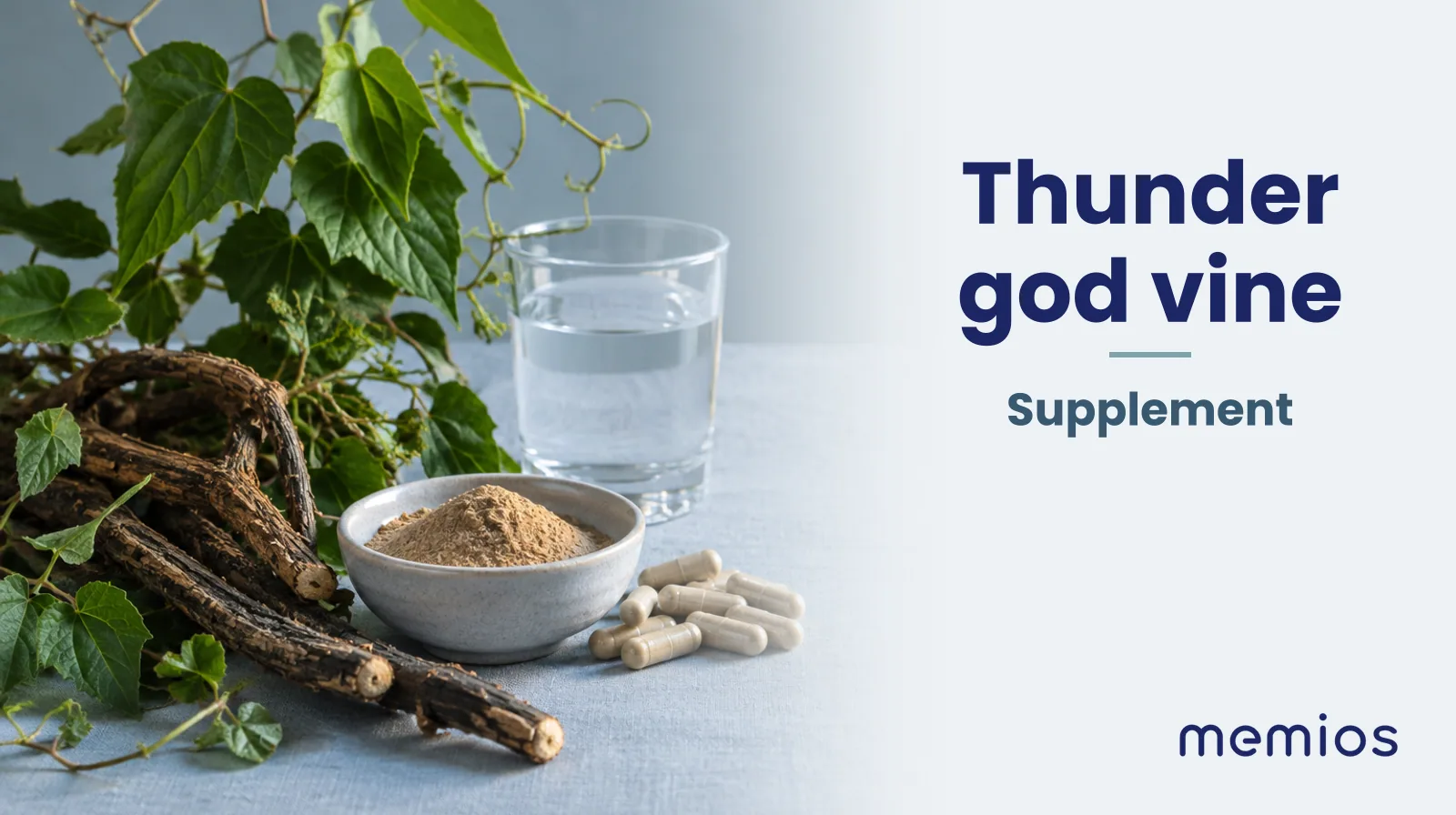
Thunder god vine is a plant used in traditional Chinese medicine; the UK medicines regulator describes lei gong teng (Tripterygium wilfordii) as also known as Thunder God Vine or Seven-step vine. It is sold as a dried herb for tea or in tablet form. One of its components, triptolide, is considered potentially toxic in people.
What the research says
The strongest evidence is for rheumatoid arthritis. An overview of 27 systematic reviews found moderate-quality evidence that it may be clinically effective, but rated every one of those reviews as low or critically low in method. An open-label trial found it not inferior to methotrexate. The harms are substantial and well documented: a meta-analysis of 23,256 users put the overall adverse event rate at 26.7%, irregular menstruation is more than four times as likely, kidney and liver damage and rare deaths have been reported, and it is considered unsafe in pregnancy. The UK regulator advised consumers not to use unlicensed products containing it.
Evidence grade: Limited evidence.
What goes wrong
A systematic review and meta-analysis of 594 studies found that more than a quarter of people taking thunder god vine had an adverse event. (Source 1)
- Meta-analysis, Low certainty.
- Size: 23,256 users across 594 studies.
- Who: Patients taking TwHF for inflammatory diseases.
- How long: Varied.
- Result: Overall adverse events 26.7% (95% CI 24.8% to 28.8%); gastrointestinal 13.3%; adverse reproductive outcomes 11.7%.
- Funding: not stated.
The overall incidence of AEs was 26.7% (95% CI 24.8%, 28.8%) in 23,256 TwHF users.
Irregular menstruation was more than four times as likely with thunder god vine than with control treatments. (Source 1)
- Meta-analysis, Low certainty.
- Size: Subset of 594 studies.
- Who: Patients taking TwHF compared with controls.
- How long: Varied.
- Result: OR 4.65, 95% CI 3.08 to 7.03.
- Funding: not stated.
The prevalence of irregular menstruation (IM) was increased in patients taking TwHF compared with those given control (odds ratio [OR] 4.65, 95% CI 3.08 to 7.03).
In the methotrexate comparison trial, seven women on thunder god vine alone developed irregular menstruation, against three on methotrexate; the difference was not statistically significant. (Source 2)
- Randomized trial, Low certainty.
- Size: 207 patients.
- Who: Adults with active rheumatoid arthritis.
- How long: 24 weeks.
- Result: Irregular menstruation: 7 TwHF, 3 methotrexate, 5 combination (p=0.216)
- Funding: not stated.
Seven, three and five women in the TwHF, MTX and combination groups, respectively, developed irregular menstruation (TwHF vs MTX monotherapy, p=0.216).
NCCIH (April 2025) lists kidney damage, liver problems and rare deaths among the serious reported harms. (Source 3)
- Official position, Certainty not rated.
- Size: Not applicable.
- Who: General.
- How long: Not applicable.
- Result: Not applicable.
- Funding: independent (US government)
Serious side effects may include kidney damage and liver problems, among others. Rare deaths have been reported; these may be related to specific preparations of thunder god vine or high doses of the herb.
NCCIH (April 2025) states that use during pregnancy is considered unsafe because of a possible risk of birth defects. (Source 3)
- Official position, Certainty not rated.
- Size: Not applicable.
- Who: Pregnant women.
- How long: Not applicable.
- Result: Not applicable.
- Funding: independent (US government)
The use of thunder god vine during pregnancy is considered unsafe, as it may increase the risk of birth defects.
A 50-year-old woman with end-stage kidney disease developed severe bone marrow suppression after a short course of a normal dose of a thunder god vine decoction and died of sepsis. (Source 4)
- Case report, Very low certainty.
- Size: 1 patient.
- Who: Adult woman with end-stage renal disease.
- How long: Short-term.
- Result: Severe myelosuppression, sepsis, septic shock, death.
- Funding: not stated.
Herein, we report the case of a 50-year-old Chinese female with end-stage renal disease (ESRD) who developed severe bone marrow suppression after taking a short-term normal dose of a T. wilfordii-containing decoction.
The UK Medicines and Healthcare products Regulatory Agency (article August 2011) advised consumers not to use unlicensed products containing thunder god vine. (Source 5)
- Official position, Certainty not rated.
- Size: Based on a Yellow Card report.
- Who: UK consumers.
- How long: Not applicable.
- Result: Not applicable.
- Funding: independent (UK government)
because of concerns about serious side effects on fertility and on the liver, kidneys, immune system, blood, and heart.
A review of preclinical (mainly animal) pharmacokinetic studies notes that triptolide is handled by P-glycoprotein and CYP3A4, so interactions with drugs that use or block those pathways are possible; in the studies it reviewed, grapefruit juice raised triptolide levels, a result not shown in people. (Source 6)
- Expert review, not systematic, Very low certainty.
- Size: Preclinical literature 2000 to 2018.
- Who: Preclinical studies, mainly in animals.
- How long: Not applicable.
- Result: Grapefruit juice increased AUC by 153% and Cmax by 141%.
- Funding: not stated.
Limit of this finding: The grapefruit juice figures (153% higher total exposure and 141% higher peak level) come from a review whose title and scope are preclinical, meaning mostly animal studies; the review abstract does not say they were measured in people. Treat them as a warning sign worth mentioning to a doctor or pharmacist, not as a measured effect in humans.
As a substrate of P-glycoprotein (P-gp) and CYP3A4, triptolide could have clinically significant pharmacokinetic interactions with those proteins substrates/inhibitors.
What the evidence supports
An overview of 27 systematic reviews concluded that thunder god vine preparations may be clinically effective for rheumatoid arthritis, based on moderate-quality evidence. (Source 7)
- Review of reviews, Moderate certainty.
- Size: 27 systematic reviews covering 385 studies and 33,888 participants.
- Who: Patients with rheumatoid arthritis.
- How long: Varied across included reviews.
- Result: GRADE: moderate quality of evidence for 5 outcomes and low quality for 5 outcomes.
- Funding: not stated.
The use of TwHF preparations for the treatment of RA may be clinically effective according to the moderate-quality evidence.
In a randomised trial against methotrexate, more patients on thunder god vine reached an ACR50 response at 24 weeks, and the combination did best. (Source 2)
- Randomized trial, Low certainty.
- Size: 207 patients.
- Who: Adults with active rheumatoid arthritis in China.
- How long: 24 weeks.
- Result: ACR50: 46.4% methotrexate, 55.1% TwHF (p=0.014 vs methotrexate), 76.8% combination (p<0.001 vs methotrexate)
- Funding: not stated; open-label design with blinded assessors.
Limit of this finding: This trial was open-label: patients and doctors knew which treatment was given, although the people scoring the outcomes did not. Patients on either single treatment whose disease had not improved enough by week 12 were switched to the combination, and the week-24 results count patients in the group they were first assigned to. The result shows thunder god vine extract did at least as well as methotrexate in this one Chinese trial; it does not show it is safer or better in general.
the proportion of patients reaching the ACR50 response criteria was 46.4% (32/69), 55.1% (38/69) and 76.8% (53/69), respectively, in the MTX, TwHF and MTX+TwHF groups
What the evidence does not support
In the same trial, quality-of-life and function scores improved in every arm but did not differ between thunder god vine, methotrexate and the combination. (Source 2)
- Randomized trial, Low certainty.
- Size: 207 patients.
- Who: Adults with active rheumatoid arthritis.
- How long: 24 weeks.
- Result: Health Assessment Questionnaire and SF-36: no significant difference among arms (p>0.05)
- Funding: not stated.
though no significant difference was found among the treatment arms (p>0.05)
The US National Center for Complementary and Integrative Health (April 2025) states that a combination of conventional therapies might outperform thunder god vine added to a conventional therapy. (Source 8)
- Official position, Certainty not rated.
- Size: Not applicable.
- Who: People with rheumatoid arthritis.
- How long: Not applicable.
- Result: Not applicable.
- Funding: independent (US government)
However, a combination of conventional therapies might also be more effective than thunder god vine plus a conventional therapy.
Where the evidence is mixed
The same overview judged all 27 underlying systematic reviews to be of low or critically low methodological quality. (Source 9)
- Review of reviews, Low certainty.
- Size: 27 systematic reviews.
- Who: Patients with rheumatoid arthritis.
- How long: Not applicable.
- Result: AMSTAR-2: 19 critically low, 8 low.
- Funding: not stated.
The AMSTAR-2 showed that 19 SRs had critically low methodological quality and the remaining 8 had low methodological quality.
Where the research disagrees
Whether thunder god vine should be used for rheumatoid arthritis
- Authors of a 2022 overview of 27 systematic reviews, umbrella review of mostly Chinese trials: "The use of TwHF preparations for the treatment of RA may be clinically effective according to the moderate-quality evidence." (Source 7)
- UK MHRA, 2011, regulatory position based on a Yellow Card report: "because of concerns about serious side effects on fertility and on the liver, kidneys, immune system, blood, and heart." (Source 5)
How much
- Reference intake: No reference intake exists. Thunder god vine is not a nutrient; NCCIH describes it as a herb with safety concerns and no government body sets a recommended intake. (Source 8)
- Upper limit: No upper limit has been set. The UK MHRA (2011) advised consumers not to use unlicensed products containing it at all. (Source 5)
- Studied: The TRIFRA trial gave TwHF 20 mg three times a day for 24 weeks, alone or with methotrexate 12.5 mg once a week. (Source 10)
A common belief, and what the research shows
The belief: Because it is a traditional herbal remedy, thunder god vine is a gentle alternative to prescription arthritis drugs.
What the research shows: A meta-analysis of 23,256 users found "The overall incidence of AEs was 26.7% (95% CI 24.8%, 28.8%) in 23,256 TwHF users." NCCIH adds that "Rare deaths have been reported; these may be related to specific preparations of thunder god vine or high doses of the herb."
Questions and answers
What is it?
Thunder god vine (Tripterygium wilfordii), known in Chinese as lei gong teng, is a plant used in traditional Chinese medicine. It is sold as a dried herb for tea or as tablets, mainly promoted for rheumatoid arthritis, other autoimmune diseases and psoriasis. (Source 5)
What does it do in the body?
Studies suggest it may reduce some rheumatoid arthritis symptoms, which is thought to relate to its effects on inflammation and the immune system. Early reports also point to possible help in some kidney disorders, but evidence for other conditions is insufficient. (Source 8)
Is it good or bad for you?
Both. There is moderate-quality evidence of benefit in rheumatoid arthritis, but more than one in four users in a large meta-analysis had an adverse event, including menstrual changes, digestive problems and blood count changes. Kidney and liver damage and rare deaths have been reported, and it is considered unsafe in pregnancy. (Source 1)
How do you get more of it?
It is only taken in as a herbal product. It is sold as a dried herb for tea or in tablet form; the TRIFRA trial gave an extract at 20 mg three times a day under medical supervision. The UK regulator advised consumers not to use unlicensed products containing it. (Source 5)
If it is harmful, what reduces it?
The body does not make it, so it is only present if someone takes it. A case report of fatal bone marrow suppression advises blood and biochemical testing during use and stopping promptly if anything abnormal appears. (Source 4)
Why might someone be low in it or missing it?
Does not apply. Thunder god vine is not a nutrient or a normal part of the body, so no one is deficient in it. (Source 8)
We searched: NCCIH fact sheet, UK MHRA drug safety update, 2022 overview of systematic reviews and 2016 safety meta-analysis; none describe a deficiency state
Which whole foods contain it or feed it?
No whole foods contain thunder god vine. It is a medicinal plant, not a food. (Source 5)
We searched: NCCIH fact sheet and MHRA drug safety update; neither lists any dietary source
What happens if you do not have it?
Nothing is known to go wrong from not taking it. It is not an essential nutrient, and no source we read describes any effect of its absence. (Source 8)
We searched: NCCIH fact sheet and the 2022 overview of systematic reviews
How can you test for it?
There is no routine test for thunder god vine levels. What the literature recommends is monitoring for harm: routine blood counts and biochemical (liver and kidney) tests during use. (Source 4)
References
- Frontiers in Pharmacology. Safety Profiles of Tripterygium wilfordii Hook F: A Systematic Review and Meta-Analysis. 2016. PMID 27877128, DOI 10.3389/fphar.2016.00402. Read the source
- Annals of the Rheumatic Diseases. Comparison of Tripterygium wilfordii Hook F with methotrexate in the treatment of active rheumatoid arthritis (TRIFRA): a randomised, controlled clinical trial. 2015. PMID 24733191, DOI 10.1136/annrheumdis-2013-204807. Read the source
- National Center for Complementary and Integrative Health (NIH). Thunder God Vine: Usefulness and Safety. 2025. Read the source
- Frontiers in Medicine. Case report: A rare case of death due to end-stage renal disease caused by Tripterygium wilfordii-induced myelosuppression. 2022. PMID 36530889, DOI 10.3389/fmed.2022.1036422. Read the source
- UK Medicines and Healthcare products Regulatory Agency, Drug Safety Update vol 5 issue 1. Traditional Chinese medicines containing lei gong teng (tripterygium wilfordii). 2011. Read the source
- Current Drug Metabolism. Preclinical Pharmacokinetics of Triptolide: A Potential Antitumor Drug. 2019. PMID 30112986, DOI 10.2174/1389200219666180816141506. Read the source
- Evidence-based Complementary and Alternative Medicine. Tripterygium wilfordii Hook. f. Preparations for Rheumatoid Arthritis: An Overview of Systematic Reviews. 2022. PMID 35463070, DOI 10.1155/2022/3151936. Read the source
- National Center for Complementary and Integrative Health (NIH). Thunder God Vine: Usefulness and Safety. 2025. Read the source
- Evidence-based Complementary and Alternative Medicine. Tripterygium wilfordii Hook. f. Preparations for Rheumatoid Arthritis: An Overview of Systematic Reviews. 2022. PMID 35463070, DOI 10.1155/2022/3151936. Read the source
- Annals of the Rheumatic Diseases. Comparison of Tripterygium wilfordii Hook F with methotrexate in the treatment of active rheumatoid arthritis (TRIFRA): a randomised, controlled clinical trial. 2015. PMID 24733191, DOI 10.1136/annrheumdis-2013-204807. Read the source