Supplements · September 29, 2026 · Memios · 8 min read
Thiamin
Thiamin is essential, and deficiency causes beriberi and Wernicke-Korsakoff syndrome, especially in heavy drinkers and after bariatric surgery.
TLDR
- Limited evidence. Thiamin is essential, and deficiency causes beriberi and Wernicke-Korsakoff syndrome, especially in heavy drinkers and after bariatric surgery.
- What it is: Thiamin is a water-soluble B vitamin, also called vitamin B1.
- Main use, supported: A 2013 meta-analysis of two small double-blind trials found thiamine improved left ventricular ejection fraction in systolic heart failure; the authors said more trials are needed. (low certainty)
- Other use, supported: The same meta-analysis found thiamine was associated with less need for kidney replacement therapy; the authors describe only a potential role in organ dysfunction.
- Claim NOT supported by research: A Cochrane systematic review found randomised trial evidence insufficient to guide the dose, frequency, route or duration of thiamine for Wernicke-Korsakoff syndrome in people who misuse alcohol. (low certainty)
- Another claim NOT supported: A 2026 meta-analysis of nine randomised trials found thiamine did not reduce short-term mortality in sepsis and septic shock.
- Recommended dose (official position): RDA 1.2 mg/day for adult men and 1.1 mg/day for adult women (US Food and Nutrition Board, as reported by NIH ODS 2023).
- Studied dose (a trial dose, not a recommendation): Cochrane-included trial compared five intramuscular doses, including 5 mg/day and 200 mg/day. Findings citing that trial: 1 against, 2 mixed.
- Upper limit: No UL set by the US Food and Nutrition Board, because adverse effects from high intakes (50 mg/day or more) from food or supplements have not been reported (NIH ODS 2023).
- What goes wrong: 4 findings on harm. In a hospital safety review of 500 mg intravenous push thiamine, injection-site reactions occurred with under 1% of doses and no anaphylaxis was seen.
- Common myth: Extra thiamine helps people survive sepsis.
What it is
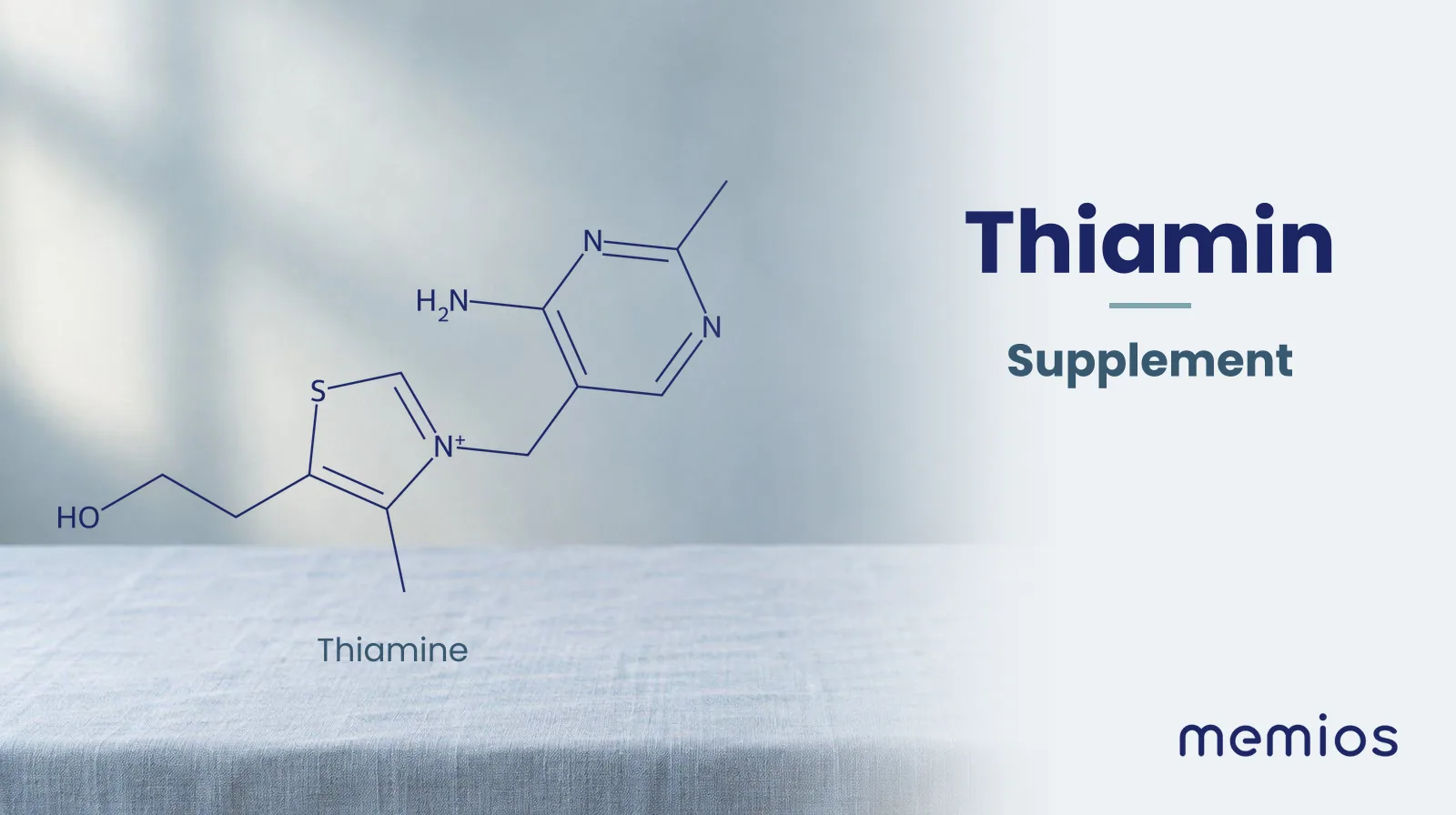
Thiamin is a water-soluble B vitamin, also called vitamin B1. Most of the body's roughly 25-30 mg is stored as thiamin diphosphate, its active form, which is a co-factor for enzymes in glucose, amino acid and fat metabolism.
What the research says
Thiamin is essential, and deficiency causes beriberi and Wernicke-Korsakoff syndrome, especially in heavy drinkers and after bariatric surgery. Beyond treating deficiency, trial evidence is thin: a Cochrane review found trials insufficient to guide thiamine dosing for Wernicke-Korsakoff syndrome, a 2026 meta-analysis found no reduction in short-term mortality in sepsis, and a heart failure benefit rests on two small trials. Oral thiamin has no upper limit; intravenous thiamin carries a small rate of injection-site reactions.
Evidence grade: Limited evidence.
What goes wrong
In a hospital safety review of 500 mg intravenous push thiamine, injection-site reactions occurred with under 1% of doses and no anaphylaxis was seen. (Source 1)
- Cohort study, Low certainty.
- Size: 463 doses in 69 patients.
- Who: Hospital inpatients at one US academic centre.
- How long: Not stated.
- Result: 4 injection-site reactions (0.86%); 0 anaphylactic reactions.
- Funding: Not stated.
A total of 4 injection site reactions (0.86%) were noted with 4 unique doses.
Position (NIH ODS, updated 2023): the diuretic furosemide has been linked to falling thiamin levels, possibly to deficiency, through urinary loss. (Source 2)
- Official position, Certainty not rated.
- Size: Not stated.
- Who: People taking furosemide.
- How long: Not applicable.
- Result: Not quantified.
- Funding: Government.
Research has linked the use of furosemide to decreases in thiamin concentrations, possibly to deficient levels, as a result of urinary thiamin loss.
Position (NIH ODS, updated 2023): case reports describe beriberi or Wernicke's encephalopathy during fluorouracil chemotherapy. (Source 2)
- Official position, Certainty not rated.
- Size: Several case reports.
- Who: People receiving fluorouracil.
- How long: Not applicable.
- Result: Not quantified.
- Funding: Government.
The published literature includes several cases of beriberi or Wernicke's encephalopathy resulting from treatment with this drug, possibly because the drug might increase thiamin metabolism
Position (NIH ODS, updated 2023): bariatric surgery can cause severe thiamin deficiency through malabsorption, leading to beriberi or Wernicke's encephalopathy. (Source 2)
- Official position, Certainty not rated.
- Size: Not stated.
- Who: People after bariatric surgery.
- How long: Not applicable.
- Result: Not quantified.
- Funding: Government.
Bariatric surgery for weight loss is associated with some risks, including severe thiamin deficiency due to malabsorption
What the evidence supports
The same meta-analysis found thiamine was associated with less need for kidney replacement therapy; the authors describe only a potential role in organ dysfunction. (Source 3)
- Meta-analysis, Certainty not rated.
- Size: 520 patients across 9 trials.
- Who: Adults with sepsis or septic shock.
- How long: Short-term.
- Result: Renal replacement therapy OR 0.26, p = 0.0007.
- Funding: Not stated.
Patients in the thiamine group were significantly associated with decreased proportion of Renal Replacement Therapy
A 2013 meta-analysis of two small double-blind trials found thiamine improved left ventricular ejection fraction in systolic heart failure; the authors said more trials are needed. (Source 4)
- Meta-analysis, Low certainty.
- Size: 38 participants across 2 trials.
- Who: Adults with systolic heart failure.
- How long: Not stated.
- Result: Net LVEF change 3.28% (95% CI 0.64% to 5.93%)
- Funding: Not stated.
Compared with placebo (2 trials, n=38), thiamine supplementation resulted in a significantly improved net change in left ventricular ejection fraction (LVEF)
What the evidence does not support
A Cochrane systematic review found randomised trial evidence insufficient to guide the dose, frequency, route or duration of thiamine for Wernicke-Korsakoff syndrome in people who misuse alcohol. (Source 5)
- Systematic review, Low certainty.
- Size: 2 trials; only 1 (n = 107) analysable.
- Who: People who misuse alcohol.
- How long: Not stated.
- Result: No pooled estimate possible.
- Funding: Not stated.
Evidence from randomised controlled clinical trials is insufficient to guide clinicians in determining the dose, frequency, route or duration of thiamine treatment
A 2026 meta-analysis of nine randomised trials found thiamine did not reduce short-term mortality in sepsis and septic shock. (Source 3)
- Meta-analysis, Certainty not rated.
- Size: 520 patients across 9 trials.
- Who: Adults with sepsis or septic shock.
- How long: Short-term.
- Result: Short-term mortality OR 0.78, p = 0.18 (not significant)
- Funding: Not stated.
No significant benefit of thiamine in reducing short-term mortality was observed.
Where the evidence is mixed
In the one analysable trial in that Cochrane review, 200 mg/day intramuscular thiamine outperformed 5 mg/day on one memory test, but the study had methodological shortcomings. (Source 5)
- Randomized trial, Low certainty.
- Size: 107 participants.
- Who: People who misuse alcohol.
- How long: Not stated.
- Result: Significant difference favouring 200 mg/day vs 5 mg/day on a delayed alternation test.
- Funding: Not stated.
A significant difference favoured 200 mg/day compared with the 5-mg/day dose in determining the number of trials needed to meet inclusion criteria on a delayed alternation test
The Cochrane authors flagged design and reporting flaws in that trial. (Source 5)
- Systematic review, Low certainty.
- Size: 107 participants.
- Who: People who misuse alcohol.
- How long: Not stated.
- Result: Not applicable.
- Funding: Not stated.
The study had methodological shortcomings in design and in the presentation of results that limited further analysis.
In an exploratory subgroup of thiamine-deficient patients, mortality appeared lower with thiamine, but this rests on 2 studies and 51 patients. (Source 3)
- Meta-analysis, Very low certainty.
- Size: 51 patients across 2 trials.
- Who: Thiamine-deficient patients with sepsis.
- How long: Short-term.
- Result: OR 0.18, p = 0.01 (exploratory)
- Funding: Not stated.
In the thiamine-deficient subgroup (2 studies, 51 patients), exploratory analysis indicated a potential short-term mortality reduction with thiamine
Position (NIH ODS, updated 2023): only small studies suggest 150-300 mg/day oral thiamin lowers glucose in type 2 diabetes or impaired glucose tolerance. (Source 2)
- Official position, Certainty not rated.
- Size: Small studies.
- Who: People with type 2 diabetes or impaired glucose tolerance.
- How long: Not stated.
- Result: Not quantified.
- Funding: Government.
Some small studies have shown that oral supplementation with 150–300 mg/day thiamin can decrease glucose levels
How much
- Reference intake: RDA 1.2 mg/day for adult men and 1.1 mg/day for adult women (US Food and Nutrition Board, as reported by NIH ODS 2023). (Source 2)
- Upper limit: No UL set by the US Food and Nutrition Board, because adverse effects from high intakes (50 mg/day or more) from food or supplements have not been reported (NIH ODS 2023). (Source 2)
- Studied: Cochrane-included trial compared five intramuscular doses, including 5 mg/day and 200 mg/day. (Source 5)
- Studied: Hospital safety study gave 500 mg intravenous push thiamine. (Source 1)
A common belief, and what the research shows
The belief: Extra thiamine helps people survive sepsis.
What the research shows: A 2026 meta-analysis of 9 trials (520 patients) concluded "No significant benefit of thiamine in reducing short-term mortality was observed."
Questions and answers
What is it?
Thiamin (also spelled thiamine) is vitamin B1, a water-soluble B vitamin. Most of it in the body is stored as thiamin diphosphate, the active form. (Source 2)
What does it do in the body?
Its active form is a co-factor for five enzymes used to process glucose, amino acids and fats, so it is central to energy metabolism. (Source 2)
Is it good or bad for you?
Thiamin is essential, and high oral intakes have no reported adverse effects. Whether extra thiamin helps people who are not deficient is less clear: in sepsis, trials found no mortality benefit. (Source 2)
How do you get more of it?
Thiamin comes from whole grains, meat (especially pork) and fish, and from fortified breads and cereals and supplements. Cooking and discarding cooking water can reduce thiamin content. (Source 2)
If it is harmful, what reduces it?
Does not apply. Thiamin is not considered harmful at high oral intakes; the body excretes excess in urine. (Source 2)
Why might someone be low in it or missing it?
Heavy alcohol use reduces absorption, and up to 80% of people with chronic alcoholism develop deficiency. Bariatric surgery, older age, diabetes, HIV, and drugs such as furosemide also raise risk. (Source 2)
Which whole foods contain it or feed it?
Whole grains, meat and fish; in the US diet, cereals and bread (often fortified) and pork are the main sources. (Source 2)
What happens if you do not have it?
Deficiency causes beriberi, mainly nerve damage and muscle wasting, and in severe cases Wernicke-Korsakoff syndrome with confusion and serious memory loss. (Source 2)
How can you test for it?
Status is usually assessed indirectly with the red-cell transketolase activity test or urinary thiamin excretion. Urinary tests reflect recent intake, not stores, and blood thiamin levels are not considered reliable indicators. (Source 2)
References
- Science Progress. Evaluation of the safety of 500 mg intravenous push thiamine at a tertiary academic medical center. 2022. DOI 10.1177/00368504221096539. Read the source
- NIH Office of Dietary Supplements. Thiamin: Fact Sheet for Health Professionals. 2023. Read the source
- Clinics. Efficacy of thiamine (vitamin B1) in sepsis and septic shock: A meta-analysis of randomized controlled trials. 2026. PMID 41863966, DOI 10.1016/j.clinsp.2026.100901. Read the source
- Ochsner Journal. Effects of Thiamine on Cardiac Function in Patients With Systolic Heart Failure: Systematic Review and Metaanalysis of Randomized, Double-Blind, Placebo-Controlled Trials. 2013. PMID 24357996. Read the source
- Cochrane Database of Systematic Reviews. Thiamine for prevention and treatment of Wernicke-Korsakoff Syndrome in people who abuse alcohol. 2013. PMID 23818100, DOI 10.1002/14651858.CD004033.pub3. Read the source