Supplements · September 30, 2026 · Memios · 15 min read
St John's wort
The evidence base is unusually large for a botanical: two systematic reviews covering roughly 29 to 35 randomised trials and 5,000 to 7,000 patients found that standardised hypericum extracts beat placebo for mild to moderate major depression and performed about the same as standard antidepressants, with fewer dropouts for side effects.
TLDR
- Disputed. The evidence base is unusually large for a botanical: two systematic reviews covering roughly 29 to 35 randomised trials and 5,000 to 7,000 patients found that standardised hypericum extracts beat placebo for mild to moderate major depression and performed about the same as standard antidepressants.
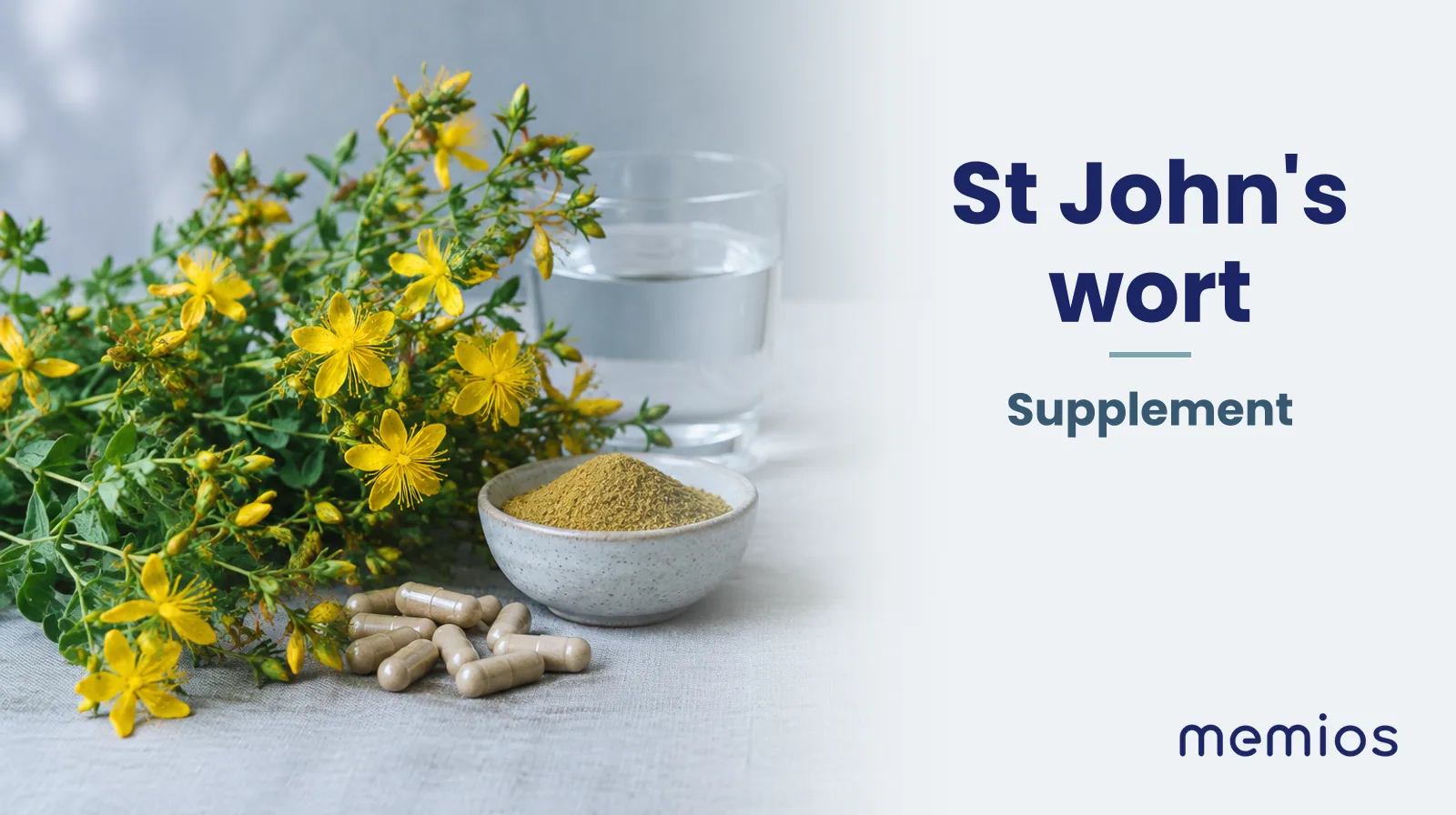
- What it is: St John's wort is an extract made from the flowers and leaves of Hypericum perforatum, a yellow-flowering perennial herb native to Europe that has spread widely and is an invasive weed in some countries.
- Main use, supported: A systematic review with GRADE ratings found St John's wort produced more treatment responders than placebo in major depressive disorder, at moderate quality of evidence. (moderate certainty)
- Other use, supported: Fewer people dropped out of trials because of side effects on St John's wort than on standard antidepressants. (moderate certainty)
- Claim NOT supported by research: St John's wort was not more effective than standard antidepressants, including SSRIs, in head-to-head trials. (moderate certainty)
- Another claim NOT supported: The evidence for severe depression is missing, and heterogeneity between trials lowers confidence in the pooled benefit. (moderate certainty)
- Recommended dose: not established. No reference intake (RDA or AI) exists. St John's wort is a herbal extract used as a treatment, not an essential nutrient, so no dietary requirement has been set by any body.
- Studied dose (a trial dose, not a recommendation): Eight of the 35 studies in the 2016 systematic review used a hypericum extract standardised to 0.3% hypericin and 1-4% hyperforin. Findings citing that trial: 1 for, 1 against.
- Upper limit: No tolerable upper intake level or ADI has been set.
- What goes wrong: 5 findings on harm. St John's wort lowers blood levels of many prescription medicines, and published cases include transplant rejection, contraceptive failure and serotonin syndrome.
- Common myth: Because it is a plant, St John's wort is a gentler and safer alternative to prescription antidepressants.
What it is
St John's wort is an extract made from the flowers and leaves of Hypericum perforatum, a yellow-flowering perennial herb native to Europe that has spread widely and is an invasive weed in some countries. Its extracts contain flavonoids, phenolic acids, naphthodianthrones such as hypericin, and phloroglucinols such as hyperforin. Which of these is responsible for any antidepressant effect is not established. It is sold over the counter in the United States and prescribed as a medicine in some other countries.
What the research says
The evidence base is unusually large for a botanical: two systematic reviews covering roughly 29 to 35 randomised trials and 5,000 to 7,000 patients found that standardised hypericum extracts beat placebo for mild to moderate major depression and performed about the same as standard antidepressants, with fewer dropouts for side effects. Both reviews are explicit that the picture is complicated by heterogeneity, by trials from German-speaking countries reporting larger benefits, and by smaller trials reporting larger benefits than large ones. There is little evidence for severe depression, for use beyond about 12 weeks, or for the many other conditions it has been tried in. Its most consequential property is not its antidepressant effect at all: it is a potent inducer of CYP3A4 and P-glycoprotein, and it lowers blood levels of a long list of prescription medicines, with reported consequences including transplant rejection, unplanned pregnancy and serotonin syndrome.
Evidence grade: Disputed.
What goes wrong
St John's wort lowers blood levels of many prescription medicines, and published cases include transplant rejection, contraceptive failure and serotonin syndrome. (Source 1)
- Expert review, not systematic, Moderate certainty.
- Size: Not quantified; a literature review of human pharmacokinetic studies and case reports to September 2003.
- Who: Healthy volunteers and patients taking interacting medicines.
- How long: Varies by study.
- Result: Decreased blood concentrations of amitriptyline, cyclosporine, digoxin, fexofenadine, indinavir, methadone, midazolam, nevirapine, phenprocoumon, simvastatin, tacrolimus, theophylline and warfarin; no change for carbamazepine, dextromethorphan, mycophenolic acid, pravastatin.
- Funding: not stated.
Several cases have been reported that St John's wort decreased cyclosporine blood concentration leading to organ rejection. St John's wort caused breakthrough bleeding and unplanned pregnancies when used concomitantly with oral contraceptives.
A single reported case links one cup of a St John's wort tea plus two doses of citalopram to serotonin syndrome requiring hospitalisation. (Source 2)
- Case report, Very low certainty.
- Size: 1 patient.
- Who: A patient starting low-dose citalopram the day after drinking a St John's wort tea.
- How long: Symptoms after two doses of citalopram.
- Result: Moderate serotonin syndrome resulting in hospitalisation; the tea was labelled 820 mg of St John's wort per tea bag.
- Funding: New Zealand government agency report (Medsafe/CARM), March 2012.
The report received by the Centre for Adverse Reactions Monitoring (CARM) describes a patient who was started on low dose citalopram one day after ingesting "Be Happy" tea. After just two doses of citalopram, the patient developed symptoms consistent with moderate serotonin syndrome.
NIH's complementary health centre reports that large oral doses or skin application can cause severe skin reactions after sun exposure, alongside other side effects. (Source 3)
- Official position, Certainty not rated.
- Size: Not quantified.
- Who: Adults taking St John's wort.
- How long: Safety described as established for up to 12 weeks, with some studies out to a year or more.
- Result: No rates given.
- Funding: US government agency (NCCIH), page dated May 2025.
If taken orally in large doses or applied to the skin, St. John's wort might cause severe skin reactions after sun exposure. Other side effects can include diarrhea, dizziness, trouble sleeping, restlessness, and skin tingling.
NIH's complementary health centre warns that St. John's wort can weaken the effects of many medicines, including crucially important ones, and that anyone on any medicine should speak to a health professional before taking it. (Source 3)
- Official position, Certainty not rated.
- Size: Not applicable; agency safety page.
- Who: Anyone taking prescription medicines.
- How long: Not applicable.
- Result: No effect size given; the page lists the affected drug classes as bullet points.
- Funding: independent (US federal agency)
If you take any type of medicine, talk with your health care provider before using St. John's wort or other herbal products; some herbs and medicines interact in harmful ways. For example, St. John's wort can weaken the effects of many medicines, including crucially important medicines such as:
The same agency page warns that taking St. John's wort alongside certain antidepressants or other drugs that act on serotonin may cause increased serotonin-related side effects that can be serious. (Source 3)
- Official position, Certainty not rated.
- Size: Not applicable; agency safety page.
- Who: Anyone taking prescription medicines.
- How long: Not applicable.
- Result: No effect size given.
- Funding: independent (US federal agency)
In addition, taking St. John's wort with certain antidepressants or other drugs that affect serotonin (a substance produced by some nerve cells) may lead to increased serotonin-related side effects, which can be serious.
What the evidence supports
A systematic review with GRADE ratings found St John's wort produced more treatment responders than placebo in major depressive disorder, at moderate quality of evidence. (Source 4)
- Systematic review, Moderate certainty.
- Size: 6,993 patients across 35 studies (18 RCTs, N = 2922, in the placebo response analysis)
- Who: Adults with major depressive disorder, mostly mild to moderate.
- How long: At least 4 weeks of administration per inclusion criteria.
- Result: Responders vs placebo RR 1.53 (95% CI 1.19, 1.97), I2 79%; SMD 0.49 (CI 0.23, 0.74), I2 89%.
- Funding: not stated.
The herb SJW was associated with more treatment responders than placebo (relative risk [RR] 1.53; 95 % confidence interval [CI] 1.19, 1.97; I2 79 %; 18 RCTs; N = 2922, moderate QoE; standardized mean differences [SMD] 0.49; CI 0.23, 0.74; 16 RCTs; I2 89 %, N = 2888, moderate QoE).
Fewer people dropped out of trials because of side effects on St John's wort than on standard antidepressants. (Source 5)
- Systematic review, Moderate certainty.
- Size: 29 trials, 5,489 patients.
- Who: Patients with major depression in head-to-head trials.
- How long: Not stated in the abstract.
- Result: Dropout due to adverse effects OR 0.24 (95% CI 0.13 to 0.46) vs older antidepressants; OR 0.53 (95% CI 0.34-0.83) vs SSRIs.
- Funding: not stated.
Patients given hypericum extracts dropped out of trials due to adverse effects less frequently than those given older antidepressants (odds ratio (OR) 0.24; 95% CI, 0.13 to 0.46) or SSRIs (OR 0.53, 95% CI, 0.34-0.83).
What the evidence does not support
St John's wort was not more effective than standard antidepressants, including SSRIs, in head-to-head trials. (Source 5)
- Systematic review, Moderate certainty.
- Size: 17 comparisons with standard antidepressants within 29 trials (5,489 patients)
- Who: Patients with major depression.
- How long: Not stated in the abstract.
- Result: RR 1.02 (95% CI 0.90 to 1.15; 5 trials) vs tri-/tetracyclics and RR 1.00 (95% CI 0.90 to 1.11; 12 trials) vs SSRIs.
- Funding: not stated.
Compared with tri- or tetracyclic antidepressants and selective serotonin reuptake inhibitors (SSRIs), respectively, RRs were 1.02 (95% CI, 0.90 to 1.15; 5 trials) and 1.00 (95% CI, 0.90 to 1.11; 12 trials).
Trial results depended on where the trial was run, with German-speaking countries reporting more favourable findings, which the reviewers said complicates interpretation. (Source 5)
- Systematic review, Low certainty.
- Size: 29 trials, 5,489 patients.
- Who: Patients with major depression.
- How long: Not stated in the abstract.
- Result: No pooled number given; the reviewers report the association of country of origin and precision with effect sizes.
- Funding: not stated.
Both in placebo-controlled trials and in comparisons with standard antidepressants, trials from German-speaking countries reported findings more favourable to hypericum.
The evidence for severe depression is missing, and heterogeneity between trials lowers confidence in the pooled benefit. (Source 4)
- Systematic review, Moderate certainty.
- Size: 35 studies, 6,993 patients.
- Who: Adults with major depressive disorder.
- How long: 4 weeks or longer.
- Result: No estimate for severe depression could be produced.
- Funding: not stated.
However, evidence of heterogeneity and a lack of research on severe depression reduce the quality of the evidence.
For conditions other than depression, NIH's complementary health centre states the research is small in quantity and has not clearly shown benefit. (Source 3)
- Official position, Certainty not rated.
- Size: Not quantified.
- Who: People with ADHD, irritable bowel syndrome, obsessive compulsive disorder, premenstrual syndrome, and others.
- How long: Not stated.
- Result: No effect estimates given.
- Funding: US government agency (NCCIH), page dated May 2025.
However, only a small amount of research has been done on the use of St. John's wort for each of these purposes, and the evidence hasn't clearly shown it to be helpful for any of them.
Unlike several other popular botanicals, St John's wort has not been convincingly linked to liver injury. (Source 6)
- Expert review, not systematic, Low certainty.
- Size: Not quantified; a summary of controlled trials and published case reports.
- Who: People taking St John's wort.
- How long: Not stated.
- Result: LiverTox likelihood score E (unlikely cause of clinically apparent liver injury)
- Funding: US government agency resource (NIDDK/NIH)
Despite wide spread use, there have been no convincing case reports linking use of St. John's wort and hepatotoxicity.
Where the evidence is mixed
The Cochrane review found hypericum superior to placebo, but the effect was much larger in small trials than in large ones, a pattern consistent with small-study bias. (Source 5)
- Systematic review, Low certainty.
- Size: 5,489 patients across 29 trials.
- Who: Patients with major depression.
- How long: Not stated in the abstract.
- Result: Nine larger trials RR 1.28 (95% CI 1.10 to 1.49); nine smaller trials RR 1.87 (95% CI 1.22 to 2.87)
- Funding: not stated.
In nine larger trials the combined response rate ratio (RR) for hypericum extracts compared with placebo was 1.28 (95% confidence interval (CI), 1.10 to 1.49) and from nine smaller trials was 1.87 (95% CI, 1.22 to 2.87).
A narrative review of the benefit-harm balance concluded that better tolerability is offset by interaction risk including potentially fatal serotonin syndrome. (Source 7)
- Expert review, not systematic, Very low certainty.
- Size: 27 papers reviewed, no pooled analysis.
- Who: Adults with depression.
- How long: Not stated.
- Result: No pooled effect estimates reported.
- Funding: not stated.
Regarding the safety profile, although SJW is better tolerated with fewer adverse effects when compared to standardized antidepressants, its predisposition to causing fatal serotonin syndrome, when used in conjunction with other serotonergic agents and drug interactions noted with CYP 450 drugs, raises a question in the safety profile.
Where the research disagrees
Whether the trial evidence really shows St John's wort works, or whether the apparent benefit reflects where and how the trials were done
- Apaydin and colleagues, Systematic Reviews 2016, systematic review of 35 RCTs with GRADE rating of moderate quality: SJW monotherapy for mild and moderate depression is superior to placebo in improving depression symptoms and not significantly different from antidepressant medication. (Source 4)
- Linde and colleagues, Cochrane 2008, Cochrane systematic review of 29 RCTs: The association of country of origin and precision with effects sizes complicates the interpretation. (Source 5)
How much
- Reference intake: No reference intake (RDA or AI) exists. St John's wort is a herbal extract used as a treatment, not an essential nutrient, so no dietary requirement has been set by any body. (Source 8)
- Upper limit: No tolerable upper intake level or ADI has been set. NCCIH (May 2025) frames safety as a question of duration rather than a maximum dose, and notes that large oral doses can cause severe photosensitivity reactions. (Source 3)
- Studied: Eight of the 35 studies in the 2016 systematic review used a hypericum extract standardised to 0.3% hypericin and 1-4% hyperforin. (Source 4)
- Studied: A New Zealand adverse reaction report involved a herbal tea labelled as containing 820 mg of St John's wort per tea bag. (Source 2)
A common belief, and what the research shows
The belief: Because it is a plant, St John's wort is a gentler and safer alternative to prescription antidepressants.
What the research shows: It is better tolerated in trials than older antidepressants, but its safety problem is not its side effects, it is what it does to other medicines. A pharmacokinetic review records that 'St John's wort caused breakthrough bleeding and unplanned pregnancies when used concomitantly with oral contraceptives' and that cases have been reported where 'St John's wort decreased cyclosporine blood concentration leading to organ rejection'. A single case reported to New Zealand's regulator followed 'A single cup of Healtheries "Be Happy" tea and two days of citalopram treatment'.
Questions and answers
What is it?
St John's wort is an extract made from the flowers and leaves of Hypericum perforatum, a yellow-flowering perennial herb originally from Europe. It is named after the saint's day around which it is traditionally harvested. Extracts contain hypericin, hyperforin and a range of flavonoids and phenolic acids. (Source 8)
What does it do in the body?
In the body it acts on mood-related signalling, and in controlled trials it has shown an antidepressant effect in mild to moderate depression. Which chemical is responsible is not settled. Separately and importantly, it switches on the liver enzyme CYP3A4 and the drug transporter P-glycoprotein, which speeds up the breakdown and removal of many medicines. (Source 8)
Is it good or bad for you?
It depends almost entirely on what else a person takes. For mild to moderate depression in people on no other medicines, pooled trial data put it ahead of placebo and level with standard antidepressants. For severe depression the evidence is largely absent, and for anyone taking contraceptives, immunosuppressants, HIV drugs, anticoagulants or serotonergic antidepressants it is a documented source of serious harm. (Source 4)
How do you get more of it?
It is not obtained from the diet. People take it as standardised capsules, tablets, tinctures or teas. In the United States it is sold over the counter as a herbal product; in some other countries it is a prescribed medicine for mild-to-moderate depression. Trials have generally used extracts standardised to a fixed hypericin and hyperforin content. (Source 8)
If it is harmful, what reduces it?
The harm comes from taking it, not from having it, so what the literature describes is stopping it or not combining it. Drug regulators state that combining St John's wort with SSRIs is not recommended, and the enzyme-inducing effect on other medicines reverses once it is discontinued. Anyone stopping or starting it while on prescription medicines needs those medicines reviewed, because their blood levels change in both directions. (Source 2)
Why might someone be low in it or missing it?
The question does not apply. St John's wort is a herbal treatment, not a nutrient the body needs or stores, so there is no such thing as being low in it or deficient. Someone simply has it in their system if they are taking a product containing it, and not otherwise. (Source 8)
We searched: Searched LiverTox, NCCIH and the Cochrane and Systematic Reviews evidence syntheses for any description of a St John's wort requirement, deficiency state or depletion; none of them describe one, and all treat it as a treatment rather than a nutrient.
Which whole foods contain it or feed it?
No whole food contains it and none feeds it. The plant itself is a weed rather than a food crop, and is toxic to grazing livestock in countries where it has spread. The only dietary route is a deliberately prepared herbal product such as a tea, and one such tea was labelled at 820 mg per bag. (Source 8)
What happens if you do not have it?
Nothing happens. There is no deficiency syndrome, because it is not a nutrient. What the literature describes instead is the counterfactual for people who were using it for depression: in the pooled trials, people not given hypericum did worse on depression scores than those given it, but people given standard antidepressants did about as well. (Source 5)
How can you test for it?
There is no clinical blood test used to measure St John's wort status, and no reason to have one. What does get tested is the product: trials use extracts standardised to a declared hypericin and hyperforin content, because the amount of hyperforin largely determines how strongly a product induces drug-metabolising enzymes. A shop-bought product's actual content is not verifiable by the person taking it. (Source 4)
References
- Journal of Psychopharmacology. Pharmacokinetic Interactions of Drugs with St John's Wort. 2004. PMID 15260917, DOI 10.1177/0269881104042632. Read the source
- Medsafe, New Zealand Medicines and Medical Devices Safety Authority (Prescriber Update 33(1): 4-5). Complementary Corner: St John's Wort and Serotonin Syndrome. 2012. Read the source
- National Center for Complementary and Integrative Health (NIH). St. John's Wort and Depression: In Depth. 2025. Read the source
- Systematic Reviews. A systematic review of St. John's wort for major depressive disorder. 2016. PMID 27589952, DOI 10.1186/s13643-016-0325-2. Read the source
- Cochrane Database of Systematic Reviews. St John's wort for major depression. 2008. PMID 18843608, DOI 10.1002/14651858.CD000448.pub3. Read the source
- National Institute of Diabetes and Digestive and Kidney Diseases (NCBI Bookshelf). St. John's Wort — LiverTox: Clinical and Research Information on Drug-Induced Liver Injury (Hepatotoxicity). 2020. PMID 31644187. Read the source
- Cureus. Advantages and Disadvantages of Using St. John's Wort as a Treatment for Depression. 2022. PMID 36299970, DOI 10.7759/cureus.29468. Read the source
- National Institute of Diabetes and Digestive and Kidney Diseases (NCBI Bookshelf). St. John's Wort — LiverTox: Clinical and Research Information on Drug-Induced Liver Injury (Background). 2020. PMID 31644187. Read the source