Supplements · September 29, 2026 · Memios · 12 min read
Senna
Senna is a stimulant laxative and this is the one thing the literature consistently agrees it does.
TLDR
- Limited evidence. Senna is a stimulant laxative and this is the one thing the literature consistently agrees it does.
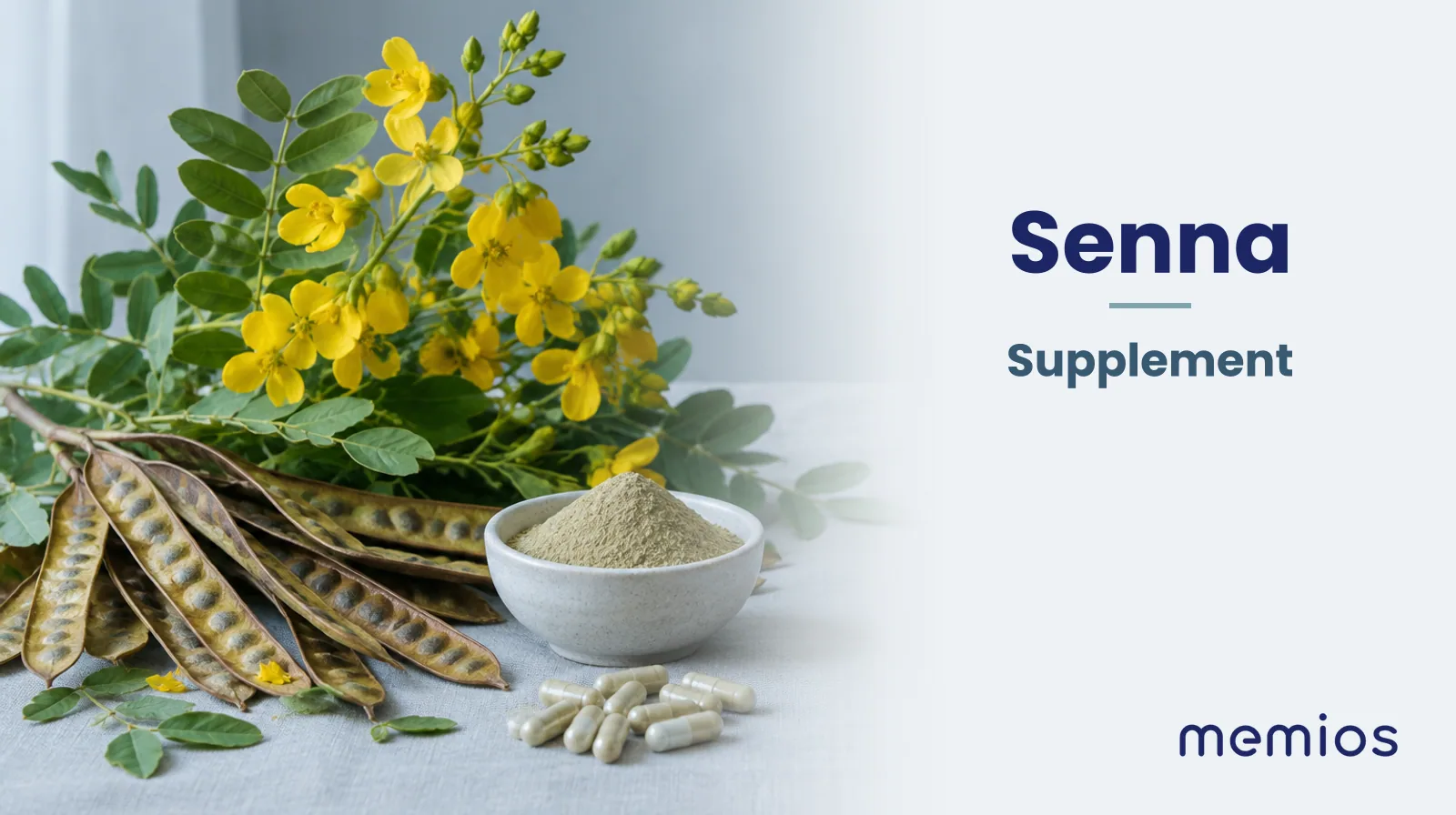
- What it is: Senna is a group of flowering plants of the tropics; the species used medicinally are Cassia acutifolia (Alexandrian senna) and Cassia angustifolia (Indian or Tinnevelly senna).
- Main use, supported: Senna's laxative action is attributed to colonic bacterial conversion of sennosides to rhein and rhein-anthrone, which irritate the colon and promote peristalsis. (moderate certainty)
- Other use, supported: In a double-blind randomised trial in people aged 65 and over with chronic constipation, senna alone improved constipation and quality-of-life scores significantly more than senna plus bisacodyl. (low certainty)
- Claim NOT supported by research: A Cochrane review of laxatives in palliative care, which included senna, found no evidence that any individual laxative was more effective or safer than another. (very low certainty)
- Another claim NOT supported: The same Cochrane review's authors concluded that the laxatives studied, senna among them, were of similar effectiveness and that the evidence remains limited by insufficient data from a few small randomised trials. (very low certainty)
- Recommended dose: not established. No reference intake (RDA or AI) exists for senna; it is a laxative drug and herbal preparation, not a nutrient, and LiverTox describes it only in terms of a typical dose for short-term use.
- Studied dose (a trial dose, not a recommendation): 20 mg sennoside B twice daily for 28 days in adults aged 65 and over with chronic constipation; the comparator arm took 3 mg sennoside B plus 5 mg bisacodyl twice daily. Findings citing that trial: 1 for.
- Upper limit: No upper limit or ADI has been set.
- What goes wrong: 3 findings on harm. Long-term use or abuse of senna is associated with cathartic colon, diarrhoea, cramps, weight loss and darkened pigmentation of the colonic mucosa.
- Common myth: Senna tea is a natural, non-drug way to lose weight and can be drunk regularly.
What it is
Senna is a group of flowering plants of the tropics; the species used medicinally are Cassia acutifolia (Alexandrian senna) and Cassia angustifolia (Indian or Tinnevelly senna). The leaves, flowers and fruit are extracted for their anthraquinone glycosides, called sennosides. Senna appears in many over-the-counter laxatives and in herbal teas marketed for purging and weight loss. It is minimally absorbed from the gut.
What the research says
Senna is a stimulant laxative and this is the one thing the literature consistently agrees it does. The sennosides pass unabsorbed to the colon, where bacteria release rhein and rhein-anthrone; these irritate the colonic lining, promote peristalsis and reduce water reabsorption. Trial evidence exists but is thinner than the drug's ubiquity suggests: a 2024 double-blind randomised trial in 105 people aged 65 and over found senna alone improved constipation and quality-of-life scores more than senna plus bisacodyl, while a 2015 Cochrane review of laxatives in palliative care found no evidence that any one laxative, senna included, outperformed another. The harms are well documented: cramps, electrolyte imbalance, darkened colonic pigmentation with long-term use, and several published cases of clinically apparent liver injury after months of higher-dose use.
Evidence grade: Limited evidence.
What goes wrong
Long-term use or abuse of senna is associated with cathartic colon, diarrhoea, cramps, weight loss and darkened pigmentation of the colonic mucosa. (Source 1)
- Expert review, not systematic, Low certainty.
- Size: not stated.
- Who: people using senna long-term or in excess.
- How long: long term use or abuse; senna is recommended for less than one week.
- Result: cathartic colon with diarrhoea, cramps, weight loss, darkened colonic pigmentation; short-term side effects abdominal cramps and electrolyte imbalance.
- Funding: independent (US National Institutes of Health)
Side effects include abdominal cramps and electrolyte imbalance. Long term use or abuse can lead to "cathartic" colon with diarrhea, cramps, weight loss and darkened pigmentation of the colonic mucosa.
Several published cases of clinically apparent liver injury have followed longer-term, higher-dose senna use, typically after 3 to 5 months. (Source 2)
- Case series, Low certainty.
- Size: several published cases.
- Who: people taking senna long-term or at higher than recommended doses.
- How long: onset usually after 3 to 5 months of use.
- Result: hepatocellular pattern of serum enzyme elevation, mild-to-moderate severity, rapid resolution on stopping; rapid recurrence on one documented rechallenge; LiverTox likelihood score D (possible rare cause)
- Funding: independent (US National Institutes of Health)
With longer term and higher dose use of senna, however, adverse events have been described including several cases of clinically apparent liver injury.
EFSA reports that epidemiological data suggested an increased risk of colorectal cancer associated with general laxative use, several such laxatives containing hydroxyanthracene derivatives of the kind found in senna. (Source 3)
- Official position, Very low certainty.
- Size: not applicable (review of observational data alongside genotoxicity studies)
- Who: not applicable.
- How long: opinion adopted 22 November 2017, published 2018.
- Result: association reported for laxative use in general, not senna specifically; EFSA could not set a safe daily intake for hydroxyanthracene derivatives.
- Funding: European Food Safety Authority (public body)
Epidemiological data suggested an increased risk for colorectal cancer associated with the general use of laxatives, several of which contain hydroxyanthracene derivatives.
What the evidence supports
In a double-blind randomised trial in people aged 65 and over with chronic constipation, senna alone improved constipation and quality-of-life scores significantly more than senna plus bisacodyl. (Source 4)
- Randomized trial, Low certainty.
- Size: 105 patients (54 senna, 51 senna + bisacodyl)
- Who: patients aged 65 years and older presenting to emergency departments with chronic constipation diagnosed by Rome IV criteria.
- How long: 28 days, twice daily dosing.
- Result: senna group scored higher on the Constipation Scoring System and the Patient Assessment of Constipation Quality of Life (p<0.001 and p=0.012); more dose reductions for side effects in the senna + bisacodyl group (p=0.026)
- Funding: not stated.
Following treatment, the senna group had a higher score on the Constipation Scoring System and Patient Assessment of Constipation Quality of Life compared with the senna + bisacodyl group, and the difference was statistically significant (p<0.001, p=0.012).
Senna's laxative action is attributed to colonic bacterial conversion of sennosides to rhein and rhein-anthrone, which irritate the colon and promote peristalsis. (Source 1)
- Expert review, not systematic, Moderate certainty.
- Size: not applicable.
- Who: not applicable.
- How long: not applicable.
- Result: mechanistic description; sennosides not absorbed, hydrolysed by colonic bacteria, also increase intestinal fluid and stool moisture.
- Funding: independent (US National Institutes of Health)
The sennosides are not absorbed but are hydrolyzed by colonic bacteria releasing the active moieties, rhein and rhein-anthrone which appear to act as local irritants on the colon, promoting peristalsis and evacuation.
What the evidence does not support
A Cochrane review of laxatives in palliative care, which included senna, found no evidence that any individual laxative was more effective or safer than another. (Source 5)
- Systematic review, Very low certainty.
- Size: 5 studies (laxatives included lactulose, senna, co-danthramer, misrakasneham, docusate and magnesium hydroxide with liquid paraffin)
- Who: people receiving palliative care with constipation.
- How long: not stated in the abstract.
- Result: no meta-analysis was possible because all five studies compared different laxatives; study findings were at an unclear risk of bias; no evidence that any individual laxative was more effective or better tolerated than another.
- Funding: Cochrane review (independent)
There was no evidence on whether individual laxatives were more effective than others or caused fewer adverse effects.
The same Cochrane review's authors concluded that the laxatives studied, senna among them, were of similar effectiveness and that the evidence remains limited by insufficient data from a few small randomised trials. (Source 6)
- Systematic review, Very low certainty.
- Size: 5 studies of laxatives including senna.
- Who: people receiving palliative care with constipation.
- How long: not stated in the abstract.
- Result: no laxative shown to be superior to another; authors describe the evidence as limited due to insufficient data from a few small RCTs, and note that no study evaluated polyethylene glycol or any intervention given rectally.
- Funding: Cochrane review (independent)
This second update found that laxatives were of similar effectiveness but the evidence remains limited due to insufficient data from a few small RCTs.
Where the evidence is mixed
A 104-week oral carcinogenicity study of a senna preparation in rats, summarised by the EMA, reported no treatment-related neoplastic changes. (Source 7)
- Animal study, Certainty not rated.
- Size: not stated in the EMA summary.
- Who: rats given a senna preparation orally.
- How long: 104 weeks.
- Result: no treatment-related neoplastic changes in any examined organ; an earlier 2-year study also found no treatment-related increase in gastrointestinal, liver or kidney tumours.
- Funding: not stated (studies summarised in an EMA herbal assessment report, adopted 27 April 2007)
No treatment-related neoplastic changes were observed in any of the examined organs.
What official bodies say
In 2002 the US FDA recorded that it had reclassified senna to category III (more data needed) in 1998 and had since received the carcinogenicity data it requested. (Source 8)
- Official position, Certainty not rated.
- Size: not applicable.
- Who: US over-the-counter laxative drug products.
- How long: final rule published 9 May 2002; 1998 reclassification described within it.
- Result: unlike aloe and cascara sagrada, senna data were submitted and the ingredient was not removed in this rule.
- Funding: US Food and Drug Administration (government)
The agency has received data on bisacodyl and senna, which will be discussed in future issues of the Federal Register.
Where the research disagrees
Whether the anthraquinones in senna carry a genotoxic or carcinogenic risk
- EFSA ANS Panel (opinion adopted 2017, published 2018), review of in vitro and in vivo genotoxicity data and observational laxative-use epidemiology: the Panel concluded that hydroxyanthracene derivatives should be considered as genotoxic and carcinogenic unless there are specific data to the contrary (Source 3)
- Rodent carcinogenicity studies of senna preparations summarised in the EMA assessment report (adopted 27 April 2007), 104-week oral carcinogenicity study in rats: No treatment-related neoplastic changes were observed in any of the examined organs. (Source 7)
How much
- Reference intake: No reference intake (RDA or AI) exists for senna; it is a laxative drug and herbal preparation, not a nutrient, and LiverTox describes it only in terms of a typical dose for short-term use. (Source 1)
- Upper limit: No upper limit or ADI has been set. EFSA (opinion adopted 22 November 2017, published 2018) was unable to advise a daily intake of hydroxyanthracene derivatives that does not give rise to concerns about harmful effects to health. LiverTox states senna is recommended for short term use only, less than one week. (Source 3)
- Studied: 20 mg sennoside B twice daily for 28 days in adults aged 65 and over with chronic constipation; the comparator arm took 3 mg sennoside B plus 5 mg bisacodyl twice daily. (Source 4)
- Studied: LiverTox describes a typical dose of 15 to 30 mg of sennosides twice a day, recommended for short term use only. (Source 1)
A common belief, and what the research shows
The belief: Senna tea is a natural, non-drug way to lose weight and can be drunk regularly.
What the research shows: Senna is a stimulant laxative and the weight it moves is stool and water, not fat. LiverTox records that "Senna is also included in several herbal teas, used for purging and in weight loss." and that "Long term use or abuse can lead to "cathartic" colon with diarrhea, cramps, weight loss and darkened pigmentation of the colonic mucosa." It also notes the drug is "recommended for short term use only (less than one week)", and that "With longer term and higher dose use of senna, however, adverse events have been described including several cases of clinically apparent liver injury."
Questions and answers
What is it?
Senna is a tropical flowering plant whose leaves, flowers and fruit are extracted for use as a laxative. The two species used are Alexandrian senna and Indian or Tinnevelly senna. The active ingredients are anthraquinone glycosides called sennosides. (Source 1)
What does it do in the body?
Sennosides are not absorbed. They travel to the colon, where gut bacteria split them into rhein and rhein-anthrone, which irritate the colon wall and trigger peristalsis. They also reduce water and electrolyte reabsorption, so stool holds more moisture. (Source 1)
Is it good or bad for you?
Both, depending on duration. Used briefly at recommended doses, senna causes few problems beyond cramps, and a 2024 randomised trial found it improved constipation scores in older adults. Used long-term or in excess, it is associated with cathartic colon, diarrhoea, cramps, weight loss and darkened colonic pigmentation, and it is recommended for less than a week. (Source 1)
How do you get more of it?
Senna is taken deliberately, as an over-the-counter laxative or an herbal tea. It is sold under trade names including Ex-lax, Fletcher's Castoria and Senokot. There is no nutritional reason to increase intake, since it is not a nutrient. (Source 1)
If it is harmful, what reduces it?
The measure described in the literature is limiting the period of use and stopping. LiverTox notes senna is recommended for short-term use only, under a week, and that liver injury cases resolved rapidly when it was discontinued. (Source 2)
Why might someone be low in it or missing it?
This does not apply. Senna is a plant laxative taken by choice, not something the body makes, stores or needs, so there is no deficiency state and no reason anyone would be low in it. (Source 1)
Which whole foods contain it or feed it?
Senna is not part of the ordinary diet. It reaches people as herbal teas, sold for purging and for weight loss, and as over-the-counter laxative preparations. No conventional whole food contains sennosides. (Source 1)
What happens if you do not have it?
Nothing happens, because senna is not required for anything. The evidence base does not even establish that senna outperforms other laxatives: a Cochrane review of laxatives in palliative care found no evidence that any one of them, senna included, was more effective or better tolerated than the others. (Source 5)
How can you test for it?
There is no validated test for senna status, and we found none in the literature searched. Senna is minimally absorbed, so it does not build up a measurable blood level. Testing that does exist is for harm: liver enzyme measurement if injury is suspected, and colonoscopy can show the darkened colonic pigmentation of long-term use. (Source 1)
We searched: LiverTox senna monograph, EMA Cassia senna assessment report, Cochrane 2015 palliative-care laxative review and web searches for a senna biomarker or status test; none describes a validated measure of senna intake or body level
References
- National Institute of Diabetes and Digestive and Kidney Diseases, NCBI Bookshelf. Senna — LiverTox: Clinical and Research Information on Drug-Induced Liver Injury (Background section). 2020. Read the source
- National Institute of Diabetes and Digestive and Kidney Diseases, NCBI Bookshelf. Senna — LiverTox: Clinical and Research Information on Drug-Induced Liver Injury (Hepatotoxicity section). 2020. Read the source
- EFSA Journal, European Food Safety Authority. Safety of hydroxyanthracene derivatives for use in food (EFSA ANS Panel scientific opinion, abstract). 2018. DOI 10.2903/j.efsa.2018.5090. Read the source
- Turkish Journal of Geriatrics 27(2):319-330. Effectiveness of Senna in Treating Chronic Constipation in Geriatric Patients Presenting to the Emergency Department: A Randomized, Double-Blind, Multicenter Study. 2024. Read the source
- Cochrane Database of Systematic Reviews. Laxatives for the management of constipation in people receiving palliative care (abstract, Main results). 2015. PMID 25967924, DOI 10.1002/14651858.CD003448.pub4. Read the source
- Cochrane Database of Systematic Reviews. Laxatives for the management of constipation in people receiving palliative care (abstract, Authors' conclusions). 2015. PMID 25967924, DOI 10.1002/14651858.CD003448.pub4. Read the source
- European Medicines Agency, Committee on Herbal Medicinal Products (HMPC). Assessment report on Cassia senna L. and Cassia angustifolia Vahl, folium — preclinical carcinogenicity data. 2007. Read the source
- US Food and Drug Administration, Federal Register 67(90):31125. Status of Certain Additional Over-the-Counter Drug Category II and III Active Ingredients. Final rule (Background). 2002. PMID 12001972. Read the source