Supplements · September 29, 2026 · Memios · 10 min read
Sea Moss
Reviewers of the primary literature are explicit that human clinical data on whole Chondrus crispus are sparse.
TLDR
- Disputed. Reviewers of the primary literature are explicit that human clinical data on whole Chondrus crispus are sparse.
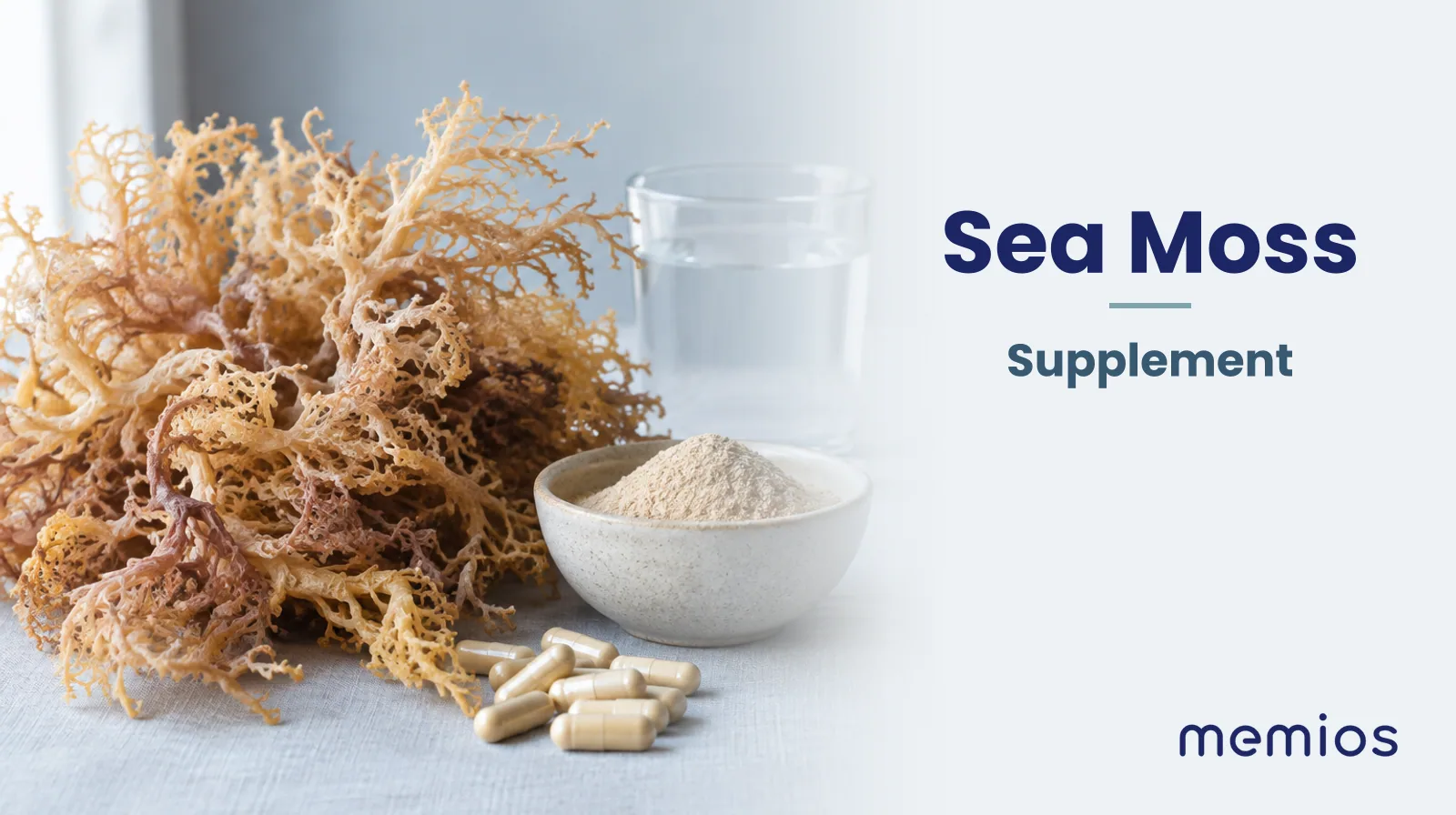
- What it is: Sea moss most often refers to Chondrus crispus, a red alga ("Irish moss" or "carrageen") that grows on rocks along the North Atlantic coast and is harvested, dried, and sold as raw moss, soaked "sea moss gel," powder, or capsules.
- Main use, supported: A randomized, placebo-controlled trial testing extracted iota-carrageenan delivered as a nasal spray (not oral whole sea moss) found that it reduced common-cold symptoms and viral load compared with placebo. (low certainty)
- Recommended dose (official position): There is no RDA or AI for "sea moss" itself. The relevant established reference intake concerns its main nutrient of concern, iodine: the U.S. Institute of Medicine (2001) set an RDA of 150 mcg/day for adults.
- Studied dose (a trial dose, not a recommendation): A randomized trial administered a 0.12% iota-carrageenan solution as a nasal spray three times daily for 4 days (not an oral dose of sea moss). Findings citing that trial: 1 for.
- Upper limit: The Institute of Medicine (2001) set a Tolerable Upper Intake Level for iodine of 1,100 mcg/day for adults.
- What goes wrong: 4 findings on harm. A European dietary exposure assessment found that some seaweed consumers, including of red algae, have iodine intakes well above typical dietary levels, and identified seaweeds broadly as an important source of heavy metal exposure.
- Common myth: Because sea moss is a "natural" whole food, taking it in supplement/pill/gel form is automatically safe.
What it is
Sea moss most often refers to Chondrus crispus, a red alga ("Irish moss" or "carrageen") that grows on rocks along the North Atlantic coast and is harvested, dried, and sold as raw moss, soaked "sea moss gel," powder, or capsules. Its main structural carbohydrate is carrageenan, a sulfated polysaccharide also extracted from it and other red seaweeds for use as a food-thickening additive. Red algae in this group are also a source of dietary iodine and can accumulate trace minerals, including heavy metals, from seawater.
What the research says
Reviewers of the primary literature are explicit that human clinical data on whole Chondrus crispus are sparse. Almost all the human trial evidence that exists concerns its extracted component, carrageenan, tested in different forms and doses for different purposes: as a nasal spray it reduced common-cold symptoms and viral load in one small industry-funded trial, while a separate diet trial found that carrageenan capsules were associated with earlier relapse in ulcerative colitis patients versus placebo. Neither trial used oral whole sea moss as sold in stores, so claims about sea moss itself (energy, libido, thyroid support, immunity) are not directly tested in the literature we could reach.
Evidence grade: Disputed.
What goes wrong
A randomized, placebo-controlled diet trial found that oral capsules of extracted carrageenan (not whole sea moss as sold and eaten) were associated with significantly earlier relapse in ulcerative colitis patients who were in remission, versus placebo capsules. (Source 1)
- Randomized trial, Low certainty.
- Size: 12 participants completed the trial.
- Who: Adults with ulcerative colitis in remission; tested substance was purified carrageenan in capsule form, not whole sea moss/Chondrus crispus.
- How long: Followed every 2 weeks until relapse or up to 1 year.
- Result: 3 of the carrageenan-capsule group relapsed versus 0 of the placebo group (p = 0.046, log-rank test); interleukin-6 also rose significantly in the carrageenan group (p = 0.02)
- Funding: Not stated in the extracted text.
Three patients who received carrageenan-containing capsules relapsed, and none of the patients who received placebo-containing capsules relapsed (p = 0.046, log-rank test).
A published case report describes a patient who developed thyroid storm (severe hyperthyroidism) after starting iodine-rich sea moss pills. (Source 2)
- Case report, Certainty not rated.
- Size: 1 patient.
- Who: 37-year-old woman with type 1 diabetes.
- How long: Symptom onset within days of starting the product.
- Result: Presented with nausea, vomiting, tachycardia and tremulousness consistent with severe hyperthyroidism after starting sea moss pills reported to contain over 3 mg/kg of iodine.
- Funding: Not stated.
A 37 year-old female with a medical history of Type 1 Diabetes presented with 3 days of nausea and vomiting after starting a diet of only 3 cups of fruit juices and 3 sea moss pills six days prior.
A European dietary exposure assessment found that some seaweed consumers, including of red algae, have iodine intakes well above typical dietary levels, and identified seaweeds broadly as an important source of heavy metal exposure. (Source 3)
- Survey study, Moderate certainty.
- Size: Population-level dietary survey/consumption data across multiple European countries.
- Who: European seaweed and halophyte consumers.
- How long: Not applicable (exposure assessment)
- Result: Iodine intakes above 20 μg/kg body weight per day identified among consumers of red/brown algae types such as Kombu and Laver; lead levels in seaweed were comparatively lower than cadmium.
- Funding: Not stated in the extracted text.
However, in few other dietary surveys, relatively high iodine intakes (above 20 μg/kg bw per day) were also identified following the consumption of different types of seaweed (Kombu, Laver).
The FDA announced a voluntary recall of a commercial sea moss gel product in January 2026 over inadequate acidification/temperature controls that created a botulism risk. (Source 4)
- Official position, Certainty not rated.
- Size: not applicable (regulatory recall)
- Who: Consumers of the recalled sea moss gel product.
- How long: not applicable.
- Result: No illnesses had been reported at the time of the recall; the concern was manufacturing conditions that could allow toxin-producing organisms to grow.
- Funding: not applicable.
Lack of required regulatory authorization and temperature monitoring records for pH-controlled food products.
What the evidence supports
A randomized, placebo-controlled trial testing extracted iota-carrageenan delivered as a nasal spray (not oral whole sea moss) found that it reduced common-cold symptoms and viral load compared with placebo. (Source 5)
- Randomized trial, Low certainty.
- Size: 35 human subjects.
- Who: Adults with early symptoms of the common cold; tested substance was purified iota-carrageenan applied intranasally, not sea moss eaten or taken orally.
- How long: 3 times daily for 4 days.
- Result: Symptom score improved, p = 0.046; viral load in nasal lavage reduced, p = 0.009.
- Funding: Marinomed Biotechnologie GmbH (manufacturer) — industry-funded; three authors were company employees/co-founders.
Administration of Iota-Carrageenan nasal spray reduced the symptoms of common cold (p = 0.046) and the viral load in nasal lavages (p = 0.009)
Where the research disagrees
Whether carrageenan (the main polysaccharide of sea moss/Irish moss) is safe for regular dietary consumption
- EFSA, JECFA and the FDA (as food-additive regulators), position: Its use as a food additive has been approved by the European Food Safety Authority (EFSA), the Joint FAO/WHO Expert Committee on Food Additives (JECFA) as well as the Food and Drug Administration (FDA). (Source 6)
- Researchers who ran the no-carrageenan diet trial in ulcerative colitis, rct: Carrageenan intake contributed to earlier relapse in patients with ulcerative colitis in remission. Restriction of dietary carrageenan may benefit patients with ulcerative colitis. (Source 1)
How much
- Reference intake: There is no RDA or AI for "sea moss" itself. The relevant established reference intake concerns its main nutrient of concern, iodine: the U.S. Institute of Medicine (2001) set an RDA of 150 mcg/day for adults. (Source 7)
- Upper limit: The Institute of Medicine (2001) set a Tolerable Upper Intake Level for iodine of 1,100 mcg/day for adults. A case report found a sea moss pill product reported to contain over 3 mg (3,000+ mcg) of iodine per kg of product, meaning a small number of pills can plausibly deliver iodine well above this UL depending on serving size and product concentration. (Source 7)
- Studied: A randomized trial administered a 0.12% iota-carrageenan solution as a nasal spray three times daily for 4 days (not an oral dose of sea moss). (Source 5)
- Studied: A randomized diet trial had ulcerative colitis patients in remission take carrageenan-containing capsules versus placebo capsules, followed for up to one year or until relapse. (Source 1)
A common belief, and what the research shows
The belief: Because sea moss is a "natural" whole food, taking it in supplement/pill/gel form is automatically safe.
What the research shows: A published case report found that concentrated sea moss pills reported to contain "over 3mg/kg of iodine" triggered thyroid storm in a previously undiagnosed patient, and the case authors note that iodine-rich seaweed may also induce hyperthyroidism. Separately, a 2026 FDA recall of a commercial sea moss gel was issued over manufacturing conditions that could allow botulism-causing organisms to grow, and dietary-exposure researchers flag some seaweed consumers' iodine intakes as running well above typical levels.
Questions and answers
What is it?
Sea moss most commonly refers to Chondrus crispus, a red seaweed also called Irish moss or carrageen, which grows on rocks along the North Atlantic coastline. It is dried and sold whole, soaked into a gel, or ground into powder/capsules, and it is the source of the food additive carrageenan. (Source 8)
What does it do in the body?
In the body it primarily supplies iodine, minerals, and gel-forming carrageenan polysaccharides. Reviewers state that direct human clinical evidence on the whole alga is very limited, and what human trial evidence exists relates to its extracted carrageenan tested in other forms (a nasal spray, and oral capsules in a colitis trial), not to eating sea moss itself. (Source 8)
Is it good or bad for you?
Context and dose dependent. In ordinary culinary seaweed amounts it functions as a mineral-containing food; in concentrated supplement form it has caused iodine-induced thyroid storm in at least one documented case, has measurable heavy-metal content, and a commercial gel product was recalled in 2026 over a botulism risk from processing conditions. (Source 2)
How do you get more of it?
As actually studied, researchers have tested its extracted carrageenan as a 0.12% solution in a nasal spray, or as oral capsules, rather than dosing the whole raw moss or gel typically sold as a supplement. Commercially, sea moss is eaten as a soaked gel, added to smoothies, or taken as capsules/powder. (Source 5)
If it is harmful, what reduces it?
For the harms identified — iodine excess, heavy metals, or contamination — the literature describes stopping the product and, where thyroid storm has already developed, urgent medical management rather than a simple dietary fix. The case report notes the episode began within days of starting sea moss pills alongside a very low-food-intake juice diet. (Source 2)
Why might someone be low in it or missing it?
Does not apply in a deficiency sense: sea moss itself is not a nutrient the body requires, so no literature frames someone as "missing" it. Its main nutrient of concern, iodine, is more often discussed as a risk of excess from concentrated sea moss products than of shortfall. (Source 8)
We searched: Searched for a described sea moss deficiency or shortfall state in PubMed and the chemistry/biology review of Chondrus; none exists, consistent with sea moss being a food rather than an essential compound.
Which whole foods contain it or feed it?
Sea moss is itself a whole food (a seaweed). Related red algae that similarly supply carrageenan-type polysaccharides and iodine include Eucheuma cottonii and other carrageenan-yielding seaweeds; other edible seaweeds such as kelp, dulse, and nori are separate species that also supply dietary iodine. (Source 9)
What happens if you do not have it?
No literature describes a harmful consequence of simply not eating sea moss, since it is not an essential nutrient itself. (Source 8)
We searched: Searched PubMed and the Chondrus review for any described consequence of sea moss absence from the diet; none was found.
How can you test for it?
There is no test for "sea moss status," but because its main safety concern is iodine, iodine exposure can be assessed indirectly through urinary iodine concentration together with thyroid function tests (TSH, free T4) when excess intake is suspected. (Source 7)
References
- Nutrition and Healthy Aging. A randomized trial of the effects of the no-carrageenan diet on ulcerative colitis disease activity. 2017. DOI 10.3233/NHA-170023. Read the source
- Endocrine Practice (ScienceDirect), AACE abstract. Thyroid Storm at Sea: A Case of Algae Induced Thyrotoxicosis. 2024. Read the source
- PMC (journal article). Dietary exposure to heavy metals and iodine intake via consumption of seaweeds and halophytes in the European population. 2022. Read the source
- U.S. Food and Drug Administration (FDA). Diva Fam Inc. Announces Voluntary Recall of Sea Moss Gel Superfood Products Due to Possible Health Risk. 2026. Read the source
- Respiratory Research (Springer). Efficacy and safety of an antiviral Iota-Carrageenan nasal spray: a randomized, double-blind, placebo-controlled exploratory study in volunteers with early symptoms of the common cold. 2010. DOI 10.1186/1465-9921-11-108. Read the source
- Nutrients (MDPI). Carrageenan in the Diet: Friend or Foe for Inflammatory Bowel Disease?. 2024. Read the source
- NIH Office of Dietary Supplements (ODS). Iodine – Fact Sheet for Health Professionals. 2024. Read the source
- PMC (journal article). An Update on the Chemical Constituents and Biological Properties of Selected Species of an Underpinned Genus of Red Algae: Chondrus. 2024. Read the source
- ScienceDirect Topics (Elsevier). Chondrus – an overview. n.d.. Read the source