Supplements · September 29, 2026 · Memios · 10 min read
Schisandra
Limited evidence. The strongest body of evidence about schisandra is not about a health benefit at all.
TLDR
- Limited evidence. The strongest body of evidence about schisandra is not about a health benefit at all, but about drug interactions: its lignans inhibit CYP3A4 and P-glycoprotein, and preparations of it measurably raise blood levels of co-administered drugs such as the transplant immunosuppressant tacrolimus.
- What it is: Schisandra is the dried fruit of Schisandra chinensis, a woody vine, used for centuries in China as both food and medicine.
- Main use, supported: A systematic review and meta-analysis of 54 animal studies found that Schisandra chinensis compounds reduced markers of liver injury; this is preclinical evidence, not a human finding. (low certainty)
- Other use, supported: A 12-week randomised placebo-controlled trial of an omija (Schisandra chinensis) and soybean mixture in people with hyperglycaemia reported lower fasting and postprandial glucose and lower LDL cholesterol than placebo. (low certainty)
- Claim NOT supported by research: The authors of the preclinical liver meta-analysis state that further research is still needed to validate schisandra's efficacy and safety. (low certainty)
- Recommended dose: not established. No reference intake exists for schisandra: it is a fruit used as food and medicine, not an essential nutrient. No RDA, AI, ADI or upper limit from a government body was reachable in this search.
- Studied dose (a trial dose, not a recommendation): 1000 mg of Schisandra chinensis extract per day for 12 weeks in post-menopausal women, against 1000 mg of starch as placebo. Findings citing that trial: 1 mixed.
- Upper limit: No upper limit or acceptable daily intake has been set by any body reached in this search.
- What goes wrong: 2 findings on harm. A pharmacokinetic study in liver transplant patients found that co-administering a Schisandra sphenanthera preparation with tacrolimus lowered tacrolimus clearance and raised its blood concentration.
- Common myth: Schisandra is a liver-protecting tonic, so it is a safe thing to add to any medicine cabinet.
What it is
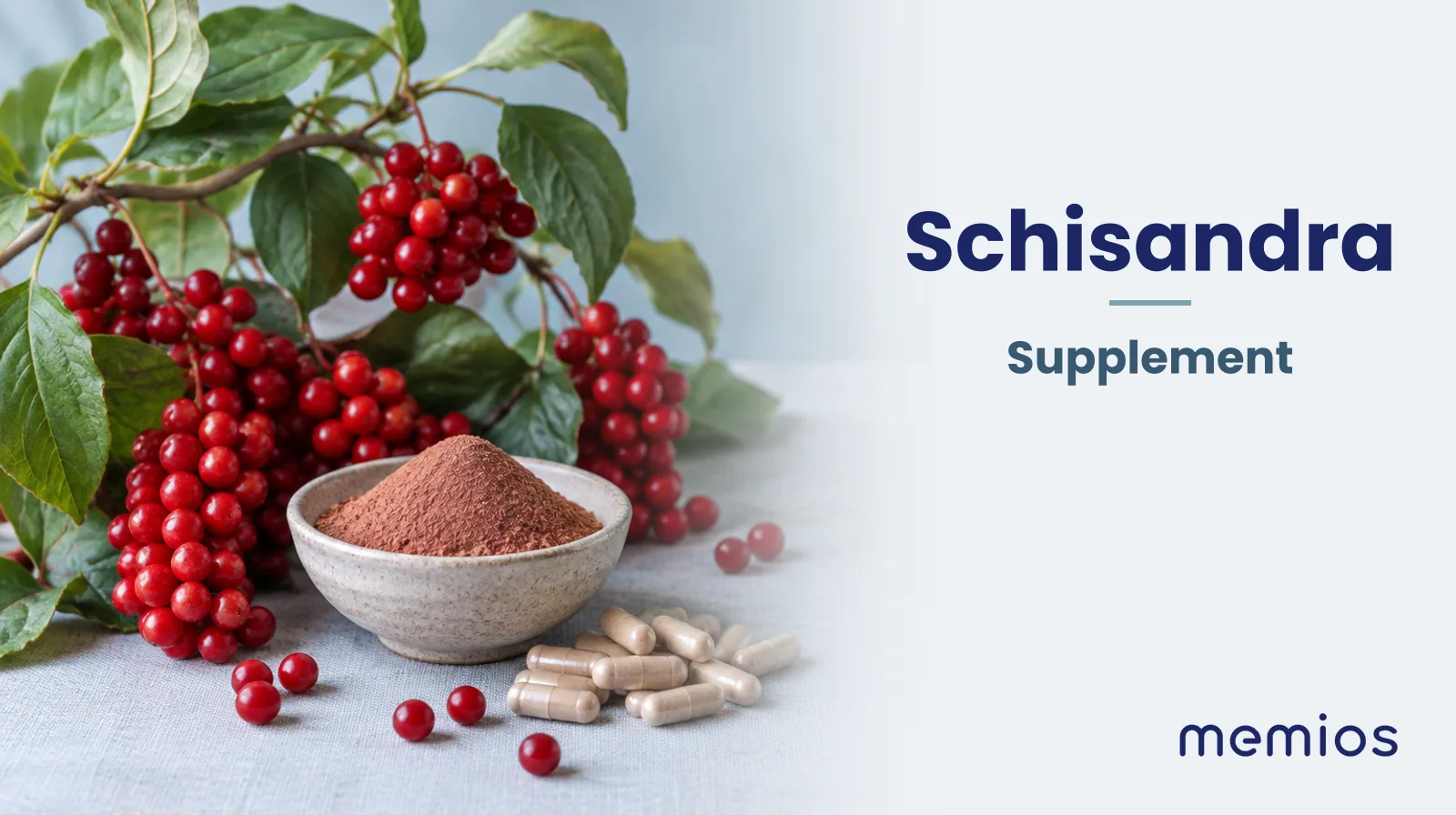
Schisandra is the dried fruit of Schisandra chinensis, a woody vine, used for centuries in China as both food and medicine. A related species, Schisandra sphenanthera, is sold under the same traditional name and is the source of the Wuzhi tablet and capsule used in Chinese hospitals. The characteristic constituents are dibenzocyclooctadiene lignans. In Korea the berry is known as omija and drunk as a tea.
What the research says
The strongest body of evidence about schisandra is not about a health benefit at all, but about drug interactions: its lignans inhibit CYP3A4 and P-glycoprotein, and preparations of it measurably raise blood levels of co-administered drugs such as the transplant immunosuppressant tacrolimus. On benefits, the liver-protective claim rests almost entirely on animal work; a 2025 meta-analysis pooling 54 animal studies found large reductions in liver enzymes, but that is not a human finding. The human trials are few and small: one 12-week trial of an omija-and-soybean mixture improved glucose measures, and a 12-week trial of schisandra extract in post-menopausal women improved quadriceps strength but found no effect on any other measured variable.
Evidence grade: Limited evidence.
What goes wrong
A pharmacokinetic study in liver transplant patients found that co-administering a Schisandra sphenanthera preparation with tacrolimus lowered tacrolimus clearance and raised its blood concentration. (Source 1)
- Blood level study, Low certainty.
- Size: 15 liver transplant patients (donors and recipients genotyped)
- Who: Chinese liver transplant patients taking tacrolimus.
- How long: not stated in the abstract.
- Result: Tacrolimus clearance (CL/F) fell from 24.421 to 12.864 in CYP3A5 expressers and from 23.532 to 11.822 in non-expressers when the Wuzhi capsule was co-administered; Tmax was shortened and V/F and CL/F decreased.
- Funding: not stated.
The co-administration of WZC can increase the tacrolimus blood concentration in Chinese liver transplant patients in clinical practice.
A pharmacology review reports that combining schisandra (wu wei zi) with other medicines in patients has caused fluctuations in the blood levels of those medicines, through inhibition of cytochrome P450 and P-glycoprotein. (Source 2)
- Expert review, not systematic, Low certainty.
- Size: not applicable.
- Who: patients taking schisandra alongside other drugs.
- How long: not applicable.
- Result: No pooled rate; the review describes altered blood levels of co-administered drugs via inhibition of cytochrome P450 enzymes and P-glycoprotein.
- Funding: not stated.
many literatures have reported that the combination of Wu Wei Zi in patients has led to fluctuations in the blood level of the combined drug
What the evidence supports
A systematic review and meta-analysis of 54 animal studies found that Schisandra chinensis compounds reduced markers of liver injury; this is preclinical evidence, not a human finding. (Source 3)
- Meta-analysis, Low certainty.
- Size: 54 animal studies.
- Who: animal models of liver injury, not humans.
- How long: not stated in the abstract.
- Result: Pooled standardized mean difference for ALT −4.74, 95% CI (−5.42, −4.06), p < 0.001, I2 = 90.8%; for AST −5.10, 95% CI (−5.84, −4.37), p < 0.001, I2 = 91.7%; alkaline phosphatase also reduced. Heterogeneity is very high, and every study is an animal study.
- Funding: not stated.
The results indicated that bioactive compounds in Schisandra chinensis significantly reduced levels of alanine aminotransferase (ALT) [standardized mean difference = −4.74, 95% confidence interval (−5.42, −4.06), p < 0.001, I2 = 90.8%], aspartate aminotransferase (AST) [SMD = −5.10, 95% CI (−5.84, −4.37), p < 0.001, I2 = 91.7%], and alkaline phosphatase (ALP).
A 12-week randomised placebo-controlled trial of an omija (Schisandra chinensis) and soybean mixture in people with hyperglycaemia reported lower fasting and postprandial glucose and lower LDL cholesterol than placebo. (Source 4)
- Randomized trial, Low certainty.
- Size: 80 participants.
- Who: adults with fasting plasma glucose of 100 to 140 mg/dL.
- How long: 12 weeks.
- Result: Significant decreases versus placebo in fasting plasma glucose, postprandial glucose at 30 and 60 minutes, postprandial insulin at 60 minutes, insulin AUC, fructosamine and LDL cholesterol; no p-values or effect sizes are given in the abstract.
- Funding: not stated.
After the intervention, the OSM group showed significantly decreased levels of FPG, PPG (30, 60 min), PPI (60 min), insulin area under the curve (AUC), fructosamine, and low-density-lipoprotein (LDL) cholesterol compared to the placebo group.
What the evidence does not support
The authors of the preclinical liver meta-analysis state that further research is still needed to validate schisandra's efficacy and safety. (Source 3)
- Meta-analysis, Low certainty.
- Size: 54 animal studies.
- Who: animal models of liver injury.
- How long: not stated.
- Result: No human efficacy estimate is offered; the review's own conclusion defers validation of both efficacy and safety to future work.
- Funding: not stated.
However, further research is needed to validate its efficacy and safety.
Where the evidence is mixed
In a randomised placebo-controlled trial in post-menopausal women, schisandra extract improved quadriceps muscle strength and resting lactate but produced no effect on any of the other measured variables. (Source 5)
- Randomized trial, Low certainty.
- Size: 45 women (24 schisandra, 21 placebo)
- Who: healthy post-menopausal middle-aged women, mean age 61.9 years.
- How long: 12 weeks.
- Result: Significant group-by-time interactions for quadriceps muscle strength (p = 0.001) and lactate (p = 0.038); no interactions for the other variables, including muscle mass, physical function and biomarkers.
- Funding: institutional (Dong-A University research fund)
However, no interactions were found between the other variables.
Where the research disagrees
Whether schisandra's liver-protective reputation is supported
- Authors of the 2025 systematic review and preclinical meta-analysis, meta-analysis of 54 animal studies, no human trials: Schisandra chinensis demonstrates significant therapeutic effects in liver injury, likely due to its anti-inflammatory, antioxidant, and anti-apoptotic properties. (Source 3)
- The same authors, on the limits of that conclusion, same meta-analysis; the evidence base is entirely animal and highly heterogeneous: However, further research is needed to validate its efficacy and safety. (Source 3)
How much
- Reference intake: No reference intake exists for schisandra: it is a fruit used as food and medicine, not an essential nutrient. No RDA, AI, ADI or upper limit from a government body was reachable in this search. (Source 2)
- Upper limit: No upper limit or acceptable daily intake has been set by any body reached in this search. The most recent systematic review of schisandra for liver injury states that its efficacy and safety still require validation. (Source 3)
- Studied: 1000 mg of Schisandra chinensis extract per day for 12 weeks in post-menopausal women, against 1000 mg of starch as placebo. (Source 5)
- Studied: An omija (Schisandra chinensis) extract and soybean mixture taken for 12 weeks by 80 adults with fasting glucose of 100 to 140 mg/dL. (Source 4)
A common belief, and what the research shows
The belief: Schisandra is a liver-protecting tonic, so it is a safe thing to add to any medicine cabinet.
What the research shows: The liver evidence is animal evidence: the 2025 review states 'A total of 54 animal studies were included in this review.' and concludes 'However, further research is needed to validate its efficacy and safety.' Meanwhile the best-documented human effect is on other drugs, not on the liver: 'The co-administration of WZC can increase the tacrolimus blood concentration in Chinese liver transplant patients in clinical practice.'
Questions and answers
What is it?
Schisandra is the dried fruit of the vine Schisandra chinensis, known in Chinese medicine as wu wei zi, the five-flavour berry. A second species, Schisandra sphenanthera, is sold under the same name. Both are used as food as well as medicine, and their characteristic constituents are lignans. (Source 2)
What does it do in the body?
The clearest documented action in people is on drug metabolism: schisandra lignans inhibit cytochrome P450 enzymes and P-glycoprotein, which changes the blood levels of other medicines. The liver-protective and antioxidant actions it is famous for have been shown mainly in animals, and the reviewers of that animal evidence say efficacy and safety still need validating. (Source 3)
Is it good or bad for you?
It depends heavily on what else a person takes. As a food, the berry has a long history of use. As a supplement taken alongside prescription medicines it is not benign, because reviews record that combining it with other drugs has caused their blood levels to fluctuate, and a study in transplant patients measured tacrolimus clearance roughly halving. (Source 2)
How do you get more of it?
Schisandra is obtained by eating the dried berry, drinking it as omija tea, or taking an extract. The trials used measured amounts: one gave post-menopausal women 1000 mg of schisandra extract a day for 12 weeks against a starch placebo. This describes what was studied, not what anyone should take. (Source 5)
If it is harmful, what reduces it?
The literature does not study clearing schisandra from the body. What it does document is that the interaction effect is one of co-administration, so it is the pairing with another drug that produces the raised blood level. Nothing has been studied on reversing or eliminating it. (Source 1)
We searched: Searched the 2022 Wuzhi capsule pharmacokinetic study, the 2022 lignan drug-interaction review and the 2025 preclinical meta-analysis for washout, elimination or reversal of schisandra exposure; none addresses it.
Why might someone be low in it or missing it?
Nobody is deficient in schisandra. It is a fruit used as food and medicine rather than a nutrient the body requires, so being without it is not a deficiency. No low or missing state, and no cause of one, appears in the literature searched. (Source 2)
We searched: Searched the 2022 lignan drug-interaction review, the 2025 preclinical meta-analysis and both human randomised trials for any account of schisandra deficiency or depletion; no such state is described.
Which whole foods contain it or feed it?
The whole food is the berry itself, dried, which is the part used in both Chinese and Korean traditions. In Korea it is called omija and consumed as an extract or tea; a randomised trial used an omija extract and soybean mixture. Nothing else in the diet supplies schisandra lignans. (Source 2)
What happens if you do not have it?
Nothing is known to happen. There is no described consequence of not consuming schisandra, because it is not an essential nutrient. The open question in the literature is whether adding it does anything reliable in humans, and the most recent review says that is still unvalidated. (Source 3)
We searched: Searched the 2025 preclinical meta-analysis, the 2022 lignan review and both human randomised trials for any consequence of absence of schisandra; nothing addresses it.
How can you test for it?
There is no clinical test of a person's schisandra status. Its lignans can be measured in blood by laboratory methods in research settings, as in the transplant pharmacokinetic study that used LC-MS/MS, but that measures the compounds in a study, not a health status, and it is not a test offered to the public. (Source 1)
We searched: Searched the 2022 Wuzhi capsule pharmacokinetic study, the 2022 lignan drug-interaction review and both human randomised trials for a validated clinical assay of schisandra status; only research-grade LC-MS/MS quantification of lignans is described.
References
- Frontiers in Pharmacology. The pharmacokinetic study of tacrolimus and Wuzhi capsule in Chinese liver transplant patients. 2022. DOI 10.3389/fphar.2022.956166. Read the source
- Frontiers in Pharmacology. A Comprehensive Review of the Main Lignan Components of Schisandra chinensis (North Wu Wei Zi) and Schisandra sphenanthera (South Wu Wei Zi) and the Lignan-Induced Drug-Drug Interactions Based on the Inhibition of Cytochrome P450 and P-Glycoprotein Activities. 2022. DOI 10.3389/fphar.2022.816036. Read the source
- Frontiers in Pharmacology. Efficacy of Schisandra chinensis in liver injury: a systematic review and preclinical meta-analysis. 2025. PMID 40832608, DOI 10.3389/fphar.2025.1627081. Read the source
- Nutrients (MDPI). Efficacy and Safety of Omija (Schisandra chinensis) Extract Mixture on the Improvement of Hyperglycemia: A Randomized, Double-Blind, and Placebo-Controlled Clinical Trial. 2022. DOI 10.3390/nu14153159. Read the source
- International Journal of Environmental Research and Public Health (MDPI). Effect of Schisandra chinensis Extract Supplementation on Quadriceps Muscle Strength and Fatigue in Adult Women: A Randomized, Double-Blind, Placebo-Controlled Trial. 2020. DOI 10.3390/ijerph17072475. Read the source