Supplements · September 30, 2026 · Memios · 14 min read
Saw palmetto
Saw palmetto is sold mainly for urinary symptoms from an enlarged prostate, and this is one of the few supplement questions the evidence has genuinely settled.
TLDR
- Not supported by the research. Saw palmetto is sold mainly for urinary symptoms from an enlarged prostate, and this is one of the few supplement questions the evidence has genuinely settled.
- What it is: Saw palmetto is a herbal preparation made from the fruit of Serenoa repens, a low-growing bushy palm.
- Main use, supported: A systematic review of saw palmetto for hair loss reported hair improvements in a handful of separate small studies of assorted topical and oral saw-palmetto-containing supplements. (very low certainty)
- Claim NOT supported by research: Saw palmetto taken alone made little to no difference to urinary symptom scores in men with an enlarged prostate at 3 to 6 months, on high-certainty evidence. (high certainty)
- Another claim NOT supported: The absence of benefit persisted at 12 to 17 months, with the point estimate slightly favouring placebo. (high certainty)
- Recommended dose: not established. No reference intake (RDA or AI) exists. Saw palmetto is a herbal preparation used as a treatment, not an essential nutrient, so no body has set a dietary requirement.
- Studied dose (a trial dose, not a recommendation): Trials pooled by Cochrane enrolled men mostly over 50 with moderate symptoms (IPSS 8 to 19) and ran from 1 to 17 months. Findings citing that trial: 3 against, 1 mixed.
- Upper limit: No tolerable upper intake level or ADI has been set.
- What goes wrong: 3 findings on harm. Rare cases of clinically apparent liver injury have been attributed to saw palmetto, with onset within 1 to 2 weeks and resolution within 1 to 3 months.
- Common myth: Saw palmetto shrinks the prostate and relieves urinary symptoms; the trials that found nothing must have used the wrong kind of extract.
What it is
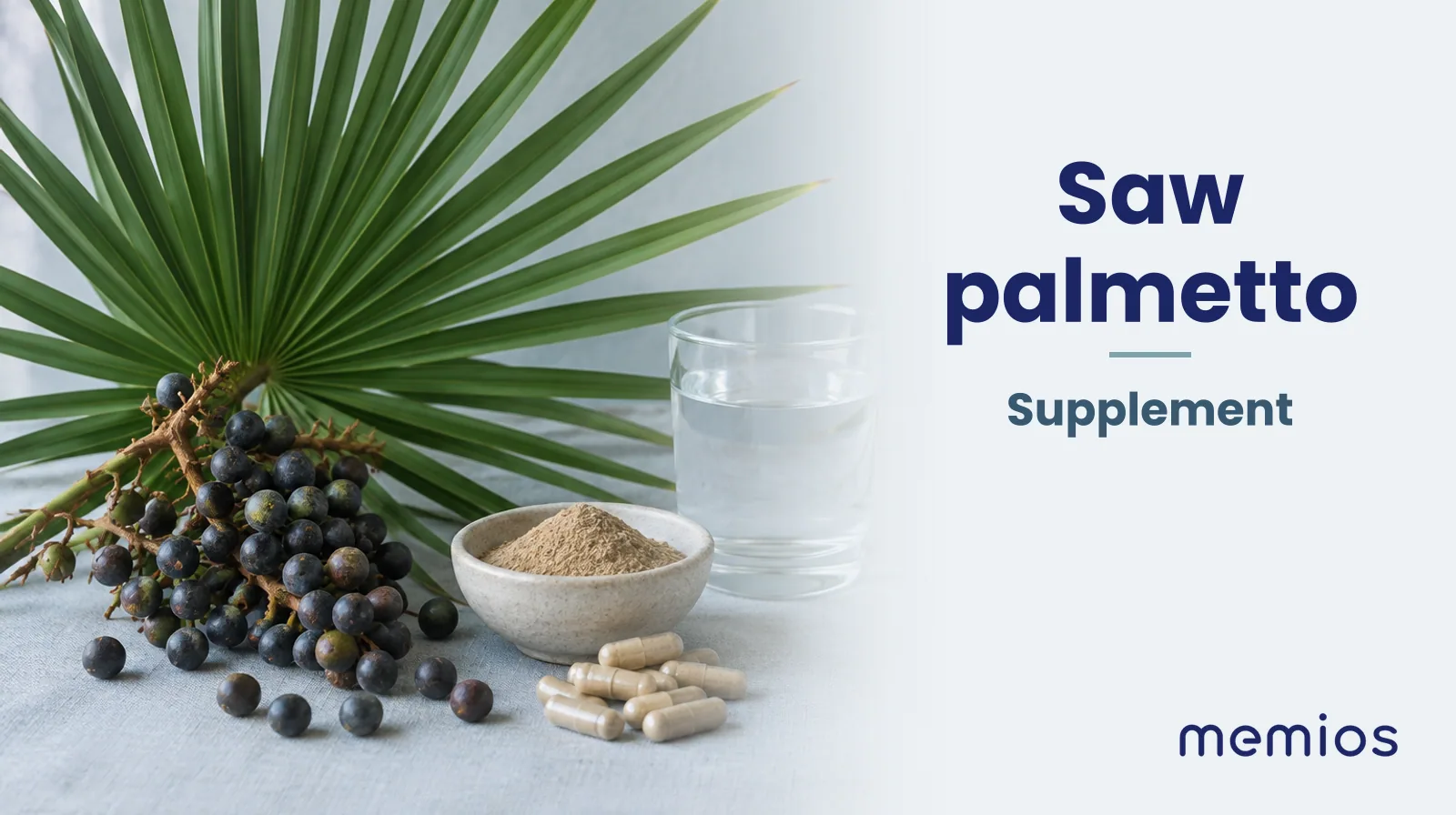
Saw palmetto is a herbal preparation made from the fruit of Serenoa repens, a low-growing bushy palm. Native Americans used the fruit both as a food and as a remedy. Its presumed active components are the volatile oils and free fatty acids, which inhibit 5-alpha-reductase in laboratory work but have not been shown to do so in humans. It is sold as liquid extracts, tablets, capsules, dried berries and teas, often combined with other supplements.
What the research says
Saw palmetto is sold mainly for urinary symptoms from an enlarged prostate, and this is one of the few supplement questions the evidence has genuinely settled. A 2023 Cochrane review of 27 placebo-controlled trials in 4,656 men rated the evidence high certainty and found essentially no difference in symptom scores, either at 3 to 6 months or at 12 to 17 months. It is also well tolerated: adverse events were no more common than on placebo. Weaker evidence, from small and low-quality studies, reports benefit for hair loss. Rare case reports describe acute pancreatitis and acute liver injury. A separate and under-appreciated problem is that commercial products differ enormously in how much of the presumed active fatty acid fraction they actually contain.
Evidence grade: Not supported by the research.
What goes wrong
A published case report describes acute pancreatitis in a man taking saw palmetto, resolving after the supplement was stopped. (Source 1)
- Case report, Very low certainty.
- Size: 1 patient.
- Who: A 61-year-old man with benign prostatic hyperplasia and reflux disease, taking saw palmetto, lansoprazole and multivitamins.
- How long: Symptoms began 36 hours before presentation; enzymes normalised by hospital day 4.
- Result: Elevated lipase and amylase with CT-confirmed peripancreatic inflammatory changes; recovery on supportive care after stopping saw palmetto.
- Funding: not stated.
We report a case of acute pancreatitis, possibly secondary to the use of saw palmetto. A 61-year-old Caucasian man with a history of benign prostatic hyperplasia and gastroesophageal reflux disease developed epigastric pain associated with nausea 36 hours prior to presentation.
Rare cases of clinically apparent liver injury have been attributed to saw palmetto, with onset within 1 to 2 weeks and resolution within 1 to 3 months. (Source 2)
- Expert review, not systematic, Low certainty.
- Size: Not quantified; rare published case reports.
- Who: People taking saw palmetto, sometimes with other possible causes of liver disease present.
- How long: Latency 1 to 2 weeks; resolution 1 to 3 months.
- Result: Hepatocellular pattern of serum enzyme elevations resembling acute viral hepatitis; LiverTox likelihood score D.
- Funding: US government agency resource (NIDDK/NIH)
However, there have been rare case reports of clinically apparent liver injury attributed to saw palmetto, although in some instances, other possible causes of liver disease were present.
Commercial saw palmetto supplements vary by roughly twentyfold in the fatty acid content believed to be responsible for any effect, with tinctures containing negligible amounts. (Source 3)
- Survey study, Low certainty.
- Size: 20 commercially available supplements.
- Who: Products, not people: liquids, powders, dried berries and tinctures bought online and locally.
- How long: Not applicable.
- Result: Total fatty acids 908.5 mg/g in liquids versus 46.3 mg/g in tinctures; total phytosterols 2.04 mg/g versus 0.10 mg/g (p < 0.05)
- Funding: not stated.
Liquid saw palmetto supplements contained significantly higher (p < 0.05) concentrations of total fatty acids (908.5 mg/g), individual fatty acids, total phytosterols (2.04 mg/g), and individual phytosterols, than the other supplement categories.
What the evidence supports
A systematic review of saw palmetto for hair loss reported hair improvements in a handful of separate small studies of assorted topical and oral saw-palmetto-containing supplements, and its authors state that robust high-quality data are lacking. (Source 4)
- Systematic review, Very low certainty.
- Size: 5 randomised clinical trials and 2 prospective cohort studies; participant totals not pooled.
- Who: Patients with androgenetic alopecia, telogen effluvium and self-perceived hair thinning.
- How long: Not pooled across studies.
- Result: Reported separately by individual studies, not pooled: 60% improvement in overall hair quality; 27% improvement in total haircount; increased hair density in 83.3% of patients; stabilised disease progression in 52%.
- Funding: not stated.
Limit of this finding: These four percentages are not a combined result. Each comes from a different individual study, and the products tested were different topical and oral preparations that contained other active ingredients as well as saw palmetto, so the numbers cannot be added together or read as the effect of saw palmetto on its own. The review's own authors say robust high-quality data are lacking and that further large trials on the sole contribution of saw palmetto are needed.
Sixty percent improvement in overall hair quality, 27% improvement in total haircount, increased hair density in 83.3% of patients, and stabilized disease progression among 52% were noted with use of various topical and oral SP-containing supplements.
What the evidence does not support
Saw palmetto taken alone made little to no difference to urinary symptom scores in men with an enlarged prostate at 3 to 6 months, on high-certainty evidence. (Source 5)
- Systematic review, High certainty.
- Size: 1,681 participants across 9 studies at low risk of bias (27 studies, 4,656 participants in the whole review)
- Who: Men mostly aged over 50 (mean age range 52 to 68) with moderate urologic symptoms (IPSS 8 to 19)
- How long: 3 to 6 months.
- Result: IPSS mean difference −0.90 (95% CI −1.74 to −0.07), I2 = 68%, on a 0 to 35 scale.
- Funding: Ten of the 27 studies were funded by the pharmaceutical industry; two by government agencies; the rest did not specify.
Serenoa repens results in little to no difference in urologic symptoms at short-term follow-up (3 to 6 months; IPSS score range 0 to 35, higher scores indicate worse symptoms; mean difference (MD) −0.90, 95% confidence interval (CI) −1.74 to −0.07; I2 = 68%; 9 studies, 1681 participants; high-certainty evidence).
The absence of benefit persisted at 12 to 17 months, with the point estimate slightly favouring placebo. (Source 5)
- Systematic review, High certainty.
- Size: 898 participants across 3 studies.
- Who: Men with lower urinary tract symptoms due to benign prostatic enlargement.
- How long: 12 to 17 months.
- Result: IPSS mean difference 0.07 (95% CI −0.75 to 0.88), I2 = 34%.
- Funding: Mixed; industry funding in ten of the review's 27 studies.
Serenoa repens results in little to no difference in urologic symptoms at long-term follow-up (12 to 17 months, IPSS score, MD 0.07, 95% CI −0.75 to 0.88; I2 = 34%; 3 studies, 898 participants; high-certainty evidence).
Saw palmetto did not increase adverse events compared with placebo across a year of follow-up. (Source 5)
- Systematic review, Moderate certainty.
- Size: 2,399 participants across 12 studies.
- Who: Men with lower urinary tract symptoms due to benign prostatic enlargement.
- How long: 1 to 17 months.
- Result: RR 1.01 (95% CI 0.77 to 1.31), I2 = 18%; 2 more events per 1000 men (38 fewer to 51 more) against a placebo rate of 164 per 1000.
- Funding: Mixed; ten of 27 studies industry-funded.
Serenoa repens probably results in little to no difference in adverse events (1 to 17 months; risk ratio (RR) 1.01, 95% CI 0.77 to 1.31; I2 = 18%; 12 studies, 2399 participants; moderate-certainty evidence).
NIH's complementary health centre states the question is settled enough to conclude saw palmetto is probably not helpful for prostate-related urinary symptoms. (Source 6)
- Official position, Certainty not rated.
- Size: Refers to a 2023 review of 27 studies and two NIH-funded trials.
- Who: Men with benign prostatic hyperplasia.
- How long: Not stated.
- Result: Includes the finding that hexane-extracted products did no better than others.
- Funding: US government agency (NCCIH), page dated April 2025.
Many studies have been conducted on the usefulness of saw palmetto for urinary tract symptoms associated with prostate enlargement in men. We know enough to conclude that saw palmetto is probably not helpful for this purpose.
Raising the dose to three times the usual amount did not improve symptoms in an NIH-funded trial included in the Cochrane review. (Source 6)
- Official position, Certainty not rated.
- Size: Two NIH-funded trials, sizes not stated on the page.
- Who: Men with benign prostatic hyperplasia.
- How long: Not stated on the page.
- Result: No improvement in BPH symptoms at standard or escalating doses.
- Funding: US National Institutes of Health funded the trials; page published by NCCIH, April 2025.
One tested a standard dose of saw palmetto; the other tested increasing doses of saw palmetto, up to three times the usual dose. In both studies, saw palmetto did not improve BPH symptoms.
Where the evidence is mixed
Combinations of saw palmetto with other herbal products showed a nominal symptom improvement, but the reviewers rated this low-certainty and said it may amount to little or no difference. (Source 7)
- Systematic review, Low certainty.
- Size: 460 participants across 4 studies.
- Who: Men with lower urinary tract symptoms.
- How long: 12 to 24 weeks.
- Result: IPSS mean difference −2.41 (95% CI −4.54 to −0.29), I2 = 67%, low-certainty evidence (reported in the review abstract)
- Funding: Mixed across the review's studies.
Serenoa repens in combination with other herbal products may result in little to no difference in urinary tract symptoms, but there is more uncertainty about effects on quality of life and adverse events.
A third of the trials in the Cochrane review were funded by the pharmaceutical industry, and most of the remainder did not state a funding source. (Source 5)
- Systematic review, High certainty.
- Size: 27 studies, 4,656 participants.
- Who: Men with lower urinary tract symptoms due to benign prostatic enlargement.
- How long: Trials ran from 1 to 17 months.
- Result: Ten industry-funded, two government-funded, remainder unspecified.
- Funding: Mixed, as quoted.
Ten studies were funded by the pharmaceutical industry; two studies were funded by government agencies; and the remaining studies did not specify funding sources.
Where the research disagrees
Whether short-term trials showing symptom improvement mean saw palmetto works for an enlarged prostate
- LiverTox (NIDDK/NIH) background summary, narrative summary of clinical trials: In short term clinical trials, saw palmetto appeared to be beneficial in improving symptoms of prostatic hypertrophy, but it had no effects on prostate size or serum prostatic specific antigen (PSA) levels. (Source 8)
- Cochrane review authors, 2023, systematic review of 27 placebo-controlled trials with sensitivity analysis restricted to low risk-of-bias studies, high-certainty GRADE rating: Based on the most trustworthy studies, Serenoa repens alone results in little to no difference in urinary tract symptoms or quality of life compared to placebo at three to six months. (Source 7)
How much
- Reference intake: No reference intake (RDA or AI) exists. Saw palmetto is a herbal preparation used as a treatment, not an essential nutrient, so no body has set a dietary requirement. (Source 8)
- Upper limit: No tolerable upper intake level or ADI has been set. NCCIH (April 2025) describes safety in terms of the length of exposure studied rather than a maximum dose. (Source 6)
- Studied: Trials pooled by Cochrane enrolled men mostly over 50 with moderate symptoms (IPSS 8 to 19) and ran from 1 to 17 months. (Source 5)
- Studied: Alopecia studies used topical and oral supplements containing 100 to 320 mg of saw palmetto. (Source 4)
- Studied: One NIH-funded trial tested a standard dose and another escalated to up to three times the usual dose. (Source 6)
A common belief, and what the research shows
The belief: Saw palmetto shrinks the prostate and relieves urinary symptoms; the trials that found nothing must have used the wrong kind of extract.
What the research shows: The Cochrane reviewers tested that explanation directly and it did not hold. NCCIH summarises the result: 'No difference was found in the effects of the two kinds of products on BPH symptoms.' The pooled symptom difference against placebo was 'mean difference (MD) −0.90, 95% confidence interval (CI) −1.74 to −0.07' on a 0 to 35 scale, rated high-certainty. A separate NIH-funded trial escalated the dose: 'In both studies, saw palmetto did not improve BPH symptoms.'
Questions and answers
What is it?
Saw palmetto is a herbal extract made from the fruit of Serenoa repens, a low-growing bushy palm native to the south-eastern United States. It is sold as liquid extracts, tablets, capsules, dried berries and teas. It is one of the most widely used herbal products in the world. (Source 8)
What does it do in the body?
The fatty acids and volatile oils in the extract block 5-alpha-reductase, the enzyme that converts testosterone to dihydrotestosterone, in laboratory experiments. That is the proposed mechanism behind its use for prostate and hair-loss problems. The same effect has not been demonstrated in humans, and in trials saw palmetto did not change prostate size or PSA levels. (Source 8)
Is it good or bad for you?
For the use it is mostly sold for, urinary symptoms from an enlarged prostate, the best evidence says it does not work, and that conclusion is rated high certainty rather than uncertain. It is, however, unusually well tolerated, with adverse event rates no different from placebo. The realistic harm is not a side effect but an opportunity cost, plus rare reports of pancreatitis and liver injury. (Source 7)
How do you get more of it?
It is not a dietary component people need more of. As studied, it is taken as a manufactured extract. Formulations differ substantially in how much of the presumed active fraction they contain, so two products at the same labelled dose are not interchangeable. (Source 8)
If it is harmful, what reduces it?
Stopping the supplement is what the case literature describes. In the reported case of acute pancreatitis the patient recovered on supportive care within four days and was told to avoid saw palmetto thereafter. In the rare liver injury cases summarised by LiverTox, enzyme abnormalities resolved within one to three months of stopping. (Source 1)
Why might someone be low in it or missing it?
The question does not apply. Saw palmetto is a herbal remedy rather than a nutrient the body requires, so there is no deficiency state and no reason a person would be low in it. Someone has it in their system only while taking a product that contains it. (Source 8)
We searched: Searched LiverTox, NCCIH and the 2023 Cochrane review for any account of a saw palmetto requirement, deficiency or depletion; all three describe it only as a herbal medication taken by choice.
Which whole foods contain it or feed it?
The saw palmetto fruit itself was historically eaten as a food by Native Americans, and dried berries are still sold. But no ordinary supermarket food contains it, and nothing in a normal diet feeds or supplies it. Any meaningful exposure comes from a deliberately taken preparation. (Source 8)
What happens if you do not have it?
Nothing happens, because there is no deficiency state. The most direct evidence is the placebo arms of 27 randomised trials: men who did not take saw palmetto had essentially the same urinary symptom scores as men who did. For uses other than prostate symptoms, NIH states there is not enough evidence even to say whether it does anything. (Source 6)
How can you test for it?
There is no clinical test for saw palmetto status in a person, and none would be meaningful. What is testable is the product: laboratories quantify the fatty acids and phytosterols by gas chromatography. That testing has shown large differences between product types, with tinctures containing only a small fraction of the fatty acids found in liquid extracts, which is not visible from the label. (Source 3)
References
- Journal of Medical Case Reports. Acute pancreatitis with saw palmetto use: a case report. 2011. PMID 21867545, DOI 10.1186/1752-1947-5-414. Read the source
- National Institute of Diabetes and Digestive and Kidney Diseases (NCBI Bookshelf). Saw Palmetto — LiverTox: Clinical and Research Information on Drug-Induced Liver Injury (Hepatotoxicity). 2020. PMID 31643699. Read the source
- Nutrients. Fatty Acid and Phytosterol Content of Commercial Saw Palmetto Supplements. 2013. PMID 24067389, DOI 10.3390/nu5093617. Read the source
- Skin Appendage Disorders. Natural Hair Supplement: Friend or Foe? Saw Palmetto, a Systematic Review in Alopecia. 2020. PMID 33313047, DOI 10.1159/000509905. Read the source
- Cochrane Database of Systematic Reviews. Serenoa repens for the treatment of lower urinary tract symptoms due to benign prostatic enlargement (Abstract: Main results). 2023. PMID 37345871, DOI 10.1002/14651858.CD001423.pub4. Read the source
- National Center for Complementary and Integrative Health (NIH). Saw Palmetto: Usefulness and Safety. 2025. Read the source
- Cochrane Database of Systematic Reviews. Serenoa repens for benign prostatic hyperplasia (Plain language summary: Key results and Certainty of the evidence). 2023. PMID 37345871, DOI 10.1002/14651858.CD001423.pub4. Read the source
- National Institute of Diabetes and Digestive and Kidney Diseases (NCBI Bookshelf). Saw Palmetto — LiverTox: Clinical and Research Information on Drug-Induced Liver Injury (Background). 2020. PMID 31643699. Read the source