Supplements · September 30, 2026 · Memios · 9 min read
Riboflavin
Riboflavin's coenzymes are needed for energy production, growth and metabolism of fats and drugs.
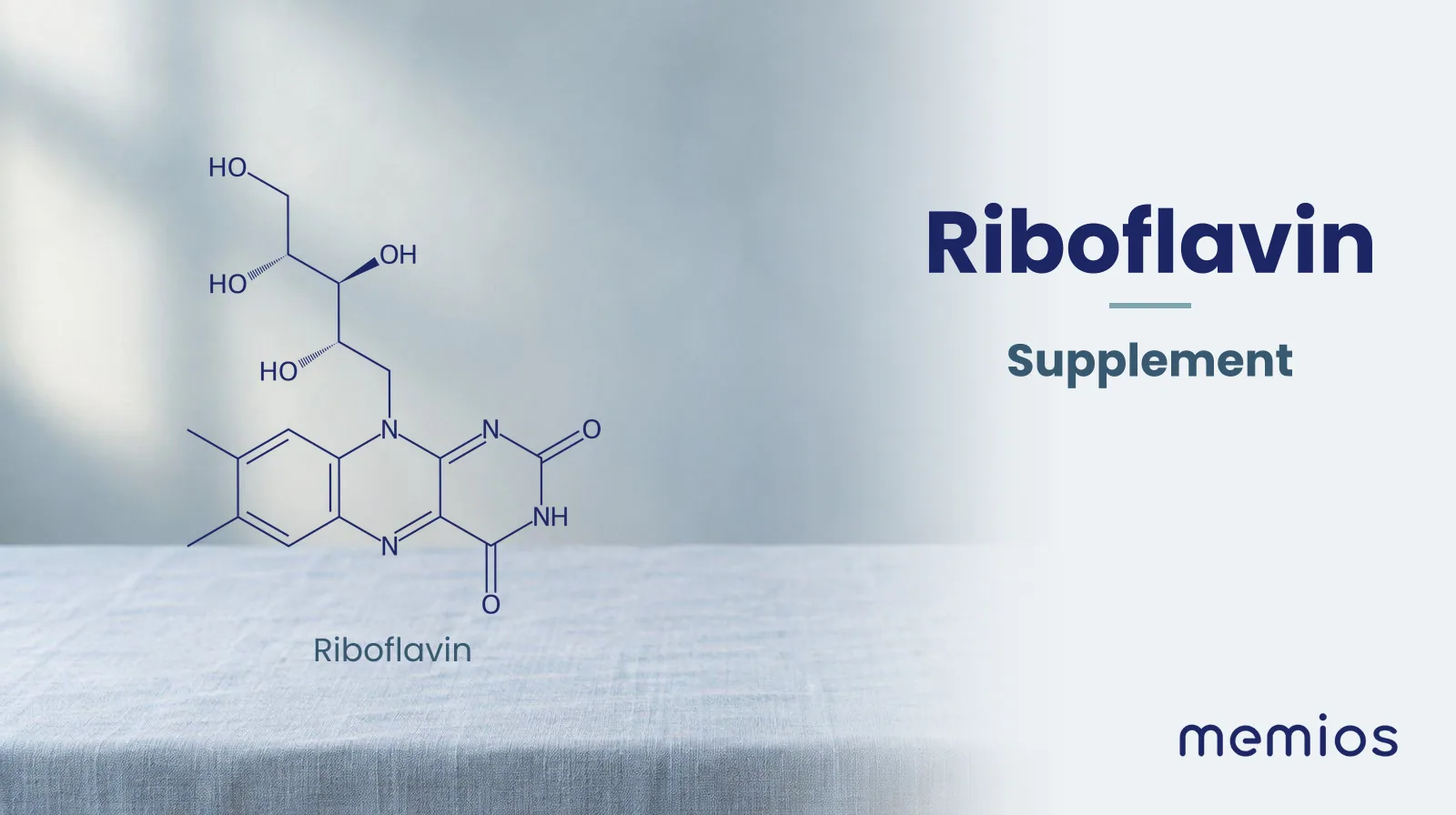
TLDR
- Limited evidence. Riboflavin's coenzymes are needed for energy production, growth and metabolism of fats and drugs.
- What it is: Riboflavin is vitamin B2, a water-soluble B vitamin. It is a component of two coenzymes, flavin mononucleotide (FMN) and flavin adenine dinucleotide (FAD).
- Main use, supported: In a 3-month randomised placebo-controlled trial, 400 mg/day riboflavin reduced migraine attack frequency and headache days in adults, with 59% responders vs 15% on placebo. (low certainty)
- Other use, supported: The same trial found riboflavin superior to placebo on attack frequency and headache days. (low certainty)
- Claim NOT supported by research: A randomised double-blind crossover trial in children found 50 mg/day riboflavin did not reduce migraine frequency more than placebo. (low certainty)
- Another claim NOT supported: The MacLennan et al. 2008 placebo-controlled trial in 48 Australian children given 200 mg/day for 12 weeks found no significant difference in migraine attacks (as summarised by Sherwood and Goldman's 2014 review. (low certainty)
- Recommended dose (official position): RDA 1.3 mg/day for adult men and 1.1 mg/day for adult women (1.4 mg in pregnancy, 1.6 mg in lactation), US Food and Nutrition Board, as reported by NIH ODS 2022.
- Studied dose (a trial dose, not a recommendation): Adult migraine trial gave 400 mg/day for 3 months. Findings citing that trial: 2 for, 1 on harm.
- Upper limit: No UL set by the US Food and Nutrition Board, because adverse effects from high intakes (400 mg/day for at least 3 months) have not been reported (NIH ODS 2022).
- What goes wrong: 3 findings on harm. In the adult trial, adverse events were minor: diarrhoea and frequent urination on riboflavin, cramps on placebo; none serious.
- Common myth: Riboflavin prevents migraine in everyone, including children.
What it is
Riboflavin is vitamin B2, a water-soluble B vitamin. It is a component of two coenzymes, flavin mononucleotide (FMN) and flavin adenine dinucleotide (FAD).
What the research says
Riboflavin's coenzymes are needed for energy production, growth and metabolism of fats and drugs. The main supplement claim is migraine prevention: a small 1998 randomised trial in 55 adults found 400 mg/day reduced attacks, and reviews call adult evidence positive but insufficient for firm recommendations. In children, two randomised trials found no significant benefit over placebo. Side effects in trials were minor (diarrhoea, frequent urination, orange urine).
Evidence grade: Limited evidence.
What goes wrong
In the adult trial, adverse events were minor: diarrhoea and frequent urination on riboflavin, cramps on placebo; none serious. (Source 1)
- Randomized trial, Low certainty.
- Size: 55 patients.
- Who: Adults with migraine.
- How long: 3 months.
- Result: 2 minor adverse events on riboflavin, 1 on placebo.
- Funding: Not stated.
Three minor adverse events occurred, two in the riboflavin group (diarrhea and polyuria) and one in the placebo group (abdominal cramps). None was serious.
Across adult and paediatric studies summarised in a 2014 review, side effects were limited to occasional diarrhoea, orange urine and vomiting. (Source 2)
- Systematic review, Low certainty.
- Size: Several paediatric studies.
- Who: Children with migraine.
- How long: Varied.
- Result: Limited reports; rates not given.
- Funding: Not stated.
In both adult and pediatric riboflavin studies, there have been only limited reports of diarrhea, orange-coloured urine, and vomiting.
Position (NIH ODS, updated 2022): riboflavin has no known clinically relevant drug interactions. (Source 3)
- Official position, Certainty not rated.
- Size: Not applicable.
- Who: General population.
- How long: Not applicable.
- Result: No known interactions.
- Funding: Government.
Riboflavin is not known to have any clinically relevant interactions with medications.
What the evidence supports
In a 3-month randomised placebo-controlled trial, 400 mg/day riboflavin reduced migraine attack frequency and headache days in adults, with 59% responders vs 15% on placebo. (Source 1)
- Randomized trial, Low certainty.
- Size: 55 patients.
- Who: Adults with migraine.
- How long: 3 months.
- Result: Attack frequency p = 0.005; headache days p = 0.012; responders 59% vs 15% (p = 0.002)
- Funding: Not stated.
the proportion of patients who improved by at least 50%, i.e. 'responders,' was 15% for placebo and 59% for riboflavin (p = 0.002)
The same trial found riboflavin superior to placebo on attack frequency and headache days. (Source 1)
- Randomized trial, Low certainty.
- Size: 55 patients.
- Who: Adults with migraine.
- How long: 3 months.
- Result: p = 0.005 and p = 0.012.
- Funding: Not stated.
riboflavin was superior to placebo in reducing attack frequency (p = 0.005) and headache days (p = 0.012)
Position (NIH ODS 2022, reporting AAN/AHS guidance): the American Academy of Neurology and American Headache Society concluded riboflavin is probably effective for preventing migraine. (Source 3)
- Official position, Certainty not rated.
- Size: Not applicable.
- Who: Adults with migraine.
- How long: Not applicable.
- Result: Not applicable.
- Funding: Professional societies.
concluded that riboflavin is probably effective for preventing migraine headaches
What the evidence does not support
A randomised double-blind crossover trial in children found 50 mg/day riboflavin did not reduce migraine frequency more than placebo. (Source 4)
- Randomized trial, Low certainty.
- Size: 42 children.
- Who: Children aged 6-13 with migraine.
- How long: Crossover; last treatment month compared.
- Result: No significant difference (P = 0.44)
- Funding: Not stated.
No significant difference in the reduction of mean frequency of migraine attacks in the last month of treatment was found between placebo and riboflavin (P = 0.44)
The MacLennan et al. 2008 placebo-controlled trial in 48 Australian children given 200 mg/day for 12 weeks found no significant difference in migraine attacks (as summarised by Sherwood and Goldman's 2014 review, not their own study). (Source 2)
- Randomized trial, Low certainty.
- Size: 48 children.
- Who: Children aged 5-15 with migraine.
- How long: 12 weeks.
- Result: No significant difference in attacks over 4 weeks.
- Funding: Not stated.
there was no significant difference in the number of migraine attacks over 4 weeks when compared with those receiving placebo.
A 2014 clinical review concluded riboflavin does not show effectiveness in preventing migraine in children. (Source 2)
- Systematic review, Low certainty.
- Size: Several paediatric studies.
- Who: Children with migraine.
- How long: Varied.
- Result: Not pooled.
- Funding: Not stated.
riboflavin does not show effectiveness in preventing migraine in children, and is not currently recommended for that indication.
Where the evidence is mixed
A review of eleven studies found riboflavin may reduce migraine frequency and duration in adults, but concluded evidence is insufficient for recommendations in adults or children. (Source 5)
- Systematic review, Low certainty.
- Size: 11 studies (7 adult, 4 paediatric)
- Who: Adults and children with migraine.
- How long: Varied.
- Result: No pooled estimate reported in the abstract.
- Funding: Not stated.
there is insufficient evidence to make recommendations regarding vitamin B2 as an adjunct therapy in adults and children with migraine.
A US Dietary Supplement Ingredient Database analysis found multivitamins' measured riboflavin tended to exceed the labelled amount. (Source 6)
- Survey study, Moderate certainty.
- Size: National sample of adult multivitamin/mineral products.
- Who: Adult multivitamin/mineral products sold in the US.
- How long: Not applicable.
- Result: Predicted mean excess over label 1.5-13% for several nutrients including riboflavin.
- Funding: Government (USDA/NIH database program)
Predicted mean percentage differences exceeded labeled amounts by 1.5–13% for copper, manganese, magnesium, niacin, phosphorus, potassium, folic acid, riboflavin, and vitamins B-12, C, and E
Where the research disagrees
Whether riboflavin should be used to prevent migraine
- American Academy of Neurology and American Headache Society (as reported by NIH ODS, 2022), Guideline based largely on small adult trials: concluded that riboflavin is probably effective for preventing migraine headaches (Source 3)
- Namazi et al. review, 2015, Review of 11 studies: there is insufficient evidence to make recommendations regarding vitamin B2 as an adjunct therapy in adults and children with migraine. (Source 5)
- Sherwood and Goldman, 2014 (children), Clinical review of paediatric trials: riboflavin does not show effectiveness in preventing migraine in children, and is not currently recommended for that indication. (Source 2)
How much
- Reference intake: RDA 1.3 mg/day for adult men and 1.1 mg/day for adult women (1.4 mg in pregnancy, 1.6 mg in lactation), US Food and Nutrition Board, as reported by NIH ODS 2022. (Source 3)
- Upper limit: No UL set by the US Food and Nutrition Board, because adverse effects from high intakes (400 mg/day for at least 3 months) have not been reported (NIH ODS 2022). (Source 3)
- Studied: Adult migraine trial gave 400 mg/day for 3 months. (Source 1)
- Studied: Paediatric trials gave 50 mg/day (crossover) and 200 mg/day for 12 weeks. (Source 4)
A common belief, and what the research shows
The belief: Riboflavin prevents migraine in everyone, including children.
What the research shows: In children, a trial found "No significant difference in the reduction of mean frequency of migraine attacks in the last month of treatment was found between placebo and riboflavin (P = 0.44)"; adult evidence rests largely on a 55-person trial.
Questions and answers
What is it?
Riboflavin is vitamin B2, one of the water-soluble B vitamins. The body uses it to build two coenzymes, FMN and FAD. (Source 3)
What does it do in the body?
Its coenzymes are needed for energy production, cell growth and development, and breaking down fats, drugs and steroids. (Source 3)
Is it good or bad for you?
Riboflavin is essential and high intakes have no reported serious harms. For migraine prevention, one small adult trial was positive, but trials in children were negative. (Source 3)
How do you get more of it?
Riboflavin comes from eggs, organ meats, lean meats and milk, and from supplements. The body absorbs little from any single dose above about 27 mg, and light destroys riboflavin in foods. (Source 3)
If it is harmful, what reduces it?
Does not apply. Riboflavin is not considered harmful at high intakes; bright or orange urine is a harmless effect reported in trials. (Source 2)
Why might someone be low in it or missing it?
Risk is higher in vegans and people who drink little milk, pregnant or breastfeeding women who rarely eat meat or dairy, vegetarian athletes, newborns treated with prolonged light therapy, and people with the rare inherited riboflavin transporter deficiency. (Source 3)
Which whole foods contain it or feed it?
Eggs, organ meats such as kidney and liver, lean meats and milk are particularly rich sources. (Source 3)
What happens if you do not have it?
Deficiency (ariboflavinosis) causes skin problems, a sore swollen mouth and throat, cracks at the corners of the mouth, hair loss and itchy red eyes; severe, prolonged deficiency can cause anaemia and cataracts. (Source 3)
How can you test for it?
The usual test is the erythrocyte glutathione reductase activity coefficient (EGRAC): 1.2 or less is adequate and above 1.4 indicates deficiency. It does not track severity well and cannot be used in people with G6PD deficiency. (Source 3)
References
- Neurology. Effectiveness of high-dose riboflavin in migraine prophylaxis: A randomized controlled trial. 1998. DOI 10.1212/WNL.50.2.466. Read the source
- Canadian Family Physician. Effectiveness of riboflavin in pediatric migraine prevention. 2014. Read the source
- NIH Office of Dietary Supplements. Riboflavin: Fact Sheet for Health Professionals. 2022. Read the source
- Cephalalgia. Medium-dose riboflavin as a prophylactic agent in children with migraine: a preliminary placebo-controlled, randomised, double-blind, cross-over trial. 2010. PMID 20974610, DOI 10.1177/0333102410365106. Read the source
- International Journal for Vitamin and Nutrition Research. Supplementation with Riboflavin (Vitamin B2) for Migraine Prophylaxis in Adults and Children: A Review. 2015. DOI 10.1024/0300-9831/a000225. Read the source
- The American Journal of Clinical Nutrition. Analytical ingredient content and variability of adult multivitamin/mineral products: national estimates for the Dietary Supplement Ingredient Database. 2017. DOI 10.3945/ajcn.116.134544. Read the source