Supplements · September 29, 2026 · Memios · 13 min read
Rhodiola
It is sold as an adaptogen for fatigue, stress, low mood and exercise performance, but the evidence is weak and contradictory.
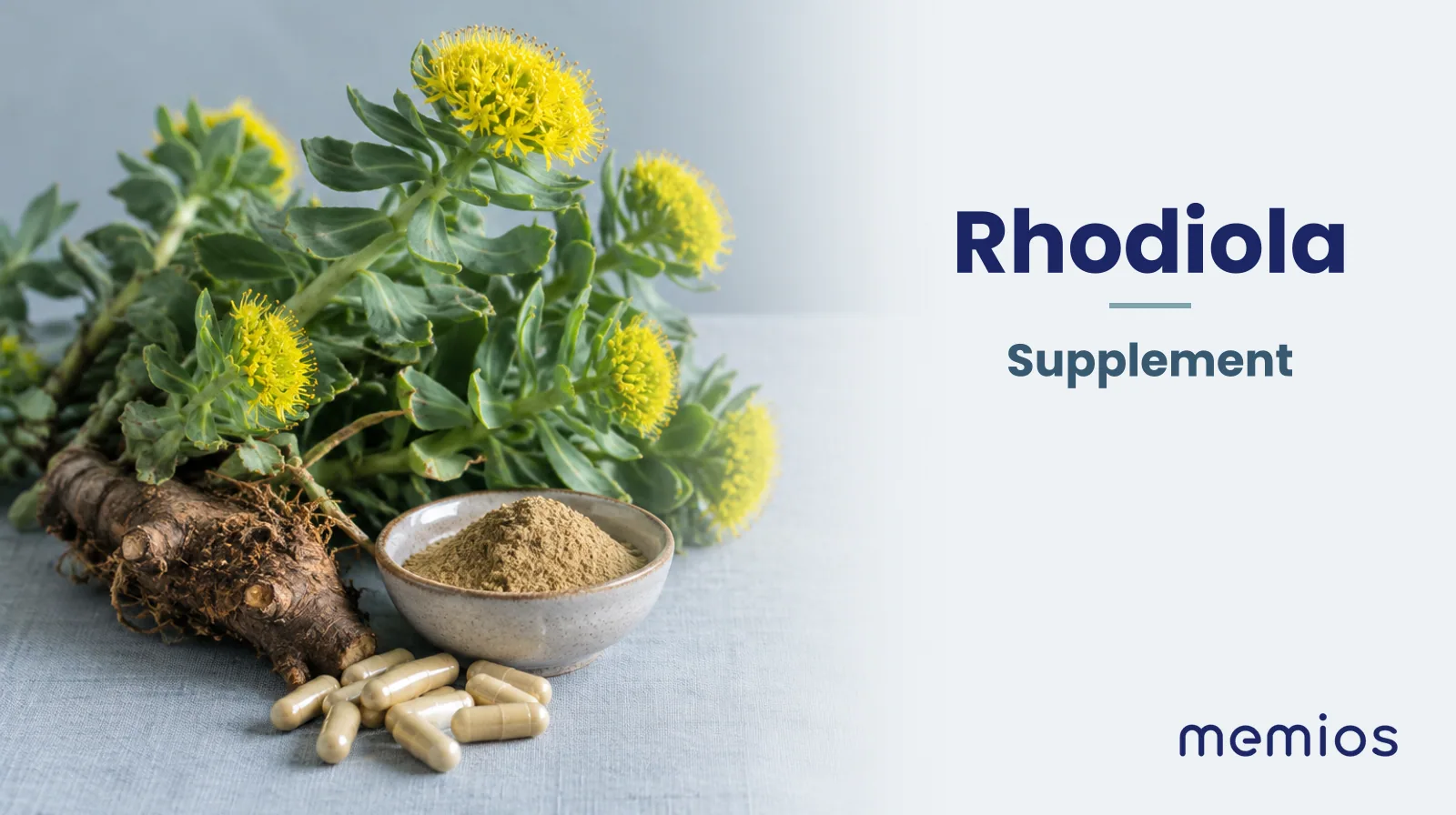
TLDR
- Disputed. It is sold as an adaptogen for fatigue, stress, low mood and exercise performance, but the evidence is weak and contradictory.
- What it is: Rhodiola preparations are made from the rhizome and root of Rhodiola rosea L., a plant of cold northern and mountainous regions.
- Main use, supported: A 2025 meta-analysis of 26 randomised trials reported small improvements in endurance performance markers with Rhodiola supplementation. (low certainty)
- Claim NOT supported by research: In that endurance meta-analysis, Rhodiola had no significant effect on inflammatory markers. (low certainty)
- Another claim NOT supported: In a randomised placebo-controlled trial against sertraline for mild to moderate depression, none of the between-group differences in depression scores reached statistical significance. (low certainty)
- Recommended dose: not established. No dietary reference intake exists for rhodiola; it is a botanical preparation rather than a nutrient, and in the EU it is registered only on the basis of long-standing traditional use.
- Studied dose (a trial dose, not a recommendation): The endurance meta-analysis pooled trials with a mean intervention duration of 33 days in healthy participants with a mean age of 22.0 years. Findings citing that trial: 1 for, 1 against.
- Upper limit: No tolerable upper intake level or acceptable daily intake was found from a food safety body in this search.
- What goes wrong: 4 findings on harm. DNA barcoding of commercial Rhodiola decoction-piece samples bought in Chinese drug stores and hospitals found that only 36 were the pharmacopoeia species R. crenulata, with the rest identified as other Rhodiola species.
- Common myth: Rhodiola is a clinically proven adaptogen for fatigue and burnout.
What it is
Rhodiola preparations are made from the rhizome and root of Rhodiola rosea L., a plant of cold northern and mountainous regions. In the European Union it is registered only as a traditional herbal medicinal product, on the basis of long-standing use rather than clinical proof. Commercial extracts are usually standardised to rosavins and salidroside. It is a botanical preparation, not a nutrient, so no dietary reference intake exists.
What the research says
It is sold as an adaptogen for fatigue, stress, low mood and exercise performance, but the evidence is weak and contradictory. The systematic review that looked hardest at fatigue could not pool the trials at all because no two measured the same outcome, and judged every included study to be at high or unclear risk of bias. A US government body states there is not enough reliable evidence to say rhodiola is useful for any health purpose. A meta-analysis of endurance trials does report performance benefits, but in small studies of young healthy people. In a head-to-head trial against sertraline for depression, none of the between-group differences reached statistical significance. A separate and practical problem is product identity: DNA testing of commercial Rhodiola material has found high rates of species substitution.
Evidence grade: Disputed.
What goes wrong
In that trial, adverse events were reported by 30% of the Rhodiola group compared with 16.7% of the placebo group. (Source 1)
- Randomized trial, Low certainty.
- Size: 57 subjects (R. rosea n=20, sertraline n=19, placebo n=18)
- Who: Adults with mild to moderate major depressive disorder.
- How long: 12 weeks.
- Result: Adverse events reported by 63.2% on sertraline, 30.0% on R. rosea and 16.7% on placebo (p = 0.012)
- Funding: not stated.
more subjects on sertraline reported adverse events (63.2%) than R. rosea (30.0%) or placebo (16.7%) (p = 0.012)
DNA barcoding of commercial Rhodiola decoction-piece samples bought in Chinese drug stores and hospitals found that only 36 were the pharmacopoeia species R. crenulata, with the rest identified as other Rhodiola species. (Source 2)
- Survey study, Moderate certainty.
- Size: 100 commercial samples, against a reference database built from 82 voucher samples of 10 Rhodiola species.
- Who: Rhodiolae Crenulatae Radix et Rhizoma decoction pieces purchased from drug stores and hospitals.
- How long: Not applicable.
- Result: 36 samples reported as authentic R. crenulata (given as 40%); 35 as R. serrata (38.9%); nine as R. rosea (10%); the rest as three other Rhodiola species.
- Funding: not stated.
Limit of this finding: The abstract says 100 samples were tested but gives 36 samples as 40%, 35 as 38.9% and nine as 10%. Those percentages only work out if about 90 samples were counted, perhaps the ones that produced a usable DNA sequence, but the abstract does not say so. Read this as: well under half of the samples were the labelled species. Do not read 40% as 40 out of 100.
The results showed that only 36 decoction piece sequences (40%) were authentic R. crenulata, which is recorded in Chinese Pharmacopeia, whereas the other samples were all adulterants and may indicate a potential safety issue.
That same body lists dizziness, headache, insomnia and dry mouth or excess saliva as possible side effects, reports an interaction with losartan, and states that little is known about safety in pregnancy or breastfeeding. (Source 3)
- Official position, Certainty not rated.
- Size: Not applicable.
- Who: Adults using rhodiola.
- How long: Described as possibly safe for up to 12 weeks.
- Result: Side effects listed qualitatively; a drug interaction with losartan has been reported.
- Funding: independent.
Rhodiola is possibly safe for up to 12 weeks. Side effects may include dizziness, headache, insomnia, and either dry mouth or excessive saliva production.
The current EU herbal monograph (2024 revision) lists headache, nausea, abdominal pain, diarrhoea, skin rash and itching as undesirable effects of rhodiola, with how often they occur not known; the earlier 2012 version had listed none. (Source 4)
- Official position, Certainty not rated.
- Size: Not applicable (regulatory monograph)
- Who: Adults using traditional herbal medicinal products containing Rhodiola rosea root and rhizome.
- How long: Not applicable.
- Result: Headache; nausea, abdominal pain, diarrhoea; skin rash, itching. Frequency not known for each. Replaces 'None known' in the superseded 2012 monograph.
- Funding: Not applicable (EU regulator)
Nervous system disorders: Headache. The frequency is not known. Gastrointestinal disorders: Nausea, abdominal pain, diarrhoea. The frequency is not known. Skin and subcutaneous tissue disorders: Skin rash, itching. The frequency is not known.
What the evidence supports
A 2025 meta-analysis of 26 randomised trials reported small improvements in endurance performance markers with Rhodiola supplementation. (Source 5)
- Meta-analysis, Low certainty.
- Size: 26 randomised controlled trials, 668 healthy participants.
- Who: Healthy participants with a mean age of 22.0 ± 10.7 years.
- How long: Mean intervention duration 33 days.
- Result: VO2max ES = 0.32 (11 studies, p < 0.01); time to exhaustion ES = 0.38 (7 studies, p < 0.05); time trial performance ES = -0.40 (5 studies, p < 0.05)
- Funding: not stated.
The results indicated that RR supplementation significantly improved endurance-related outcomes, including VO2max (11 studies; ES = 0.32, p < 0.01), time to exhaustion (TTE; 7 studies; ES = 0.38, p < 0.05), and time trial performance (TTP; 5 studies; ES = −0.40, p < 0.05).
What the evidence does not support
In that endurance meta-analysis, Rhodiola had no significant effect on inflammatory markers. (Source 5)
- Meta-analysis, Low certainty.
- Size: 26 randomised controlled trials, 668 healthy participants.
- Who: Healthy young adults.
- How long: Mean 33 days.
- Result: No significant effect on interleukin-6 or C-reactive protein.
- Funding: not stated.
No significant effects were observed on inflammatory markers, including interleukin-6 (IL-6) and C-reactive protein (CRP).
In a randomised placebo-controlled trial against sertraline for mild to moderate depression, none of the between-group differences in depression scores reached statistical significance. (Source 1)
- Randomized trial, Low certainty.
- Size: 57 subjects randomised.
- Who: Adults with mild to moderate major depressive disorder.
- How long: 12 weeks.
- Result: HAM-D, BDI and CGI/C changes did not differ significantly between groups (p = 0.79, p = 0.28, p = 0.17). HAM-D decline was -8.2 (95% CI -12.7 to -3.6) for sertraline, -5.1 (95% CI -8.8 to -1.3) for R. rosea and -4.6 (95% CI -8.6 to -0.6) for placebo.
- Funding: not stated.
Modest, albeit statistically non-significant, reductions were observed for HAM-D, BDI, and CGI/C scores for all treatment conditions with no significant difference between groups (p = 0.79, p = 0.28, and p = 0.17, respectively).
Where the evidence is mixed
A systematic review of Rhodiola rosea for physical and mental fatigue found the research contradictory and could not perform a meta-analysis because no two trials measured the same outcomes. (Source 6)
- Systematic review, Very low certainty.
- Size: 11 trials met inclusion criteria out of 206 unique articles identified.
- Who: Healthy and clinical populations with physical or mental fatigue.
- How long: Varied across trials.
- Result: Two of six trials examining physical fatigue in healthy populations reported an effect; three of five RCTs evaluating mental fatigue reported an effect; no pooled estimate was possible.
- Funding: not stated.
None of the studies examining R. rosea examining physical or mental fatigue measured outcomes consistently - no two studies reported the same outcomes. As such, meta-analysis could not be performed.
The authors of that same review stated that every included Rhodiola trial was at high or unclear risk of bias. (Source 7)
- Systematic review, Very low certainty.
- Size: 11 trials.
- Who: Participants in Rhodiola rosea trials for fatigue.
- How long: Varied.
- Result: No trial was free of plausible bias.
- Funding: not stated.
All of the included studies exhibit either a high risk of bias or have reporting flaws that hinder assessment of their true validity (unclear risk of bias).
What official bodies say
The US National Center for Complementary and Integrative Health states there is not enough reliable evidence that rhodiola is useful for any health purpose and describes most human research as low-to-moderate quality. (Source 3)
- Official position, Certainty not rated.
- Size: Not applicable.
- Who: General public.
- How long: Not applicable.
- Result: Qualitative assessment of the evidence base.
- Funding: independent.
There isn't enough reliable evidence to determine whether rhodiola or its components are useful for any health-related purpose.
In the European Union, Rhodiola rosea is recognised only as a traditional herbal medicinal product for the relief of stress symptoms such as fatigue and exhaustion, on the basis of long-standing use rather than clinical evidence of efficacy. (Source 4)
- Official position, Certainty not rated.
- Size: Not applicable.
- Who: Adults in the EU.
- How long: Not applicable.
- Result: Registration category is traditional use (2024 revision of the EU monograph); the monograph states use in pregnancy and lactation is not recommended and use under 18 is not recommended.
- Funding: independent.
The product is a traditional herbal medicinal product for use in specified indications exclusively based upon long-standing use.
Where the research disagrees
Whether rhodiola has any demonstrated clinical usefulness
- US National Center for Complementary and Integrative Health, position statement summarising the human research base: There isn't enough reliable evidence to determine whether rhodiola or its components are useful for any health-related purpose. (Source 3)
- Wang and colleagues, 2025 endurance meta-analysis, meta-analysis of 26 randomised controlled trials in 668 healthy young participants: The results indicated that RR supplementation significantly improved endurance-related outcomes, including VO2max (11 studies; ES = 0.32, p < 0.01), time to exhaustion (TTE; 7 studies; ES = 0.38, p < 0.05), and time trial performance (TTP; 5 studies; ES = −0.40, p < 0.05). (Source 5)
How much
- Reference intake: No dietary reference intake exists for rhodiola; it is a botanical preparation rather than a nutrient, and in the EU it is registered only on the basis of long-standing traditional use. (Source 4)
- Upper limit: No tolerable upper intake level or acceptable daily intake was found from a food safety body in this search. The US National Center for Complementary and Integrative Health characterises rhodiola as possibly safe for up to 12 weeks and notes that little is known about pregnancy and breastfeeding. (Source 3)
- Studied: The endurance meta-analysis pooled trials with a mean intervention duration of 33 days in healthy participants with a mean age of 22.0 years. (Source 5)
- Studied: The depression trial gave a standardised R. rosea extract for 12 weeks to 57 randomised subjects alongside sertraline and placebo arms. (Source 1)
A common belief, and what the research shows
The belief: Rhodiola is a clinically proven adaptogen for fatigue and burnout.
What the research shows: The systematic review devoted to fatigue could not even combine the trials, reporting that "None of the studies examining R. rosea examining physical or mental fatigue measured outcomes consistently - no two studies reported the same outcomes. As such, meta-analysis could not be performed." and that "All of the included studies exhibit either a high risk of bias or have reporting flaws that hinder assessment of their true validity (unclear risk of bias)." A US government body concludes that "There isn't enough reliable evidence to determine whether rhodiola or its components are useful for any health-related purpose."
Questions and answers
What is it?
Rhodiola (golden root, arctic root) is a plant. Its root and underground stem are used in the traditional medicine of Eastern and Northern Europe and parts of Asia. (Source 8)
What does it do in the body?
Rhodiola is sold as an 'adaptogen', meaning a herb said to help the body cope with stress, and the proposed mechanism is lower cortisol. A 2023 systematic review of adaptogens in stressed healthy adults found 25 trials across nine herbs, but it had enough data to pool results only for ashwagandha, not for rhodiola. (Source 9)
Is it good or bad for you?
The benefit is unproven. A clinical reference text states that no high-quality human studies show rhodiola is effective for any health condition. One small trial is described under ifAbsent. (Source 8)
How do you get more of it?
Rhodiola is taken as an extract of the root. In one randomised double-blind trial, healthy male students took 600 mg of extract a day for four weeks. (Source 10)
If it is harmful, what reduces it?
Does not apply as a body level, since rhodiola is not a body substance. Reported side effects of taking it include dizziness and either dry mouth or excess saliva. (Source 8)
Why might someone be low in it or missing it?
Does not apply. Rhodiola is not a nutrient or a normal part of the body, so no one is deficient in it. It exists as a herbal medicinal product or supplement. (Source 11)
Which whole foods contain it or feed it?
Rhodiola is not an everyday food. It comes from the root of one plant and is sold as a herbal medicinal product. (Source 11)
What happens if you do not have it?
Nothing is known to happen, because there is no deficiency state. Even among people who take it, a small trial found no change in endurance or hormone levels. (Source 10)
How can you test for it?
No test on the person exists or is needed. Products can be tested for marker compounds (rosavin and salidroside) using chromatography and NMR. In one study of about 40 commercial products, roughly one fifth labelled as R. rosea contained no rosavin, and many of the rest appeared to be mixed with other Rhodiola species. (Source 11)
References
- Phytomedicine 2015;22(3):394-9. Rhodiola rosea versus sertraline for major depressive disorder: A randomized placebo-controlled trial. 2015. PMID 25837277, DOI 10.1016/j.phymed.2015.01.010. Read the source
- Scientific Reports. Survey of commercial Rhodiola products revealed species diversity and potential safety issues. 2015. DOI 10.1038/srep08337. Read the source
- US National Center for Complementary and Integrative Health (NIH). Rhodiola. n.d.. Read the source
- European Medicines Agency, Committee on Herbal Medicinal Products (HMPC). European Union herbal monograph on Rhodiola rosea L., rhizoma et radix, Revision 1 (EMA/HMPC/24177/2023). 2024. Read the source
- Frontiers in Nutrition. The effect of Rhodiola rosea supplementation on endurance performance and related biomarkers: a systematic review and meta-analysis. 2025. PMID 41080184, DOI 10.3389/fnut.2025.1645346. Read the source
- BMC Complementary and Alternative Medicine. Rhodiola rosea for physical and mental fatigue: a systematic review. 2012. PMID 22643043, DOI 10.1186/1472-6882-12-70. Read the source
- Centre for Reviews and Dissemination / NCBI Bookshelf (NBK126493). Rhodiola rosea for physical and mental fatigue: a systematic review (Ishaque et al., 2012) - DARE record reproducing the review authors' own abstract. 2012. Read the source
- Merck Manual Professional Edition. Rhodiola - Merck Manual Professional Edition (Shane-McWhorter L). 2025. Read the source
- Journal of Functional Foods. The effect of adaptogenic plants on stress: A systematic review and meta-analysis. 2023. DOI 10.1016/j.jff.2023.105695. Read the source
- Journal of Sport and Health Science. Effects of Rhodiola rosea supplementation on mental performance, physical capacity, and oxidative stress biomarkers in healthy men. 2018. DOI 10.1016/j.jshs.2016.05.005. Read the source
- Phytomedicine. The authenticity and quality of Rhodiola rosea products. 2016. PMID 26626192, DOI 10.1016/j.phymed.2015.10.006. Read the source