Supplements · September 30, 2026 · Memios · 13 min read
Resveratrol
Disputed. The human evidence is contested rather than settled.
TLDR
- Disputed. The human evidence is contested rather than settled.
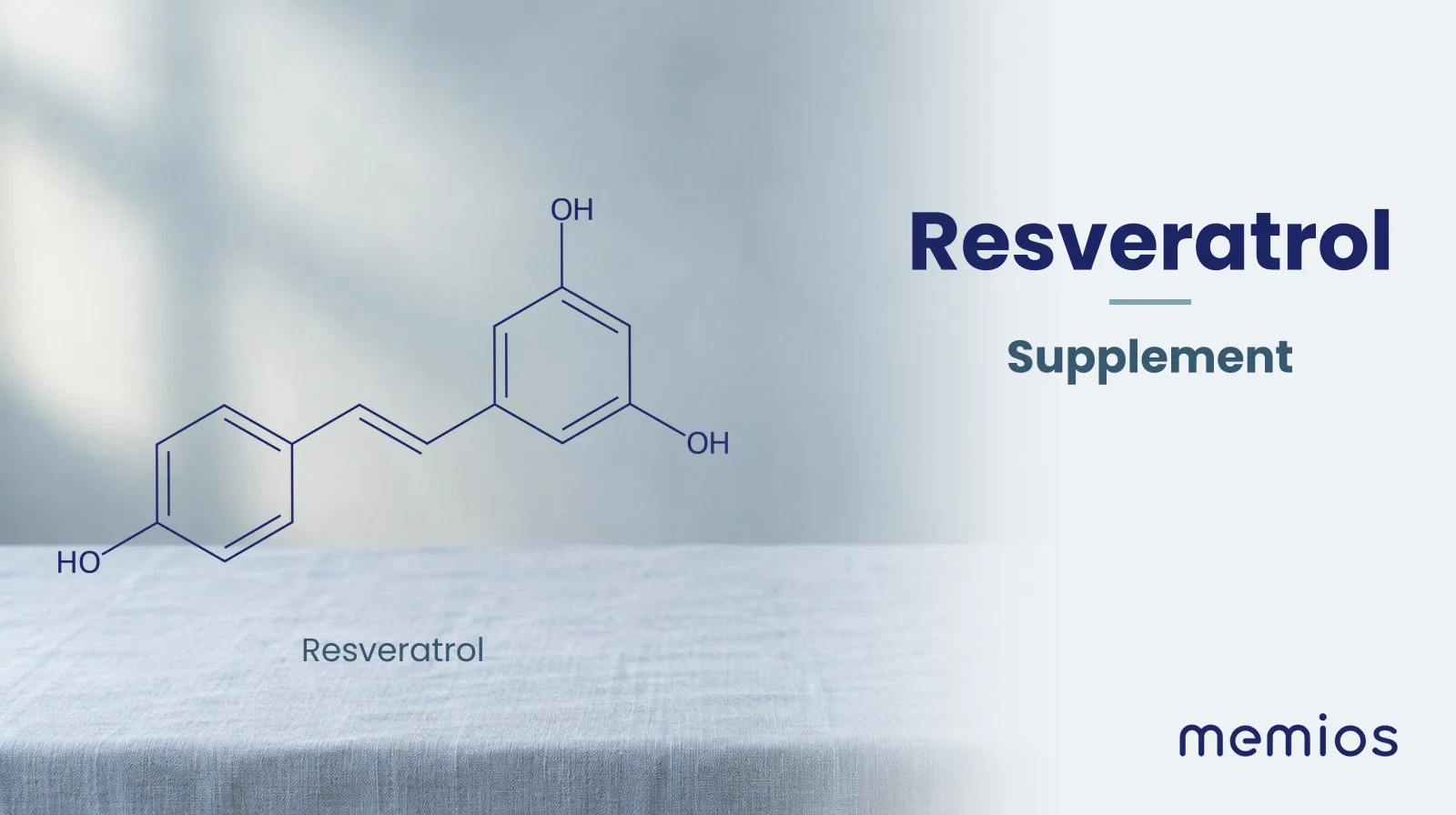
- What it is: Resveratrol is a polyphenol of the stilbene class made by certain plants.
- Main use, supported: A 2026 umbrella review of 45 systematic reviews found four of its 35 statistically significant associations were supported by high-certainty GRADE evidence: small reductions in waist circumference. (high certainty)
- Claim NOT supported by research: A GRADE-appraised meta-analysis in people with obesity or overweight found no significant effect of resveratrol on triglycerides, total cholesterol, HbA1c, insulin, liver enzymes or BMI. (low certainty)
- Another claim NOT supported: An earlier umbrella review in the American Journal of Clinical Nutrition concluded the evidence does not support resveratrol for cardiometabolic risk factors, because effects were trivial and certainty very low to low. (very low certainty)
- Recommended dose: not established. No reference intake exists. Resveratrol is not an essential nutrient and no nutrition body has set a recommended intake for it; what is on sale instead ranges from under 1 mg to 500 mg of resveratrol per tablet or capsule.
- Studied dose (a trial dose, not a recommendation): Retail supplements analysed contained from under 1 mg to 500 mg of resveratrol per tablet or capsule. No finding here cites that trial.
- Upper limit: No tolerable upper intake level has been set by a nutrition body.
- What goes wrong: 4 findings on harm. A phase 2 trial of the micronised resveratrol drug SRT501 in relapsed or refractory multiple myeloma was stopped after severe adverse events, most prominently renal failure.
- Common myth: Drinking red wine gives you a meaningful dose of resveratrol, and that is why wine is said to be good for the heart.
What it is
Resveratrol is a polyphenol of the stilbene class made by certain plants. It is present in grapes, wine, grape juice, peanuts, cocoa and some berries, and supplements usually supply trans-resveratrol extracted from Japanese knotweed. Capsules on the market range from under one milligram to 500 mg per unit. Taken by mouth it is absorbed but then rapidly conjugated, so its bioavailability as the parent compound is low.
What the research says
The human evidence is contested rather than settled. Two umbrella reviews of the same field reach opposite conclusions: a 2021 review in the American Journal of Clinical Nutrition says the evidence does not support resveratrol for cardiometabolic risk factors because effects were trivial and certainty very low to low, while a 2026 umbrella review rates a handful of small effects on waist circumference, blood pressure and cholesterol as high certainty. A GRADE-appraised meta-analysis in people with obesity found no significant effect on blood fats, HbA1c, insulin, liver enzymes or BMI. Harms are real at supplement doses: gastrointestinal upset above 1,000 mg/day, cytochrome P450 interactions, and a cancer trial of a micronised resveratrol drug that was stopped after severe adverse events including renal failure.
Evidence grade: Disputed.
What goes wrong
A phase 2 trial of the micronised resveratrol drug SRT501 in relapsed or refractory multiple myeloma was stopped after severe adverse events, most prominently renal failure. (Source 1)
- Expert review, not systematic, Low certainty.
- Size: Phase 2 trial in relapsed/refractory multiple myeloma, as summarised by this review.
- Who: Patients with relapsed or refractory multiple myeloma receiving SRT501 with bortezomib.
- How long: Short-course dosing before termination.
- Result: Several severe adverse events occurred, the most prominent being renal failure; the review notes no nephrotoxicity had occurred in a phase 1 colorectal cancer study.
- Funding: not stated (review of industry-sponsored trials)
the clinical trial found that it caused several severe adverse events, the most prominent of which was renal failure.
Gastrointestinal side effects have been reported at resveratrol intakes above 1,000 mg/day. (Source 2)
- Expert review, not systematic, Low certainty.
- Size: Not stated by the source.
- Who: Human participants in supplementation studies.
- How long: Up to 29 consecutive days.
- Result: Nausea, abdominal pain, flatulence and diarrhoea reported above 1,000 mg/day; no rate given.
- Funding: independent (academic institute)
In a follow-up study, mild-to-moderate gastrointestinal side effects, including nausea, abdominal pain, flatulence, and diarrhea, have been reported in participants who consume more than 1,000 mg/day of resveratrol for up to 29 consecutive days.
Resveratrol inhibited drug-metabolising cytochrome P450 enzymes in healthy volunteers taking 1 gram a day, and cancer-centre and academic sources warn it may add to the effect of blood thinners; the bleeding interaction is described as a theoretical one rather than a demonstrated event. (Source 3)
- Official position, Low certainty.
- Size: Healthy volunteers in the cited interaction study.
- Who: Adults taking anticoagulants, antiplatelets or CYP-metabolised drugs.
- How long: 1 gram daily for 4 weeks in the cited volunteer study.
- Result: CYP3A4, 2D6 and 2C9 inhibited and 1A2 induced after 1 g/day for 4 weeks; bleeding risk flagged with warfarin.
- Funding: not stated.
Limit of this finding: The bleeding concern has not been observed in a trial. The Linus Pauling Institute introduces it with the word "Theoretically", meaning it is predicted from how the compound behaves, not something that has been measured happening in people taking warfarin.
Resveratrol inhibited CYP3A4, 2D6, and 2C9, and induced 1A2 in healthy volunteers following daily intake of 1 gram for 4 weeks.
Laboratory analysis of retail resveratrol supplements found most products did not contain the amount stated on the label, and a quarter delivered more than the EU maximum for trans-resveratrol. (Source 4)
- Survey study, Low certainty.
- Size: 20 food supplement products.
- Who: Commercial resveratrol supplements on the Slovenian market.
- How long: Single-timepoint product analysis.
- Result: 95% of products had contents different from the declared amount; 55% contained more than declared; 25% exceeded the EU maximum level of 150 mg/day.
- Funding: not stated.
Analyses of 20 food supplements performed using high-performance thin-layer chromatography (HPTLC) coupled with densitometry showed that 95% of products had contents different from what was declared and 55% of products contained higher contents than declared.
What the evidence supports
A 2026 umbrella review of 45 systematic reviews found four of its 35 statistically significant associations were supported by high-certainty GRADE evidence: small reductions in waist circumference, in total cholesterol in overweight adults, and in blood pressure in type 2 diabetes. (Source 5)
- Review of reviews, High certainty.
- Size: 45 systematic reviews, 129 associations, 68 outcomes.
- Who: Adults across mixed clinical populations, mostly type 2 diabetes, metabolic syndrome and overweight/obesity.
- How long: Trial durations pooled from the included reviews; the authors flag ≥12 weeks and ≥500 mg/d as less beneficial.
- Result: Waist circumference MD = -0.80 cm, 95% CI = -1.40, -0.20; total cholesterol in overweight adults MD = -0.19 mmol/L, 95% CI = -0.32, -0.06; diastolic BP in T2DM MD = -3.55 mmHg, 95% CI = -5.18, -1.93; systolic BP in T2DM MD = -7.97 mmHg, 95% CI = -10.63, -5.31.
- Funding: not stated.
Limit of this finding: The high-certainty rating applies to only four findings out of the 129 associations the review examined, and the reductions are small. It does not mean resveratrol has been shown to work for most of the things it is sold for.
Among 35 significant associations, four were supported by high-certainty evidence according to GRADE, including positive effects of resveratrol supplementation on reducing waist circumference (mean difference [MD] = -0.80 cm, 95% CI = -1.40, -0.20), total cholesterol among overweight adults (MD = -0.19 mmol/L, 95% CI = -0.32, -0.06), diastolic blood pressure (MD = -3.55 mmHg, 95% CI = -5.18, -1.93) and systolic blood pressure (MD = -7.97 mmHg, 95% CI = -10.63, -5.31) among patients with type 2 diabetes.
What the evidence does not support
An earlier umbrella review in the American Journal of Clinical Nutrition concluded the evidence does not support resveratrol for cardiometabolic risk factors, because effects were trivial and certainty very low to low. (Source 6)
- Review of reviews, Very low certainty.
- Size: 38 meta-analyses covering 79 outcomes in 1,476 people with T2D, 727 with metabolic syndrome and 271 with NAFLD.
- Who: Adults with type 2 diabetes, metabolic syndrome or non-alcoholic fatty liver disease.
- How long: Short-term trials, most under 12 weeks.
- Result: For almost all outcomes the effect magnitude was trivial or certainty was very low to low; the exception was HbA1c under 12 weeks, mean difference −1.05%, 95% CI: −2.09%, −0.02%; n = 6; GRADE = moderate.
- Funding: not stated.
Current evidence does not support supplementation with resveratrol for the management of cardiometabolic risk factors in patients with T2D, MetS, and NAFLD.
A GRADE-appraised meta-analysis in people with obesity or overweight found no significant effect of resveratrol on triglycerides, total cholesterol, HbA1c, insulin, liver enzymes or BMI. (Source 7)
- Meta-analysis, Low certainty.
- Size: 5 trials, 419 participants.
- Who: Adults with obesity or overweight.
- How long: Trials of about 4 weeks and longer.
- Result: Triglycerides SMD = 0.11, 95%CI [-0.14, 0.35], P = 0.39; total cholesterol SMD = 0.04, 95%CI [-0.26, 0.33], P = 0.82; HbA1c SMD = 0.00, 95%CI [-0.99, 1.00], P = 0.99, I2 = 80 %; BMI MD = 0.21, 95%CI [-0.970, 1.39], P = 0.70.
- Funding: not stated.
Limit of this finding: The paper contradicts itself on how many people were studied: its abstract says 5 trials with 419 participants, while the main text says five studies with 491 participants. The figure quoted here is the abstract's. Either way this is a small evidence base, and the discrepancy should be resolved before the participant count is relied on.
Our results tagged with p-value>0.05 are an evidence-based indication that resveratrol supplementation does not lead to significant improvements in metabolic or anthropometric parameters.
Where the evidence is mixed
The same umbrella review found a short-term, moderate-certainty reduction in HbA1c, but flagged short follow-up and small samples. (Source 6)
- Review of reviews, Moderate certainty.
- Size: 6 meta-analysed comparisons.
- Who: Adults with type 2 diabetes.
- How long: Under 12 weeks.
- Result: Mean difference: −1.05%, 95% CI: −2.09%, −0.02%; n = 6; GRADE = moderate.
- Funding: not stated.
In the case of HbA1c, subject to the limitations such as short-term follow-up and small sample size, there was a clinically important effect.
Where the research disagrees
Whether resveratrol supplementation has worthwhile cardiometabolic effects
- Umbrella review, Nutrition Journal 2026, umbrella review of 45 systematic reviews, 129 associations: High certainty of evidence suggested that resveratrol supplementation could decline waist circumference, lower blood pressure among patients with type 2 diabetes, and reduce total cholesterol among overweight adults. (Source 8)
- Umbrella review, American Journal of Clinical Nutrition 2021, umbrella review of 38 meta-analyses in T2D, metabolic syndrome and NAFLD: Current evidence does not support supplementation with resveratrol for the management of cardiometabolic risk factors in patients with T2D, MetS, and NAFLD. (Source 6)
How much
- Reference intake: No reference intake exists. Resveratrol is not an essential nutrient and no nutrition body has set a recommended intake for it; what is on sale instead ranges from under 1 mg to 500 mg of resveratrol per tablet or capsule. (Source 9)
- Upper limit: No tolerable upper intake level has been set by a nutrition body. EU novel food conditions specify a maximum of 150 mg/day of trans-resveratrol in food supplements; a 2023 analysis found 25% of tested products exceeded it per unit. (Source 10)
- Studied: Retail supplements analysed contained from under 1 mg to 500 mg of resveratrol per tablet or capsule. (Source 9)
- Studied: Gastrointestinal side effects were reported in participants consuming more than 1,000 mg/day for up to 29 consecutive days. (Source 11)
- Studied: An interaction study gave healthy volunteers 1 gram daily for 4 weeks. (Source 12)
A common belief, and what the research shows
The belief: Drinking red wine gives you a meaningful dose of resveratrol, and that is why wine is said to be good for the heart.
What the research shows: The Linus Pauling Institute is explicit that the laboratory effects cannot be assumed to occur at wine-level intakes: "there is currently no convincing evidence that these effects can be achieved in the amounts present in one to two glasses of red wine". Supplement trials use doses hundreds of times larger, and even at those doses a GRADE-appraised meta-analysis reported that "resveratrol supplementation does not lead to significant improvements in metabolic or anthropometric parameters".
Questions and answers
What is it?
Resveratrol is a plant polyphenol of the stilbene class, made by grapes, peanuts and some berries in response to stress. In supplements it is usually trans-resveratrol, often extracted from Japanese knotweed. Capsules on the market range from under a milligram to several hundred milligrams. (Source 11)
What does it do in the body?
Resveratrol is absorbed but then rapidly conjugated in the gut wall and liver, so very little circulates as the parent compound. Most of what reaches the blood is sulfate and glucuronide metabolites. That low bioavailability is the main reason laboratory effects have been hard to reproduce in people. (Source 13)
Is it good or bad for you?
It depends which review you read and which outcome. A 2026 umbrella review rated some small cardiometabolic effects as high certainty, while a 2021 umbrella review in the American Journal of Clinical Nutrition concluded the evidence does not support its use for those same risk factors. At high intakes it causes gastrointestinal upset and can interact with medicines. (Source 6)
How do you get more of it?
It occurs in grapes, wine, grape juice, peanuts, cocoa and berries of Vaccinium species, and is sold as capsules. Retail supplements range from under 1 mg to 500 mg per tablet or capsule, and trial doses are far above anything obtainable from food. No reference intake has been set for it. (Source 9)
If it is harmful, what reduces it?
Resveratrol is not stored or accumulated; it is cleared quickly by conjugation and excretion, so intake is what determines exposure. The reported gastrointestinal effects are tied to intakes above 1,000 mg/day, which is a supplement-level intake rather than a dietary one. (Source 2)
Why might someone be low in it or missing it?
Resveratrol is not an essential nutrient, so there is no deficiency state to be in. Dietary intakes are very small: the Linus Pauling Institute notes there is no convincing evidence the effects seen in the laboratory can be reached from the amounts in red wine. (Source 14)
Which whole foods contain it or feed it?
Grapes, red wine, grape juice, peanuts, pistachios, cocoa and berries such as blueberries and cranberries contain resveratrol. The amounts are in the fraction-of-a-milligram range per serving, far below trial doses. (Source 12)
What happens if you do not have it?
Nothing is known to happen, because there is no described resveratrol deficiency and no reference intake. The clearest statement we found on what happens without it is the umbrella review's conclusion that supplementation is not supported for cardiometabolic risk factors in the first place. (Source 6)
We searched: Searched for a defined resveratrol deficiency state or reference intake in the Linus Pauling Institute monograph, the 2021 AJCN umbrella review and the 2026 Nutrition Journal umbrella review; none describes one.
How can you test for it?
Resveratrol and its metabolites can be measured in plasma and urine by laboratory assay, mostly as sulfate conjugates, and peak plasma levels occur about an hour after a dose. There is no clinical test of resveratrol status and no reference range to interpret a result against. (Source 15)
References
- npj Precision Oncology. The therapeutic potential of resveratrol: a review of clinical trials. 2017. PMID 28989978, DOI 10.1038/s41698-017-0038-6. Read the source
- Linus Pauling Institute, Oregon State University. Resveratrol - Micronutrient Information Center. 2015. Read the source
- Memorial Sloan Kettering Cancer Center. Resveratrol - About Herbs, Botanicals & Other Products. 2023. Read the source
- Nutrients. Resveratrol Food Supplement Products and the Challenges of Accurate Label Information to Ensure Food Safety for Consumers. 2023. DOI 10.3390/nu15020474. Read the source
- Nutrition Journal. Effects of resveratrol supplementation on multiple health outcomes: an umbrella review of systematic reviews and meta-analyses of randomized controlled trials. 2026. DOI 10.1186/s12937-026-01319-5. Read the source
- The American Journal of Clinical Nutrition. The effects of resveratrol supplementation in patients with type 2 diabetes, metabolic syndrome, and nonalcoholic fatty liver disease: an umbrella review of meta-analyses of randomized controlled trials. 2021. DOI 10.1093/ajcn/nqab250. Read the source
- Obesity Pillars. Effect of resveratrol supplementation on metabolic risk markers and anthropometric parameters in individuals with obesity or overweight: A systematic review and meta-analysis of randomized controlled trials. 2024. PMID 39967810, DOI 10.1016/j.obpill.2024.100141. Read the source
- Nutrition Journal. Effects of resveratrol supplementation on multiple health outcomes: an umbrella review of systematic reviews and meta-analyses of randomized controlled trials. 2026. DOI 10.1186/s12937-026-01319-5. Read the source
- Linus Pauling Institute, Oregon State University. Resveratrol - Micronutrient Information Center. 2015. Read the source
- Nutrients. Resveratrol Food Supplement Products and the Challenges of Accurate Label Information to Ensure Food Safety for Consumers. 2023. DOI 10.3390/nu15020474. Read the source
- Linus Pauling Institute, Oregon State University. Resveratrol - Micronutrient Information Center. 2015. Read the source
- Memorial Sloan Kettering Cancer Center. Resveratrol - About Herbs, Botanicals & Other Products. 2023. Read the source
- Linus Pauling Institute, Oregon State University. Resveratrol - Micronutrient Information Center. 2015. Read the source
- Linus Pauling Institute, Oregon State University. Resveratrol - Micronutrient Information Center. 2015. Read the source
- Linus Pauling Institute, Oregon State University. Resveratrol - Micronutrient Information Center. 2015. Read the source