Supplements · September 29, 2026 · Memios · 9 min read
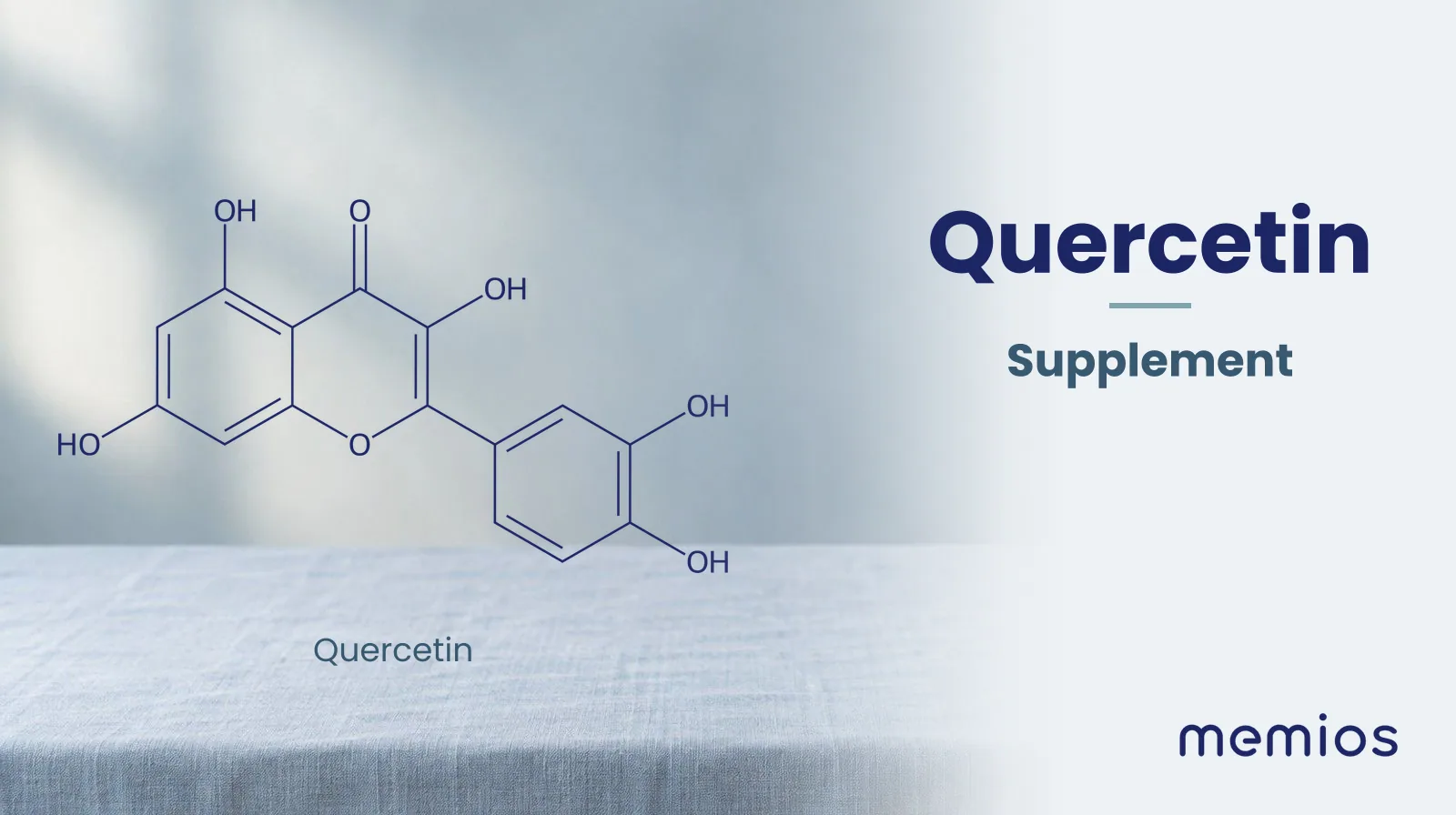
Quercetin
An umbrella review (2023) of meta-analyses found quercetin may lower systolic blood pressure by about 2 mmHg and insulin slightly.
TLDR
- Limited evidence. An umbrella review (2023) of meta-analyses found quercetin may lower systolic blood pressure by about 2 mmHg and insulin slightly, but does not affect diastolic pressure, cholesterol, inflammation, body measurements or blood sugar, with certainty ranging from very low to moderate.
- What it is: Quercetin is a flavonol, the most abundant one in the diet, found in small amounts in many fruits and vegetables and in larger amounts in a few foods such as onion, asparagus and berries.
- Main use, supported: A 2016 meta-analysis of 7 trials found quercetin lowered systolic and diastolic blood pressure, possibly only at doses over 500 mg a day.
- Claim NOT supported by research: The umbrella review found quercetin does not affect diastolic blood pressure, lipids, inflammation, body measurements, fasting glucose or insulin resistance. (low certainty)
- Another claim NOT supported: A 2020 meta-analysis of 17 trials found quercetin lowered blood pressure but did not significantly change cholesterol, triglycerides or glucose overall.
- Recommended dose: not established. No RDA or AI exists for quercetin; it is not an essential nutrient. Average US adult intake has been estimated at 3.5 mg/day.
- Studied dose (a trial dose, not a recommendation): Supplements are frequently marketed at daily doses of up to 1000 mg, far above dietary intake. Findings citing that trial: 3 on harm.
- Upper limit: No tolerable upper intake level was found.
- What goes wrong: 4 findings on harm. A safety review found adverse effects from supplemental quercetin in human studies were rare and mild, but no adequate data exist on long-term use of high doses.
- Common myth: Quercetin is a natural food compound, so high-dose supplements are known to be safe long term.
What it is
Quercetin is a flavonol, the most abundant one in the diet, found in small amounts in many fruits and vegetables and in larger amounts in a few foods such as onion, asparagus and berries. As a supplement it is sold mostly as the free aglycone, often at up to 1000 mg a day, far above usual dietary intake.
What the research says
An umbrella review (2023) of meta-analyses found quercetin may lower systolic blood pressure by about 2 mmHg and insulin slightly, but does not affect diastolic pressure, cholesterol, inflammation, body measurements or blood sugar, with certainty ranging from very low to moderate. Side effects in human studies have been rare and mild, but long-term safety of high doses (over 12 weeks at 1000 mg or more) has not been assessed, animal studies raise concerns for damaged kidneys and estrogen-dependent cancers, and quercetin can change the levels of some drugs. Given intravenously at high doses in a cancer trial, it caused kidney toxicity.
Evidence grade: Limited evidence.
What goes wrong
A safety review found adverse effects from supplemental quercetin in human studies were rare and mild, but no adequate data exist on long-term use of high doses. (Source 1)
- Systematic review, Low certainty.
- Size: Numerous published human intervention studies (count not given in abstract)
- Who: Humans taking isolated quercetin.
- How long: Mostly 12 weeks or less.
- Result: Adverse effects rare and mild; no adequate data beyond 12 weeks at 1000 mg or more.
- Funding: Not stated in fetched text (authors from the German Federal Institute for Risk Assessment)
Among the numerous published human intervention studies, adverse effects following supplemental quercetin intake have been rarely reported and any such effects were mild in nature.
Animal studies suggest quercetin may worsen kidney damage in an already damaged kidney and may promote estrogen-dependent tumours; these are animal findings, not human ones. (Source 1)
- Animal study, Very low certainty.
- Size: Animal studies summarised in a review.
- Who: Animals given oral quercetin.
- How long: Not stated.
- Result: Possible enhanced nephrotoxicity in predamaged kidney; possible tumour promotion in estrogen-dependent cancer.
- Funding: Not stated.
Based on animal studies involving oral quercetin application some possible critical safety aspects could be identified such as the potential of quercetin to enhance nephrotoxic effects in the predamaged kidney
Animal and short-term human studies show quercetin can interact with certain drugs and change how much of the drug reaches the blood. (Source 1)
- Systematic review, Low certainty.
- Size: Not stated in abstract.
- Who: Animals and humans.
- How long: Single dose or short-term.
- Result: Altered drug bioavailability (specific drugs not listed in abstract)
- Funding: Not stated.
Furthermore, animal and human studies with single time or short-term supplemental quercetin application revealed interactions between quercetin and certain drugs leading to altered drug bioavailability.
In a phase I cancer trial, quercetin given by intravenous infusion caused dose-limiting kidney toxicity at 1700 mg/m2. (Source 2)
- Case series, Low certainty.
- Size: Cancer patients in a dose-escalation trial (total not captured)
- Who: People with cancer.
- How long: Infusions every 3 weeks or weekly.
- Result: Dose-limiting nephrotoxicity at 1700 mg/m2; 1400 mg/m2 recommended for phase II. Non-randomized dose-escalation design; intravenous, not oral.
- Funding: Not stated in fetched text.
At the 10th dose level of 1700 mg/m2, dose-limiting nephrotoxicity was encountered
What the evidence supports
A 2016 meta-analysis of 7 trials found quercetin lowered systolic and diastolic blood pressure, possibly only at doses over 500 mg a day. (Source 3)
- Meta-analysis, Certainty not rated.
- Size: 7 trials, 9 treatment arms, 587 patients.
- Who: Adults in placebo-controlled trials.
- How long: Varied.
- Result: SBP WMD -3.04 mmHg (95% CI -5.75 to -0.33; P=0.028); DBP WMD -2.63 mmHg (95% CI -3.26 to -2.01)
- Funding: Not stated in fetched text.
The results of the meta-analysis showed a statistically significant effect of quercetin supplementation in the reduction of BP, possibly limited to, or greater with dosages of >500 mg/day.
What the evidence does not support
The umbrella review found quercetin does not affect diastolic blood pressure, lipids, inflammation, body measurements, fasting glucose or insulin resistance. (Source 4)
- Review of reviews, Low certainty.
- Size: 5 meta-analyses plus 5 RCTs.
- Who: Adults.
- How long: Varied.
- Result: No significant effect on DBP, lipid profile, inflammation, anthropometric indices, FBG, HOMA-IR.
- Funding: Not stated in fetched text.
The results indicated Quercetin does not affect diastolic blood pressure (DBP), lipid profile, inflammation, anthropometric indices
A 2020 meta-analysis of 17 trials found quercetin lowered blood pressure but did not significantly change cholesterol, triglycerides or glucose overall. (Source 5)
- Meta-analysis, Certainty not rated.
- Size: 17 trials, 896 participants.
- Who: Adults in randomized trials.
- How long: Varied; some lipid changes only in trials of 8 weeks or more.
- Result: SBP WMD -3.09 mmHg (95% CI -4.59 to -1.59); DBP WMD -2.86 mmHg (95% CI -5.09 to -0.63); no significant change in lipids or glucose.
- Funding: Not stated in fetched text.
Neither lipid profiles nor glucose concentrations changed significantly.
Where the evidence is mixed
An umbrella review of meta-analyses found quercetin reduced systolic blood pressure and insulin but not other cardiometabolic measures, with certainty from very low to moderate. (Source 4)
- Review of reviews, Low certainty.
- Size: 5 meta-analyses including 18 RCTs, plus 5 further RCTs.
- Who: Adults in randomized trials.
- How long: Varied.
- Result: SBP WMD -1.9 mmHg (95% CI -3.2 to -0.6; I2 88.3%); insulin WMD -1.07 (95% CI -1.9 to -0.1)
- Funding: Not stated in fetched text.
Quercetin supplementation has reducing effects on SBP and insulin levels but not other cardiometabolic parameters.
The umbrella review rated the certainty of the evidence as very low to moderate. (Source 4)
- Review of reviews, Very low certainty.
- Size: 5 meta-analyses.
- Who: Adults.
- How long: Varied.
- Result: GRADE very low to moderate.
- Funding: Not stated in fetched text.
The certainty of evidence ranged from very low to moderate.
Where the research disagrees
Whether quercetin lowers diastolic blood pressure
- Serban et al., 2016 (Journal of the American Heart Association), Meta-analysis of 7 RCTs: The results of the meta-analysis showed a statistically significant effect of quercetin supplementation in the reduction of BP, possibly limited to, or greater with dosages of >500 mg/day. (Source 3)
- Arabi et al., 2023 (Phytotherapy Research umbrella review), Umbrella review of 5 meta-analyses plus 5 RCTs, GRADE rated: The results indicated Quercetin does not affect diastolic blood pressure (DBP), lipid profile, inflammation, anthropometric indices (Source 4)
How much
- Reference intake: No RDA or AI exists for quercetin; it is not an essential nutrient. Average US adult intake has been estimated at 3.5 mg/day. (Source 6)
- Upper limit: No tolerable upper intake level was found. A 2018 safety review stated that adequate data on long-term use (over 12 weeks) of high doses (1000 mg or more) are not available. (Source 1)
- Studied: Supplements are frequently marketed at daily doses of up to 1000 mg, far above dietary intake. (Source 1)
- Studied: Blood pressure effects were possibly limited to, or greater with, doses above 500 mg/day in a 2016 meta-analysis. (Source 3)
- Studied: An intravenous cancer trial escalated to 1700 mg/m2 and recommended 1400 mg/m2 for phase II. (Source 2)
A common belief, and what the research shows
The belief: Quercetin is a natural food compound, so high-dose supplements are known to be safe long term.
What the research shows: Supplement doses far exceed diet, and long-term high-dose safety is unassessed: 'Published adequate scientific data for safety assessment in regard to the long-term use (>12 weeks) of high supplemental quercetin doses' are not available, and quercetin can interact with drugs.
Questions and answers
What is it?
Quercetin is a flavonoid, the most common flavonol in the diet. It occurs in small amounts in many fruits and vegetables, and is also sold as an isolated supplement. (Source 1)
What does it do in the body?
In trials it may lower systolic blood pressure by a couple of mmHg and insulin slightly, but not diastolic pressure, cholesterol, inflammation or blood sugar. Certainty is very low to moderate. (Source 4)
Is it good or bad for you?
At food levels there is no known harm. As a supplement, side effects in studies were rare and mild, but high-dose long-term safety is unassessed, animal studies raise kidney and estrogen-dependent cancer concerns, and it can alter drug levels. (Source 1)
How do you get more of it?
From foods such as onion, asparagus and berries, or from supplements, which are often sold at up to 1000 mg a day. Absorption varies by form; one comparison found higher absorption from fried onions than from pure quercetin. (Source 6)
If it is harmful, what reduces it?
Does not apply at dietary levels. The sources raise concern only about high supplemental doses, especially for people with damaged kidneys or estrogen-dependent cancer and people on interacting drugs. (Source 1)
Why might someone be low in it or missing it?
Intake is low when few quercetin-rich foods are eaten; average US adult intake is only a few milligrams a day. Absorption also differs a lot by food and chemical form. (Source 6)
Which whole foods contain it or feed it?
Onion, asparagus and berries are among the few foods high in quercetin; many other fruits and vegetables contain small amounts. (Source 6)
What happens if you do not have it?
Nothing specific is known: quercetin is not an essential nutrient and no deficiency disease is described. Trials adding it found only small changes in systolic blood pressure and insulin. (Source 4)
How can you test for it?
Quercetin metabolites can be measured in blood and urine in research studies, but this is used to track intake in trials, not as a routine clinical test, and no reference range was found. (Source 6)
References
- Molecular Nutrition & Food Research. Safety Aspects of the Use of Quercetin as a Dietary Supplement. 2018. PMID 29127724, DOI 10.1002/mnfr.201700447. Read the source
- Clinical Cancer Research. Phase I clinical trial of the flavonoid quercetin: pharmacokinetics and evidence for in vivo tyrosine kinase inhibition. 1996. PMID 9816216. Read the source
- Journal of the American Heart Association. Effects of Quercetin on Blood Pressure: A Systematic Review and Meta-Analysis of Randomized Controlled Trials. 2016. PMID 27405810, DOI 10.1161/JAHA.115.002713. Read the source
- Phytotherapy Research. The effects of Quercetin supplementation on cardiometabolic outcomes: An umbrella review of meta-analyses of randomized controlled trials. 2023. PMID 37654199, DOI 10.1002/ptr.7971. Read the source
- Nutrition Reviews. Effect of quercetin supplementation on plasma lipid profiles, blood pressure, and glucose levels: a systematic review and meta-analysis. 2020. DOI 10.1093/nutrit/nuz071. Read the source
- Nutrients. Dietary Quercetin and Kaempferol: Bioavailability and Potential Cardiovascular-Related Bioactivity in Humans. 2019. DOI 10.3390/nu11102288. Read the source