Supplements · September 29, 2026 · Memios · 7 min read
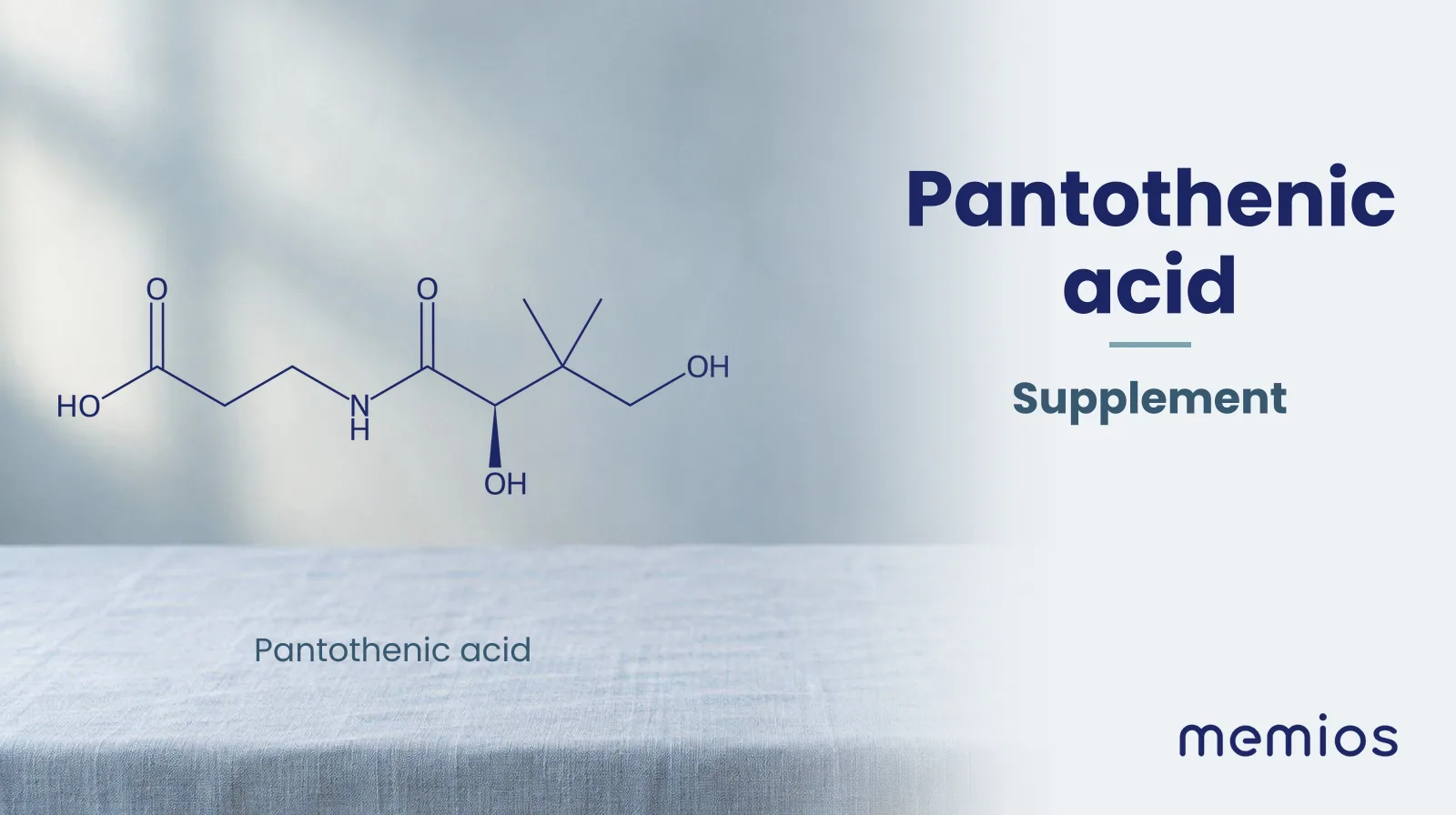
Pantothenic acid
The evidence for supplements is thin. Pantethine, a related compound, lowered LDL cholesterol by about 11% in one small 16-week trial of 32 people.
TLDR
- Limited evidence. The evidence for supplements is thin. Pantethine, a related compound, lowered LDL cholesterol by about 11% in one small 16-week trial of 32 people.
- What it is: Pantothenic acid is a water-soluble B vitamin. Its main role is as a building block of coenzyme A and acyl carrier protein. It is present in almost all foods, so deficiency is rare.
- Main use, supported: In a triple-blinded placebo-controlled trial, pantethine lowered LDL cholesterol by about 11% from baseline over 16 weeks, versus a 3% rise on placebo. (low certainty)
- Other use, supported: A small 12-week placebo-controlled trial of a pantothenic acid-based supplement (2.2 g a day) reported a greater reduction in total acne lesion count than placebo. (low certainty)
- Claim NOT supported by research: A crossover trial in trained cyclists found no effect of a pantethine/pantothenic acid plus thiamin supplement on any measured performance or physiological outcome. (very low certainty)
- Recommended dose: not established. Adequate Intake (Food and Nutrition Board, as reported by NIH ODS, fact sheet updated May 2026): 5 mg a day for adults 19 and over. No RDA exists because the data were insufficient to set an Estimated Average Requirement, so the AI is based on usual intakes.
- Studied dose (a trial dose, not a recommendation): Pantethine 600 mg/day for weeks 1 to 8, then 900 mg/day for weeks 9 to 16. Findings citing that trial: 1 for, 1 mixed, 1 on harm.
- Upper limit: No UL has been set (Food and Nutrition Board, per NIH ODS 2026) because there are no reports of pantothenic acid toxicity in humans at high intakes.
- What goes wrong: 3 findings on harm. In the pantethine trial, flatulence and diarrhoea were reported but resolved during the study.
- Common myth: High-dose vitamin B5 is a proven acne treatment.
What it is
Pantothenic acid is a water-soluble B vitamin. Its main role is as a building block of coenzyme A and acyl carrier protein. It is present in almost all foods, so deficiency is rare.
What the research says
The evidence for supplements is thin. Pantethine, a related compound, lowered LDL cholesterol by about 11% in one small 16-week trial of 32 people. That trial was funded by a pantethine maker. A 12-week acne trial of 41 evaluable people, funded by the supplement's marketer, reported fewer lesions. A small trial in cyclists found no performance effect. No upper limit has been set because no toxicity has been reported at high intakes. Very large doses (around 10 g a day) can cause diarrhoea, and one case report linked a B5-plus-biotin supplement to a life-threatening fluid build-up around the heart and lungs.
Evidence grade: Limited evidence.
What goes wrong
NIH ODS reports that large doses of pantothenic acid, such as 10 g a day, can cause mild diarrhoea and gut upset. (Source 1)
- Official position, Certainty not rated.
- Size: not stated.
- Who: people taking large supplemental doses.
- How long: not stated.
- Result: mild diarrhoea and gastrointestinal distress at about 10 g/day; rates not given.
- Funding: government.
Some individuals taking large doses of pantothenic acid supplements (e.g., 10 g/day) develop mild diarrhea and gastrointestinal distress.
A case report described a 76-year-old woman who developed life-threatening eosinophilic pleuropericardial effusion with cardiac tamponade after two months of vitamins B5 and H (biotin). She recovered after the vitamins were stopped. (Source 2)
- Case report, Very low certainty.
- Size: 1 patient.
- Who: 76-year-old woman.
- How long: 2 months of supplementation.
- Result: pleurisy and pericardial tamponade with eosinophilia; recovery after withdrawal.
- Funding: not stated.
After withdrawal of the vitamins, the patient recovered and the eosinophilia disappeared
In the pantethine trial, flatulence and diarrhoea were reported but resolved during the study. (Source 3)
- Randomized trial, Low certainty.
- Size: 32 randomised.
- Who: adults at low to moderate cardiovascular risk.
- How long: 16 weeks.
- Result: counts not given in the fetched abstract.
- Funding: industry-funded.
flatulence and diarrhea were reported, but these two events resolved during the study
What the evidence supports
In a triple-blinded placebo-controlled trial, pantethine lowered LDL cholesterol by about 11% from baseline over 16 weeks, versus a 3% rise on placebo. (Source 3)
- Randomized trial, Low certainty.
- Size: 32 randomised.
- Who: adults at low to moderate cardiovascular risk eligible for statins.
- How long: 16 weeks.
- Result: LDL-C lower vs placebo at 8 and 16 weeks (P=0.020 and P=0.006); 11% decrease vs 3% increase.
- Funding: industry-funded (Daiichi Fine Chemical; authors employed by Daiichi and Kyowa Hakko)
An 11% decrease in LDL-C from baseline was seen in participants on pantethine, at weeks 4, 8, 12, and 16, while participants on placebo showed a 3% increase
A small 12-week placebo-controlled trial of a pantothenic acid-based supplement (2.2 g a day) reported a greater reduction in total acne lesion count than placebo. (Source 4)
- Randomized trial, Low certainty.
- Size: 48 enrolled, 41 evaluable.
- Who: adults with mild to moderate facial acne.
- How long: 12 weeks.
- Result: significant mean reduction in total lesion count vs placebo at week 12 (P = 0.0197)
- Funding: industry-funded (Avilan Marketing LLC)
There was a significant mean reduction in total lesion count in the pantothenic acid group versus placebo at week 12 (P = 0.0197).
What the evidence does not support
A crossover trial in trained cyclists found no effect of a pantethine/pantothenic acid plus thiamin supplement on any measured performance or physiological outcome. (Source 5)
- Randomized trial, Very low certainty.
- Size: 6 trained cyclists.
- Who: highly trained cyclists.
- How long: 7 days before each ride.
- Result: no significant differences in any measured parameter.
- Funding: not stated.
There were no significant differences in any of the measured parameters between experimental conditions.
Where the evidence is mixed
The pantethine cholesterol trial was sponsored by a pantethine manufacturer, and some authors were company employees. (Source 3)
- Randomized trial, Low certainty.
- Size: 32 randomised.
- Who: adults at low to moderate cardiovascular risk.
- How long: 16 weeks.
- Result: not applicable (funding)
- Funding: industry-funded.
This study was supported by Daiichi Fine Chemical Co, Ltd.
How much
- Reference intake: Adequate Intake (Food and Nutrition Board, as reported by NIH ODS, fact sheet updated May 2026): 5 mg a day for adults 19 and over. No RDA exists because the data were insufficient to set an Estimated Average Requirement, so the AI is based on usual intakes. (Source 1)
- Upper limit: No UL has been set (Food and Nutrition Board, per NIH ODS 2026) because there are no reports of pantothenic acid toxicity in humans at high intakes. (Source 1)
- Studied: Pantethine 600 mg/day for weeks 1 to 8, then 900 mg/day for weeks 9 to 16. (Source 3)
- Studied: A pantothenic acid-based supplement providing 2.2 g of pantothenic acid per four-tablet dose for 12 weeks. (Source 4)
- Studied: 1.8 g of a pantethine/pantothenic acid compound with 1 g allithiamin daily for 7 days. (Source 5)
A common belief, and what the research shows
The belief: High-dose vitamin B5 is a proven acne treatment.
What the research shows: The evidence is one small 12-week trial of 41 evaluable people, funded by the product's marketer: "Sponsorship for this study was provided by Avilan Marketing LLC (Brooklyn, NY, USA)."
Questions and answers
What is it?
Pantothenic acid is vitamin B5, a water-soluble B vitamin. Supplements often contain it as calcium pantothenate, and a related compound, pantethine, is also sold. (Source 1)
What does it do in the body?
The body uses it to make coenzyme A and acyl carrier protein. These molecules are needed to build and break down fats and to release energy from food. (Source 1)
Is it good or bad for you?
It is essential in the diet. No toxicity has been reported at high intakes, which is why no upper limit exists. Very large doses can upset the gut, and one case report linked a B5 and biotin supplement to a serious inflammatory reaction. Benefits of supplements rest on a few small, industry-funded trials. (Source 1)
How do you get more of it?
Most people get enough from ordinary food, because it occurs in almost all foods. Supplements and multivitamins also contain it. (Source 1)
If it is harmful, what reduces it?
Pantothenic acid is not considered harmful at usual intakes. In the reported case of a serious reaction, the person recovered after stopping the vitamins. (Source 2)
Why might someone be low in it or missing it?
Deficiency is rare because the vitamin is so widespread in food. It is seen mainly in severe malnutrition. NIH ODS also notes that people with a rare inherited mutation in the PANK2 gene cannot use it normally. (Source 1)
Which whole foods contain it or feed it?
Beef, chicken, organ meats, whole grains and some vegetables are among the richest sources. (Source 1)
What happens if you do not have it?
In severe deficiency, people report numbness and burning in the hands and feet, headache, tiredness and irritability. (Source 1)
How can you test for it?
Levels in urine are considered the most reliable indicator because they track dietary intake. This is not a routine clinical test. (Source 1)
References
- NIH Office of Dietary Supplements. Pantothenic Acid: Fact Sheet for Health Professionals (updated May 1, 2026). 2026. Read the source
- Annals of Pharmacotherapy. Life-Threatening Eosinophilic Pleuropericardial Effusion Related to Vitamins B5 and H. 2001. PMID 11302404, DOI 10.1345/aph.10213. Read the source
- Vascular Health and Risk Management. Pantethine, a derivative of vitamin B5, favorably alters total, LDL and non-HDL cholesterol in low to moderate cardiovascular risk subjects eligible for statin therapy: a triple-blinded placebo and diet-controlled investigation. 2014. DOI 10.2147/VHRM.S57116. Read the source
- Dermatology and Therapy. A Randomized, Double-Blind, Placebo-Controlled Study of a Novel Pantothenic Acid-Based Dietary Supplement in Subjects with Mild to Moderate Facial Acne. 2014. PMID 24831048, DOI 10.1007/s13555-014-0052-3. Read the source
- European Journal of Applied Physiology and Occupational Physiology. Physiological and performance responses to supplementation with thiamin and pantothenic acid derivatives. 1998. DOI 10.1007/s004210050364. Read the source