Supplements · September 29, 2026 · Memios · 16 min read
Panax notoginseng
The clinical evidence is large in volume but weak in quality, and almost all of it comes from China.
TLDR
- Limited evidence. The clinical evidence is large in volume but weak in quality, and almost all of it comes from China.
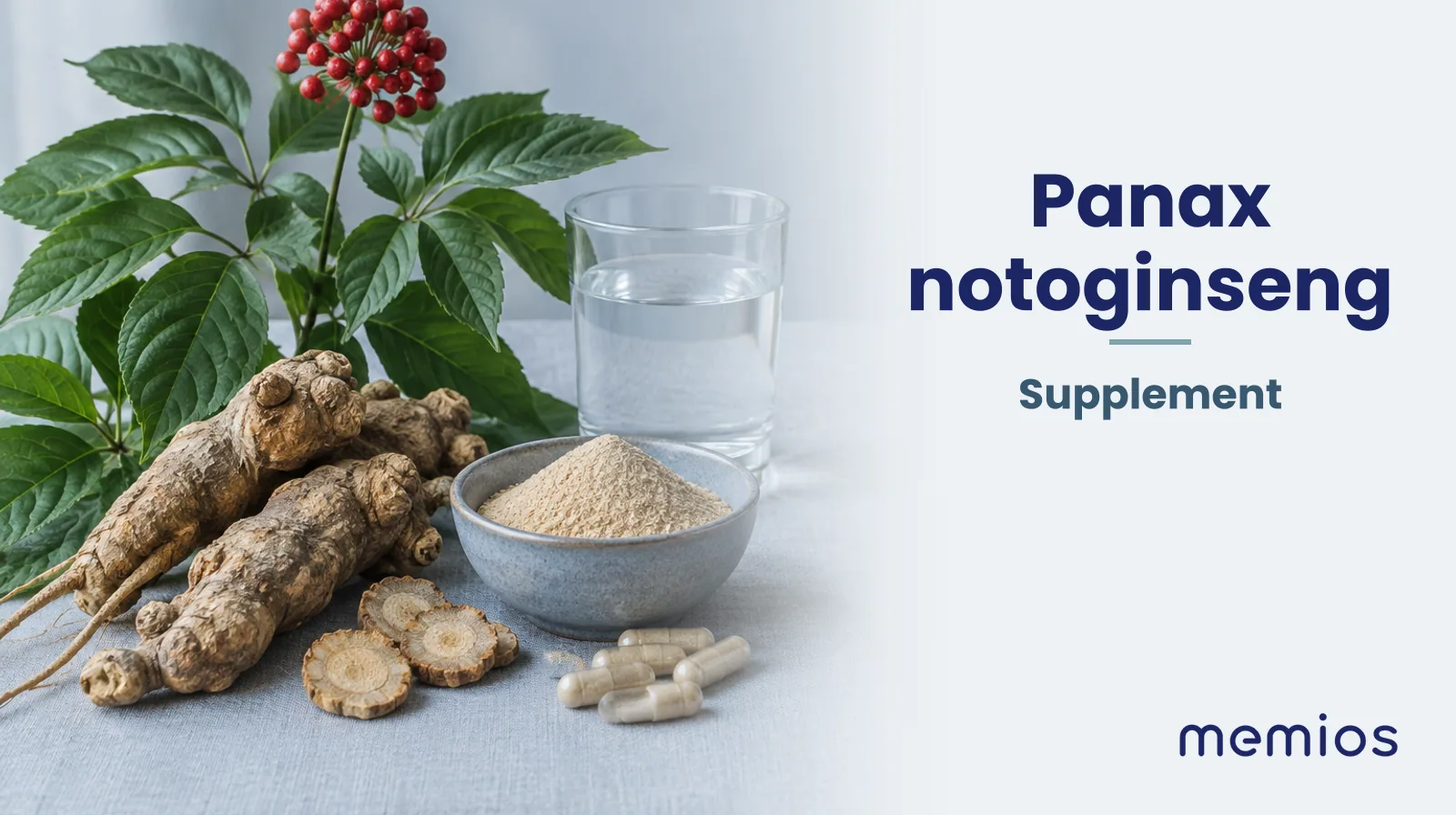
- What it is: Panax notoginseng is a cultivated relative of ginseng whose root is the medicinal part, known in East Asia as Sanqi, Tianqi or Sanchi.
- Main use, supported: Adding a Panax notoginseng preparation to aspirin reduced platelet aggregation more than aspirin alone in a meta-analysis of 20 randomised trials. (low certainty)
- Other use, supported: A meta-analysis of 206 randomised trials reports improved neurological status and daily living activities in elderly stroke patients given Panax notoginseng saponins. (low certainty)
- Claim NOT supported by research: In that meta-analysis, platelet count and prothrombin time did not differ between the notoginseng saponin combination and aspirin alone. (low certainty)
- Another claim NOT supported: Adding notoginseng preparations to aspirin did not increase bleeding events, and D-dimer did not differ, in the pooled trials. (low certainty)
- Recommended dose: not established. No reference intake (RDA or AI) exists for Panax notoginseng: it is a medicinal root used in traditional Chinese medicine, not a nutrient, and no body has set a dietary requirement for it.
- Studied dose (a trial dose, not a recommendation): A review describes a 1-year randomised trial in which the 600 patients in the experimental group were given Panax notoginseng saponins 300 mg three times a day. No finding here cites that trial.
- Upper limit: No tolerable upper intake level or acceptable daily intake has been set by any body we could find, and the toxicological literature on the plant is described as very sparse.
- What goes wrong: 3 findings on harm. Post-marketing surveillance of nearly 31,000 patients given Xueshuantong injection, a notoginseng saponin product, found an adverse drug reaction rate of 4.14 per thousand, most of them allergic.
- Common myth: Notoginseng is the herb that stops bleeding, so it is safe for anyone and cannot thin the blood.
What it is
Panax notoginseng is a cultivated relative of ginseng whose root is the medicinal part, known in East Asia as Sanqi, Tianqi or Sanchi. It has been in medicinal use for over four hundred years, traditionally as a pain reliever and an agent said to alter the flow properties of blood. More than 200 compounds have been isolated from it, and most of its pharmacological activity is attributed to its saponins, which are sold as a standardised fraction called Panax notoginseng saponins (PNS) in tablets, capsules and injections. The injectable forms - Xueshuantong and Xuesaitong - are hospital medicines in China, not supplements.
What the research says
The clinical evidence is large in volume but weak in quality, and almost all of it comes from China. A meta-analysis of 20 randomised trials found that adding a notoginseng saponin preparation to aspirin reduced platelet aggregation more than aspirin alone, which is a laboratory measure rather than a clinical outcome; the same analysis found no increase in bleeding events and no difference in platelet count or prothrombin time. A very large meta-analysis of 206 trials reports improved neurological status in elderly stroke patients. But the authors of the antiplatelet meta-analysis state plainly that the methodological quality of the included literature was not high and that nearly all of it was published in Chinese. The clearest harms come from the injectable forms: a 30,884-patient surveillance study found an adverse drug reaction rate of 4.14 per thousand, mostly allergic, and case reports describe pustular drug eruptions after PNS injection.
Evidence grade: Limited evidence.
What goes wrong
Post-marketing surveillance of nearly 31,000 patients given Xueshuantong injection, a notoginseng saponin product, found an adverse drug reaction rate of 4.14 per thousand, most of them allergic. (Source 1)
- Cohort study, Moderate certainty.
- Size: 30,884 patients in 33 hospitals across 7 provinces; 128 cases classed as probable or possible.
- Who: Hospital patients treated with intravenous Panax notoginseng saponins for cardiovascular and cerebrovascular disease in China.
- How long: Prospective post-marketing surveillance.
- Result: ADR incidence 4.14 per thousand; skin and appendage damage the commonest manifestation; 95.49% type A reactions, 41.41% occurring within 24 hours of treatment.
- Funding: Government grant (National Science and Technology Major Projects for 'Major New Drugs Innovation and Development'), with the manufacturer participating in the investigation panel.
Incidence rate of ADR of XSTI was 4.14‰ and the most common clinical manifestations were skin and its appendages damage.
Most of the adverse drug reactions recorded in that surveillance were anaphylactic in nature. (Source 1)
- Cohort study, Moderate certainty.
- Size: 128 adverse drug reaction cases among 30,884 patients.
- Who: Hospital patients given Xueshuantong injection.
- How long: Prospective post-marketing surveillance.
- Result: Anaphylaxis predominant among reported reactions; serious reactions tracked included anaphylactic shock, severe mucocutaneous lesions, liver damage, renal damage and death.
- Funding: Government grant, with manufacturer involvement in the investigation panel.
Most of ADRs were anaphylaxis which indicated that safety monitoring should be in progress promptly.
A case report describes a pustular drug eruption beginning the day after a first injection of Panax notoginseng saponins, requiring intravenous corticosteroid treatment. (Source 2)
- Case report, Very low certainty.
- Size: 1 patient reported in detail, with further cases described.
- Who: Patient receiving intravenous PNS 400 mg once daily.
- How long: Rash appeared within a day of the first injection; in each described case PNS had been used less than one week.
- Result: Pustular skin eruption treated with intravenous methylprednisolone 80 mg once daily, with gradual improvement.
- Funding: not stated.
On the day before the appearance of the skin rash, the patient had received her first injection of PNS (400 mg, intended for once-daily administration).
What the evidence supports
Adding a Panax notoginseng preparation to aspirin reduced platelet aggregation more than aspirin alone in a meta-analysis of 20 randomised trials. (Source 3)
- Meta-analysis, Low certainty.
- Size: 20 randomised controlled trials, 2,216 patients.
- Who: Patients with coronary heart disease or ischaemic stroke already taking aspirin.
- How long: Varied across included trials.
- Result: Platelet aggregation rate: PNS preparations WMD = -6.10 (-7.25, -4.95), p < 0.00001; PTS preparations WMD = -3.53 (-4.68, -2.38), p < 0.00001, as reported by the authors. Platelet aggregation is a laboratory surrogate, not a clinical event.
- Funding: not stated.
Compared with ASA alone, PNP plus ASA had a stronger inhibitory effect on in PAgR
A meta-analysis of 206 randomised trials reports improved neurological status and daily living activities in elderly stroke patients given Panax notoginseng saponins. (Source 4)
- Meta-analysis, Low certainty.
- Size: 206 studies published 1999-2022, 21,759 participants.
- Who: Elderly patients with stroke, in China.
- How long: Varied across included trials.
- Result: Neurological status SMD -0.826 (95% CI -0.946 to -0.707); total clinical efficacy RR 1.197 (95% CI 1.165 to 1.229); daily living activities SMD 1.675 (95% CI 1.218 to 2.133). The review states the included studies were at low risk of bias, which conflicts with other reviews of the same literature.
- Funding: not stated.
The results showed that the improved neurological status shown in the intervention group with PNS alone was statistically significant (SMD = -0.826, 95% CI: -0.946 to -0.707) in contrast to the control group.
What the evidence does not support
In that meta-analysis, platelet count and prothrombin time did not differ between the notoginseng saponin combination and aspirin alone. (Source 3)
- Meta-analysis, Low certainty.
- Size: 20 randomised controlled trials, 2,216 patients.
- Who: Patients with coronary heart disease or ischaemic stroke on aspirin.
- How long: Varied across included trials.
- Result: Platelet count p = 0.07 and prothrombin time p = 0.34, neither statistically significant.
- Funding: not stated.
while PLT (p = 0.07) and PT (p = 0.34) were not significantly different
Adding notoginseng preparations to aspirin did not increase bleeding events, and D-dimer did not differ, in the pooled trials. (Source 3)
- Meta-analysis, Low certainty.
- Size: 20 randomised controlled trials, 2,216 patients.
- Who: Patients with coronary heart disease or ischaemic stroke on aspirin.
- How long: Varied across included trials.
- Result: No significant difference for D-dimer (p = 0.1), positive faecal occult blood (p = 0.96), upper gastrointestinal bleeding (p = 0.67), subcutaneous haemorrhage (p = 0.51), bulbar conjunctival haemorrhage (p = 0.51) or haematuria (p = 0.58). The trials were short and not powered for bleeding.
- Funding: not stated.
whereas no significant difference in DD (p = 0.1) and bleeding-related events (positive fecal occult blood, p = 0.96; upper gastrointestinal bleeding, p = 0.67; subcutaneous hemorrhage, p = 0.51; bulbar conjunctival hemorrhage, p = 0.51; hematuria, p = 0.58).
Where the evidence is mixed
The authors of that meta-analysis state that the methodological quality of the included literature was not high and that almost all of it was published in Chinese. (Source 5)
- Meta-analysis, Very low certainty.
- Size: 20 randomised controlled trials.
- Who: Trials of Panax notoginseng preparations plus aspirin.
- How long: n/a.
- Result: Quality judged not high; all but one included report in Chinese, with language bias not excludable.
- Funding: not stated.
Second, the methodological quality of the literatures included in the analysis were not high, which might reduce the reliability of our findings to some extent.
Language restriction of the evidence base is acknowledged as a source of bias by the reviewers themselves. (Source 5)
- Meta-analysis, Very low certainty.
- Size: 20 randomised controlled trials.
- Who: Trials of Panax notoginseng preparations plus aspirin.
- How long: n/a.
- Result: Only one of the included reports was in English.
- Funding: not stated.
First, most of the included literatures were in Chinese and only one was in English, and the possibility of language bias could not be excluded.
Toxicology research on Panax notoginseng itself is sparse, according to a comprehensive review of the plant. (Source 6)
- Expert review, not systematic, Low certainty.
- Size: n/a (review of traditional uses, botany, phytochemistry, pharmacology and toxicology)
- Who: n/a.
- How long: n/a.
- Result: Few toxicity studies of the plant; a small number concerning the saponin fraction because of its clinical use.
- Funding: not stated.
Studies regarding the toxicity of P. notoginseng are very few, but there are a few studies about the toxic effects of PNS due to its widespread use in clinical treatment
Safety monitoring of the injectable notoginseng product was conducted under China's national adverse drug reaction reporting and monitoring requirements. (Source 1)
- Official position, Certainty not rated.
- Size: n/a.
- Who: Chinese hospital patients receiving traditional Chinese medicine injections.
- How long: Regulatory framework as described in a 2018 publication.
- Result: Serious adverse reactions investigated by a panel under the 'National ADR Reporting and Monitoring Management Measures'
- Funding: Government grant, manufacturer represented on the panel.
Accordance to requirements of 'National ADR Reporting and Monitoring Management Measures', all serious ADRs/ADEs were further investigated by a panel consisting of head of organizer of the project and staffs from sub center and manufacturing enterprise.
Where the research disagrees
How trustworthy the Chinese-language randomised trial evidence for Panax notoginseng is
- Authors of the 206-trial stroke meta-analysis, Evidence-Based Complementary and Alternative Medicine 2023, meta-analysis of 206 randomised controlled trials: Altogether 206 studies published between 1999 and 2022 with a low risk of bias were included, covering 21,759 participants. (Source 4)
- Dai and colleagues, Frontiers in Pharmacology 2022, meta-analysis of 20 randomised controlled trials of the same class of products: Second, the methodological quality of the literatures included in the analysis were not high, which might reduce the reliability of our findings to some extent. (Source 5)
Whether notoginseng saponin injections are safe
- Investigators of the Xueshuantong post-marketing surveillance study, prospective surveillance of 30,884 patients, government funded with manufacturer participation: Therefore, XSTI is safe in clinical use according to the incidence, type and recovery of ADRs in this study. (Source 1)
- The same study's own adverse reaction data, adverse drug reaction classification within the same surveillance study: Most of ADRs were anaphylaxis which indicated that safety monitoring should be in progress promptly. (Source 1)
- Yin and colleagues, Drug Design, Development and Therapy 2014, case report of pustular drug eruption after PNS injection: In each case, PNS had been used for less than 1 week before appearance of the rash. (Source 2)
How much
- Reference intake: No reference intake (RDA or AI) exists for Panax notoginseng: it is a medicinal root used in traditional Chinese medicine, not a nutrient, and no body has set a dietary requirement for it. (Source 7)
- Upper limit: No tolerable upper intake level or acceptable daily intake has been set by any body we could find, and the toxicological literature on the plant is described as very sparse. (Source 6)
- Studied: A review describes a 1-year randomised trial in which the 600 patients in the experimental group were given Panax notoginseng saponins 300 mg three times a day. The review is a secondhand account of a trial by another team and these figures have not been checked against the primary trial report. (Source 8)
- Studied: A separate, smaller trial described in the same review gave PNS 120 mg three times a day for three months alongside conventional therapy. (Source 9)
- Studied: Trials pooled in a meta-analysis used Xuesaitong tablet, Xuesaitong soft capsule, Xuesaitong injection, Xueshuantong injection and Sanqi Tongshu capsule alongside aspirin. (Source 10)
- Studied: In post-marketing surveillance the injectable product was given to 30,884 hospital patients across 33 hospitals. (Source 1)
A common belief, and what the research shows
The belief: Notoginseng is the herb that stops bleeding, so it is safe for anyone and cannot thin the blood.
What the research shows: Its saponin preparations are used and studied as antiplatelet agents. A meta-analysis of 20 randomised trials found that 'Compared with ASA alone, PNP plus ASA had a stronger inhibitory effect on in PAgR' - that is, on platelet aggregation - when added to aspirin. Those same pooled trials found 'whereas no significant difference in DD (p = 0.1) and bleeding-related events', but they were short and not designed to detect bleeding. And the injectable forms carry a documented allergic risk: post-marketing surveillance of 30,884 patients found 'Incidence rate of ADR of XSTI was 4.14‰ and the most common clinical manifestations were skin and its appendages damage.'
Questions and answers
What is it?
Panax notoginseng is a relative of ginseng grown mainly in southwestern China; the root is the part used and is known as Sanqi or Sanchi. It has a documented medicinal history of more than four hundred years. Most products are made from a standardised saponin fraction rather than the raw root. (Source 11)
What does it do in the body?
Traditionally it is used for pain and for changing the flow properties of blood. In modern trials its saponins are studied mostly as an add-on antiplatelet agent, where they reduce measured platelet aggregation beyond aspirin alone. That is a laboratory measurement, not proof of fewer strokes or heart attacks. (Source 12)
Is it good or bad for you?
It depends on the form and the setting. Oral saponin preparations added to aspirin in Chinese trials increased antiplatelet effect without a detected increase in bleeding, though the trials were short and of limited quality. The injectable hospital forms carry a measurable allergic reaction risk and are not a consumer product. Anyone on antiplatelet or anticoagulant medicines is in exactly the situation these trials studied and where interaction matters. (Source 13)
How do you get more of it?
It comes from the dried root, taken as powder or as standardised saponin tablets and capsules; in Chinese hospitals it is also given intravenously. A review describes a 1-year randomised trial in which the 600 patients in the experimental group were given Panax notoginseng saponins at 300 mg three times a day, and a separate, smaller trial using 120 mg three times a day for three months. Those figures are the review’s description of other people’s trials, and they describe what was studied, not a recommendation. (Source 8)
If it is harmful, what reduces it?
The exposure ends when the product is stopped; there is no store of it in the body to clear. Where harm has occurred it has been an allergic reaction to injected saponins, and in the published case the treatment was stopping the drug and giving an intravenous corticosteroid, after which the rash improved. (Source 2)
Why might someone be low in it or missing it?
Nobody is deficient in notoginseng. It is a widely used traditional Chinese medicine rather than a nutrient, so there is no dietary requirement and no deficiency state described in the literature. A person has none in their system unless they take a preparation of it. (Source 7)
Which whole foods contain it or feed it?
The root itself is the only source, used as a herb rather than as a food, and it is sometimes cooked into soups in Chinese households. No ordinary Western food contains notoginseng saponins. More than 200 compounds have been isolated from the plant, including the saponins that products are standardised to. (Source 14)
What happens if you do not have it?
Nothing happens from not taking it; there is no deficiency. The reverse question - what taking it adds - has been studied mainly as an add-on to standard treatment, where the measured differences were in laboratory markers such as platelet aggregation, while platelet count and prothrombin time were unchanged. (Source 3)
How can you test for it?
There is no test for a person's notoginseng status. What trials measured was the effect, not the substance: platelet aggregation rate, platelet count and prothrombin time are standard laboratory tests that were used to detect its antiplatelet action. Those are tests of blood clotting function, not of whether someone has taken notoginseng. (Source 3)
We searched: Searched PubMed, Frontiers, Springer and ScienceDirect for a notoginseng or notoginsenoside biomarker, blood level assay or validated clinical test in humans; found only trial outcome measures of platelet function and pharmacological reviews, no test of individual status.
References
- BMC Complementary and Alternative Medicine. Post-marketing safety surveillance and re-evaluation of Xueshuantong injection. 2018. PMID 30326892, DOI 10.1186/s12906-018-2329-z. Read the source
- Drug Design, Development and Therapy. Pustular drug eruption due to Panax notoginseng saponins. 2014. DOI 10.2147/DDDT.S67015. Read the source
- Frontiers in Pharmacology. Panax notoginseng preparation plus aspirin versus aspirin alone on platelet aggregation and coagulation in patients with coronary heart disease or ischemic stroke: A meta-analysis of randomized controlled trials (abstract, Results). 2022. DOI 10.3389/fphar.2022.1015048. Read the source
- Evidence-Based Complementary and Alternative Medicine. Evaluation on the Efficacy and Safety of Panax Notoginseng Saponins in the Treatment of Stroke among Elderly People: A Systematic Review and Meta-Analysis of 206 Randomized Controlled Trials. 2023. PMID 37181679, DOI 10.1155/2023/4312489. Read the source
- Frontiers in Pharmacology. Panax notoginseng preparation plus aspirin versus aspirin alone on platelet aggregation and coagulation in patients with coronary heart disease or ischemic stroke: A meta-analysis of randomized controlled trials (Discussion, limitations). 2022. DOI 10.3389/fphar.2022.1015048. Read the source
- Journal of Ethnopharmacology. Traditional uses, botany, phytochemistry, pharmacology and toxicology of Panax notoginseng (Burk.) F.H. Chen: A review (body, Toxicology section). 2016. PMID 27154405, DOI 10.1016/j.jep.2016.05.005. Read the source
- Journal of Ethnopharmacology. Traditional uses, botany, phytochemistry, pharmacology and toxicology of Panax notoginseng (Burk.) F.H. Chen: A review (abstract, Ethnopharmacological relevance). 2016. PMID 27154405, DOI 10.1016/j.jep.2016.05.005. Read the source
- Frontiers in Pharmacology. Panax notoginseng Saponins for Treating Coronary Artery Disease: A Functional and Mechanistic Overview. 2017. DOI 10.3389/fphar.2017.00702. Read the source
- Frontiers in Pharmacology. Panax notoginseng Saponins for Treating Coronary Artery Disease: A Functional and Mechanistic Overview. 2017. DOI 10.3389/fphar.2017.00702. Read the source
- Frontiers in Pharmacology. Panax notoginseng preparation plus aspirin versus aspirin alone on platelet aggregation and coagulation in patients with coronary heart disease or ischemic stroke: A meta-analysis of randomized controlled trials (body, products included). 2022. DOI 10.3389/fphar.2022.1015048. Read the source
- Frontiers in Pharmacology. Stereoisomers of Saponins in Panax notoginseng (Sanqi): A Review. 2018. DOI 10.3389/fphar.2018.00188. Read the source
- Frontiers in Pharmacology. Panax notoginseng Saponins for Treating Coronary Artery Disease: A Functional and Mechanistic Overview. 2017. DOI 10.3389/fphar.2017.00702. Read the source
- Frontiers in Pharmacology. Panax notoginseng preparation plus aspirin versus aspirin alone on platelet aggregation and coagulation in patients with coronary heart disease or ischemic stroke: A meta-analysis of randomized controlled trials (abstract, Conclusion). 2022. DOI 10.3389/fphar.2022.1015048. Read the source
- Journal of Ethnopharmacology. Traditional uses, botany, phytochemistry, pharmacology and toxicology of Panax notoginseng (Burk.) F.H. Chen: A review (abstract, Results). 2016. PMID 27154405, DOI 10.1016/j.jep.2016.05.005. Read the source