Supplements · September 29, 2026 · Memios · 12 min read
Noni
Limited evidence. Noni is marketed as an antioxidant, immune-supporting and anticancer supplement.
TLDR
- Limited evidence. Noni is marketed as an antioxidant, immune-supporting and anticancer supplement, but the evidence behind those claims is thin. NIH's LiverTox record states that although in vitro and animal work suggests antitumour activity, "In clinical trials, however, noni has yet to be proven to have anticancer activity."
- What it is: Noni is the fruit of Morinda citrifolia, a small evergreen tropical tree or shrub in the coffee family (Rubiaceae), native from Southeast Asia to Australia and now grown throughout the tropics.
- Main use, supported: In a small Indonesian trial, urinary hs-CRP (a marker of oxidative stress and inflammation) was significantly lower after 30 days of treatment than before it, in both the noni-extract group and the comparison drug group. (very low certainty)
- Claim NOT supported by research: A randomized, double-blind, placebo-controlled trial of fermented noni polysaccharide extract found no significant reduction in respiratory infections or immune biomarkers compared to placebo. (moderate certainty)
- Another claim NOT supported: A 2022 systematic review of noni as an anticancer agent found that its included clinical evidence amounted to a single Phase I trial and two gastric-cancer case reports, with the rest of the 51 included studies preclinical. (low certainty)
- Recommended dose: not established. No RDA, AI, or other essential-nutrient reference intake has been established for noni by NIH ODS, EFSA, or the sources we reviewed; noni is consumed as a traditional fruit/juice, not as an essential nutrient.
- Studied dose (a trial dose, not a recommendation): A randomized trial gave 975 mg/day of fermented noni polysaccharide extract (two 487.5 mg tablets daily) for 8 weeks. Findings citing that trial: 1 against.
- Upper limit: No Tolerable Upper Intake Level has been set for noni fruit or juice by the bodies or literature we searched.
- What goes wrong: 3 findings on harm. A case report documents fulminant, biopsy-supported drug-induced hepatitis in one young woman who had been drinking noni juice daily for four weeks, with liver enzymes normalising after she stopped.
- Common myth: Noni juice is a purely safe, natural antioxidant tonic because it is a traditional fruit product.
What it is
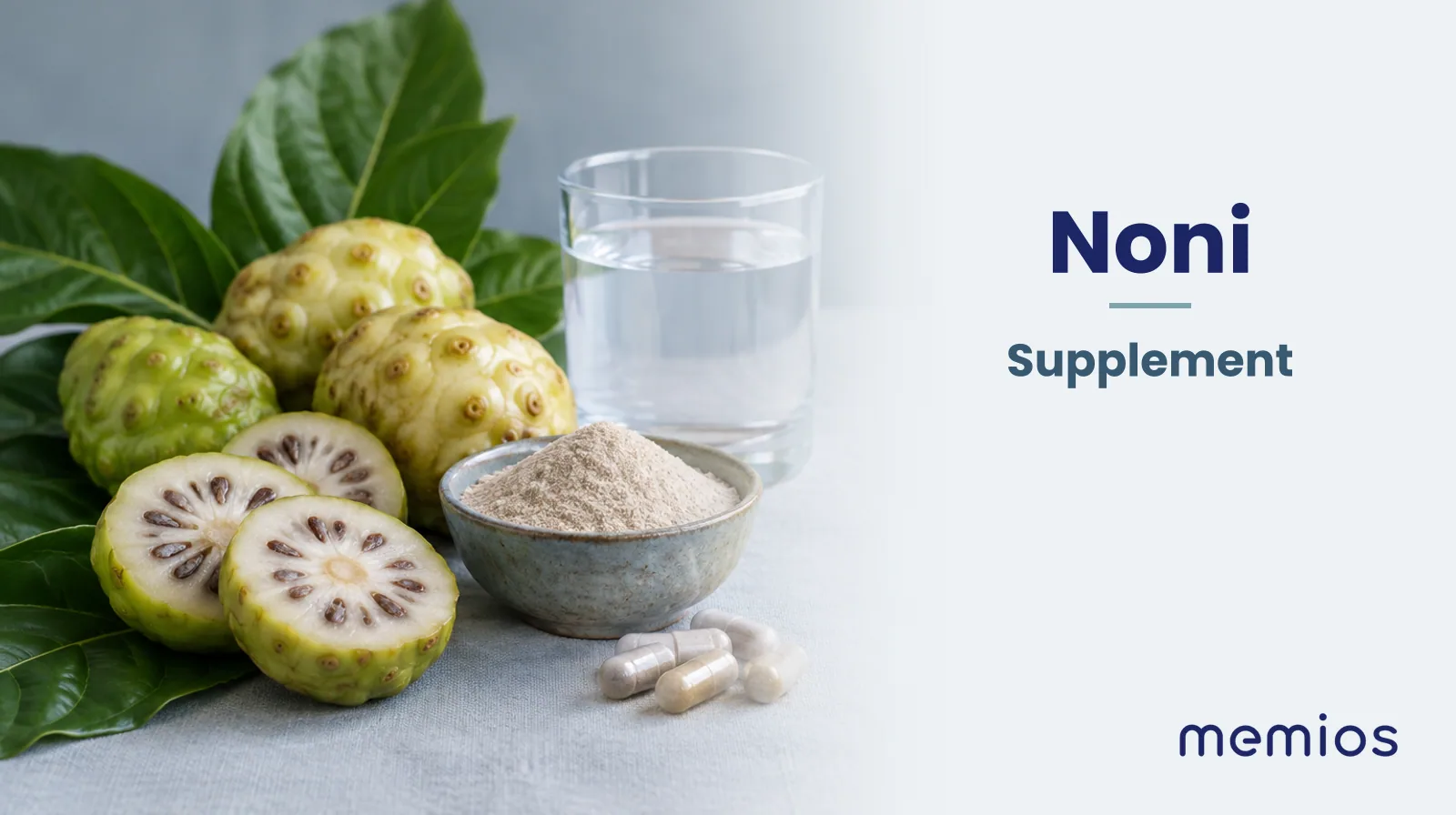
Noni is the fruit of Morinda citrifolia, a small evergreen tropical tree or shrub in the coffee family (Rubiaceae), native from Southeast Asia to Australia and now grown throughout the tropics. The ripe fruit is most often processed into juice, or dried and sold as a powder or capsule extract, and has a long history of traditional use in Pacific Island and Southeast Asian medicine.
What the research says
Noni is marketed as an antioxidant, immune-supporting and anticancer supplement, but the evidence behind those claims is thin. NIH's LiverTox record states that although in vitro and animal work suggests antitumour activity, "In clinical trials, however, noni has yet to be proven to have anticancer activity." A 2022 systematic review pooled 51 clinical and preclinical studies and found the clinical evidence amounted to one Phase I trial and two gastric-cancer case reports. A small Indonesian trial in women with overactive bladder reported a fall in a urinary inflammation marker after treatment, and a randomized placebo-controlled trial of a noni polysaccharide extract for recurrent respiratory infections found no significant clinical benefit.
Evidence grade: Limited evidence.
What goes wrong
A case report documents fulminant, biopsy-supported drug-induced hepatitis in one young woman who had been drinking noni juice daily for four weeks, with liver enzymes normalising after she stopped. (Source 1)
- Case report, Certainty not rated.
- Size: 1 patient.
- Who: A 24-year-old woman being treated for multiple sclerosis.
- How long: 4 weeks of daily noni juice before onset.
- Result: Highly elevated transaminase and bilirubin levels with reduced prothrombin time and suspected beginning acute liver failure; viral, alcoholic, Budd-Chiari, haemochromatosis, Wilson's disease and autoimmune causes were excluded, and liver enzymes returned to normal within 1 month of stopping the juice.
- Funding: not stated.
Limit of this finding: This is one patient, not a rate. She had also been taking interferon beta-1a, which was stopped before the noni juice came to light, so noni cannot be shown to be the sole cause. The paper also contradicts itself on how long she took the interferon — the abstract says 6 weeks, the case report body says 10 weeks — so that detail should not be relied on. What the report establishes is a temporal link and recovery after stopping, not a measured risk for anyone else.
Fine-needle aspiration biopsy of the liver ruled out an autoimmune hepatitis but showed signs of drug-induced toxicity.
A case report of one man with chronic kidney disease who presented with high blood potassium measured the potassium content of noni juice directly and found it comparable to orange or tomato juice. (Source 2)
- Case report, Certainty not rated.
- Size: 1 patient.
- Who: A man with chronic renal insufficiency.
- How long: not stated.
- Result: Presented with hyperkalemia despite reporting adherence to a low-potassium diet; measured potassium concentration in noni juice samples was 56.3 mEq/L.
- Funding: not stated.
Limit of this finding: This is a single case, not a rate. The juice's potassium level is a measured fact; the link to this one man's high potassium is inferred by the authors, and the risk it describes applies to people whose kidneys cannot clear potassium, not to the general population.
The potassium concentration in noni juice samples was determined and found to be 56.3 mEq/L, similar to that in orange juice and tomato juice.
LiverTox rates noni a probable rare cause of clinically apparent, idiosyncratic liver injury, occasionally severe enough to require transplantation. (Source 3)
- Official position, Certainty not rated.
- Size: not applicable.
- Who: not applicable.
- How long: not applicable.
- Result: Likelihood score C; occasional progression to acute liver failure requiring transplantation.
- Funding: not applicable.
Hepatotoxicity attributed to noni juice has occasionally been severe and led to acute liver failure, which in at least one case necessitated emergency liver transplantation.
What the evidence supports
In a small Indonesian trial, urinary hs-CRP (a marker of oxidative stress and inflammation) was significantly lower after 30 days of treatment than before it, in both the noni-extract group and the comparison drug group. (Source 4)
- Randomized trial, Very low certainty.
- Size: 56 female nursing health workers, allocated to two treatment groups.
- Who: Adult women with overactive bladder at H. Adam Malik General Hospital, Medan, Indonesia.
- How long: 30 days.
- Result: A significant difference (p < 0.05) in urinary hs-CRP after treatment compared with before treatment; the same abstract reports the noni fruit extract itself had weak antioxidant activity (IC50 >150 ppm)
- Funding: not stated.
Limit of this finding: The trial's own numbers do not fully line up with its conclusion. The abstract reports that the noni extract had weak antioxidant activity, and the significant hs-CRP change it reports is a before-versus-after comparison within each group rather than a comparison of noni against the other treatment or against a placebo. Two separate readings of the paper's results table also returned different units for the hs-CRP values. Read this as a small, unreplicated signal in a laboratory marker, not as evidence that noni treats overactive bladder.
From the statistical analysis, a significant difference (p < 0.05) was obtained in hs-CRP urine level after compared to before treatment.
What the evidence does not support
A randomized, double-blind, placebo-controlled trial of fermented noni polysaccharide extract found no significant reduction in respiratory infections or immune biomarkers compared to placebo. (Source 5)
- Randomized trial, Moderate certainty.
- Size: 100 adults.
- Who: Adults aged 40 to under 75 with a history of 2 or more upper respiratory tract infections in the prior year.
- How long: 8 weeks.
- Result: URTI incidence and immune markers (IgG, GARS, WBC, leukocyte subsets) did not differ significantly between the noni-polysaccharide and placebo groups; exploratory NK-cell biomarker differences were +8.94 (95% CI −0.61 to 18.50; p = 0.066) at E:T 50:1 and did not reach significance.
- Funding: not stated.
URTI incidence at week 4, week 8, and cumulatively did not differ significantly between groups.
A 2022 systematic review of noni as an anticancer agent found that its included clinical evidence amounted to a single Phase I trial and two gastric-cancer case reports, with the rest of the 51 included studies preclinical. (Source 6)
- Systematic review, Low certainty.
- Size: 51 clinical and preclinical studies (41 efficacy, 10 safety)
- Who: Studies of Morinda citrifolia in cancer models and in cancer patients.
- How long: not applicable.
- Result: Only 1 Phase I clinical trial and 2 gastric-cancer case reports were included as clinical evidence; the review concludes more preclinical efficacy and safety work is needed before translation into clinical studies.
- Funding: not stated.
A Phase I clinical trial and 2 case reports of gastric cancer that utilized noni as part of the treatment for cancer were included in this review.
Where the research disagrees
Whether noni juice is a genuine, if rare, cause of liver injury, or whether the case reports mostly reflect weak or confounded associations
- LiverTox (NIH/NIDDK), position: Several case reports have suggested that noni may account for some cases of idiosyncratic acute liver injury, although the association was weak in many cases. (Source 3)
- LiverTox (NIH/NIDDK), on the quality of those reports, position: While considered safe, several case reports of adverse events attributed to use of noni have appeared, although often criticized because of lack of chemical analysis of the actual product to exclude misidentification and contamination. (Source 7)
- Authors of the 2005 Digestion case report, case-report: After cessation of the Noni juice ingestion, her transaminase levels normalized quickly and were in the normal range within 1 month. (Source 1)
How much
- Reference intake: No RDA, AI, or other essential-nutrient reference intake has been established for noni by NIH ODS, EFSA, or the sources we reviewed; noni is consumed as a traditional fruit/juice, not as an essential nutrient. (Source 7)
- Upper limit: No Tolerable Upper Intake Level has been set for noni fruit or juice by the bodies or literature we searched. (Source 7)
- Studied: A randomized trial gave 975 mg/day of fermented noni polysaccharide extract (two 487.5 mg tablets daily) for 8 weeks. (Source 5)
- Studied: A controlled trial gave noni fruit extract capsules at 500 mg (8 to 16 mg/kg body weight), one capsule a day for 30 days. (Source 8)
- Studied: A 2022 systematic review reported that the only clinical studies it could include were one Phase I trial and two gastric-cancer case reports. (Source 6)
- Studied: A case of fulminant hepatitis followed about 4 weeks of daily noni juice drinking. (Source 1)
A common belief, and what the research shows
The belief: Noni juice is a purely safe, natural antioxidant tonic because it is a traditional fruit product.
What the research shows: Case reports have linked noni juice to acute liver injury. In one, a "Fine-needle aspiration biopsy of the liver ruled out an autoimmune hepatitis but showed signs of drug-induced toxicity," and NIH's LiverTox rates noni a likelihood-C "probable rare cause of clinically apparent liver injury." A separate case report measured noni juice's potassium content directly and found it "56.3 mEq/L, similar to that in orange juice and tomato juice," which matters for people whose kidneys cannot clear potassium. These are single cases, not rates.
Questions and answers
What is it?
Noni is the fruit of Morinda citrifolia, a small tropical tree also known as Indian Mulberry or Ba Ji Tian. It has been eaten as a food and used as a herbal remedy in Polynesia and Southeast Asia for centuries. In Western markets it is usually sold as a bottled juice, or dried and encapsulated as an extract. (Source 7)
What does it do in the body?
Noni is marketed for antioxidant, immune and anticancer effects. Laboratory and animal work has found antitumour activity for some of its components, but that has not carried across into people: NIH's LiverTox record states plainly that clinical trials have not proven an anticancer effect. The human trials that do exist have measured small changes in blood or urine markers rather than disease outcomes. (Source 7)
Is it good or bad for you?
The evidence for benefit is weak and mostly preclinical, while the harm signal, though rare, is real: several case reports describe acute liver injury after noni use, and LiverTox classes noni a probable rare cause of idiosyncratic liver injury. LiverTox also notes those case reports have been criticised, because the actual products were often not chemically analysed to rule out a different plant or a contaminant. In ordinary light dietary use the risk appears low; the literature does not establish it as broadly beneficial either. (Source 7)
How do you get more of it?
Noni is obtained from the Morinda citrifolia fruit itself, normally as juice or as a dried extract in capsules or tablets. As studied, one randomized trial gave 975 mg/day of a fermented noni polysaccharide extract as two tablets daily for 8 weeks; another controlled trial gave 500 mg/day of noni fruit extract capsules for 30 days. (Source 5)
If it is harmful, what reduces it?
In the reported cases of noni-associated liver injury, stopping the juice was followed by recovery. In one case report of a young woman with fulminant hepatitis, her liver enzymes returned to the normal range within a month of stopping noni juice. No other removal method is described in the literature we read. (Source 1)
Why might someone be low in it or missing it?
Not directly addressed in the literature we reviewed. Noni is a food and herbal remedy rather than a nutrient the body requires, so the sources we found do not describe a low-noni or noni-deficient state to explain. (Source 7)
We searched: Searched for 'noni deficiency' and 'noni essential nutrient'; found no such literature, only sources describing noni's traditional dietary and herbal use, such as the NIH LiverTox background record.
Which whole foods contain it or feed it?
The only whole-food source is the noni fruit (Morinda citrifolia) itself, eaten as a food and used as a herbal remedy in Polynesia and Southeast Asia, and sold in the West mainly as juice or dried extract. It does not occur in other common foods. (Source 7)
What happens if you do not have it?
Not directly addressed. Because noni is not an essential nutrient, the literature we reviewed describes no deficiency syndrome or consequence of not consuming it. (Source 7)
We searched: Searched the case reports, trials and reviews located for any described consequence of not consuming noni, including the NIH LiverTox background record; none describes one.
How can you test for it?
There is no validated test of a person's noni intake or 'noni status'. What is tested clinically is the harm noni can cause: standard liver-function blood tests are how noni-associated hepatitis has been identified and followed, including the return of enzymes to normal after the juice was stopped. (Source 1)
References
- Digestion (Karger). Hepatitis Induced by Noni Juice from Morinda citrifolia: A Rare Cause of Hepatotoxicity or the Tip of the Iceberg?. 2005. PMID 16837801, DOI 10.1159/000094524. Read the source
- American Journal of Kidney Diseases. Noni juice (Morinda citrifolia): Hidden potential for hyperkalemia?. 2000. PMID 10676732, DOI 10.1016/S0272-6386(00)70342-8. Read the source
- LiverTox: Clinical and Research Information on Drug-Induced Liver Injury, National Institute of Diabetes and Digestive and Kidney Diseases (NIH). Noni. Read the source
- Open Access Macedonian Journal of Medical Sciences. Controlled Clinical Trial Effect of Noni Fruit Extract (Morinda citrifolia) Toward Overactive Bladder Women through Observation of High-Sensitivity C-reactive Protein in Urine Levels. 2020. DOI 10.3889/oamjms.2020.4693. Read the source
- Nutrients (MDPI). Fermented Noni Polysaccharides and Immune-Related Biomarkers in Adults with Recurrent URTIs: A Randomized, Double-Blind, Placebo-Controlled Trial. 2026. DOI 10.3390/nu18111691. Read the source
- Integrative Cancer Therapies (SAGE). Efficacy and Safety of Morinda citrifolia L. (Noni) as a Potential Anticancer Agent (Results: Clinical Evidence). 2022. DOI 10.1177/15347354221132848. Read the source
- National Institute of Diabetes and Digestive and Kidney Diseases (NIDDK). Noni (LiverTox: Clinical and Research Information on Drug-Induced Liver Injury) – Background. 2020. Read the source
- Open Access Macedonian Journal of Medical Sciences. Controlled Clinical Trial Effect of Noni Fruit Extract (Morinda citrifolia) Toward Overactive Bladder Women through Observation of High-Sensitivity C-reactive Protein in Urine Levels (Methods: treatment allocation). 2020. DOI 10.3889/oamjms.2020.4693. Read the source