Supplements · September 29, 2026 · Memios · 17 min read
Methylsulfonylmethane
Limited evidence. The evidence is limited.
TLDR
- Limited evidence. The evidence is limited.
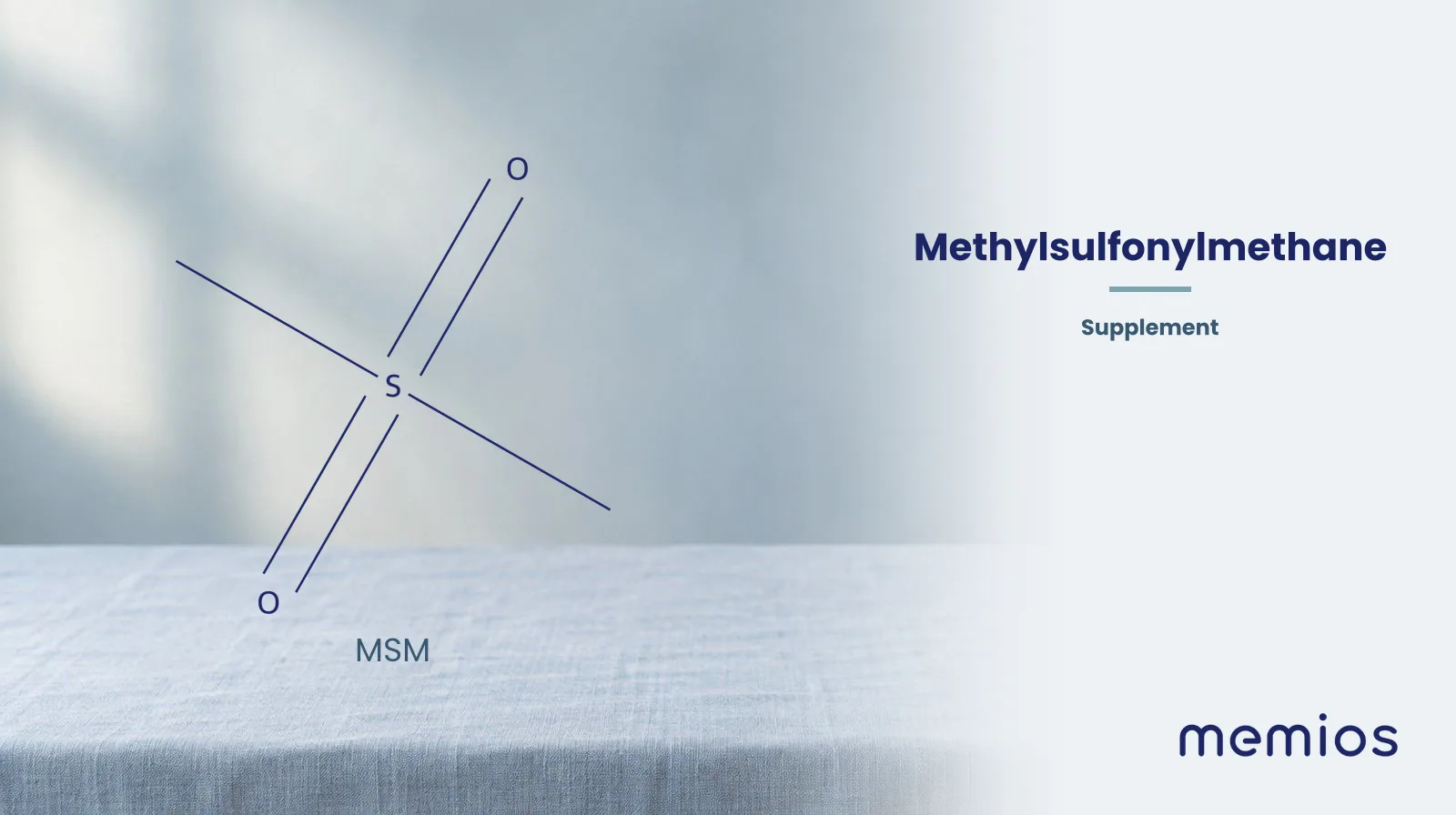
- What it is: Methylsulfonylmethane is a small organosulfur compound, the oxidised relative of dimethyl sulfoxide (DMSO).
- Main use, supported: A pilot randomised trial found MSM 3 g twice daily reduced WOMAC pain and physical function impairment compared with placebo. (low certainty)
- Other use, supported: An industry-funded trial of a much smaller dose (2 g daily) in people with mild knee pain reported a significant difference on its primary knee questionnaire score. (low certainty)
- Claim NOT supported by research: The same review states outright that no definitive conclusion can currently be drawn, and calls for definitive efficacy trials and longer-term safety data. (low certainty)
- Another claim NOT supported: In that same pilot trial, WOMAC stiffness and the aggregated total symptom score did not change. (low certainty)
- Recommended dose: not established. No reference intake (RDA or AI) exists for MSM. It is not an essential nutrient; it is described only as a naturally occurring sulphur compound present in trace amounts in a normal human diet.
- Studied dose (a trial dose, not a recommendation): A pilot trial gave MSM 3 g twice a day, 6 g a day in total, for 12 weeks. Findings citing that trial: 1 for, 1 against.
- Upper limit: No formal tolerable upper intake level was located.
- What goes wrong: 3 findings on harm. Animal toxicity reporting includes a single rat death after a very large oral dose, with no gross pathology found at necropsy.
- Common myth: MSM is a proven treatment for arthritis.
What it is
Methylsulfonylmethane is a small organosulfur compound, the oxidised relative of dimethyl sulfoxide (DMSO). Before it was sold as a supplement it was used industrially as a high-temperature polar aprotic solvent. It occurs naturally in some green plants and in mammals, and appears in trace amounts in ordinary diets, for example in cow's milk, coffee, tomato, tea and maize. As a supplement it is sold in gram-scale doses under several names.
What the research says
The evidence is limited. A systematic review of the randomised trials concluded no definitive conclusion could be drawn, while describing the MSM trials as providing positive but not definitive evidence in mild to moderate knee osteoarthritis; the trials are small and short. Individual trials are mixed: one found significant improvement in pain and physical function but not in stiffness, another found improvements too small to know whether they matter clinically. A 16-week trial monitoring blood chemistry found no effect on liver, kidney or blood counts, and reported side effects are mild and occurred about as often on placebo. The Norwegian food safety committee nonetheless judged 3 g a day from supplements a possible risk.
Evidence grade: Limited evidence.
What goes wrong
The Norwegian Scientific Committee for Food and Environment concluded in 2021 that 3 g of MSM a day from supplements may represent a risk of adverse health effects in adults. (Source 1)
- Official position, Certainty not rated.
- Size: not applicable.
- Who: adults aged 18 and over.
- How long: daily supplement use.
- Result: 3 g/day judged a possible risk; 0.2 g/day judged unlikely to cause adverse health effects.
- Funding: Norwegian Scientific Committee for Food and Environment (VKM), 2021.
A daily dose of 3 g MSM from food supplements may represent a risk of adverse health effects in adults ≥18 years.
The Norwegian risk assessment's summary table for one included trial, Kim et al. (2006), records no major adverse events and side effects — bloating, constipation, indigestion, fatigue, concentration problems, insomnia and headache — at frequencies comparable to placebo. (Source 2)
- Official position, Certainty not rated.
- Size: Kim et al. (2006): 50 participants randomised, 40 completed (21 MSM, 19 placebo), aged 40-76.
- Who: adults with knee osteoarthritis.
- How long: about 12 weeks, at doses escalating to 6 g/day.
- Result: no major adverse events; symptom frequency comparable between MSM and placebo groups.
- Funding: Norwegian Scientific Committee for Food and Environment (VKM), 2021.
Limit of this finding: These words are the Norwegian committee's tabulated summary of a single 2006 trial, not the committee's own overall verdict on MSM. The same report separately concludes that 3 g a day may represent a risk of adverse health effects, so this table row should not be read as an official all-clear for MSM at any dose.
Side effects reported included bloating, constipation, indigestion, fatigue, concentration issues, insomnia, and headache.
Animal toxicity reporting includes a single rat death after a very large oral dose, with no gross pathology found at necropsy. (Source 3)
- Animal study, Very low certainty.
- Size: one female rat in a preliminary toxicity report.
- Who: rats.
- How long: two days.
- Result: single mortality at an oral aqueous dose of 15.4 g/kg; mild skin and eye irritation reported with topical application.
- Funding: not stated.
In a preliminary toxicity study report, a single mortality was reported in a female rat given an oral aqueous dose of 15.4 g/kg after two days; however, a post-mortem necropsy examination showed no gross pathological alterations.
What the evidence supports
A pilot randomised trial found MSM 3 g twice daily reduced WOMAC pain and physical function impairment compared with placebo. (Source 4)
- Randomized trial, Low certainty.
- Size: 50 men and women.
- Who: adults aged 40 to 76 with knee osteoarthritis pain, outpatient medical center.
- How long: 12 weeks.
- Result: significant decreases in WOMAC pain and physical function impairment, P<0.05.
- Funding: not stated.
Compared to placebo, MSM produced significant decreases in WOMAC pain and physical function impairment (P<0.05).
An industry-funded trial of a much smaller dose (2 g daily) in people with mild knee pain reported a significant difference on its primary knee questionnaire score. (Source 5)
- Randomized trial, Low certainty.
- Size: 88 participants (44 MSM, 44 placebo)
- Who: healthy Japanese adults with mild knee joint pain.
- How long: 12 weeks.
- Result: Japanese Knee Osteoarthritis Measure total score differed at 12 weeks, p = 0.046; health condition subscale p = 0.032.
- Funding: industry-funded: supported by CIC FRONTIER Co., Ltd.
The total scores at 12 weeks in the MSM and placebo groups as the primary outcome were significantly different (p = 0.046).
A safety analysis nested in a randomised controlled trial of 6 g MSM daily found no difference from placebo in blood counts, liver enzymes, creatinine, weight or blood pressure. (Source 6)
- Randomized trial, Low certainty.
- Size: subgroup analysis of a randomised controlled trial of low back pain.
- Who: patients with osteoarthritis and back pain at a military family medicine residency.
- How long: 16 weeks.
- Result: no significant difference between MSM and placebo for WBC, platelets, haemoglobin, glucose, total bilirubin, ALT, AST, creatinine, weight, diastolic or systolic blood pressure.
- Funding: product identified as OptiMSM, Bergstrom Nutrition; funding not stated in the abstract.
Limit of this finding: This comes from a safety subgroup analysis of one low back pain trial, not a standalone safety study, and the authors limit the claim with the words “in this study”. The run-together phrase “creatinine weight” is the paper's own missing comma between two separate measurements. The same abstract elsewhere prints “no significant difference between MSM and placebo (p < 0.05)”, which is self-contradictory, so treat this as reassuring but weak evidence rather than proof that 6 g a day is safe.
MSM has no effects on WBC, platelets, Hb, total bilirubin, AST, ALT, creatinine weight, DBP, or SBP in this study.
Oral MSM raises plasma MSM concentrations in a dose-related way, reaching a plateau within four weeks. (Source 7)
- Blood level study, Low certainty.
- Size: 45 men and women aged about 25.
- Who: healthy young adults.
- How long: 16 weeks at 1, 2 or 3 grams daily.
- Result: group effect p<0.0001; higher plasma levels at 2 and 3 g/day than 1 g/day; values at weeks 4 to 16 above baseline (p<0.05) with no differences between weeks 4 and 16 (p>0.05)
- Funding: not stated.
A higher dose of supplement results in a greater plasma MSM concentration.
In the 2023 trial of 2 g daily, physical examination, urine analysis, blood tests and medical interview found no health problems and no adverse events. (Source 8)
- Randomized trial, Low certainty.
- Size: 88 participants.
- Who: healthy Japanese adults with mild knee pain.
- How long: 12 weeks.
- Result: no adverse events reported.
- Funding: industry-funded: supported by CIC FRONTIER Co., Ltd.
revealed no health problems during the study period, and no adverse events were reported
What the evidence does not support
The same review states outright that no definitive conclusion can currently be drawn, and calls for definitive efficacy trials and longer-term safety data. (Source 9)
- Systematic review, Low certainty.
- Size: 6 studies in total; 2 MSM trials.
- Who: adults with knee osteoarthritis.
- How long: varied.
- Result: no pooled estimate.
- Funding: not stated.
No definitive conclusion can currently be drawn for either supplement.
In that same pilot trial, WOMAC stiffness and the aggregated total symptom score did not change. (Source 4)
- Randomized trial, Low certainty.
- Size: 50 men and women.
- Who: adults with knee osteoarthritis pain.
- How long: 12 weeks.
- Result: no notable change in WOMAC stiffness or aggregated total symptoms scores.
- Funding: not stated.
No notable changes were found in WOMAC stiffness and aggregated total symptoms scores.
The authors of that pilot trial state that its benefits and safety cannot be confirmed from a pilot study. (Source 10)
- Randomized trial, Low certainty.
- Size: 50 participants.
- Who: adults with knee osteoarthritis pain.
- How long: 12 weeks.
- Result: no effect estimate; a stated limitation.
- Funding: not stated.
The benefits and safety of MSM in managing OA and long-term use cannot be confirmed from this pilot trial
A separate randomised trial reported that MSM and placebo did not differ significantly on WOMAC pain, WOMAC stiffness or SF-36 total score, although the trial's own confidence intervals for stiffness and SF-36 do not match the p-values it prints. (Source 11)
- Randomized trial, Low certainty.
- Size: 50 patients randomised (per the published trial)
- Who: patients with knee osteoarthritis.
- How long: 12 weeks.
- Result: WOMAC pain 12.4 mm (CI 0.0, 24.8), p = 0.08; WOMAC stiffness 27.2 mm (CI 8.2, 46.2), p = 0.08; SF-36 total 11.6 (CI 1.0, 22.1), p = 0.54.
- Funding: not stated.
Limit of this finding: The published paper contradicts itself here. It calls the WOMAC stiffness result non-significant (p = 0.08) and the SF-36 result a non-significant difference (p = 0.54), yet the confidence intervals it prints for both (8.2 to 46.2 and 1.0 to 22.1) do not include zero, which would normally mean a significant difference; it also calls the VAS pain result significant (p = 0.05) while printing an interval (-0.9 to 2.4) that does include zero, and labels that result in seconds, which is not a unit of pain. These errors are in the paper as published, not in our transcription. Read this trial as inconclusive about MSM and knee symptoms; do not read any of these individual numbers as a reliable result either way.
Treatment groups did not differ significantly in WOMAC pain (12.4 mm [CI: 0.0, 24.8]); p = 0.08) or WOMAC stiffness (27.2 mm [CI: 8.2, 46.2]; p = 0.08).
Where the evidence is mixed
A systematic review concluded that no definitive conclusion can be drawn for MSM, while noting the MSM trials gave positive but not definitive evidence in mild to moderate knee osteoarthritis. (Source 9)
- Systematic review, Low certainty.
- Size: 168 patients across the MSM trials, with 52 on active treatment.
- Who: adults with osteoarthritis of the knee.
- How long: trials of varying and questioned duration.
- Result: no pooled effect estimate reported in the abstract.
- Funding: not stated.
The data from the more rigorous MSM trials provide positive but not definitive evidence that MSM is superior to placebo in the treatment of mild to moderate OA of the knee.
The authors of that trial say the improvements they did see were small and of unknown clinical significance. (Source 12)
- Randomized trial, Low certainty.
- Size: 50 patients.
- Who: patients with knee osteoarthritis.
- How long: 12 weeks.
- Result: WOMAC physical function 14.6 mm (CI 4.3, 25.0), p = 0.04; WOMAC total 15.0 mm (CI 5.1, 24.9), p = 0.03.
- Funding: not stated.
These improvements, however, are small and it is yet to be determined if they are of clinical significance.
Where the research disagrees
Whether gram-scale daily MSM is safe
- Norwegian Scientific Committee for Food and Environment (VKM), 2021, regulatory risk assessment of the human and animal literature: A daily dose of 3 g MSM from food supplements may represent a risk of adverse health effects in adults ≥18 years. (Source 1)
- Butawan and colleagues, Nutrients (2017), narrative review of applications and safety: As a Generally Recognized As Safe (GRAS) approved substance, MSM is well-tolerated by most individuals at dosages of up to four grams daily, with few known and mild side effects. (Source 13)
- Safety analysis of a randomised controlled trial (2019), subgroup safety analysis of a 16-week randomised controlled trial at 6 g daily: MSM has no effects on WBC, platelets, Hb, total bilirubin, AST, ALT, creatinine weight, DBP, or SBP in this study. (Source 6)
How much
- Reference intake: No reference intake (RDA or AI) exists for MSM. It is not an essential nutrient; it is described only as a naturally occurring sulphur compound present in trace amounts in a normal human diet. (Source 14)
- Upper limit: No formal tolerable upper intake level was located. The Norwegian Scientific Committee for Food and Environment (VKM, 2021) instead gave dose-specific judgements: 3 g a day from supplements may represent a risk, while 0.2 g a day is unlikely to cause adverse health effects in healthy adults aged 18 and over. (Source 1)
- Studied: A pilot trial gave MSM 3 g twice a day, 6 g a day in total, for 12 weeks. (Source 4)
- Studied: A 2023 trial gave 10 tablets containing 200 mg MSM each, 2 g a day, for 12 weeks. (Source 5)
- Studied: A pharmacokinetic study gave 1, 2 or 3 grams of MSM daily for 16 weeks. (Source 15)
- Studied: A safety analysis studied 6 g daily of a branded MSM for 16 weeks. (Source 16)
A common belief, and what the research shows
The belief: MSM is a proven treatment for arthritis.
What the research shows: The systematic review of the randomised evidence says the opposite: "No definitive conclusion can currently be drawn for either supplement." It describes the MSM data as "positive but not definitive evidence that MSM is superior to placebo in the treatment of mild to moderate OA of the knee", based on only "168 patients for MSM (N=52 on active treatment)". A later randomised trial found no significant difference from placebo in WOMAC pain (p = 0.08) and concluded that the improvements it did find "are small and it is yet to be determined if they are of clinical significance."
Questions and answers
What is it?
MSM is a small sulfur-containing molecule, chemically dimethyl sulfone, and the oxidised relative of DMSO. It is sold under several names including methyl sulfone, organic sulfur and crystalline dimethyl sulfoxide. Before its use as a supplement it was mainly an industrial solvent. (Source 17)
What does it do in the body?
MSM is absorbed quickly, spreads widely through the body including across the blood-brain barrier, and is excreted largely unchanged in urine. Anti-inflammatory effects have been reported, but what it does to human joints remains uncertain, and the trials that tested it are small and short. (Source 18)
Is it good or bad for you?
Neither clearly. The randomised evidence is too thin to call: the systematic review that pooled it says no definitive conclusion can be drawn. Reported side effects are mild and occurred about as often on placebo, and a 16-week trial found no change in liver, kidney or blood test results at 6 g a day; but a national food safety body judged 3 g a day from supplements a possible risk. (Source 9)
How do you get more of it?
Ordinary diets supply only traces, so studied intakes came from supplements. Trials have used 6 g a day (3 g twice daily) for 12 weeks, 2 g a day for 12 weeks, and 1 to 3 g a day for 16 weeks. (Source 4)
If it is harmful, what reduces it?
MSM is cleared by the kidneys. Both human and animal data show urine is the main route of elimination and that it leaves the body mostly unchanged, so stopping the supplement is what ends exposure; no specific removal treatment is described in the literature we searched. (Source 19)
Why might someone be low in it or missing it?
There is no MSM deficiency to be missing. It is not an essential nutrient and the ordinary diet contains only trace amounts, so blood levels reflect whether someone is taking a supplement rather than any nutritional state. (Source 14)
Which whole foods contain it or feed it?
MSM occurs naturally in a scattering of ordinary foods and drinks, at microgram-per-gram levels: cow's milk, coffee, tomato, tea and maize are the examples given in the Norwegian risk assessment. These amounts are far below the gram doses used in trials. (Source 14)
What happens if you do not have it?
No deficiency syndrome is described anywhere in the literature we searched, because MSM is not a required nutrient. In the randomised trials the placebo groups, who received none, showed no harm from its absence; in one trial they did not differ significantly from the MSM group on knee pain at all. (Source 11)
How can you test for it?
MSM can be measured in blood by laboratory mass spectrometry, and levels track the dose taken, plateauing after about four weeks. This is a research measurement of recent intake, not a clinical test of health or need, and no reference range for health is defined. (Source 15)
References
- Norwegian Scientific Committee for Food and Environment (VKM). Risk assessment of methylsulfonylmethane (MSM). Opinion of the Panel on Nutrition, Dietetic Products, Novel Food and Allergy of the Norwegian Scientific Committee for Food and Environment. 2021. Read the source
- Norwegian Scientific Committee for Food and Environment (VKM). Risk assessment of methylsulfonylmethane (MSM). Opinion of the Panel on Nutrition, Dietetic Products, Novel Food and Allergy of the Norwegian Scientific Committee for Food and Environment. 2021. Read the source
- Nutrients (MDPI). Methylsulfonylmethane: Applications and Safety of a Novel Dietary Supplement. 2017. PMID 28300758, DOI 10.3390/nu9030290. Read the source
- Osteoarthritis and Cartilage. Efficacy of methylsulfonylmethane (MSM) in osteoarthritis pain of the knee: a pilot clinical trial. 2006. PMID 16309928, DOI 10.1016/j.joca.2005.10.003. Read the source
- Nutrients (MDPI). Methylsulfonylmethane Improves Knee Quality of Life in Participants with Mild Knee Pain: A Randomized, Double-Blind, Placebo-Controlled Trial. 2023. PMID 37447322, DOI 10.3390/nu15132995. Read the source
- Complementary Therapies in Medicine. Methylsulfonylmethane for treatment of low back pain: A safety analysis of a randomized, controlled trial. 2019. PMID 31331587, DOI 10.1016/j.ctim.2019.05.022. Read the source
- Journal of Nutrition & Food Sciences. Blood MSM Concentrations Following Escalating Dosages of Oral MSM in Men and Women. 2019. Read the source
- Nutrients (MDPI). Methylsulfonylmethane Improves Knee Quality of Life in Participants with Mild Knee Pain: A Randomized, Double-Blind, Placebo-Controlled Trial. 2023. DOI 10.3390/nu15132995. Read the source
- Osteoarthritis and Cartilage. Systematic review of the nutritional supplements dimethyl sulfoxide (DMSO) and methylsulfonylmethane (MSM) in the treatment of osteoarthritis. 2008. PMID 18417375, DOI 10.1016/j.joca.2008.03.002. Read the source
- Osteoarthritis and Cartilage. Efficacy of methylsulfonylmethane (MSM) in osteoarthritis pain of the knee: a pilot clinical trial. 2006. PMID 16309928, DOI 10.1016/j.joca.2005.10.003. Read the source
- BMC Complementary and Alternative Medicine. Efficacy of methylsulfonylmethane supplementation on osteoarthritis of the knee: a randomized controlled study. 2011. PMID 21708034, DOI 10.1186/1472-6882-11-50. Read the source
- BMC Complementary and Alternative Medicine. Efficacy of methylsulfonylmethane supplementation on osteoarthritis of the knee: a randomized controlled study. 2011. PMID 21708034, DOI 10.1186/1472-6882-11-50. Read the source
- Nutrients (MDPI). Methylsulfonylmethane: Applications and Safety of a Novel Dietary Supplement. 2017. PMID 28300758, DOI 10.3390/nu9030290. Read the source
- Norwegian Scientific Committee for Food and Environment (VKM). Risk assessment of methylsulfonylmethane (MSM). Opinion of the Panel on Nutrition, Dietetic Products, Novel Food and Allergy of the Norwegian Scientific Committee for Food and Environment. 2021. Read the source
- Journal of Nutrition & Food Sciences. Blood MSM Concentrations Following Escalating Dosages of Oral MSM in Men and Women. 2019. Read the source
- Complementary Therapies in Medicine. Methylsulfonylmethane for treatment of low back pain: A safety analysis of a randomized, controlled trial. 2019. PMID 31331587, DOI 10.1016/j.ctim.2019.05.022. Read the source
- Nutrients (MDPI). Methylsulfonylmethane: Applications and Safety of a Novel Dietary Supplement. 2017. PMID 28300758, DOI 10.3390/nu9030290. Read the source
- Norwegian Scientific Committee for Food and Environment (VKM). Risk assessment of methylsulfonylmethane (MSM). Opinion of the Panel on Nutrition, Dietetic Products, Novel Food and Allergy of the Norwegian Scientific Committee for Food and Environment. 2021. Read the source
- Norwegian Scientific Committee for Food and Environment (VKM). Risk assessment of methylsulfonylmethane (MSM). Opinion of the Panel on Nutrition, Dietetic Products, Novel Food and Allergy of the Norwegian Scientific Committee for Food and Environment. 2021. Read the source