Supplements · September 30, 2026 · Memios · 8 min read
Maitake
A systematic review found a lack of systematic study of maitake's safety and effectiveness in people.
TLDR
- Limited evidence. A systematic review found a lack of systematic study of maitake's safety and effectiveness in people.
- What it is: Maitake is an edible mushroom eaten widely in Asia and used in traditional medicine.
- Main use, supported: In a single-arm phase II trial in lower-risk myelodysplastic syndrome, maitake extract increased laboratory measures of neutrophil and monocyte function. (low certainty)
- Claim NOT supported by research: A systematic review of maitake found no systematic human study of its safety or effectiveness. (very low certainty)
- Recommended dose: not established. No RDA or Adequate Intake exists. Maitake is a food mushroom, not an essential nutrient, and no body in the sources searched sets a reference intake.
- Studied dose (a trial dose, not a recommendation): Maitake liquid extract 0.1, 0.5, 1.5, 3 or 5 mg/kg twice daily for 3 weeks in breast cancer survivors. Findings citing that trial: 1 mixed, 1 on harm.
- Upper limit: No tolerable upper limit has been set by any body in the sources searched.
- What goes wrong: 4 findings on harm. The authors of the breast cancer trial warned that maitake may suppress as well as boost immune function.
- Common myth: Maitake simply 'boosts' the immune system.
What it is
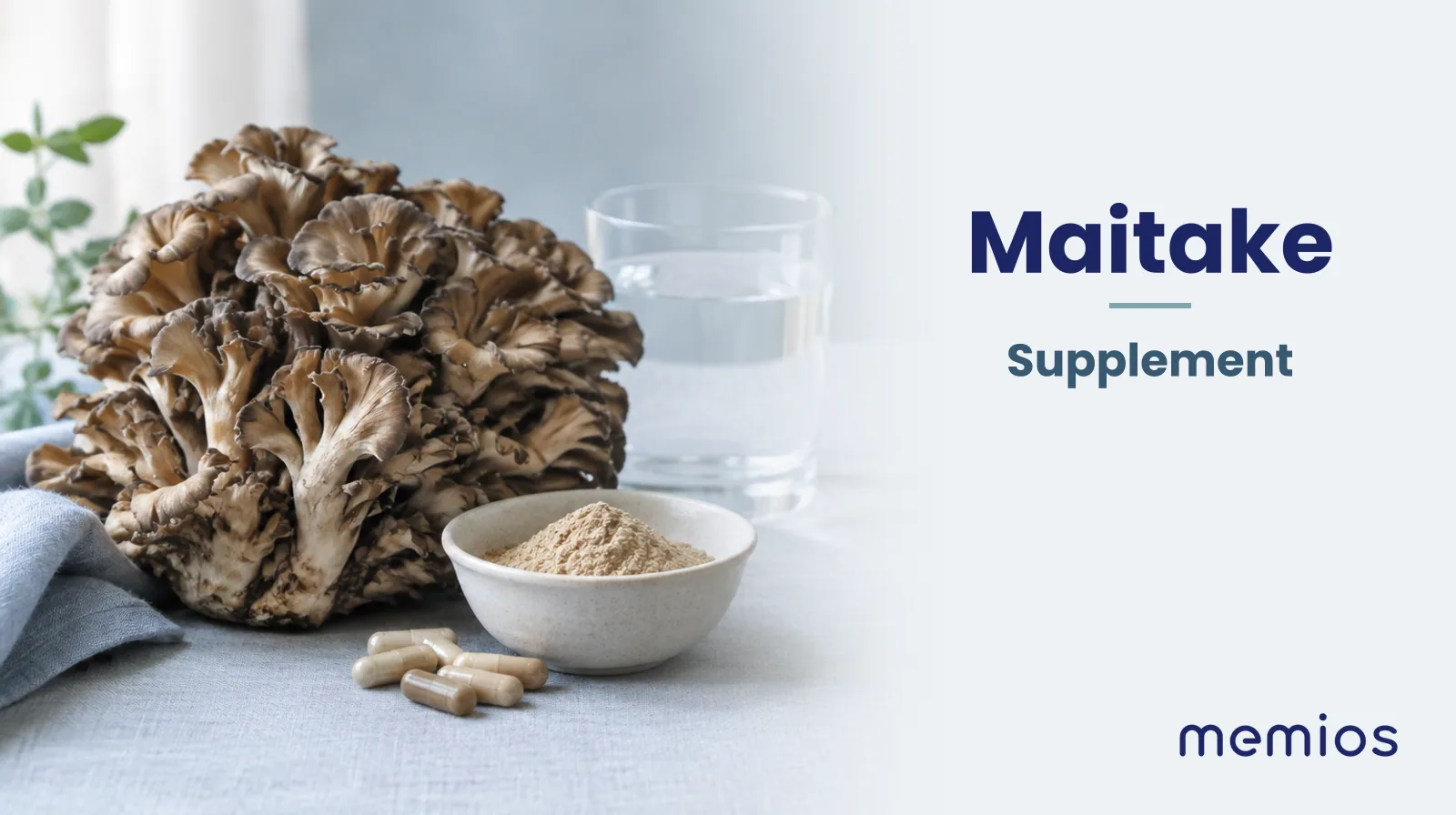
Maitake is an edible mushroom eaten widely in Asia and used in traditional medicine. Supplements are made from polysaccharide (beta-glucan) extracts of the mushroom.
What the research says
A systematic review found a lack of systematic study of maitake's safety and effectiveness in people. Small trials show measurable changes in immune cells, but in the dose-finding trial in breast cancer survivors maitake both raised and lowered different immune measures. One small open-label study reported ovulation in women with polycystic ovary syndrome. It may raise INR with warfarin and add to diabetes medicines.
Evidence grade: Limited evidence.
What goes wrong
The authors of the breast cancer trial warned that maitake may suppress as well as boost immune function. (Source 1)
- Randomized trial, Low certainty.
- Size: 34 participants.
- Who: Postmenopausal breast cancer patients.
- How long: 3 weeks.
- Result: Two withdrawals for grade I possibly related side effects (nausea and joint swelling; rash and pruritus); no dose-limiting toxicity.
- Funding: not stated.
Two patients withdrew prior to completion of the study due to grade I possibly related side effects: nausea and joint swelling in one patient; rash and pruritus in the second.
In the same trial, asymptomatic eosinophilia (raised eosinophil white cells) occurred in 4 of the patients. (Source 2)
- Randomized trial, Low certainty.
- Size: 18 evaluable patients.
- Who: Adults with myelodysplastic syndromes.
- How long: 12 weeks.
- Result: Eosinophilia in 4 patients, p = 0.014.
- Funding: not stated.
Asymptomatic eosinophilia occurred in 4 patients (p = 0.014).
A case report links maitake to a raised INR in a person on warfarin. (Source 3)
- Case report, Very low certainty.
- Size: 1 patient.
- Who: Person taking warfarin.
- How long: not stated.
- Result: INR elevation.
- Funding: independent (academic cancer centre summary)
A case report suggests maitake can interact with warfarin, resulting in INR elevation.
Maitake may add to the effect of diabetes medicines in people with type 2 diabetes. (Source 3)
- Expert review, not systematic, Very low certainty.
- Size: not stated.
- Who: People with type 2 diabetes.
- How long: not stated.
- Result: Possible added glucose lowering.
- Funding: independent (academic cancer centre summary)
Hypoglycemic medications: Maitake may increase their effects in type-2 diabetic patients.
What the evidence supports
In a single-arm phase II trial in lower-risk myelodysplastic syndrome, maitake extract increased laboratory measures of neutrophil and monocyte function. (Source 2)
- Randomized trial, Low certainty.
- Size: 21 enrolled, 18 evaluable.
- Who: Adults with Low or Intermediate-1 risk myelodysplastic syndromes, compared with age-matched healthy controls.
- How long: 12 weeks.
- Result: Basal neutrophil function p = 0.005; monocyte function p = 0.021; fMLP-stimulated ROS p = 0.03.
- Funding: not stated.
Maitake increased endogenous (basal) neutrophil (p = 0.005) and monocyte function (p = 0.021).
What the evidence does not support
A systematic review of maitake found no systematic human study of its safety or effectiveness. (Source 4)
- Systematic review, Very low certainty.
- Size: not stated in the abstract.
- Who: All published maitake evidence, ten databases.
- How long: Literature to 2009.
- Result: Lack of systematic human studies; randomised trials called for.
- Funding: not stated.
There was a lack of systematic study on the safety and effectiveness of maitake in humans.
Where the evidence is mixed
In a dose-escalation trial in 34 breast cancer survivors, maitake extract had a statistically significant association with immune function, but raised some measures and lowered others. (Source 1)
- Randomized trial, Low certainty.
- Size: 34 participants in five dose cohorts.
- Who: Postmenopausal breast cancer patients free of disease after initial treatment.
- How long: 3 weeks.
- Result: p < 0.0005 association with immune function; non-monotonic dose response, with both stimulation and suppression.
- Funding: not stated.
Increasing doses of Maitake increased some immunologic parameters and depressed others
An open-label study in women with polycystic ovary syndrome, with no placebo group, reported ovulation in 76.9% of 26 women given a maitake extract and 93.5% of 31 women given the standard drug clomiphene. It does not show that maitake works as well as clomiphene. (Source 5)
- Randomized trial, Very low certainty.
- Size: 57 women evaluated (26 maitake, 31 clomiphene)
- Who: Women with polycystic ovary syndrome.
- How long: 3 menstrual cycles.
- Result: Ovulation 76.9% with maitake SX-fraction vs 93.5% with clomiphene.
- Funding: not stated.
Limit of this finding: These are the share of women who ovulated at least once among those evaluated at the end, not among everyone who started. The original paper (Chen 2010) randomised 72 women and reports that this per-woman difference was not statistically significant, while the per-cycle ovulation rate clearly favoured clomiphene. The study was open-label with no placebo, so it cannot show maitake works on its own or matches clomiphene.
After 3 menstrual cycles, the MSX group (26 women) had an ovulation rate of 76.9% and the CC group (31 women) had an ovulation rate of 93.5%.
Where the research disagrees
Whether maitake's immune effects are a benefit
- Wesa et al., 2015 (phase II trial in myelodysplastic syndromes), single-arm phase II trial, 18 evaluable patients: Enhanced in vitro neutrophil and monocyte function following treatment demonstrate that Maitake has beneficial immunomodulatory potential in MDS. (Source 2)
- Deng et al., 2009 (phase I/II trial in breast cancer), dose-escalation trial, 34 patients: Cancer patients should be made aware of the fact that botanical agents produce more complex effects than assumed, and may depress as well as enhance immune function. (Source 1)
How much
- Reference intake: No RDA or Adequate Intake exists. Maitake is a food mushroom, not an essential nutrient, and no body in the sources searched sets a reference intake. (Source 4)
- Upper limit: No tolerable upper limit has been set by any body in the sources searched. (Source 4)
- Studied: Maitake liquid extract 0.1, 0.5, 1.5, 3 or 5 mg/kg twice daily for 3 weeks in breast cancer survivors. (Source 1)
- Studied: Oral maitake extract 3 mg/kg twice daily for 12 weeks in myelodysplastic syndromes. (Source 2)
- Studied: Maitake SX-fraction, 3 tablets three times daily, in polycystic ovary syndrome. (Source 5)
A common belief, and what the research shows
The belief: Maitake simply 'boosts' the immune system.
What the research shows: In the dose-finding trial some immune measures went up and others went down. The authors wrote that oral maitake "is associated with both immunologically stimulatory and inhibitory measurable effects in peripheral blood."
Questions and answers
What is it?
Maitake, also called hen of the woods, is an edible mushroom eaten widely in Asia. It has been used in traditional medicine for diabetes and high blood pressure, and supplements are concentrated extracts of its polysaccharides. (Source 6)
What does it do in the body?
Its extracts change laboratory measures of immune cells in small trials, but a systematic review found no systematic human study of safety or effectiveness. Whether these changes lead to better health outcomes has not been tested. (Source 4)
Is it good or bad for you?
As a food it is widely eaten. As a concentrated extract its effects are mixed: in one trial it both raised and lowered immune measures, a few people stopped for mild side effects, and it may interact with warfarin and diabetes medicines. (Source 1)
How do you get more of it?
People get maitake by eating the mushroom or taking extracts. Trials gave liquid extracts by body weight; for example, one trial gave 3 mg per kilogram twice a day for 12 weeks. (Source 2)
If it is harmful, what reduces it?
Does not apply. Maitake is not a substance the body builds up, and the literature we searched describes no need to reduce it. (Source 4)
We searched: WebSearch for maitake systematic reviews, trials, case reports and interactions; Memorial Sloan Kettering monograph
Why might someone be low in it or missing it?
Does not apply. Maitake is not an essential nutrient or a gut organism, so no deficiency is described. (Source 4)
We searched: WebSearch for maitake systematic reviews and trials
Which whole foods contain it or feed it?
Maitake is itself a food: an edible mushroom commonly cooked in Asian cuisine. (Source 6)
What happens if you do not have it?
Nothing is known to happen. No literature we searched describes any effect of not eating maitake. (Source 4)
We searched: WebSearch for maitake systematic reviews and trials
How can you test for it?
No test for maitake intake exists in the literature we searched. Trials measured immune-cell function in blood, which is a research measure, not a test of maitake levels. (Source 2)
We searched: WebSearch for maitake trials; Wesa 2015 and Deng 2009 abstracts
References
- Journal of Cancer Research and Clinical Oncology. A phase I/II trial of a polysaccharide extract from Grifola frondosa (Maitake mushroom) in breast cancer patients: immunological effects. 2009. PMID 19253021, DOI 10.1007/s00432-009-0562-z. Read the source
- Cancer Immunology, Immunotherapy. Maitake mushroom extract in myelodysplastic syndromes (MDS): a phase II study. 2015. PMID 25351719, DOI 10.1007/s00262-014-1628-6. Read the source
- Memorial Sloan Kettering Cancer Center. Maitake (About Herbs). 2026. Read the source
- Journal of the Society for Integrative Oncology. Maitake mushroom (Grifola frondosa): systematic review by the Natural Standard Research Collaboration. 2009. PMID 19476741, DOI 10.2310/7200.2009.0007. Read the source
- Natural Medicine Journal. Maitake Induces Ovulation in People With Polycystic Ovarian Syndrome (commentary on Chen JT et al., J Altern Complement Med 2010;16(12):1295-1299). Read the source
- Memorial Sloan Kettering Cancer Center. Maitake (About Herbs). 2026. Read the source