Supplements · September 30, 2026 · Memios · 13 min read
Maca
The honest summary is that the human evidence is thin. Systematic reviews of randomised trials for sexual function.
TLDR
- Limited evidence. The honest summary is that the human evidence is thin. Systematic reviews of randomised trials for sexual function, erectile function and menopausal symptoms all reach the same verdict: a small number of small trials point in a favourable direction.
- What it is: Maca is the dried underground hypocotyl of Lepidium meyenii, a plant in the brassica (mustard) family grown high in the Peruvian Andes.
- Main use, supported: A systematic review of randomised placebo-controlled trials found only limited evidence that maca improves sexual function, with the trials too few and too small to be conclusive. (low certainty)
- Other use, supported: An observational study of 600 Andean residents found no significant difference in clinical, liver, kidney and lipid parameters between regular and non-habitual maca users. (very low certainty)
- Claim NOT supported by research: A meta-analysis of randomised trials failed to show that maca increases sperm concentration compared with placebo. (low certainty)
- Recommended dose: not established. No reference intake (RDA or AI) exists for maca: it is a food plant and not an essential nutrient. Health Canada assessed maca root extract in 2024 and found the data insufficient even to set acceptable conditions of use in supplemented foods.
- Studied dose (a trial dose, not a recommendation): 3 g of maca powder daily for 12 weeks in a clinical study, which produced transient gastrointestinal upset, headache and irritability. Findings citing that trial: 1 for, 1 on harm.
- Upper limit: No upper limit or acceptable daily intake has been set by any body reached in this search.
- What goes wrong: 4 findings on harm. Analysis of maca grown in Andean soils found cadmium and lead in both soil and the edible hypocotyl above permissible limits.
- Common myth: Maca is a proven natural fertility and libido booster.
What it is
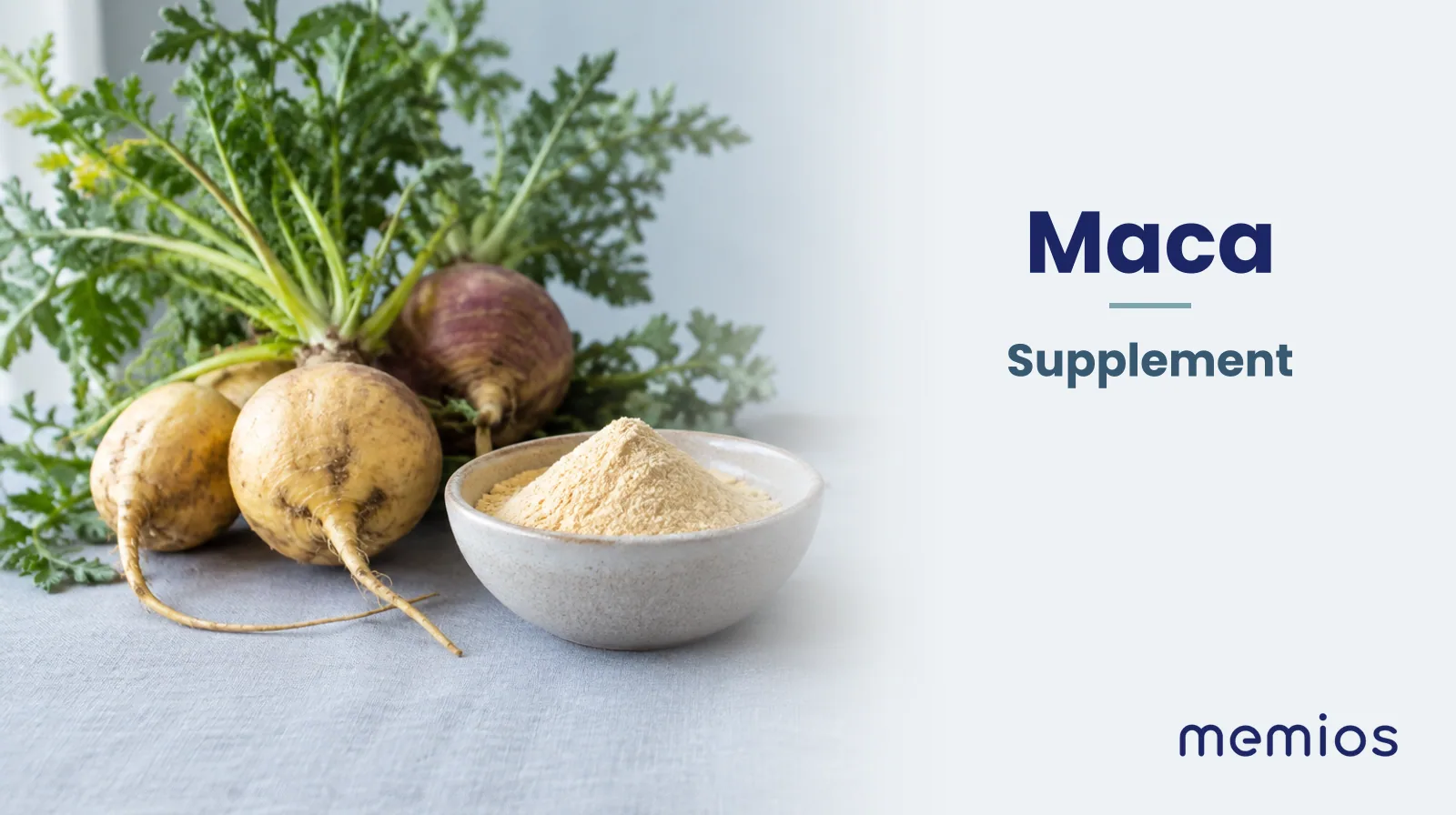
Maca is the dried underground hypocotyl of Lepidium meyenii, a plant in the brassica (mustard) family grown high in the Peruvian Andes. It is eaten in the Andes as a food, usually as a dried powder, and sold elsewhere as a capsule or extract. It comes in colour types (yellow, red, purple, black) that differ in composition. Because it is a root crop, its mineral content reflects the soil it is grown in.
What the research says
The honest summary is that the human evidence is thin. Systematic reviews of randomised trials for sexual function, erectile function and menopausal symptoms all reach the same verdict: a small number of small trials point in a favourable direction, but the trials are too few, too small and too variable in quality to support firm conclusions. A meta-analysis of semen quality found no effect on sperm concentration. Reported adverse effects in trials have mostly been mild and transient, but there are published case reports of serious events, and maca grown in mining-affected Andean soils can carry cadmium and lead.
Evidence grade: Limited evidence.
What goes wrong
Published case reports describe vaginal bleeding in a young woman and a manic episode in a young man attributed to maca consumption, alongside transient gastrointestinal upset, headache and irritability in a trial. (Source 1)
- Case report, Very low certainty.
- Size: 2 individual case reports, plus adverse events recorded in a 12-week trial of 3 g/day.
- Who: a 24-year-old woman; a 27-year-old man with no psychiatric history; trial participants.
- How long: case reports not stated; the trial ran 12 weeks.
- Result: Two case reports of serious events; transient gastrointestinal upset, headache and irritability at 3 g/day for 12 weeks; a moderate rise in AST and diastolic blood pressure at 0.6 g/kg/day for 90 days.
- Funding: not stated.
However, two studies reported apparent adverse effects due to its consumption, one of vaginal bleeding in a 24-year-old woman (Srikugan et al., 2011) and another of a manic episode in a 27-year-old man with no psychiatric history (Quandt and Puga, 2016).
Analysis of maca grown in Andean soils found cadmium and lead in both soil and the edible hypocotyl above permissible limits. (Source 2)
- Expert review, not systematic, Low certainty.
- Size: one analytical study of yellow and purple maca, summarised in a review.
- Who: yellow and purple maca hypocotyls and the soil they grew in.
- How long: not applicable.
- Result: Cadmium and lead concentrations in both the soil and the hypocotyls exceeded permissible limits; zinc was also elevated.
- Funding: not stated.
One study analyzed yellow and purple maca for toxic metals and essential minerals and concluded that cadmium and lead concentrations in both the soil and hypocotyls exceeded permissible limits 79.
Health Canada declined to permit maca root extract as a supplemental ingredient in supplemented foods, judging the available data insufficient. (Source 3)
- Official position, Certainty not rated.
- Size: not applicable.
- Who: Canadian supplemented-food market.
- How long: decision dated 15 August 2024.
- Result: No acceptable conditions of use, maximum amount or cautionary statement were established, because the ingredient was not permitted.
- Funding: government assessment.
The assessment considered publicly available information and found the data insufficient to establish acceptable conditions for its use as a supplemental ingredient in supplemented foods.
A published case report describes a woman whose blood lead concentration rose again after she began taking a maca root powder supplement and fell once she stopped it. (Source 4)
- Case report, Very low certainty.
- Size: 1 patient.
- Who: a 32-year-old woman investigated for raised blood lead, with two sequential sources identified.
- How long: lead levels tracked across more than a year.
- Result: Initial whole blood lead concentration 44 μg/dL from a lead-glazed ceramic mug; levels fell after she stopped using the mug, rose a year later after she started maca root powder, and fell again after she stopped the maca.
- Funding: not stated.
Limit of this finding: This is a single case. The rise and fall of her blood lead alongside starting and stopping the supplement is suggestive, but one patient cannot show how often maca powder is contaminated, and the same report identifies a ceramic mug as her first source of lead.
She stopped drinking from the mug and her blood lead levels decreased, but increased a year later after she began to ingest a maca root powder supplement.
What the evidence supports
A systematic review of randomised placebo-controlled trials found only limited evidence that maca improves sexual function, with the trials too few and too small to be conclusive. (Source 5)
- Systematic review, Low certainty.
- Size: 4 randomised controlled trials.
- Who: healthy menopausal women, healthy adult men, healthy cyclists, and men with erectile dysfunction.
- How long: trials searched to April 2010; individual trial durations not stated in the abstract.
- Result: Two of four RCTs favoured maca on sexual dysfunction or desire; one RCT showed no effect in cyclists; one RCT in erectile dysfunction using the IIEF-5 showed significant effects.
- Funding: not stated.
The results of our systematic review provide limited evidence for the effectiveness of maca in improving sexual function.
An observational study of 600 Andean residents found no significant difference in clinical, liver, kidney and lipid parameters between regular and non-habitual maca users. (Source 1)
- Survey study, Very low certainty.
- Size: 600 people.
- Who: residents of the Peruvian Andes, regular versus non-habitual maca users.
- How long: not stated.
- Result: No significant difference was observed between regular and non-habitual users on the clinical parameters, liver and kidney function and lipid profile evaluated.
- Funding: not stated.
an observational study conducted in 600 people from the Peruvian Andes reported that maca consumption was safe after evaluating some clinical parameters, liver and kidney function, and lipid profile, where no significant difference was observed between regular and non-habitual users (Gonzales, 2010)
What the evidence does not support
A meta-analysis of randomised trials failed to show that maca increases sperm concentration compared with placebo. (Source 6)
- Meta-analysis, Low certainty.
- Size: 5 randomised controlled trials met inclusion; pooled analysis of sperm concentration.
- Who: men experiencing infertility and healthy men.
- How long: not stated in the abstract.
- Result: Weighted mean difference 2.22, 95% confidence interval -2.94 to 7.37, p = 0.4 for sperm concentration.
- Funding: not stated.
The meta-analysis also failed to show the efficacy of maca in increasing the sperm concentration compared to the placebo (weighted mean difference, 2.22, 95% confidence interval -2.94 to 7.37, p = 0.4).
Where the evidence is mixed
A GRADE-assessed meta-analysis of two randomised trials in men with mild erectile dysfunction found a small pooled improvement in erectile function, on a very small evidence base. (Source 7)
- Meta-analysis, Low certainty.
- Size: 2 randomised controlled trials, n = 79 pooled.
- Who: men with mild erectile dysfunction.
- How long: not stated in the abstract.
- Result: The paper reports the pooled result as “(n = 79, MDs 1.13: 0.64 to 1.61, p = 0.01; p < 0.0001)”, printing two conflicting p-values. One of the two RCTs showed a positive effect and the other did not.
- Funding: not stated.
Limit of this finding: The paper prints this result as “(n = 79, MDs 1.13: 0.64 to 1.61, p = 0.01; p < 0.0001)”, which gives two different p-values for the same result and uses a colon where a confidence interval normally takes a dash. That is an error in the published paper, not in the transcription. A reader should take from it only that two small trials were pooled and disagreed with each other, and should not treat either p-value as a reliable number.
One RCT showed a positive effect of maca on EF, whereas the other RCT did not.
A systematic review of four randomised trials in menopausal women reported favourable effects on symptom scores but said the safety of maca has not been established. (Source 8)
- Systematic review, Low certainty.
- Size: 4 randomised controlled trials.
- Who: healthy perimenopausal, early postmenopausal and late postmenopausal women.
- How long: trials searched to June 2011; individual durations not stated in the record.
- Result: All four RCTs reported favourable effects on the Kupperman Menopausal Index and the Greene Climacteric Score; no pooled estimate was reported.
- Funding: not stated.
Furthermore, the safety has not been proved yet.
Where the research disagrees
Whether maca's safety can be regarded as established
- Lee and colleagues, systematic review of maca for menopausal symptoms, systematic review of 4 randomised controlled trials: Furthermore, the safety has not been proved yet. (Source 8)
- Health Canada, Food and Nutrition Directorate, regulatory assessment of publicly available information, 2024: Maca root powder has a history of safe use as a food ingredient. (Source 3)
How much
- Reference intake: No reference intake (RDA or AI) exists for maca: it is a food plant and not an essential nutrient. Health Canada assessed maca root extract in 2024 and found the data insufficient even to set acceptable conditions of use in supplemented foods. (Source 3)
- Upper limit: No upper limit or acceptable daily intake has been set by any body reached in this search. Health Canada's 2024 decision set no maximum amount because it did not permit maca root extract in supplemented foods. (Source 3)
- Studied: 3 g of maca powder daily for 12 weeks in a clinical study, which produced transient gastrointestinal upset, headache and irritability. (Source 1)
- Studied: Approximately 5 g of gelatinized maca daily for 30 days, with mild gastrointestinal disturbances reported. (Source 1)
- Studied: 0.6 g/kg/day of maca powder for 90 days, with a moderate increase in AST and diastolic blood pressure reported. (Source 1)
A common belief, and what the research shows
The belief: Maca is a proven natural fertility and libido booster.
What the research shows: Reviews of the randomised trials do not support that framing. The systematic review of sexual function concluded that 'The results of our systematic review provide limited evidence for the effectiveness of maca in improving sexual function.' and the semen-quality meta-analysis reported that 'The meta-analysis also failed to show the efficacy of maca in increasing the sperm concentration compared to the placebo (weighted mean difference, 2.22, 95% confidence interval -2.94 to 7.37, p = 0.4).'
Questions and answers
What is it?
Maca is the dried underground part (the hypocotyl) of Lepidium meyenii, a plant in the brassica or mustard family that grows at high altitude in the Peruvian Andes. It has been eaten there for centuries as a food and used traditionally as a tonic. It is sold today as a powder, capsule or extract, in yellow, red, purple and black types. (Source 8)
What does it do in the body?
What maca does in the body is not well established. Trials have mainly measured sexual function, erectile function, menopausal symptom scores and semen quality rather than a mechanism. The systematic reviews describe the effects as possible but unproven, because the trials are few and small. (Source 5)
Is it good or bad for you?
It depends on form and amount. Maca root eaten as a food has a long history of use and an observational study in the Andes found no difference in liver, kidney or lipid measures between habitual and non-habitual users. But concentrated extracts are not the same as the powder, trials have recorded transient gastrointestinal upset, headache and irritability, and there are published case reports of vaginal bleeding and of a manic episode attributed to maca. (Source 1)
How do you get more of it?
Maca is obtained by eating the root, normally as a dried powder, or by taking a supplement. Health Canada notes that the powder has a history of use as a food, but that extracts concentrate constituents and cannot be assumed equivalent. Trials have given 3 g of powder daily for 12 weeks and about 5 g of gelatinized maca daily for 30 days. (Source 3)
If it is harmful, what reduces it?
The literature does not study how to clear maca from the body. What it records is that the adverse effects seen in trials were mild and tied to dose and duration, which is what stopping intake would change. No elimination or detoxification protocol has been studied. (Source 1)
We searched: Searched the 2024 Frontiers in Pharmacology review of maca, the Health Canada 2024 decision and the four systematic reviews for washout, elimination, clearance or detoxification of maca; none addresses removing it from the body.
Why might someone be low in it or missing it?
Nobody is deficient in maca. It is a food plant, not a nutrient the body requires, so being low in it simply means not eating it. The literature contains no deficiency state, no biomarker of low maca, and no medical or dietary cause of one. (Source 8)
We searched: Searched the systematic reviews of maca for sexual function, erectile function, menopause and semen quality, plus the 2024 comprehensive review, for any description of maca deficiency, insufficiency or depletion; no such state is described.
Which whole foods contain it or feed it?
The whole food is the maca root itself, eaten in the Andes as a dried powder and now widely sold in that form. Health Canada records the powder as having a history of use as a food ingredient. The colour types that are analysed and sold include yellow and purple maca, and the edible part is the hypocotyl. (Source 2)
What happens if you do not have it?
Nothing is known to happen. There is no described consequence of not consuming maca, because it is not an essential nutrient and no deficiency syndrome has been reported. The trials measure whether adding maca changes symptoms, and even there the reviews call the evidence limited. (Source 5)
We searched: Searched the four systematic reviews of maca and the 2024 comprehensive review for any account of what follows from not consuming maca; none reports a deficiency or absence state.
How can you test for it?
There is no validated test of a person's maca status, and no clinical marker of it. The testing described in the literature is of the product rather than the person: reviewers call for toxic metal analysis of maca lots because cadmium and lead can accumulate from the soil. (Source 2)
We searched: Searched the maca systematic reviews, the 2024 comprehensive review and the Nutrients 2024 review of maca colors for any blood, urine or tissue test of maca intake or status in people; only product-level toxic metal testing is described.
References
- Frontiers in Pharmacology. Exploring the chemical and pharmacological variability of Lepidium meyenii: a comprehensive review of the effects of maca. 2024. DOI 10.3389/fphar.2024.1360422. Read the source
- Nutrients (MDPI). Not All Maca Is Created Equal: A Review of Colors, Nutrition, Phytochemicals, and Clinical Uses. 2024. DOI 10.3390/nu16040530. Read the source
- Health Canada, Food and Nutrition Directorate. Decision on maca root extract as a supplemental ingredient in foods. 2024. Read the source
- Journal of Medical Toxicology. Unintentional and Sequential Lead Exposure from a Ceramic Mug and Maca (Lepidium meyenii). 2018. PMID 29313251, DOI 10.1007/s13181-017-0649-x. Read the source
- BMC Complementary and Alternative Medicine. Maca (L. meyenii) for improving sexual function: a systematic review. 2010. PMID 20691074, DOI 10.1186/1472-6882-10-44. Read the source
- Frontiers in Pharmacology. Maca (Lepidium meyenii Walp.) on semen quality parameters: A systematic review and meta-analysis. 2022. PMID 36110519, DOI 10.3389/fphar.2022.934740. Read the source
- Journal of Men's Health. Maca (L. meyenii) for erectile dysfunction: a systematic review and meta-analysis. 2023. DOI 10.22514/jomh.2023.003. Read the source
- Maturitas (record held in the Database of Abstracts of Reviews of Effects, NCBI Bookshelf). Maca (Lepidium meyenii) for treatment of menopausal symptoms: a systematic review. 2011. PMID 21840656, DOI 10.1016/j.maturitas.2011.07.017. Read the source