Supplements · September 29, 2026 · Memios · 20 min read
Lion's mane
The honest summary is that almost all of the biology behind lion's mane's reputation is cell-culture and rodent work, and the human evidence is a handful of small, short trials with inconsistent results.
TLDR
- Limited evidence. The honest summary is that almost all of the biology behind lion's mane's reputation is cell-culture and rodent work, and the human evidence is a handful of small, short trials with inconsistent results.
- What it is: Lion's mane is an edible mushroom that grows on dead hardwood in the northern hemisphere and has long white spines.
- Main use, supported: In a 30-person Japanese trial in mild cognitive impairment, cognitive scale scores were higher on lion's mane than placebo at weeks 8, 12 and 16, and fell significantly four weeks after the supplement stopped. (low certainty)
- Other use, supported: LiverTox finds no case reports of clinically apparent liver injury from lion's mane in small clinical trials or in large liver-injury case series, and grades it an unlikely cause of such injury. (low certainty)
- Claim NOT supported by research: In an 18-person single-dose crossover study, a lion's mane fruiting body extract produced no significant effect on overall cognition or mood. (low certainty)
- Another claim NOT supported: The authors of that acute study concluded any benefit may be confined to specific tasks rather than cognition as a whole. (low certainty)
- Recommended dose: not established. No dietary reference intake or recommended intake has been set for lion's mane by any body located in this search; it is regulated as a food and a dietary supplement, and the NIH LiverTox monograph states that it is not approved for the treatment of symptoms or any disease in the United States.
- Studied dose (a trial dose, not a recommendation): The 2009 Japanese mild cognitive impairment trial gave four 250 mg tablets containing 96% dried Yamabushitake powder three times a day for 16 weeks. Findings citing that trial: 1 for, 1 mixed.
- Upper limit: No tolerable upper intake level for humans has been set by any authority located.
- What goes wrong: 3 findings on harm. Gastrointestinal side effects have been reported in under 10% of people in trials of prolonged lion's mane use, and at least one acute hypersensitivity reaction has been described.
- Common myth: Lion's mane regrows nerves and is proven to boost memory.
What it is
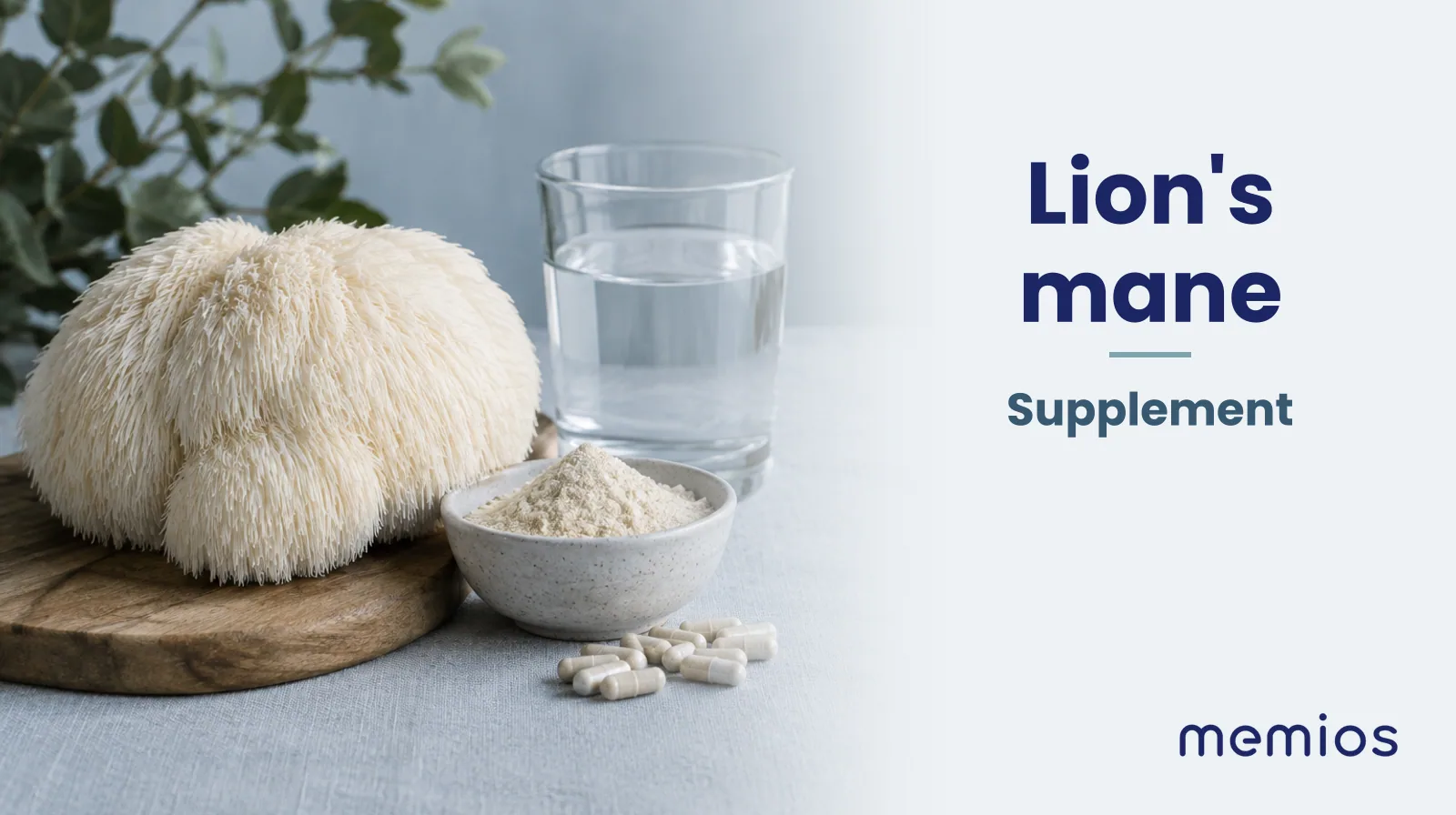
Lion's mane is an edible mushroom that grows on dead hardwood in the northern hemisphere and has long white spines. Chemical analysis finds hericenones, erinacine terpenoids, beta-glucan polysaccharides and phenolic acids in it, and which of these might be responsible for any effect is not known. The two compound families come from different parts of the organism: hericenones were isolated from fruiting bodies, while erinacines are reported mainly from the mycelium. Supplements are sold as fruiting-body powder, as mycelium grown on grain such as oats, or as blends of both, so two products with the same name can differ chemically.
What the research says
The honest summary is that almost all of the biology behind lion's mane's reputation is cell-culture and rodent work, and the human evidence is a handful of small, short trials with inconsistent results. Nerve-growth-factor stimulation, recovery from ischaemic injury and improved learning have been shown in rats and mice, not in people. In humans, one 30-person Japanese trial in mild cognitive impairment found higher cognitive scores while people were taking it and a significant fall four weeks after stopping; a 109-person industry-funded trial found an effect on one computerised task and none on five others; and an 18-person single-dose study found no effect on overall cognition or mood. There is no meta-analysis of lion's mane and cognition, and the one published systematic review counted only five randomised trials against fifteen laboratory studies. Reported side effects are mostly mild gut symptoms, but one published case describes acute respiratory distress syndrome attributed to a lion's mane supplement.
Evidence grade: Limited evidence.
What goes wrong
Gastrointestinal side effects have been reported in under 10% of people in trials of prolonged lion's mane use, and at least one acute hypersensitivity reaction has been described. (Source 1)
- Official position, Low certainty.
- Size: not quantified across trials.
- Who: participants in clinical trials of lion's mane.
- How long: prolonged therapy.
- Result: abdominal discomfort, nausea or diarrhoea usually in less than 10% of treated subjects, generally not requiring discontinuation.
- Funding: government body (NIH)
In clinical trials of prolonged therapy, mild gastrointestinal complains of abdominal discomfort, nausea, or diarrhea have been reported usually in less than 10% of treated subjects and generally not requiring discontinuation of the herbal product. At least one example of an acute hypersensitivity reaction to oral lion's mane has been described.
A published case report describes a 63-year-old man admitted with acute respiratory distress syndrome after regularly taking lion's mane supplements. (Source 2)
- Case report, Very low certainty.
- Size: 1 patient.
- Who: 63-year-old Japanese man with mild untreated diabetes taking lion's mane supplements.
- How long: regular use from December 2001 until emergency admission.
- Result: low-grade fever, haemosputum, cough, exertional dyspnoea and diffuse infiltration in both lungs; described by the reviewers as potentially fatal severity.
- Funding: not stated.
Our data screening identified one case report—interestingly, one of the rare cases wherein a side effect of potentially fatal severity was reported.
In that case the man presented with low-grade fever, blood-stained sputum, cough and breathlessness on exertion, with diffuse infiltration in both lungs. (Source 2)
- Case report, Very low certainty.
- Size: 1 patient.
- Who: 63-year-old man.
- How long: regular use from December 2001 until emergency admission.
- Result: diffuse infiltration in both lungs on imaging.
- Funding: not stated.
He presented with low-grade fever, hemosputum, cough, and exertional dyspnea; clinical findings revealed diffuse infiltration in both lungs.
What the evidence supports
The same review reports the pooled cognitive-scale change as an increase of 1.17 points, a small change drawn from only two small studies. (Source 3)
- Systematic review, Very low certainty.
- Size: one RCT and one pilot clinical trial.
- Who: adults assessed with the Mini-Mental State Examination.
- How long: not stated in the abstract.
- Result: combined weighted mean increase of 1.17 on the Mini-Mental State Examination in the intervention group.
- Funding: not stated.
Mini-Mental State Examination scores from one RCT and one PCT showed a combined weighted mean increase of 1.17 in the intervention group.
In a 30-person Japanese trial in mild cognitive impairment, cognitive scale scores were higher on lion's mane than placebo at weeks 8, 12 and 16, and fell significantly four weeks after the supplement stopped. (Source 4)
- Randomized trial, Low certainty.
- Size: 30 participants randomised into two groups of 15.
- Who: Japanese men and women aged 50 to 80 diagnosed with mild cognitive impairment.
- How long: 16 weeks of intake plus 4 weeks of observation.
- Result: significantly increased scores on a scale based on the Revised Hasegawa Dementia Scale at weeks 8, 12 and 16; scores decreased significantly 4 weeks after intake stopped; no adverse effect on laboratory tests.
- Funding: not stated in the abstract; author affiliations were not checked in this pass.
At weeks 8, 12 and 16 of the trial, the Yamabushitake group showed significantly increased scores on the cognitive function scale compared with the placebo group.
LiverTox finds no case reports of clinically apparent liver injury from lion's mane in small clinical trials or in large liver-injury case series, and grades it an unlikely cause of such injury. (Source 1)
- Official position, Low certainty.
- Size: not applicable; based on absence of cases in registries and case series.
- Who: humans taking lion's mane orally.
- How long: not applicable.
- Result: likelihood score E, unlikely cause of clinically apparent liver injury.
- Funding: government body (NIH)
In small clinical trials, there have been no case reports of clinically apparent liver injury attributed to lion's mane, and it is not mentioned or listed in large case series or systematic reviews of the literature on herbal and dietary supplement induced liver injury.
A rodent toxicology study of a commercial lion's mane powder grown on oats found no acute or subchronic toxicity up to 2000 mg per kg body weight per day, but this is an animal result funded by the ingredient manufacturer. (Source 5)
- Animal study, Low certainty.
- Size: rats (Wistar) and mice; numbers not given in the abstract.
- Who: rats for acute and 90-day studies, mice for the micronucleus test.
- How long: acute and 90-day subchronic.
- Result: no acute toxicity, no subchronic oral toxicity at doses up to 2000 mg/kg body weight/day, no genotoxicity.
- Funding: industry-funded by M2 Ingredients, which participated in preparing the manuscript.
The results demonstrated that both Organic Lion's Mane M2-102-10 powder and Organic Turkey Tail M2-101-03 powder did not induce acute toxicity
What the evidence does not support
The review's own limitations section says the anticancer findings come from cancer cell lines in the laboratory, not from people. (Source 6)
- Systematic review, Very low certainty.
- Size: 15 laboratory studies.
- Who: cultured cancer cell lines.
- How long: not applicable.
- Result: the anticancer evidence comes from cancer cell lines; the reviewers say these do not account for tumour biology in living organisms, immune responses or pharmacokinetics.
- Funding: not stated.
The majority of studies have been conducted using cancer cell lines under controlled laboratory conditions, and they do not account for the complexity of tumor biology, such as in vivo models, including tumor microenvironment interactions, immune responses, and pharmacokinetics.
In an 18-person single-dose crossover study, a lion's mane fruiting body extract produced no significant effect on overall cognition or mood. (Source 7)
- Randomized trial, Low certainty.
- Size: 18 healthy participants.
- Who: healthy adults aged 18 to 35.
- How long: acute single dose, assessed 90 minutes later.
- Result: no significant main effect of intervention and no intervention by time interaction for the composite measure of global cognitive function or for the composite measure of mood; a single pegboard test improved.
- Funding: two authors were employed by Beyond Alcohol Ltd (Three Spirit Drinks), which uses lion's mane in its products, and the company contributed to the publication fee.
There was no significant main effect of Intervention (active drink vs. control drink), or an Intervention x Time interaction for the composite measure of global cognitive function
The authors of that acute study concluded any benefit may be confined to specific tasks rather than cognition as a whole. (Source 7)
- Randomized trial, Low certainty.
- Size: 18 healthy participants.
- Who: healthy adults aged 18 to 35.
- How long: acute, 90 minutes.
- Result: no significant overall improvement in cognitive performance or mood versus placebo.
- Funding: industry-linked, as above.
did not demonstrate a significant overall improvement in cognitive performance and mood compared to the placebo and any benefits may be task or domain specific.
That trial found no difference between lion's mane and placebo on five of its cognitive measures, including the composite score. (Source 8)
- Randomized trial, Low certainty.
- Size: 109 participants.
- Who: adults aged 40 to 75 with self-reported cognitive difficulty.
- How long: 8 weeks.
- Result: no significant between-group differences for Memory Grid, Target Tracker, Mental Map, Sandia's Matrices, or composite cognitive scores.
- Funding: industry-funded by M2 Ingredients.
differences were observed for Memory Grid, Target Tracker, Mental Map, Sandia's Matrices, or composite cognitive scores.
The US National Institutes of Health LiverTox monograph states that lion's mane's purported effects have been shown in cell culture and animals but not in humans. (Source 1)
- Official position, Certainty not rated.
- Size: not applicable.
- Who: not applicable.
- How long: not applicable.
- Result: no approved human indication in the United States.
- Funding: government body (NIDDK/NIH), last updated 5 January 2024.
Most of these effects have been demonstrated in cell culture or in animal models but have not been found in humans.
LiverTox states the erinacine findings on nerve growth factor, ischaemic recovery and learning come from rats and mice, and have not been shown to any great extent in humans. (Source 1)
- Official position, Certainty not rated.
- Size: not applicable.
- Who: rats and mice.
- How long: not applicable.
- Result: neuroprotective and cognitive-enhancing activity demonstrated in rodents only.
- Funding: government body (NIH)
Erinacines have been found to cross the blood-brain barrier in rats and to stimulate synthesis of nerve growth factor, to speed recovery from ischemic injury, and improve alertness and learning in mice. These neuroprotective and mental cognitive enhancing activities have not been shown to any great extent in humans.
Where the evidence is mixed
A published systematic review of lion's mane found only five randomised controlled trials, against fifteen laboratory studies, so most of the literature behind the supplement is not human. (Source 3)
- Systematic review, Low certainty.
- Size: 5 RCTs, 3 pilot clinical trials, 1 cohort, 1 case report plus 15 laboratory studies and 1 computer analysis.
- Who: adults with and without dementia, plus cell and animal models.
- How long: not stated in the abstract passage quoted.
- Result: Mini-Mental State Examination scores from one RCT and one pilot trial gave a combined weighted mean increase of 1.17 in the intervention group.
- Funding: not stated.
This review includes results from five randomized controlled trials (RCTs), 15 laboratory studies, three pilot clinical trials (PCTs), one cohort study, one case report, and one computer analysis.
The benefit seen in that trial did not persist: scores fell significantly once people stopped taking the mushroom. (Source 4)
- Randomized trial, Low certainty.
- Size: 30 participants.
- Who: Japanese adults with mild cognitive impairment.
- How long: 4-week follow-up after 16 weeks of intake.
- Result: scores decreased significantly at week 4 after termination of the 16 weeks intake.
- Funding: not stated in the abstract; author affiliations were not checked in this pass.
The Yamabushitake group's scores increased with the duration of intake, but at week 4 after the termination of the 16 weeks intake, the scores decreased significantly.
In a 109-person, 8-week industry-funded trial, lion's mane beat placebo on one computerised attention task and on subjective sleep and mood, but not on the other cognitive tests. (Source 8)
- Randomized trial, Low certainty.
- Size: 109 participants in the primary analysis (57 lion's mane, 52 placebo)
- Who: adults aged 40 to 75 with self-reported cognitive difficulty.
- How long: one-week baseline plus eight weeks of daily supplementation.
- Result: significantly greater improvement in the Juggle Factor visual attention and working memory task, subjective sleep quality, morning restedness and mood (p < 0.05); the placebo group improved faster on subjective motivation.
- Funding: industry-funded by M2 Ingredients, whose staff were authors.
109 Participants were included in the primary analysis (H. erinaceus, n = 57; placebo, n = 52).
The trial reporting the positive attention result was paid for by the ingredient manufacturer, whose employees co-authored it. (Source 8)
- Randomized trial, Low certainty.
- Size: 109 participants.
- Who: adults aged 40 to 75.
- How long: 8 weeks.
- Result: not applicable; funding disclosure.
- Funding: industry-funded.
This study was funded by M2 Ingredients. Authors from M2 Ingredients reviewed, but could not change or omit any analyses from the results of this study.
A 33-person pilot trial reported a cognitive improvement only after statistical adjustment for baseline scores, age, sex and a blood marker, and reported neuropeptide Y did not differ within groups. (Source 9)
- Randomized trial, Very low certainty.
- Size: 33 subjects randomised.
- Who: adults in a pilot study.
- How long: 8 weeks.
- Result: improvement in the THP test (F = 4.6, p < 0.05) after adjustment; increase in gut microbiota diversity correlated with NPY levels.
- Funding: independent; funded by the Republic of Slovenia, the European Regional Development Fund and the Slovenian Research Agency, with no declared competing interests.
In the HE group, a significant improvement in cognitive ability was observed when the corresponding cognitive scores at baseline, CHI3L1 level, age, and gender were considered.
That toxicology study was of a product made from mycelial biomass and fruiting body cultured on oats, illustrating that commercial lion's mane is often grown on grain rather than harvested as mushroom. (Source 5)
- Animal study, Low certainty.
- Size: not applicable.
- Who: not applicable; product description.
- How long: not applicable.
- Result: not applicable.
- Funding: industry-funded.
Oftentimes, they are available as extract preparations produced from selected life stages such as fruiting body or mycelium. Their composition may vary based on where they are grown and the conditions of post-harvest preparation.
The two headline compound families of lion's mane are not found in the same material: hericenones were isolated from fruiting bodies and erinacines are reported mainly from mycelium. (Source 10)
- Systematic review, Low certainty.
- Size: not applicable; narrative chemistry review.
- Who: not applicable.
- How long: not applicable.
- Result: eight hericenones (A to H) isolated from fruiting bodies; erinacines reported mainly in mycelium, mostly as xylosides.
- Funding: not stated.
According to existing reports, erinacines mainly exist in the mycelium of
Hericenones were first isolated from the fruiting body, which is the part most consumers assume they are buying. (Source 10)
- Systematic review, Low certainty.
- Size: not applicable.
- Who: not applicable.
- How long: not applicable.
- Result: eight benzyl alcohol derivatives named hericenones A to H extracted from fruiting bodies.
- Funding: not stated.
In the 1990s, Kawagishi et al. took the lead in successively extracting and purifying 8 benzyl alcohol derivatives from the fruiting bodies of
Where the research disagrees
Whether lion's mane has been shown to improve human cognition
- Menon and colleagues, Frontiers in Nutrition systematic review, 2025, systematic review whose abstract reports this pooled cognitive-score increase from only one RCT and one pilot trial, within a review that counted five randomised trials against fifteen laboratory studies: Mini-Mental State Examination scores from one RCT and one PCT showed a combined weighted mean increase of 1.17 in the intervention group. (Source 3)
- NIH LiverTox monograph on lion's mane, 2024, government evidence summary: These neuroprotective and mental cognitive enhancing activities have not been shown to any great extent in humans. (Source 1)
How much
- Reference intake: No dietary reference intake or recommended intake has been set for lion's mane by any body located in this search; it is regulated as a food and a dietary supplement, and the NIH LiverTox monograph states that it is not approved for the treatment of symptoms or any disease in the United States. (Source 1)
- Upper limit: No tolerable upper intake level for humans has been set by any authority located. The only quantitative safety ceiling found is a rodent no-observed-adverse-effect level of 2000 mg per kg body weight per day from an industry-funded OECD-guideline study, which is an animal figure and not a human intake limit. (Source 5)
- Studied: The 2009 Japanese mild cognitive impairment trial gave four 250 mg tablets containing 96% dried Yamabushitake powder three times a day for 16 weeks. (Source 4)
- Studied: The 2026 trial in adults with self-reported cognitive difficulty gave 2 g a day of fruiting body and mycelial biomass for eight weeks. (Source 8)
- Studied: The acute crossover study gave a single 3 g dose of a 10:1 fruiting body extract and tested 90 minutes later. (Source 7)
- Studied: Across the studies in the 2025 systematic review, human doses ranged from 0.5 g of powdered fruiting body (in cookies) to 10 g given in two muffins per day. (Source 3)
A common belief, and what the research shows
The belief: Lion's mane regrows nerves and is proven to boost memory.
What the research shows: The nerve growth factor story comes from rodents and cell culture. LiverTox records that "Erinacines have been found to cross the blood-brain barrier in rats and to stimulate synthesis of nerve growth factor, to speed recovery from ischemic injury, and improve alertness and learning in mice. These neuroprotective and mental cognitive enhancing activities have not been shown to any great extent in humans." In people, the largest published trial reported "No significant between-group differences were observed for Memory Grid, Target Tracker, Mental Map, Sandia's Matrices, or composite cognitive scores." and a single-dose study found the extract "did not demonstrate a significant overall improvement in cognitive performance and mood compared to the placebo and any benefits may be task or domain specific."
Questions and answers
What is it?
Lion's mane (Hericium erinaceus) is an edible mushroom that has been used in traditional Asian medicine. It is increasingly sold as an ingredient in supplements. (Source 11)
What does it do in the body?
Most of what is known comes from cells and rodents. A 2025 systematic review of that lab work found that preparations made from the mushroom's mycelium, and the erinacine compounds in them, improved movement, memory and depression-like behaviour in animals. Those results have not been shown in people. (Source 11)
Is it good or bad for you?
The human evidence is thin. In one small 49-week pilot trial in people with mild Alzheimer's disease, one memory-test score improved in the group taking erinacine A-enriched mycelium, another fell in the placebo group, and a daily-living score differed between groups. Four participants dropped out because of abdominal discomfort, nausea or skin rash. The company that made the product paid some of the authors' salaries and supplied the study materials. (Source 12)
How do you get more of it?
People eat it as a culinary mushroom or take it as a supplement. In the 49-week trial, participants took three 350 mg capsules a day of erinacine A-enriched mycelium. (Source 12)
If it is harmful, what reduces it?
It is not generally considered harmful. The exception is a person who is allergic to it: in the published anaphylaxis case, the patient was told to avoid all foods containing it and was prescribed an adrenaline (epinephrine) auto-injector. (Source 13)
Why might someone be low in it or missing it?
Does not apply. Lion's mane is a food and supplement, not a nutrient or a body substance, so no one is 'low' in it. We found no literature describing a deficiency. (Source 14)
We searched: Frontiers in Nutrition 2025 systematic review (Menon et al.), Frontiers in Pharmacology 2025 preclinical systematic review; WebSearch for Hericium erinaceus human trials and adverse events
Which whole foods contain it or feed it?
Lion's mane is itself a whole food: an edible mushroom that is becoming more popular in cooking. (Source 13)
What happens if you do not have it?
Nothing is known to happen. It is not an essential nutrient, and the literature we searched describes no effects of not consuming it. (Source 14)
We searched: Frontiers in Nutrition 2025 systematic review, Frontiers in Pharmacology 2025 systematic review, Frontiers in Aging Neuroscience 2020 trial
How can you test for it?
We found no test that measures lion's mane or its compounds in a person. The only clinical test we found is for allergy, from a single case report: skin testing with the fresh mushroom was positive while skin testing with a commercial mushroom extract was negative, so the result depends on the material used. (Source 13)
References
- National Institute of Diabetes and Digestive and Kidney Diseases, National Institutes of Health. Lion's Mane - LiverTox: Clinical and Research Information on Drug-Induced Liver Injury. 2024. Read the source
- Frontiers in Nutrition. Benefits, side effects, and uses of Hericium erinaceus as a supplement: a systematic review. 2025. PMID 40959699, DOI 10.3389/fnut.2025.1641246. Read the source
- Frontiers in Nutrition. Benefits, side effects, and uses of Hericium erinaceus as a supplement: a systematic review. 2025. PMID 40959699, DOI 10.3389/fnut.2025.1641246. Read the source
- Phytotherapy Research. Improving effects of the mushroom Yamabushitake (Hericium erinaceus) on mild cognitive impairment: a double-blind placebo-controlled clinical trial. 2009. PMID 18844328, DOI 10.1002/ptr.2634. Read the source
- Frontiers in Toxicology. A toxicological assessment of Hericium erinaceus (Lion's mane) and Trametes versicolor (Turkey tail) mushroom powders. 2025. DOI 10.3389/ftox.2025.1651442. Read the source
- Frontiers in Nutrition. Benefits, side effects, and uses of Hericium erinaceus as a supplement: a systematic review. 2025. PMID 40959699, DOI 10.3389/fnut.2025.1641246. Read the source
- Frontiers in Nutrition. Acute effects of a standardised extract of Hericium erinaceus (Lion's Mane mushroom) on cognition and mood in healthy younger adults: a double-blind randomised placebo-controlled study. 2025. DOI 10.3389/fnut.2025.1405796. Read the source
- medRxiv preprint. A randomized, double-blind, placebo-controlled study evaluating the impact of Hericium erinaceus (Lion's Mane) on cognitive performance and subjective wellbeing. 2026. DOI 10.64898/2026.04.13.26350781. Read the source
- Journal of Functional Foods. Effect of erinacine A-enriched Hericium erinaceus supplementation on cognition: A randomized, double-blind, placebo-controlled pilot study. 2024. DOI 10.1016/j.jff.2024.106120. Read the source
- Food Science and Human Wellness. Bioactive compounds in Hericium erinaceus and their biological properties: a review. 2024. DOI 10.26599/FSHW.2022.9250152. Read the source
- Frontiers in Pharmacology. Unveiling the role of erinacines in the neuroprotective effects of Hericium erinaceus: a systematic review in preclinical models. 2025. DOI 10.3389/fphar.2025.1582081. Read the source
- Frontiers in Aging Neuroscience. Prevention of Early Alzheimer's Disease by Erinacine A-Enriched Hericium erinaceus Mycelia Pilot Double-Blind Placebo-Controlled Study. 2020. PMID 32581767, DOI 10.3389/fnagi.2020.00155. Read the source
- Annals of Allergy, Asthma & Immunology (129(5) Suppl, S147). Dangers at the Dinner Table – A Report of Anaphylaxis to Lion's Mane Mushroom. 2022. DOI 10.1016/j.anai.2022.08.931. Read the source
- Frontiers in Nutrition. Benefits, side effects, and uses of Hericium erinaceus as a supplement: a systematic review. 2025. PMID 40959699, DOI 10.3389/fnut.2025.1641246. Read the source