Supplements · September 29, 2026 · Memios · 12 min read
L-theanine
The best-supported effect is narrow and short-lived: a single dose of around 200 mg improves one measure of attention in healthy adults within an hour.
TLDR
- Limited evidence. The best-supported effect is narrow and short-lived: a single dose of around 200 mg improves one measure of attention in healthy adults within an hour.
- What it is: L-theanine is a non-proteinogenic amino acid, meaning it is not one of the amino acids the body uses to build proteins.
- Main use, supported: A meta-analysis of 31 randomised trials found that a single 200 mg dose of L-theanine improved choice reaction time in healthy adults. (moderate certainty)
- Claim NOT supported by research: The same meta-analysis found no significant effect of L-theanine on fatigue and found anxiety effects inconsistent and non-significant apart from a single study. (low certainty)
- Another claim NOT supported: A 28-day manufacturer-funded randomised placebo-controlled trial of 400 mg/day L-theanine found no significant difference from placebo in salivary cortisol, its stress biomarker. (low certainty)
- Recommended dose: not established. No dietary reference intake exists for L-theanine; it is a non-essential, non-proteinogenic amino acid found in tea rather than a required nutrient.
- Studied dose (a trial dose, not a recommendation): A single 200 mg dose taken 30 to 60 minutes before cognitive testing was the dose behind the attention finding in the 31-trial meta-analysis. Findings citing that trial: 1 for, 1 against, 1 mixed.
- Upper limit: No tolerable upper intake level or acceptable daily intake was located from a food safety body in this search, and a 2026 review states that the evidence is not yet sufficient even to set optimal doses.
- What goes wrong: 1 finding on harm. In that trial more adverse events occurred in the L-theanine group than in placebo, though all were resolved by the end of the study.
- Common myth: L-theanine is a proven natural treatment for anxiety.
What it is
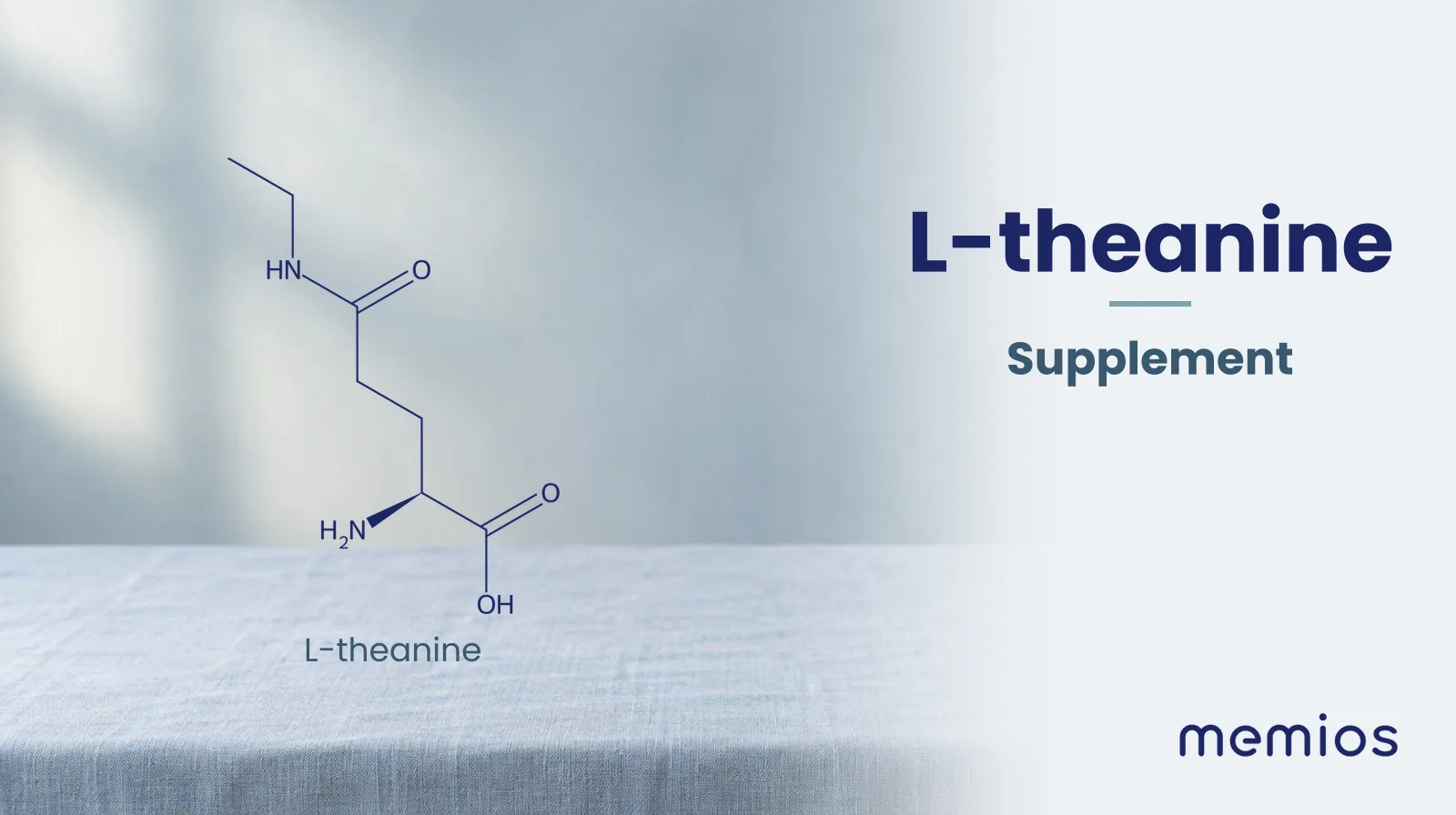
L-theanine is a non-proteinogenic amino acid, meaning it is not one of the amino acids the body uses to build proteins. It occurs naturally in the tea plant Camellia sinensis and in some mushrooms, and is the compound most often credited for the calm associated with drinking tea. Supplement forms are usually produced by fermentation or synthesis and sold as isolated capsules or added to drinks. It is not an essential nutrient, so no dietary reference intake exists for it.
What the research says
The best-supported effect is narrow and short-lived: a single dose of around 200 mg improves one measure of attention in healthy adults within an hour. Claims about anxiety, stress and sleep are much weaker. The largest meta-analysis to date found the acute stress effect modest and driven mainly by studies at high risk of bias, found anxiety effects inconsistent and non-significant, and found no effect on fatigue. A manufacturer-funded 28-day trial found no significant difference from placebo on its cortisol measure. Reported harms are limited to mild, transient effects, and no serious adverse events have been reported in the pooled trials, though the trials are small and mostly short.
Evidence grade: Limited evidence.
What goes wrong
In that trial more adverse events occurred in the L-theanine group than in placebo, though all were resolved by the end of the study. (Source 1)
- Randomized trial, Low certainty.
- Size: 30 healthy adults, 15 per group.
- Who: Healthy adults with moderate stress.
- How long: 28 days.
- Result: Eight adverse events reported by five participants on L-theanine, including metallic taste and dry mouth judged mild and possibly related to the product, versus one adverse event on placebo.
- Funding: industry-funded.
Eight AEs reported by five participants supplemented with AlphaWave® l-Theanine
What the evidence supports
A meta-analysis of 31 randomised trials found that a single 200 mg dose of L-theanine improved choice reaction time in healthy adults. (Source 2)
- Meta-analysis, Moderate certainty.
- Size: 31 randomised controlled trials, n = 1168.
- Who: Healthy and clinical populations.
- How long: Single dose taken 30-60 minutes before testing.
- Result: Choice reaction time SMD = 0.51 (95% CI 0.25-0.77)
- Funding: not stated.
A single 200 mg dose taken 30–60 min before cognitive testing significantly improved choice reaction time (Standardised Mean Difference [SMD] = 0.51; 95% CI, 0.25–0.77), indicating enhanced attention.
What the evidence does not support
The same meta-analysis found no significant effect of L-theanine on fatigue and found anxiety effects inconsistent and non-significant apart from a single study. (Source 2)
- Meta-analysis, Low certainty.
- Size: 31 randomised controlled trials, n = 1168.
- Who: Healthy and clinical populations.
- How long: Single dose to repeated dosing.
- Result: No significant effect on fatigue; anxiety inconsistent and non-significant except for one study on psychotic anxiety (SMD = 0.54; 400 mg/day for 8 weeks)
- Funding: not stated.
No significant effect on fatigue was observed. Excluding one outlier, a significant reduction in depressive symptoms following a single dose in healthy individuals was found (SMD = 0.69; 95% CI, 0.13–1.25) with low heterogeneity. Anxiety effects were inconsistent and non-significant except for one study on psychotic anxiety
A 28-day manufacturer-funded randomised placebo-controlled trial of 400 mg/day L-theanine found no significant difference from placebo in salivary cortisol, its stress biomarker. (Source 1)
- Randomized trial, Low certainty.
- Size: 30 healthy adults, 15 per group.
- Who: Healthy adults aged 18-65 with moderate stress.
- How long: 28 days.
- Result: No significant between-group difference in salivary cortisol. Perceived Stress Scale fell 12.92% (p = 0.051) at day 14 and 17.98% (p = 0.04) at day 28 on L-theanine, versus 9.74% (p = 0.061) and 17.88% (p = 0.009) on placebo.
- Funding: industry-funded.
There were no significant differences between groups for change in salivary cortisol.
That review states there is insufficient evidence to recommend L-theanine as a standalone or add-on treatment for chronic stress or any psychiatric condition. (Source 3)
- Systematic review, Low certainty.
- Size: Mini-review of systematic reviews and meta-analyses.
- Who: Healthy adults.
- How long: Single dose to eight weeks.
- Result: Qualitative assessment; the authors call for further high-quality studies.
- Funding: industry-funded.
However, there is currently insufficient evidence for L-theanine to be recommended as a standalone or adjunctive therapeutic intervention for chronic stress or any psychiatric conditions.
Where the evidence is mixed
In that same meta-analysis the acute stress reduction was modest and was largely driven by studies at high risk of bias. (Source 2)
- Meta-analysis, Low certainty.
- Size: 31 randomised controlled trials, n = 1168.
- Who: Healthy and clinical populations.
- How long: Single dose and repeated dosing.
- Result: Acute stress SMD = 0.31.
- Funding: not stated.
The reduction in acute stress was modest (SMD = 0.31) and largely influenced by studies with a high risk of bias.
That trial was funded by the ingredient manufacturer and included an employee of that company among its authors. (Source 1)
- Randomized trial, Low certainty.
- Size: 30 healthy adults.
- Who: Healthy adults with moderate stress.
- How long: 28 days.
- Result: Funding and author affiliations disclosed to the ingredient supplier and a contract research organisation.
- Funding: industry-funded.
Lora Xiong is an employee of Ethical Naturals Inc., Marc Moulin, David C. Crowley, Najla Guthrie, and Erin D. Lewis are employees of KGK Science Inc.
A 2026 review of L-theanine reports that the reviews it drew on found adverse effects to be few and mild, but two of its authors work for a British American Tobacco subsidiary that sells products containing L-theanine. (Source 3)
- Systematic review, Low certainty.
- Size: A mini-review of existing systematic reviews and meta-analyses of human randomised controlled trials.
- Who: Healthy adults.
- How long: Underlying trials ranged from a single dose to eight weeks of daily use.
- Result: Doses of 100-400 mg produced small but statistically significant improvements in aspects of cognitive performance; 200-450 mg/day was reported to support sleep quality with little effect on total sleep duration.
- Funding: Two authors employed by a British American Tobacco subsidiary that sells L-theanine products.
JC and HK were employed by The Water Street Collective Ltd, a wholly owned subsidiary of British American Tobacco. The Water Street Collective Ltd sells products that contain L-theanine.
A systematic review of L-theanine in people with diagnosed mental disorders included only 11 randomised trials and concluded further studies are needed to validate the findings. (Source 4)
- Systematic review, Low certainty.
- Size: 11 studies from six countries, identified from 419 publications.
- Who: Patients with schizophrenia, ADHD, OCD, major depressive disorder, sleep disorders, generalised anxiety disorder and Tourette syndrome.
- How long: Varied across trials.
- Result: L-theanine reduced psychiatric symptoms more than control in schizophrenia, anxiety disorders and ADHD; two studies showed some risk of bias and nine were judged low risk.
- Funding: not stated.
The findings from this systematic review suggest that LT supplementation significantly reduced psychiatric symptoms more effectively than control conditions in individuals with schizophrenia, anxiety disorders, and ADHD. However, further studies are essential to validate these findings
What official bodies say
The European Food Safety Authority formally assessed health claims for L-theanine covering cognitive function, psychological stress, normal sleep and menstrual discomfort in 2011. (Source 5)
- Official position, Certainty not rated.
- Size: Not applicable.
- Who: General EU population.
- How long: Not applicable.
- Result: The Panel considered L-theanine from tea sufficiently characterised, while tea itself was not sufficiently characterised in relation to the claimed effects. The Panel's conclusion on each claim could not be retrieved in this search and must be checked.
- Funding: independent.
This opinion addresses the scientific substantiation of health claims in relation to L-theanine from Camellia sinensis (L.) Kuntze (tea) and improvement of cognitive function, alleviation of psychological stress, maintenance of normal sleep and reduction of menstrual discomfort.
Where the research disagrees
Whether L-theanine meaningfully reduces stress and anxiety
- Gerolymos and colleagues, 2026 meta-analysis of 31 randomised trials, meta-analysis, n = 1168: The reduction in acute stress was modest (SMD = 0.31) and largely influenced by studies with a high risk of bias. (Source 2)
- Authors of a 2026 industry-affiliated mini-review, narrative mini-review of systematic reviews, authored in part by employees of a British American Tobacco subsidiary: It has also been reported to reduce both perceived and physiological markers of stress and anxiety under stress-inducing conditions at doses of 200–400mg/day, without causing sedation. (Source 3)
How much
- Reference intake: No dietary reference intake exists for L-theanine; it is a non-essential, non-proteinogenic amino acid found in tea rather than a required nutrient. (Source 3)
- Upper limit: No tolerable upper intake level or acceptable daily intake was located from a food safety body in this search, and a 2026 review states that the evidence is not yet sufficient even to set optimal doses. (Source 3)
- Studied: A single 200 mg dose taken 30 to 60 minutes before cognitive testing was the dose behind the attention finding in the 31-trial meta-analysis. (Source 2)
- Studied: A 28-day trial gave 400 mg of L-theanine per day as two 200 mg capsules to healthy adults with moderate stress. (Source 1)
- Studied: A 2026 review describes cognitive trials using 100-400 mg and sleep trials using 200-450 mg/day. (Source 3)
A common belief, and what the research shows
The belief: L-theanine is a proven natural treatment for anxiety.
What the research shows: The largest pooled analysis found the opposite for anxiety specifically: "Anxiety effects were inconsistent and non-significant except for one study on psychotic anxiety". The clearest supported effect is much narrower and short-term: "A single 200 mg dose taken 30–60 min before cognitive testing significantly improved choice reaction time (Standardised Mean Difference [SMD] = 0.51; 95% CI, 0.25–0.77), indicating enhanced attention." Even a review written partly by industry-employed authors concedes there is "insufficient evidence for L-theanine to be recommended as a standalone or adjunctive therapeutic".
Questions and answers
What is it?
L-theanine is an amino acid that is not used to build proteins. It is found in large amounts in the leaves of the tea plant, and it is sold as a supplement with claims about relaxation and thinking. (Source 6)
What does it do in the body?
It is absorbed well from the gut and gets into the brain. Some studies report more alpha brain waves (linked to relaxed attention), less stress and anxiety, and better sleep, but the results often disagree. A 2025 review said the evidence for many of the health claims is still limited, mainly because rigorous human trials are lacking. (Source 6)
Is it good or bad for you?
Mixed. A 2025 review found a good safety profile in toxicology studies. It also found that evidence for relaxation, stress, anxiety and sleep claims is often inconsistent and limited by a lack of rigorous human trials, and it called for caution until stronger evidence emerges. (Source 6)
How do you get more of it?
Tea and supplement capsules both supply it. In a 12-person crossover study, 100 mg of L-theanine taken as capsules or as green tea raised blood levels in a similar way, peaking after about 0.8 hours. (Source 7)
If it is harmful, what reduces it?
Does not apply. L-theanine is not treated as harmful: a 2025 review described a good safety profile in toxicology studies. The same review still urged caution about pharmacologic supplement doses for the wider population, because well-designed human trials are lacking. (Source 6)
Why might someone be low in it or missing it?
Does not apply as far as the literature we searched shows. L-theanine is not an essential nutrient, and no study we found describes deficiency or low levels as a condition. It comes into the diet mainly from tea. (Source 6)
We searched: Frontiers in Nutrition 2022 review of L-theanine, Nutrition Research 2025 review (Dashwood & Visioli), J Nutr 2012 kinetics study; WebSearch for L-theanine deficiency and low levels
Which whole foods contain it or feed it?
Tea is the main food source. A 2022 review, citing an earlier analysis of 37 teas, reports average L-theanine contents of 6.56 mg per gram for green tea, 6.26 for white, 6.09 for oolong and 5.13 for black. (Source 8)
What happens if you do not have it?
The literature we searched describes no harm from not consuming L-theanine. It is not an essential nutrient, and no deficiency condition has been described. (Source 6)
We searched: Nutrition Research 2025 review, Frontiers in Nutrition 2022 review, BMC Psychiatry 2024 systematic review; WebSearch for theanine deficiency
How can you test for it?
Research labs can measure L-theanine and its breakdown product ethylamine in blood and urine using HPLC, as in a 2012 kinetics study. That is a research method, not a clinical test. In that study blood levels peaked within about an hour of a dose, and we found no validated clinical test or reference range. (Source 7)
References
- Neurology and Therapy. Safety and Efficacy of AlphaWave L-Theanine Supplementation for 28 Days in Healthy Adults with Moderate Stress: A Randomized, Double-Blind, Placebo-Controlled Trial. 2024. DOI 10.1007/s40120-024-00624-7. Read the source
- Molecular Psychiatry. Cognitive and affective effects of L-Theanine: a systematic review and meta-analysis of 31 randomized trials. 2026. DOI 10.1038/s41380-026-03727-9. Read the source
- Frontiers in Nutrition. Effects of L-theanine on cognition, mood and sleep: evidence from human trials. 2026. DOI 10.3389/fnut.2026.1922819. Read the source
- BMC Psychiatry. The effects of L-theanine supplementation on the outcomes of patients with mental disorders: a systematic review. 2024. PMID 39633316, DOI 10.1186/s12888-024-06285-y. Read the source
- EFSA Panel on Dietetic Products, Nutrition and Allergies (NDA), EFSA Journal (record accessed via DTU Orbit). Scientific Opinion on the substantiation of health claims related to L-theanine from Camellia sinensis (L.) Kuntze (tea) and improvement of cognitive function (ID 1104, 1222, 1600, 1601, 1707, 1935, 2004, 2005), alleviation of psychological stress (ID 1598, 1601), maintenance of normal sleep (ID 1222, 1737, 2004) and reduction of menstrual discomfort (ID 1599) pursuant to Article 13(1) of Regulation (EC) No 1924/2006. 2011. DOI 10.2903/j.efsa.2011.2238. Read the source
- Nutrition Research. l-theanine: From tea leaf to trending supplement – does the science match the hype for brain health and relaxation?. 2025. DOI 10.1016/j.nutres.2024.12.008. Read the source
- The Journal of Nutrition. Kinetics of L-Theanine Uptake and Metabolism in Healthy Participants Are Comparable after Ingestion of L-Theanine via Capsules and Green Tea. 2012. DOI 10.3945/jn.112.166371. Read the source
- Frontiers in Nutrition. L-Theanine: A Unique Functional Amino Acid in Tea (Camellia sinensis L.) With Multiple Health Benefits and Food Applications. 2022. DOI 10.3389/fnut.2022.853846. Read the source