Supplements · September 30, 2026 · Memios · 17 min read
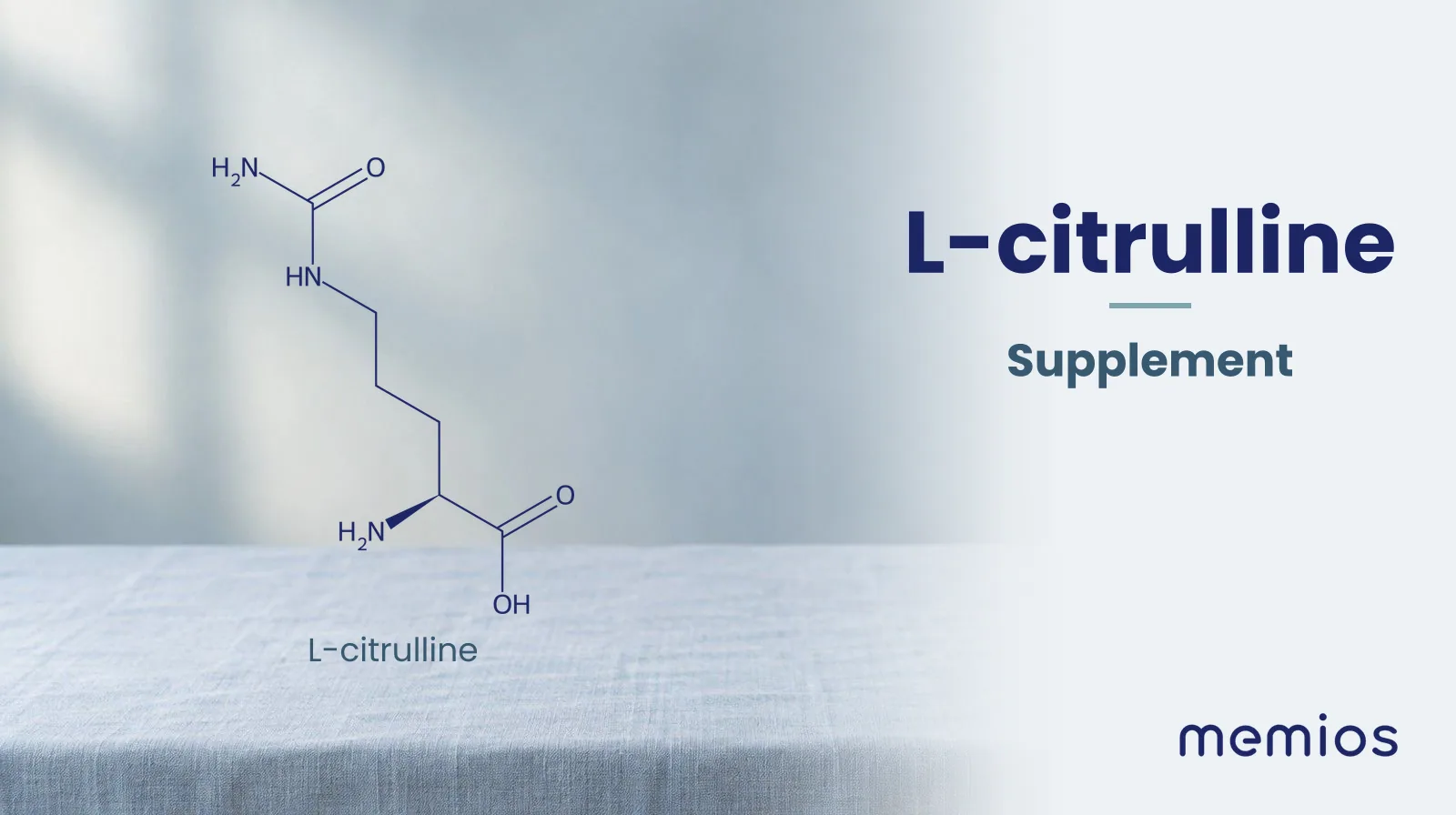
L-citrulline
The clearest human evidence is for blood pressure: a meta-analysis of randomised trials found reductions of around 4 mmHg systolic and 4 mmHg diastolic.
TLDR
- Limited evidence. The clearest human evidence is for blood pressure: a meta-analysis of randomised trials found reductions of around 4 mmHg systolic and 4 mmHg diastolic, with the authors themselves urging caution because there were few trials.
- What it is: L-citrulline is a non-essential amino acid that the body produces, mainly from glutamine, and that is also obtained from food.
- Main use, supported: A meta-analysis of randomised trials found oral L-citrulline lowered brachial systolic and diastolic blood pressure, and aortic systolic but not aortic diastolic pressure. (low certainty)
- Other use, supported: A small crossover randomised trial in adults with type 2 diabetes reported improvements in microvascular endothelial function and calf muscle strength with 6 g/day citrulline. (low certainty)
- Claim NOT supported by research: A randomised crossover trial in older active women found no effect of seven days of citrulline on any measure of functional performance, though resting diastolic blood pressure fell. (low certainty)
- Another claim NOT supported: The same review concludes that the efficacy of citrulline malate for exercise performance remains ambiguous. (low certainty)
- Recommended dose: not established. No Recommended Dietary Allowance or Adequate Intake has been set for citrulline, a non-essential amino acid the body makes from glutamine. NIH describes watermelon as the best-known dietary source at about 365 mg per cup of diced seedless watermelon.
- Studied dose (a trial dose, not a recommendation): 6 g/day for 4 weeks in a crossover trial in adults with type 2 diabetes. Findings citing that trial: 1 for.
- Upper limit: No Tolerable Upper Intake Level or Acceptable Daily Intake has been set by a body we could reach.
- What goes wrong: 4 findings on harm. A dose-ranging pharmacokinetic study in eight healthy men found no side effects at 2, 5, 10 or 15 g of citrulline, but showed that conversion to arginine saturates at higher doses.
- Common myth: Citrulline is a better way to raise nitric oxide than arginine, so it must work for performance.
What it is
L-citrulline is a non-essential amino acid that the body produces, mainly from glutamine, and that is also obtained from food. Watermelon is its best-known dietary source, at about 365 mg per cup of diced seedless flesh according to NIH. About 80% of the body's citrulline is converted in the kidneys into arginine. Supplements supply either free L-citrulline or citrulline malate, a salt with malic acid.
What the research says
The clearest human evidence is for blood pressure: a meta-analysis of randomised trials found reductions of around 4 mmHg systolic and 4 mmHg diastolic, with the authors themselves urging caution because there were few trials. For exercise, a 2026 three-level meta-analysis of 30 trials found only a small overall effect with GRADE certainty rated low to very low, no significant effect on perceived exertion, and no significant effect for chronic dosing; NIH concludes the research does not strongly support it. A dose-ranging study shows citrulline reliably raises blood arginine, though the kidney conversion saturates at higher doses.
Evidence grade: Limited evidence.
What goes wrong
Stomach discomfort was reported by 6 of 41 weight lifters in a citrulline trial cited by NIH, and long-term safety has not been adequately assessed. (Source 1)
- Official position, Certainty not rated.
- Size: 6 of 41 participants in the cited trial.
- Who: Weight lifters taking supplemental citrulline.
- How long: Short-term; NIH notes months-long use has not been assessed.
- Result: 6/41 (about 15%) reported stomach discomfort; other short-term studies at up to 6 g/day for 4 weeks and 1.35 g/day for 6 weeks found no adverse effects.
- Funding: government agency.
In the study of weight lifters described above, 6 of the 41 participants reported stomach discomfort after taking the supplement
A dose-ranging pharmacokinetic study in eight healthy men found no side effects at 2, 5, 10 or 15 g of citrulline, but showed that conversion to arginine saturates at higher doses. (Source 2)
- Blood level study, Low certainty.
- Size: 8 fasting healthy males.
- Who: Healthy men, four separate oral loading tests each.
- How long: Blood sampled ten times over 8 hours per loading test; urine over 24 hours.
- Result: No side effects at any dose; plasma citrulline accumulated at the highest doses while arginine rose less than expected; urinary citrulline excretion stayed low.
- Funding: not stated.
Limit of this finding: The passage quoted here prints the peak plasma arginine and ornithine concentrations in millimoles per litre ("146 (SEM 8) to 303 (SEM 11) mmol/l"). That unit is wrong in the published article: concentrations that high are not compatible with being alive, and the values only make sense as micromoles per litre (µmol/l), which is the normal range for these amino acids. We have kept the wording exactly as the journal printed it rather than silently correcting it. A reader should not take the printed concentration at face value, and no claim in this entry rests on it – the finding here is about the absence of side effects at doses of 2 to 15 g, which is unaffected by the unit error.
None of the subjects experienced side effects whatever the CIT dose.
A critical review reports quality-control problems with the citrulline-to-malate ratio in some commercial citrulline malate products, which is one reason trial results disagree. (Source 3)
- Expert review, not systematic, Low certainty.
- Size: Not applicable - a critical review.
- Who: Products used in citrulline malate exercise trials.
- How long: Not applicable.
- Result: No quantified contamination rates given; the review names manufacturer quality control of citrulline:malate ratios as a source of disparity.
- Funding: not stated.
Reasons for the disparity in conclusions seem to be due to methodological discrepancies such as the testing protocols and the associated test–retest reliability, dosing strategy (i.e., amount and timing), and the recent discovery of quality control issues with some manufacturers stated (i.e., citrulline:malate ratios).
Citrulline appears in 71% of the top 100 pre-workout supplements, often inside proprietary blends that do not disclose how much of each ingredient is present. (Source 4)
- Survey study, Low certainty.
- Size: 100 commercially available pre-workout products.
- Who: Top-selling multi-ingredient pre-workout supplements.
- How long: Single snapshot of supplement facts panels.
- Result: Citrulline present in 71% of products at an average 4.0 +/- 2.5 g; 44.3% of all ingredients sat in proprietary blends with undisclosed amounts.
- Funding: not stated.
Nearly half (44.3%) of all ingredients were included as part of a proprietary blend with undisclosed amounts of each ingredient.
What the evidence supports
A meta-analysis of randomised trials found oral L-citrulline lowered brachial systolic and diastolic blood pressure, and aortic systolic but not aortic diastolic pressure. (Source 5)
- Meta-analysis, Low certainty.
- Size: 14 trials from 8 studies for brachial blood pressure; 9 trials for aortic blood pressure.
- Who: Adults in randomised controlled trials, at rest and under exercise or cold challenge.
- How long: Not stated in the abstract.
- Result: Brachial SBP -4.490 mmHg (95% CI -7.332 to -1.648, P = 0.002); brachial DBP -3.629 mmHg (95% CI -5.825 to -1.434, P = 0.001); aortic SBP -6.763 mmHg (95% CI -10.991 to -2.534, P = 0.002); aortic DBP -3.396 mmHg (95% CI -7.418 to 0.627, P = 0.098)
- Funding: not stated.
Results showed that L-Cit supplementation significantly reduced both brachial SBP (− 4.490 mmHg, 95% CI: − 7.332 to − 1.648, P = 0.002) and brachial DBP (− 3.629 mmHg, 95% CI: − 5.825 to − 1.434, P = 0.001).
A small crossover randomised trial in adults with type 2 diabetes reported improvements in microvascular endothelial function and calf muscle strength with 6 g/day citrulline. (Source 6)
- Randomized trial, Low certainty.
- Size: 16 participants.
- Who: Adults aged 53-72 with type 2 diabetes, nine of them female.
- How long: 4 weeks on each treatment with an 8-week washout between.
- Result: LnRHI change 0.11 +/- 0.16 versus -0.08 +/- 0.24 (p < 0.05); calf muscle strength 1.5 +/- 2.8 kg versus -0.3 +/- 1.2 kg (p < 0.05); plasma arginine 43 +/- 28 versus 1 +/- 16 micromol/L (p < 0.001)
- Funding: not stated.
Conclusions: This study showed that CITS improves microvascular endothelial function, muscle microvascular reactivity, and calf muscle strength in middle-aged and older patients with T2D.
In a laboratory cell model, watermelon flesh had the highest citrulline content of the fruit's parts, but the work was in vitro and cannot be read as a human finding. (Source 7)
- Lab study in cells, Very low certainty.
- Size: Not applicable - Caco-2 cell monolayer experiments.
- Who: Human intestinal epithelial Caco-2 cells exposed to watermelon flesh, rind and skin extracts.
- How long: 1, 2 and 4 hours of exposure.
- Result: Watermelon flesh had the highest citrulline content; skin extracts showed greater percentage transport than flesh, rind or the L-citrulline standard.
- Funding: not stated.
Watermelon flesh had the highest citrulline content, but the watermelon skin had the highest total phenolic content and antioxidant activity compared to other watermelon parts.
In children with short bowel syndrome, plasma citrulline tracked residual bowel length and intestinal failure severity, which is why it is used as a marker of enterocyte mass. (Source 8)
- Cohort study, Low certainty.
- Size: 31 children.
- Who: Children with short bowel syndrome, median age 16 months.
- How long: Median follow-up 14 months (range 6-40 months)
- Result: Citrulline rose from 15.8 +/- 11.5 to 19.3 +/- 3.8 micromol/L in those weaned from parenteral nutrition, versus 6.5 +/- 3.0 to 7.7 +/- 6.0 micromol/L in those still needing it.
- Funding: not stated.
Plasma citrulline at inclusion showed a positive correlation with residual short bowel length. Subsequent values correlated negatively with intestinal failure severity.
What the evidence does not support
In the same meta-analysis the pooled effect of citrulline malate on perceived exertion was not statistically significant. (Source 9)
- Meta-analysis, Very low certainty.
- Size: 644 participants across 30 randomised controlled trials.
- Who: Participants in exercise performance trials of citrulline malate.
- How long: Acute and chronic protocols.
- Result: Perceived exertion not statistically significant; GRADE certainty across outcomes low to very low.
- Funding: not stated.
The pooled effect on perceived exertion was not statistically significant. Current evidence appeared more stable for acute than chronic supplementation, although the protocol subgroup difference remained uncertain.
A randomised crossover trial in older active women found no effect of seven days of citrulline on any measure of functional performance, though resting diastolic blood pressure fell. (Source 10)
- Randomized trial, Low certainty.
- Size: 16 women.
- Who: Older active women, mean age 66.9 years.
- How long: 7 days on each treatment with a 14-day washout.
- Result: No significant (p>0.05) differences for any functional performance measure; resting diastolic blood pressure interaction F = 5.34, p = 0.028.
- Funding: not stated.
There were no significant (p>0.05) differences between CIT and placebo for any measure of functional performance following the interventions.
The NIH Office of Dietary Supplements position is that the research does not strongly support citrulline or citrulline malate for exercise or athletic performance. (Source 11)
- Official position, Certainty not rated.
- Size: Not applicable - an agency review of the literature.
- Who: People taking citrulline for exercise performance.
- How long: Not applicable.
- Result: No pooled numbers given in the bottom line.
- Funding: government agency.
The research to date does not provide strong support for taking citrulline or citrulline malate to enhance exercise or athletic performance.
The NIH Office of Dietary Supplements also notes that raised nitric oxide metabolites after citrulline have not been tied to any performance improvement. (Source 12)
- Official position, Certainty not rated.
- Size: Not applicable.
- Who: People taking citrulline supplements.
- How long: Not applicable.
- Result: No effect estimate given.
- Funding: government agency.
Although citrulline supplementation might increase plasma levels of nitric oxide metabolites, such a response has not been directly related to any improvement in athletic performance
The same review concludes that the efficacy of citrulline malate for exercise performance remains ambiguous. (Source 3)
- Expert review, not systematic, Low certainty.
- Size: Not applicable.
- Who: People taking citrulline malate for exercise.
- How long: Most trials used a single acute 8 g dose.
- Result: Described as producing equivocal results.
- Funding: not stated.
Until such studies are completed, the efficacy of CM supplementation to improve exercise performance remains ambiguous.
Where the evidence is mixed
The authors of that blood-pressure meta-analysis said their own findings should be interpreted cautiously because of the small number of trials. (Source 5)
- Meta-analysis, Low certainty.
- Size: 14 trials from 8 studies.
- Who: Adults in randomised controlled trials.
- How long: Not stated.
- Result: No separate numbers; a statement about the strength of the pooled estimates.
- Funding: not stated.
Given the relatively small number of available trials in the stratified analyses and the potential limitations of these trials, the present findings should be interpreted cautiously and need to be confirmed in future well-designed trials with a larger sample size.
A three-level meta-analysis of 30 randomised trials found only a small pooled effect of citrulline malate on exercise performance, with GRADE certainty rated low to very low. (Source 13)
- Meta-analysis, Very low certainty.
- Size: 644 participants across 30 randomised controlled trials, contributing 138 effect sizes.
- Who: Participants in exercise performance trials of citrulline malate.
- How long: Acute single-dose and chronic protocols.
- Result: Overall performance g = 0.16 (95% CI 0.05 to 0.27), p = 0.01, I2 = 45%, power 8%, prediction interval -0.37 to 0.69; chronic supplementation g = 0.13 (95% CI -0.01 to 0.28), p = 0.08.
- Funding: not stated.
CM supplementation was associated with a small improvement in overall exercise performance (g = 0.16, 95% CI [0.05, 0.27]; p = 0.01; k = 138; Low GRADE), with moderate heterogeneity (I2 = 45%) and low statistical power (8%); the prediction interval was −0.37 to 0.69.
Where the research disagrees
Whether citrulline malate improves exercise performance
- 2026 Nutrients three-level meta-analysis, meta-analysis of 30 randomised trials, GRADE low to very low: CM supplementation was associated with a small improvement in overall exercise performance (g = 0.16, 95% CI [0.05, 0.27]; p = 0.01; k = 138; Low GRADE), with moderate heterogeneity (I2 = 45%) and low statistical power (8%) (Source 13)
- NIH Office of Dietary Supplements, agency review of the literature: The research to date does not provide strong support for taking citrulline or citrulline malate to enhance exercise or athletic performance. (Source 11)
How much
- Reference intake: No Recommended Dietary Allowance or Adequate Intake has been set for citrulline, a non-essential amino acid the body makes from glutamine. NIH describes watermelon as the best-known dietary source at about 365 mg per cup of diced seedless watermelon. (Source 14)
- Upper limit: No Tolerable Upper Intake Level or Acceptable Daily Intake has been set by a body we could reach. NIH states that studies have not adequately assessed the safety of citrulline taken in supplemental form for months at a time. (Source 1)
- Studied: 6 g/day for 4 weeks in a crossover trial in adults with type 2 diabetes. (Source 6)
- Studied: 6 g/day for 7 days in a crossover trial in older active women. (Source 15)
- Studied: Single oral loading doses of 2, 5, 10 or 15 g in a pharmacokinetic study in healthy men. (Source 2)
- Studied: A single acute 8 g dose of citrulline malate has been the most common approach in exercise trials. (Source 3)
A common belief, and what the research shows
The belief: Citrulline is a better way to raise nitric oxide than arginine, so it must work for performance.
What the research shows: It does raise blood arginine, but that has not translated into performance. NIH records that "Although citrulline supplementation might increase plasma levels of nitric oxide metabolites, such a response has not been directly related to any improvement in athletic performance". The conversion also saturates: "at the highest doses, CIT accumulated in plasma while plasma ARG levels increased less than expected."
Questions and answers
What is it?
L-citrulline is a non-essential amino acid. The body makes it, mainly from glutamine, and it is also eaten in food. Watermelon is its best-known dietary source. Around 80% of the body's citrulline is turned into arginine in the kidneys, which is why it is sold as a nitric-oxide precursor. (Source 14)
What does it do in the body?
Its main measurable action is to raise blood arginine, and through that nitric oxide. A dose-ranging study in healthy men showed it is a potent arginine precursor, but that the kidney conversion step saturates, so bigger doses do not give proportionally more arginine. (Source 2)
Is it good or bad for you?
Pooled randomised trials show modest blood-pressure lowering, which is the best-supported effect. For exercise, the pooled effect is small and rated low to very low certainty, and NIH concludes the research does not strongly support it. Short-term use at the studied doses appears well tolerated, with stomach discomfort the reported complaint. (Source 9)
How do you get more of it?
In trials it was given as supplemental L-citrulline or citrulline malate. Studies used 6 g/day for four weeks in type 2 diabetes, 6 g/day for seven days in older women, and single loading doses of 2 to 15 g in a pharmacokinetic study. In food, watermelon is the best-known source. (Source 14)
If it is harmful, what reduces it?
This does not really apply: citrulline is a normal body metabolite, not a substance to be cleared. The practical issue is tolerability, and the reported problem is stomach discomfort in a minority of users; NIH notes that other short-term studies at up to 6 g/day found no adverse effects. (Source 1)
Why might someone be low in it or missing it?
Because most circulating citrulline is made in the gut lining from glutamine, people with damaged or shortened small bowel have low plasma citrulline. In children with short bowel syndrome, levels stayed low while parenteral nutrition was still needed and rose as the bowel adapted. (Source 8)
Which whole foods contain it or feed it?
Watermelon is the food most associated with citrulline; NIH puts a cup of diced seedless watermelon at about 365 mg. A laboratory study found the flesh has the highest citrulline content of the fruit's parts, although that work was done in cells rather than people. (Source 7)
What happens if you do not have it?
There is no described dietary deficiency of citrulline in healthy adults. Low plasma citrulline is a consequence of gut disease rather than of low intake: in children with short bowel syndrome it fell with the amount of functioning small intestine and reflected the severity of intestinal failure. (Source 8)
How can you test for it?
Plasma citrulline is a real, used clinical measurement, but of gut function rather than of supplement need. Serial assays in children with short bowel syndrome tracked bowel adaptation. No test tells a healthy adult whether a citrulline supplement would help them. (Source 8)
References
- Office of Dietary Supplements, National Institutes of Health. Dietary Supplements for Exercise and Athletic Performance – Health Professional Fact Sheet (citrulline, safety). no revision date captured from the fetched page; accessed 23 September 2026. Read the source
- British Journal of Nutrition. Dose-ranging effects of citrulline administration on plasma amino acids and hormonal patterns in healthy subjects: the Citrudose pharmacokinetic study. 2008. PMID 17953788, DOI 10.1017/S0007114507841110. Read the source
- European Journal of Applied Physiology. A critical review of citrulline malate supplementation and exercise performance. 2021. DOI 10.1007/s00421-021-04774-6. Read the source
- Nutrients. Common Ingredient Profiles of Multi-Ingredient Pre-Workout Supplements. 2019. PMID 30678328, DOI 10.3390/nu11020254. Read the source
- Nutrition & Metabolism. Effect of oral L-citrulline on brachial and aortic blood pressure defined by resting status: evidence from randomized controlled trials. 2019. DOI 10.1186/s12986-019-0415-y. Read the source
- Nutrients. Citrulline Supplementation Improves Microvascular Function and Muscle Strength in Middle-Aged and Older Adults with Type 2 Diabetes. 2025. DOI 10.3390/nu17172790. Read the source
- Applied Sciences (MDPI); read as the open repository copy at University of Arkansas ScholarWorks. Bioavailability of Citrulline in Watermelon Flesh, Rind, and Skin Using a Human Intestinal Epithelial Caco-2 Cell Model. 2023. DOI 10.3390/app13084882. Read the source
- Pediatric Research. Plasma Citrulline Concentration Reflects Enterocyte Mass in Children With Short Bowel Syndrome. 2009. DOI 10.1203/PDR.0b013e31819986da. Read the source
- Nutrients. Effects of Citrulline Malate Supplementation on Exercise Performance: A Systematic Review and Three-Level Meta-Analysis. 2026. DOI 10.3390/nu18121881. Read the source
- Journal of Exercise and Nutrition, 6(1), Townsend, Edwards, Littlefield, Morimune, Jones and Henry. Short-Term Citrulline Supplementation Does Not Improve Functional Performance in Older Active Women. 2023. Read the source
- Office of Dietary Supplements, National Institutes of Health. Dietary Supplements for Exercise and Athletic Performance – Health Professional Fact Sheet (citrulline, bottom line). no revision date captured from the fetched page; accessed 23 September 2026. Read the source
- Office of Dietary Supplements, National Institutes of Health. Dietary Supplements for Exercise and Athletic Performance – Health Professional Fact Sheet (citrulline, efficacy). no revision date captured from the fetched page; accessed 23 September 2026. Read the source
- Nutrients. Effects of Citrulline Malate Supplementation on Exercise Performance: A Systematic Review and Three-Level Meta-Analysis (results passage). 2026. DOI 10.3390/nu18121881. Read the source
- Office of Dietary Supplements, National Institutes of Health. Dietary Supplements for Exercise and Athletic Performance – Health Professional Fact Sheet (citrulline, introductory paragraph). no revision date captured from the fetched page; accessed 23 September 2026. Read the source
- Journal of Exercise and Nutrition, 6(1), Townsend, Edwards, Littlefield, Morimune, Jones and Henry. Short-Term Citrulline Supplementation Does Not Improve Functional Performance in Older Active Women (methods passage). 2023. Read the source