Supplements · September 30, 2026 · Memios · 19 min read
L-arginine
Disputed. The evidence is mixed and contested.
TLDR
- Disputed. The evidence is mixed and contested.
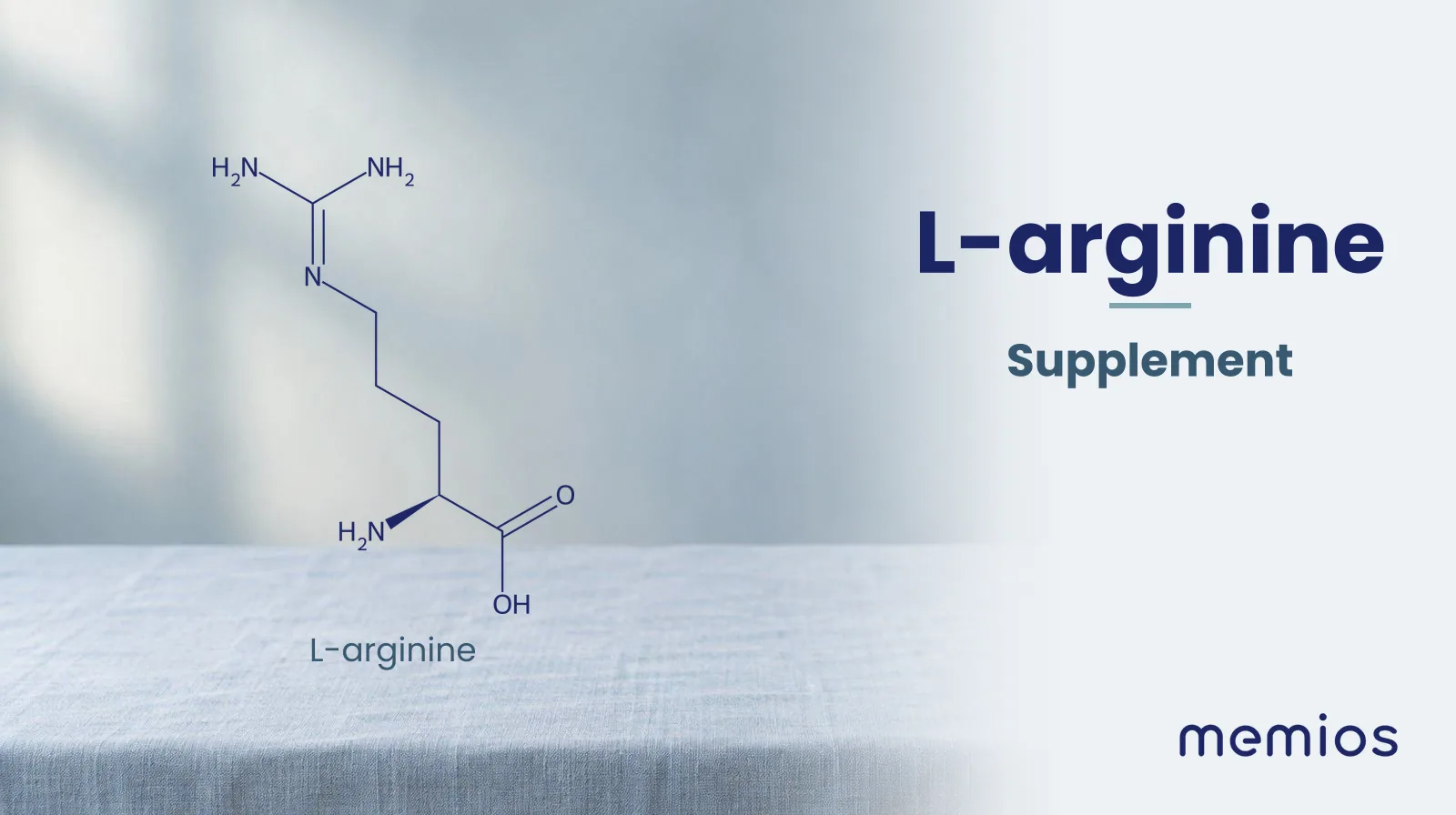
- What it is: L-arginine is an amino acid present in protein-containing foods, especially animal products and nuts, with typical dietary intake estimated at 4-5 grams a day.
- Main use, supported: A 90-day randomised placebo-controlled safety trial reported that 15 and 30 g/day of arginine were tolerated without adverse events in overweight or obese adults. (moderate certainty)
- Other use, supported: A meta-analysis of 11 double-blind placebo-controlled trials found oral L-arginine lowered systolic and diastolic blood pressure, but with substantial heterogeneity for systolic pressure. (low certainty)
- Claim NOT supported by research: A meta-analysis of the two randomised trials of oral L-arginine after acute myocardial infarction found no effect on clinical outcomes. (low certainty)
- Another claim NOT supported: The US National Institutes of Health Office of Dietary Supplements position is that arginine has little to no effect on exercise performance.
- Recommended dose: not established. No Recommended Dietary Allowance or Adequate Intake has been set for arginine, which the body can make as well as absorb. NIH's Office of Dietary Supplements describes typical dietary intake as 4-5 grams per day.
- Studied dose (a trial dose, not a recommendation): Erectile dysfunction trials pooled in a 2019 meta-analysis gave 1,500 to 5,000 mg. Findings citing that trial: 1 for, 1 on harm.
- Upper limit: No Tolerable Upper Intake Level or Acceptable Daily Intake has been set by a food-standards body that we could reach.
- What goes wrong: 9 findings on harm. In the VINTAGE MI randomised trial, L-arginine added to standard post-infarction therapy did not improve vascular stiffness or ejection fraction, and six participants in the arginine group died while none died on placebo.
- Common myth: Arginine raises nitric oxide, so more of it must be good for the heart and circulation.
What it is
L-arginine is an amino acid present in protein-containing foods, especially animal products and nuts, with typical dietary intake estimated at 4-5 grams a day. The body also synthesises it from citrulline, mainly in the kidneys. It is the substrate from which nitric oxide is made, which is the mechanism behind most claims made for it. Supplements usually supply free L-arginine or arginine hydrochloride.
What the research says
The evidence is mixed and contested. Pooled randomised trials show modest reductions in blood pressure and improvement in mild-to-moderate erectile dysfunction, but the independent appraisers of the blood-pressure meta-analysis described its conclusions as tentative because the trials were small, short and in mixed populations. For exercise performance the picture conflicts: one 2020 meta-analysis found small-to-large pooled effects with extreme heterogeneity, while the NIH Office of Dietary Supplements concludes there is little to no effect. In people recovering from a heart attack, a randomised trial found no benefit and more deaths on arginine, and was stopped early.
Evidence grade: Disputed.
What goes wrong
In the same erectile-dysfunction meta-analysis, adverse effects were about three times more frequent on arginine than placebo, though none were classed as severe. (Source 1)
- Meta-analysis, Low certainty.
- Size: 540 patients across 10 randomised controlled trials.
- Who: Men with mild to moderate erectile dysfunction.
- How long: Varied.
- Result: Adverse effect rate 8.3% with arginine versus 2.3% with placebo.
- Funding: not stated.
The adverse effect rate in the arginine-treated group was 8.3%, and that in the placebo group was 2.3%, none of which were severe.
In the VINTAGE MI randomised trial, L-arginine added to standard post-infarction therapy did not improve vascular stiffness or ejection fraction, and six participants in the arginine group died while none died on placebo, leading the safety committee to close enrolment. (Source 2)
- Randomized trial, Moderate certainty.
- Size: 153 patients (77 aged 60 years or older)
- Who: Patients after a first ST-segment elevation myocardial infarction.
- How long: 6 months, stopped early.
- Result: 6 participants (8.6%) died in the L-arginine group versus none in placebo (P = .01); no significant change in vascular stiffness or ejection fraction.
- Funding: not stated.
However, 6 participants (8.6%) in the L-arginine group died during the 6-month study period vs none in the placebo group (P = .01). Because of the safety concerns, the data and safety monitoring committee closed enrollment.
The VINTAGE MI investigators concluded arginine should not be recommended after a heart attack. (Source 2)
- Randomized trial, Moderate certainty.
- Size: 153 patients.
- Who: Patients after a first ST-segment elevation myocardial infarction.
- How long: 6 months.
- Result: No improvement in vascular stiffness or ejection fraction; higher post-infarction mortality.
- Funding: not stated.
L-Arginine, when added to standard postinfarction therapies, does not improve vascular stiffness measurements or ejection fraction and may be associated with higher postinfarction mortality. L-Arginine should not be recommended following acute myocardial infarction.
A review of gastrointestinal toxicity found arginine provokes diarrhoea by a nitric-oxide mediated mechanism, with most side effects at single doses above 9 g. (Source 3)
- Expert review, not systematic, Low certainty.
- Size: Clinical trials spanning arginine intakes from 3 g/d to more than 100 g/d.
- Who: Adults in clinical trials, including athletes and people with diabetes.
- How long: Varied; single-dose and daily regimens.
- Result: Single doses of 3-6 g rarely provoked side effects; most side effects at single doses above 9 g (>140 mg/kg), often within daily regimes around or above 30 g/d.
- Funding: not stated.
Most side effects of arginine and NAC occurred at single doses of >9 g in adults (>140 mg/kg) often when part of a daily regime of ∼>30 g/d (>174 mmol/d).
A case report describes acute pancreatitis in a young man attributed to l-arginine in a protein powder after other causes were excluded. (Source 4)
- Case report, Very low certainty.
- Size: 1 patient.
- Who: A young man with upper abdominal pain and raised serum lipase.
- How long: Single episode.
- Result: Mild acute pancreatitis confirmed on contrast-enhanced CT; reported as the second human case.
- Funding: not stated.
This is, to the best of our knowledge, the second case in human of arginine-induced acute pancreatitis.
In the blood-pressure meta-analysis, adverse events were recorded in only six of eleven trials and diarrhoea was the reported problem. (Source 5)
- Meta-analysis, Low certainty.
- Size: 6 of 11 trials reported adverse events.
- Who: Adults in blood-pressure trials.
- How long: Short treatment durations.
- Result: No adverse events in four trials; diarrhoea in participants in two trials.
- Funding: not stated.
Adverse events (measured in six trials) were not observed in four trials; in the other two, some participants experienced diarrhoea.
The NIH Office of Dietary Supplements records gastrointestinal discomfort and lowered blood pressure as the commonest adverse reactions at 9-30 g/day and states that safety beyond three months is unknown. (Source 6)
- Official position, Certainty not rated.
- Size: Not applicable.
- Who: People taking arginine supplements.
- How long: Position statement covering use beyond 3 months.
- Result: Up to 9 g/day described as safe and well tolerated; diarrhea, nausea and slightly reduced blood pressure at 9-30 g/day.
- Funding: government agency.
At doses of 9–30 g/day, the most commonly reported adverse reactions are gastrointestinal discomfort, such as diarrhea and nausea, and slightly reduced blood pressure. The safety of taking high-dose arginine supplements for more than 3 months is not known.
Mayo Clinic lists interactions in which arginine may add to the blood-pressure-lowering effect of medicines and raise potassium with potassium-sparing diuretics. (Source 7)
- Official position, Certainty not rated.
- Size: Not applicable.
- Who: People taking arginine alongside prescribed medicines.
- How long: Not applicable.
- Result: No numerical estimates given; named classes include blood pressure drugs, nitrates, isoproterenol, sildenafil and potassium-sparing diuretics.
- Funding: clinical body.
Water pills (potassium-sparing diuretics). Don't take L-arginine with amiloride (Midamor), spironolactone (Aldactone, Carospir) or triamterene (Dyrenium). These medications can increase potassium levels, increasing the risk of developing a higher than normal level of potassium in your blood (hyperkalemia).
An analysis of the 100 top-selling pre-workout products, a common way arginine-type ingredients are sold, found nearly half of all ingredients sat inside proprietary blends with undisclosed amounts. (Source 8)
- Survey study, Low certainty.
- Size: 100 commercially available pre-workout products.
- Who: Top-selling multi-ingredient pre-workout supplements.
- How long: Single snapshot of supplement facts panels.
- Result: 18.4 +/- 9.7 ingredients per product, of which 8.1 +/- 9.9 were in a proprietary blend; 44.3% of all ingredients were in proprietary blends.
- Funding: not stated.
Nearly half (44.3%) of all ingredients were included as part of a proprietary blend with undisclosed amounts of each ingredient.
What the evidence supports
A meta-analysis of 11 double-blind placebo-controlled trials found oral L-arginine lowered systolic and diastolic blood pressure, but with substantial heterogeneity for systolic pressure. (Source 5)
- Meta-analysis, Low certainty.
- Size: 387 participants across 11 randomised controlled trials.
- Who: Adults with a range of health conditions; individual trials ranged from 12 to 79 people.
- How long: Short treatment durations; the appraisers noted long-term effects could not be assessed.
- Result: Systolic WMD -5.39 mmHg (95% CI -8.54 to -2.25), I-squared 73.3%; diastolic WMD -2.66 mmHg (95% CI -3.77 to -1.54), I-squared 34.4%.
- Funding: not stated.
Compared to placebo, oral L-arginine was associated with a significant reduction in systolic blood pressure (WMD -5.39mmHg, 95% CI -8.54 to -2.25; significant heterogeneity;
A meta-analysis of 10 randomised trials in men with mild-to-moderate erectile dysfunction found arginine supplements improved erectile dysfunction compared with placebo or no treatment. (Source 1)
- Meta-analysis, Low certainty.
- Size: 540 patients across 10 randomised controlled trials.
- Who: Men with mild to moderate erectile dysfunction.
- How long: Treatment dosage and duration varied between studies.
- Result: Odds ratio 3.37 (95% CI 1.29 to 8.77), P = .01, I2 = 44, at doses of 1,500 to 5,000 mg.
- Funding: not stated.
The analysis demonstrated that arginine supplements with dosage ranging from 1,500 to 5,000 mg significantly improved ED compared with placebo or no treatment (odds ratios, 3.37 [1.29, 8.77], P = .01, I2 = 44).
A 90-day randomised placebo-controlled safety trial reported that 15 and 30 g/day of arginine were tolerated without adverse events in overweight or obese adults. (Source 9)
- Randomized trial, Moderate certainty.
- Size: 101 randomised subjects (45 men, 56 women) after 142 completed a wash-in.
- Who: Overweight or obese but otherwise healthy adults with BMI 25 kg/m2 or more.
- How long: 90 days after a 7-day wash-in at 12 g/day.
- Result: Serum arginine rose progressively with dose (P < 0.05); 30 g/day lowered systolic blood pressure and serum glucose in females (P < 0.05)
- Funding: not stated.
Based on physiological and biochemical variables, study subjects tolerated oral administration of 15 and 30 g Arg/day without adverse events.
What the evidence does not support
The US National Institutes of Health Office of Dietary Supplements position is that arginine has little to no effect on exercise performance. (Source 10)
- Official position, Certainty not rated.
- Size: Not applicable - an agency review of the literature.
- Who: People taking arginine for exercise performance.
- How long: Not applicable.
- Result: Doses of 2-20 g/day described as having little to no effect.
- Funding: government agency.
The research to support supplemental arginine as a performance enhancer is limited and conflicting. Overall, it suggests that doses of 2–20 g/day arginine have little to no effect on performance in either anaerobic or aerobic exercise.
A meta-analysis of the two randomised trials of oral L-arginine after acute myocardial infarction found no effect on clinical outcomes. (Source 11)
- Meta-analysis, Low certainty.
- Size: 2 randomised placebo-controlled trials; 914 participants in the pooled mortality analysis (459 L-arginine, 455 control)
- Who: Patients after acute myocardial infarction.
- How long: Not stated in the abstract.
- Result: Mortality 105/459 (22.9%) with arginine versus 111/455 (24.4%) with control; RR 0.93 (95% CI 0.74-1.17), P = 0.54.
- Funding: not stated.
Limit of this finding: The paper’s own numbers do not add up. It says 2 trials with 927 participants were included, but the pooled mortality result it reports covers 459 people on L-arginine and 455 on placebo, which is 914, not 927. We have quoted the paper faithfully, but a reader should treat 914 as the number actually analysed for mortality and should not rely on the 927 figure. The conclusion that L-arginine made no significant difference to outcomes is unaffected by the discrepancy, because the risk ratio and confidence interval come from the 914.
None of the 2 studies showed a significant difference in event rate between the L‐arginine and placebo groups.
Where the evidence is mixed
The independent appraisers of that blood-pressure meta-analysis judged its conclusions tentative because of small samples, mixed populations and short treatment. (Source 12)
- Systematic review, Low certainty.
- Size: Same 11 trials, 387 participants.
- Who: Adults with varied health conditions.
- How long: Short treatment durations.
- Result: No numerical effect; a quality appraisal of the review.
- Funding: independent (Centre for Reviews and Dissemination)
The review was generally well conducted, but limitations in the evidence base and lack of precision suggest the authors' conclusions should be considered tentative.
A meta-analysis of 15 exercise trials reported small-to-large pooled improvements in aerobic and anaerobic performance tests with arginine, but the aerobic estimate had extreme heterogeneity. (Source 13)
- Meta-analysis, Very low certainty.
- Size: 15 studies pooled from 18 included studies (participant total not stated in the abstract)
- Who: Participants in aerobic and anaerobic performance testing; no filter on athlete level, sex, ethnicity or age.
- How long: Acute and chronic supplementation protocols.
- Result: Aerobic SMD 0.84 (95% CI 0.12 to 1.56), I2 89%, p = 0.02; anaerobic SMD 0.24 (95% CI 0.05 to 0.43), I2 0%, p = 0.01.
- Funding: not stated.
Results revealed that Arg supplementation could improve aerobic (SMD, 0.84; 95% CI, 0.12 to 1.56; magnitude of SMD (MSMD), large; I2, 89%; p = 0.02) and anaerobic (SMD, 0.24; 95% CI, 0.05 to 0.43; MSMD, small; I2, 0%; p = 0.01) performance tests.
What official bodies say
A review of arginine safety in adults put the observed safe level for oral arginine at about 20 g/day while calling for more data. (Source 14)
- Expert review, not systematic, Low certainty.
- Size: Not applicable - a narrative review.
- Who: Adults, including pregnant women, preterm infants and people with cystic fibrosis.
- How long: Not applicable.
- Result: Observed safe level about 20 g/d.
- Funding: not stated.
The observed safe level for oral administration of Arg is ∼20 g/d, but higher levels have been tested in short-term studies without serious adverse effects; however, more data are needed in both animal models and humans to fully evaluate safety as well as efficacy.
Where the research disagrees
Whether arginine improves exercise performance
- Víribay and colleagues, Nutrients 2020 meta-analysis, meta-analysis of 15 trials: Results revealed that Arg supplementation could improve aerobic (SMD, 0.84; 95% CI, 0.12 to 1.56; magnitude of SMD (MSMD), large; I2, 89%; p = 0.02) and anaerobic (SMD, 0.24; 95% CI, 0.05 to 0.43; MSMD, small; I2, 0%; p = 0.01) performance tests. (Source 13)
- NIH Office of Dietary Supplements, agency review of the same literature: Overall, it suggests that doses of 2–20 g/day arginine have little to no effect on performance in either anaerobic or aerobic exercise. (Source 10)
How much weight to put on the blood-pressure meta-analysis
- Dong and colleagues, American Heart Journal 2011, meta-analysis of 11 double-blind placebo-controlled trials: Compared to placebo, oral L-arginine was associated with a significant reduction in systolic blood pressure (WMD -5.39mmHg, 95% CI -8.54 to -2.25; (Source 5)
- Centre for Reviews and Dissemination appraisers, independent critical appraisal: The review was generally well conducted, but limitations in the evidence base and lack of precision suggest the authors' conclusions should be considered tentative. (Source 12)
How much oral arginine has been shown to be safe, and for how long
- NIH Office of Dietary Supplements, agency fact sheet summarising the trial literature: Most study results suggest that up to 9 g/day arginine for several days or weeks is safe and well tolerated. At doses of 9–30 g/day, the most commonly reported adverse reactions are gastrointestinal discomfort, such as diarrhea and nausea, and slightly reduced blood pressure. The safety of taking high-dose arginine supplements for more than 3 months is not known. (Source 6)
- McNeal and colleagues, The Journal of Nutrition 2016, narrative review of safety, pharmacokinetics and effectiveness: The observed safe level for oral administration of Arg is ∼20 g/d, but higher levels have been tested in short-term studies without serious adverse effects; however, more data are needed in both animal models and humans to fully evaluate safety as well as efficacy. (Source 14)
- Authors of the 2018 Amino Acids safety trial, 90-day randomised placebo-controlled trial in 101 overweight or obese adults: We conclude that a long-term safe level of dietary Arg supplementation is at least 30 g/day in adult humans. (Source 9)
How much
- Reference intake: No Recommended Dietary Allowance or Adequate Intake has been set for arginine, which the body can make as well as absorb. NIH's Office of Dietary Supplements describes typical dietary intake as 4-5 grams per day. (Source 15)
- Upper limit: No Tolerable Upper Intake Level or Acceptable Daily Intake has been set by a food-standards body that we could reach. A 2016 review in The Journal of Nutrition places the observed safe level for oral arginine at about 20 g/day; NIH ODS says safety beyond three months at high doses is unknown. (Source 14)
- Studied: Erectile dysfunction trials pooled in a 2019 meta-analysis gave 1,500 to 5,000 mg. (Source 1)
- Studied: A 90-day randomised safety trial gave 0, 15 or 30 g of arginine hydrochloride per day in at least two divided doses after a 7-day wash-in at 12 g/day. (Source 9)
- Studied: NIH ODS describes exercise studies using doses of 2-20 g/day. (Source 10)
A common belief, and what the research shows
The belief: Arginine raises nitric oxide, so more of it must be good for the heart and circulation.
What the research shows: In the setting where that reasoning was tested hardest it failed and did harm. In VINTAGE MI, "6 participants (8.6%) in the L-arginine group died during the 6-month study period vs none in the placebo group (P = .01). Because of the safety concerns, the data and safety monitoring committee closed enrollment." The same nitric oxide mechanism in the gut is also what drives its commonest side effect: "Oral supplements of arginine and citrulline increase local nitric oxide (NO) production in the small intestine and this may be harmful under certain circumstances."
Questions and answers
What is it?
L-arginine is an amino acid. It occurs in protein-containing foods, particularly animal products and nuts, and the body also makes it from citrulline, mostly in the kidneys. NIH puts typical dietary intake at about 4-5 grams a day. In supplements it is usually sold as free L-arginine or arginine hydrochloride. (Source 15)
What does it do in the body?
Arginine is the substrate the body uses to make nitric oxide, a signalling molecule that relaxes blood vessels. That is the basis of most claims made for it. The same nitric oxide effect in the gut is also what produces its commonest side effect. (Source 3)
Is it good or bad for you?
It depends heavily on the setting. Pooled trials show modest blood-pressure lowering and improvement in mild-to-moderate erectile dysfunction, but the reviewers themselves call the evidence tentative. In one randomised trial in people recovering from a heart attack, more people died in the arginine group than on placebo and the trial was stopped. (Source 2)
How do you get more of it?
In trials people took it as a supplement. Erectile-dysfunction trials used 1,500 to 5,000 mg; blood-pressure and performance trials have used 2-20 g/day; a 90-day safety trial used 15 or 30 g/day in divided doses. Dietary arginine comes from protein foods rather than from a specific supplement. (Source 1)
If it is harmful, what reduces it?
Arginine is not a contaminant to be removed; the question that arises in practice is how to reduce its side effects. The gastrointestinal review found that adverse effects tracked the dosing regimen and went away when the same daily amount was split into divided doses. (Source 3)
Why might someone be low in it or missing it?
Healthy adults are not usually short of arginine: it is in ordinary protein foods and the body also synthesises it from citrulline in the kidneys. That synthesis route is why kidney disease, and conditions that damage the gut where citrulline is made, are the situations in which arginine supply is most plausibly reduced. (Source 15)
Which whole foods contain it or feed it?
Protein-containing foods, especially animal products and nuts, are the dietary sources. NIH estimates typical intake at 4-5 grams a day, which is already within the range some trials have supplemented with. (Source 15)
What happens if you do not have it?
No dietary deficiency syndrome for arginine in healthy adults appears in the literature we searched, because the body makes it as well as taking it in from food. We could not find a study describing what happens to healthy adults who take in less arginine, so this remains unanswered as a supplement question. (Source 15)
We searched: Searched NIH ODS exercise and athletic performance fact sheet, the J Nutr arginine safety review and the arginine gastrointestinal toxicity review for a described deficiency state in healthy adults; none reports one.
How can you test for it?
Arginine is measurable in blood: the 90-day safety trial measured serum arginine and showed it rose in step with the oral dose. There is no validated clinical test of arginine status that tells an individual whether they need more, and we found none in the reviews we read. (Source 9)
References
- The Journal of Sexual Medicine. The Potential Role of Arginine Supplements on Erectile Dysfunction: A Systemic Review and Meta-Analysis. 2019. PMID 30770070, DOI 10.1016/j.jsxm.2018.12.002. Read the source
- JAMA. L-Arginine Therapy in Acute Myocardial Infarction: The Vascular Interaction With Age in Myocardial Infarction (VINTAGE MI) Randomized Clinical Trial. 2006. PMID 16391217, DOI 10.1001/jama.295.1.58. Read the source
- The Journal of Nutrition. Adverse Gastrointestinal Effects of Arginine and Related Amino Acids. 2007. PMID 17513449, DOI 10.1093/jn/137.6.1693S. Read the source
- Clinical Journal of Gastroenterology. The second case of a young man with l-arginine-induced acute pancreatitis. 2018. DOI 10.1007/s12328-018-0862-4. Read the source
- Database of Abstracts of Reviews of Effects (DARE), Centre for Reviews and Dissemination / NCBI Bookshelf. Effect of oral L-arginine supplementation on blood pressure: a meta-analysis of randomized, double-blind, placebo-controlled trials (DARE quality-assessed abstract of Dong JY et al., American Heart Journal 2011). 2011. Read the source
- Office of Dietary Supplements, National Institutes of Health. Dietary Supplements for Exercise and Athletic Performance – Health Professional Fact Sheet (arginine, safety). no revision date captured from the fetched page; accessed 23 September 2026. Read the source
- Mayo Clinic. L-arginine – Drugs and Supplements (Interactions section). no date printed on the page; accessed 23 September 2026. Read the source
- Nutrients. Common Ingredient Profiles of Multi-Ingredient Pre-Workout Supplements. 2019. PMID 30678328, DOI 10.3390/nu11020254. Read the source
- Amino Acids. Safety of dietary supplementation with arginine in adult humans. 2018. PMID 29858688, DOI 10.1007/s00726-018-2594-7. Read the source
- Office of Dietary Supplements, National Institutes of Health. Dietary Supplements for Exercise and Athletic Performance – Health Professional Fact Sheet (arginine, efficacy conclusion). no revision date captured from the fetched page; accessed 23 September 2026. Read the source
- Clinical Cardiology. Oral L‐arginine Supplementation in Acute Myocardial Infarction Therapy: A Meta‐analysis of Randomized Controlled Trials. 2009. DOI 10.1002/clc.20616. Read the source
- Database of Abstracts of Reviews of Effects (DARE), Centre for Reviews and Dissemination / NCBI Bookshelf. CRD commentary on: Effect of oral L-arginine supplementation on blood pressure: a meta-analysis of randomized, double-blind, placebo-controlled trials. 2011. Read the source
- Nutrients. Effects of Arginine Supplementation on Athletic Performance Based on Energy Metabolism: A Systematic Review and Meta-Analysis. 2020. DOI 10.3390/nu12051300. Read the source
- The Journal of Nutrition. Safety and Effectiveness of Arginine in Adults. 2016. PMID 27934649, DOI 10.3945/jn.116.234740. Read the source
- Office of Dietary Supplements, National Institutes of Health. Dietary Supplements for Exercise and Athletic Performance – Health Professional Fact Sheet (arginine, introductory paragraph). no revision date captured from the fetched page; accessed 23 September 2026. Read the source