Supplements · September 29, 2026 · Memios · 13 min read
Kratom
Disputed. There are almost no controlled human efficacy trials.
TLDR
- Disputed. There are almost no controlled human efficacy trials.
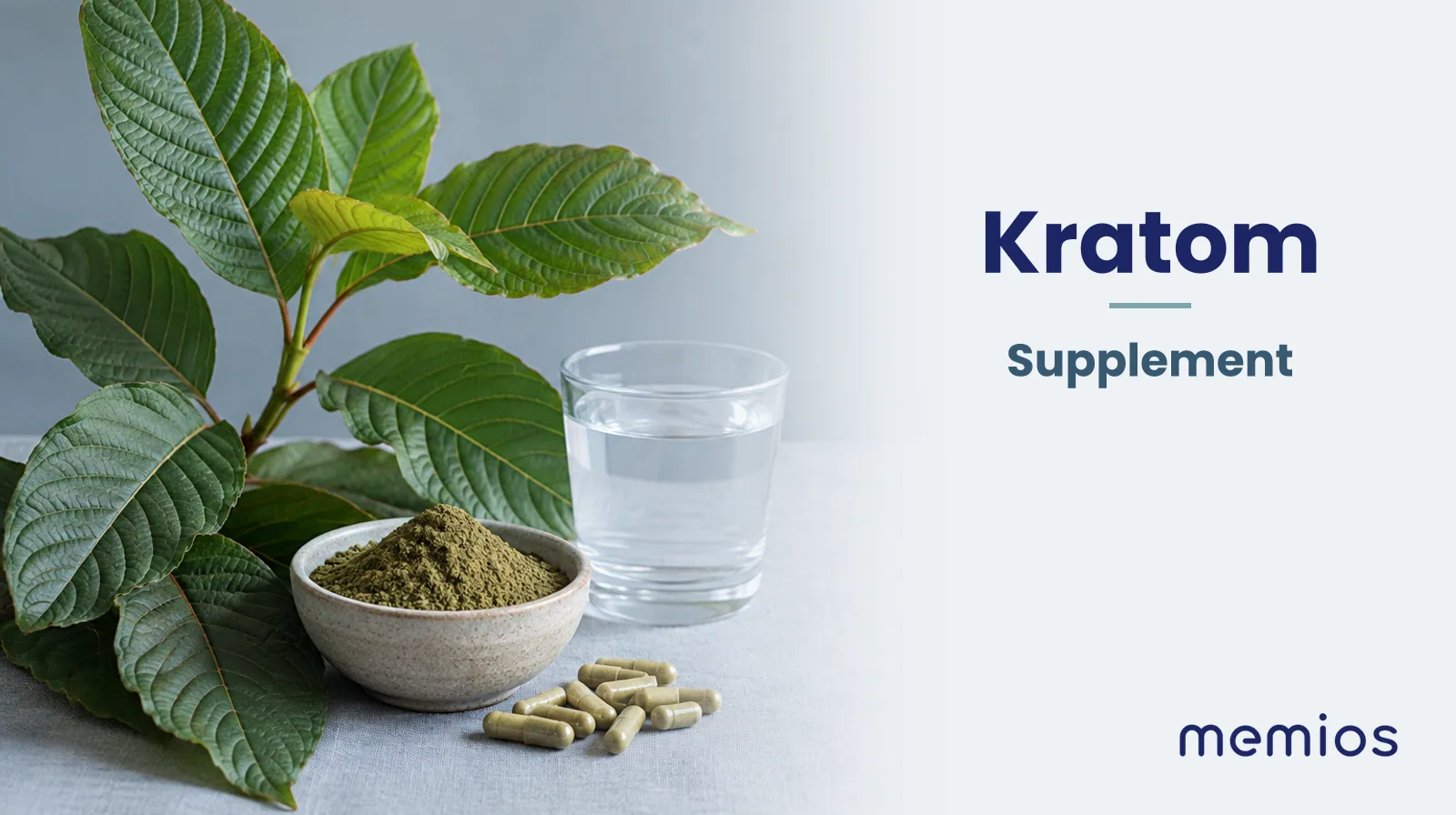
- What it is: Kratom is the leaf of Mitragyna speciosa, a tree in the coffee family native to Southeast Asia, where it has a long history of traditional use.
- Main use, supported: A text-mining study of social media posts found that people posting about kratom describe pain relief, help with opioid withdrawal and improved mood; this records what users say about themselves, not a measured clinical effect. (very low certainty)
- Claim NOT supported by research: A systematic evaluation of published kratom case reports concluded the literature does not show that kratom on its own causes severe acute harm. (low certainty)
- Recommended dose: not established. No reference intake exists. Kratom is not a nutrient, and FDA states it is not lawfully marketed in the United States as a drug, dietary supplement or food additive.
- Studied dose (a trial dose, not a recommendation): No controlled human dosing trial was reachable in this run. What the case literature records instead is postmortem and clinical mitragynine blood concentrations: 3.5 to 7,500 ng/mL in deceased cases and 5 to 340... Findings citing that trial: 1 against, 2 on harm.
- Upper limit: No tolerable upper intake level or acceptable daily intake has been set by any body located in this search; FDA's position is that consumers should not use kratom at all.
- What goes wrong: 10 findings on harm. Deaths with kratom present are documented, but most had other drugs on board.
- Common myth: Kratom is a natural herbal leaf, so what you buy is just leaf powder and is safer than an opioid.
What it is
Kratom is the leaf of Mitragyna speciosa, a tree in the coffee family native to Southeast Asia, where it has a long history of traditional use. Its main alkaloid is mitragynine; a minor alkaloid, 7-hydroxymitragynine, is far more potent at the mu-opioid receptor. In the United States it is sold as powders, capsules and extracts; one 2020 commentary estimates that 10 to 15 million people there consume it, mostly to self-treat pain or opioid withdrawal, though that estimate is offered without a primary survey behind it.
What the research says
There are almost no controlled human efficacy trials. What exists is self-report and case material: in online posts users describe pain relief, help with opioid withdrawal, and mood and energy effects, while the same posts describe nausea, gut, cardiac, respiratory and liver problems. None of that is a measured clinical effect. The serious-harm literature is dominated by case reports and postmortem series, and a 2025 systematic evaluation of those case reports concluded they are too confounded by other drugs to show that kratom alone causes severe acute harm - which is not the same as showing it is safe. Separately, kratom products have repeatedly been adulterated or contaminated.
Evidence grade: Disputed.
What goes wrong
Deaths with kratom present are documented, but most had other drugs on board. (Source 1)
- Case series, Low certainty.
- Size: 95 patients reviewed; 35 deceased with confirmed mitragynine.
- Who: case reports of acute adverse effects involving kratom.
- How long: not applicable.
- Result: mitragynine blood levels 3.5 to 7,500 ng/mL in the deceased and 5 to 340 ng/mL in survivors.
- Funding: not stated in the abstract.
Limit of this finding: The blood mitragynine levels in this review overlap and span two orders of magnitude - 3.5 to 7,500 ng/mL in people who died and 5 to 340 ng/mL in people who survived. That wide, overlapping spread is what the source reports, not a typing error, and it means no safe or dangerous blood level can be read off these numbers. Because most deceased cases also involved other drugs, the deaths cannot be attributed to kratom on these data.
95 patients were identified for review. Mitragynine presence was toxicologically confirmed in 55 cases; 35 were deceased (mitragynine blood levels ranged from 3.5 to 7,500 ng/mL), and 20 were living (range of 5 to 340 ng/mL).
The same review found the reported adverse effects span several organ systems. (Source 1)
- Case series, Low certainty.
- Size: 95 patients.
- Who: published case reports.
- How long: not applicable.
- Result: no rates can be derived because the denominator of users is unknown.
- Funding: not stated in the abstract.
Limit of this finding: These adverse effects are what published case reports described. A case report records one person's course and cannot show that kratom caused the effect, and this review found the toxicology and medical histories behind many of the cases were weak or incomplete.
Reported adverse effects included pulmonary, cardiovascular, brain, liver, kidney, and gastrointestinal effects, as well as seizures, loss of consciousness, lethargy, fatigue, and altered mental state.
Kratom has been linked to cholestatic liver injury in individual biopsy-documented cases. (Source 2)
- Case report, Very low certainty.
- Size: 1 patient, with three prior biopsy-documented cases in the literature.
- Who: a 40-year-old woman with mixed cholestatic and hepatocellular liver injury.
- How long: single episode with recovery after stopping.
- Result: liver biopsy showed granulomatous hepatitis with prominent duct injury; symptoms improved after kratom was stopped.
- Funding: not stated.
Reports of kratom-induced hepatic toxicity are limited and only three case reports of kratom-induced liver injury with histopathologic examination of the liver biopsies are available.
Rechallenge was not performed, but the case improved on withdrawal of kratom. (Source 2)
- Case report, Very low certainty.
- Size: 1 patient.
- Who: adult woman with unexplained cholestatic injury.
- How long: single episode.
- Result: clinical improvement after stopping the supplement.
- Funding: not stated.
Kratom was discontinued and the symptoms improved.
Kratom products have repeatedly been adulterated or contaminated, including one adulterated product linked to at least nine fatal poisonings. (Source 3)
- Expert review, not systematic, Low certainty.
- Size: seven documented outbreaks.
- Who: kratom products on the US market.
- How long: episodes spanning the period reviewed.
- Result: outbreaks involved O-desmethyltramadol, hydrocodone and morphine, phenylethylamine, heavy metals, multiple Salmonella enterica serotypes, and exogenous 7-hydroxymitragynine.
- Funding: not stated.
krypton, a kratom product adulterated with O-desmethyltramadol that resulted in at least nine fatal poisonings
The review attributes these contamination episodes to weak supplement regulation rather than to isolated bad actors. (Source 3)
- Expert review, not systematic, Low certainty.
- Size: seven outbreaks.
- Who: US dietary supplement market.
- How long: not applicable.
- Result: no rate given.
- Funding: not stated.
Inadequate supplement regulation contributed to multiple examples of kratom contamination and adulteration
Self-reported adverse effects in online discourse include gastrointestinal, cardiac, respiratory and liver problems. (Source 4)
- Survey study, Very low certainty.
- Size: social media corpus; size not given in the abstract.
- Who: people posting about kratom online.
- How long: not applicable.
- Result: topic shares reported were nausea 46.80%, upset stomach and constipation 12.60%, heart-related issues 9.00%, respiratory issues 8.00%, liver-related issues 6.80%.
- Funding: not stated.
Limit of this finding: These are effects people described in online posts. As with the reported benefits, there is no denominator and no clinical measurement, so the list shows what is talked about rather than how often it happens.
Conversely, it may induce nausea, upset stomach, and constipation, elevate heart risks, affect respiratory function, and threaten liver health.
The US Food and Drug Administration's position, as stated on its kratom page dated 2 December 2025, is that consumers should not use kratom. (Source 5)
- Official position, Certainty not rated.
- Size: not applicable.
- Who: US consumers.
- How long: not applicable.
- Result: no rate given; FDA cites liver toxicity, seizures and substance use disorder.
- Funding: government agency.
FDA has warned consumers not to use kratom because of the risk of serious adverse events, including liver toxicity, seizures, and substance use disorder (SUD).
FDA states that the minor alkaloid 7-hydroxymitragynine is more potent at the mu-opioid receptor than morphine. (Source 5)
- Official position, Certainty not rated.
- Size: not applicable.
- Who: not applicable.
- How long: not applicable.
- Result: no numeric potency ratio is given on the page.
- Funding: government agency.
7-OH demonstrates substantially greater mu-opioid receptor potency than kratom's primary alkaloid constituent mitragynine, as well as other classical opioids such as morphine.
Adulterated kratom products are described as increasingly sold through the internet and convenience stores. (Source 6)
- Expert review, not systematic, Very low certainty.
- Size: not applicable.
- Who: US and European kratom market.
- How long: not applicable.
- Result: no rate given.
- Funding: not stated.
Limit of this finding: This source is a commentary on possible COVID-19 supply disruption, not a study. It describes a trend without presenting original data on it. The same paper is the origin of the widely repeated figure of 10 to 15 million US kratom consumers, which its abstract gives as an estimate with no primary survey cited behind it, so both the trend and that figure should be read as the authors' estimate rather than a measurement.
increases in the sales of adulterated kratom products on the internet or in convenience stores could exacerbate circumstances further
What the evidence supports
A text-mining study of social media posts found that people posting about kratom describe pain relief, help with opioid withdrawal and improved mood; this records what users say about themselves, not a measured clinical effect. (Source 4)
- Survey study, Very low certainty.
- Size: social media posts analysed by topic modelling; number of posts not given in the abstract.
- Who: self-selected people posting about kratom online.
- How long: not applicable.
- Result: topics identified included addiction and opiate withdrawal (32.49%), anxiety and depression relief (26.08%), chronic pain (22.49%) and mood and energy (7.23%)
- Funding: not stated.
Limit of this finding: This is an automated analysis of what people wrote online, not a trial and not a survey. There is no comparison group, no denominator and no measurement of anyone's symptoms, and people who post about kratom are not a representative sample. The percentages are shares of discussion topics, not rates of benefit. Nothing here shows that kratom works.
The analysis showed that kratom aids in addiction recovery and managing opiate withdrawal, alleviates anxiety, depression, and chronic pain, enhances mood, energy, and overall mental well-being, and improves quality of life.
What the evidence does not support
A systematic evaluation of published kratom case reports concluded the literature does not show that kratom on its own causes severe acute harm. (Source 1)
- Systematic review, Low certainty.
- Size: 95 patients; mitragynine confirmed in 55.
- Who: published human case reports and case series of acute adverse effects after kratom use.
- How long: not applicable.
- Result: confounding substances present in 32 of the deceased and 7 of the surviving cases (p = 0.0002)
- Funding: not stated in the abstract.
Limit of this finding: This is a review of published case reports, not a controlled study, and its own figures show why it cannot settle the question: other drugs were present in 32 of the 35 deceased cases and in 7 of the 20 surviving ones. Saying the evidence is insufficient to show kratom alone caused severe harm is not the same as showing kratom is safe. Case reports also have no denominator, so nothing here says how often anything happens.
Currently, the literature provides insufficient evidence to support the claim that kratom consumption alone increases the risk of severe acute adverse health effects.
Where the research disagrees
Whether kratom by itself causes severe acute harm and death
- Authors of a 2025 systematic evaluation of kratom case reports, systematic review of 95 published human case reports, with statistical comparison of confounding substances: Currently, the literature provides insufficient evidence to support the claim that kratom consumption alone increases the risk of severe acute adverse health effects. (Source 1)
- US Food and Drug Administration, page dated 2 December 2025, agency position drawing on adverse event reports and medical examiner findings: FDA has warned consumers not to use kratom because of the risk of serious adverse events, including liver toxicity, seizures, and substance use disorder (SUD). (Source 5)
How much
- Reference intake: No reference intake exists. Kratom is not a nutrient, and FDA states it is not lawfully marketed in the United States as a drug, dietary supplement or food additive. (Source 5)
- Upper limit: No tolerable upper intake level or acceptable daily intake has been set by any body located in this search; FDA's position is that consumers should not use kratom at all. (Source 5)
- Studied: No controlled human dosing trial was reachable in this run. What the case literature records instead is postmortem and clinical mitragynine blood concentrations: 3.5 to 7,500 ng/mL in deceased cases and 5 to 340 ng/mL in surviving cases. These ranges overlap and no threshold can be inferred from them. (Source 1)
A common belief, and what the research shows
The belief: Kratom is a natural herbal leaf, so what you buy is just leaf powder and is safer than an opioid.
What the research shows: What is in the packet is not reliably leaf. A review of the US market records that "At least seven distinct episodes of kratom product contamination or adulteration are known", including heavy metals, Salmonella, and added synthetic opioids, and one adulterated product "resulted in at least nine fatal poisonings". FDA also states that the kratom alkaloid 7-OH "demonstrates substantially greater mu-opioid receptor potency than kratom's primary alkaloid constituent mitragynine, as well as other classical opioids such as morphine."
Questions and answers
What is it?
Kratom is the leaf of Mitragyna speciosa, a tree in the coffee family that grows in Southeast Asia and has been chewed or brewed there traditionally. Outside that region it is sold as dried leaf powder, capsules and concentrated extracts. Its effects come from alkaloids, chiefly mitragynine. (Source 6)
What does it do in the body?
Kratom alkaloids act at opioid receptors. Mitragynine is the main alkaloid, while the minor alkaloid 7-hydroxymitragynine is much more potent at the mu-opioid receptor, which is the pharmacological basis of both the opioid-like effects people seek and the overdose concern. (Source 5)
Is it good or bad for you?
Contested. Users report benefit for pain and opioid withdrawal, and a 2025 review of case reports found the harm literature too confounded by other drugs to prove kratom alone causes severe acute injury. Regulators take the opposite view and warn against any use. There is no controlled trial evidence establishing a favourable balance. (Source 5)
How do you get more of it?
Kratom is obtained only by buying leaf products; it is not present in the ordinary diet. A 2020 commentary estimates that 10 to 15 million people in the United States use it, mostly to self-treat pain, psychiatric symptoms or opioid withdrawal; that figure is an estimate offered without a primary survey behind it. Because it is not lawfully marketed, supply is unregulated. (Source 6)
If it is harmful, what reduces it?
The documented step when kratom appears to be causing organ injury is stopping it. In the reported cholestatic liver-injury case the patient improved after kratom was withdrawn. No antidote or elimination treatment specific to kratom is described in this literature. (Source 2)
Why might someone be low in it or missing it?
Does not apply. Kratom is not something the body needs or makes, so there is no deficiency. Its absence from a person's system simply means they have not taken it. In the United States it is not a legal supplement or food ingredient. (Source 5)
Which whole foods contain it or feed it?
No conventional whole food contains kratom. The source is the leaf of the tree itself, traditionally chewed fresh or brewed as a tea in Southeast Asia; everything sold elsewhere is a processed leaf product or extract. (Source 6)
What happens if you do not have it?
Nothing happens from never having taken kratom; there is no deficiency state and no approved medical role for it. FDA warns that use carries a risk of substance use disorder. How often dependence or withdrawal occurs is not quantified anywhere in this write-up, because the reviews carrying rates could not be reached. (Source 5)
How can you test for it?
Kratom exposure can be measured by testing blood for mitragynine, which is what forensic and clinical case reports rely on. The reliability of that testing in practice is poor: the 2025 review of case reports found the toxicology work behind many published cases was weak or incomplete, and reported blood levels overlap widely between people who died and people who survived. (Source 1)
References
- Frontiers in Pharmacology. The acute adverse health effects of kratom: an evaluation of case reports. 2025. PMID 40949154, DOI 10.3389/fphar.2025.1620601. Read the source
- Gastroenterology Research. Kratom-Induced Cholestatic Liver Injury Mimicking Anti-Mitochondrial Antibody-Negative Primary Biliary Cholangitis: A Case Report and Review of Literature. 2019. DOI 10.14740/gr1204. Read the source
- Current Addiction Reports. A Cautionary Tale of Herbal Supplements: What We Have Learned from Kratom. 2023. DOI 10.1007/s40429-023-00465-8. Read the source
- Informatics. Health Benefits and Adverse Effects of Kratom: A Social Media Text-Mining Approach. 2024. Read the source
- US Food and Drug Administration (page content dated 2 December 2025). FDA and Kratom. 2025. Read the source
- Frontiers in Psychiatry. Current and Future Potential Impact of COVID-19 on Kratom (Mitragyna speciosa Korth.) Supply and Use. 2020. DOI 10.3389/fpsyt.2020.574483. Read the source