Supplements · September 29, 2026 · Memios · 12 min read
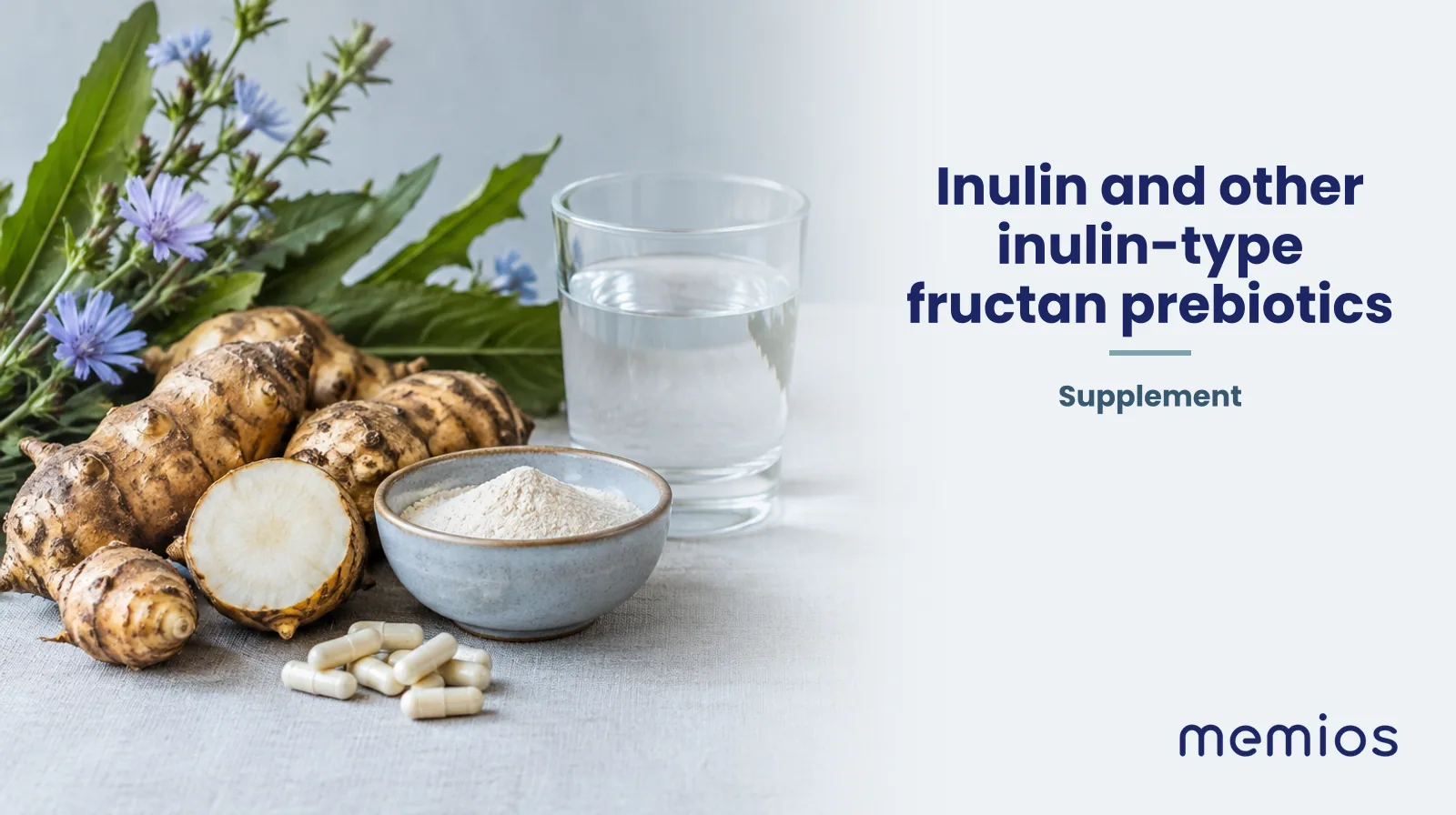
Inulin and other inulin-type fructan prebiotics
Inulin reliably feeds and increases bifidobacteria in the gut: a 50-trial meta-analysis found a clear rise.
TLDR
- Limited evidence. Inulin reliably feeds and increases bifidobacteria in the gut: a 50-trial meta-analysis found a clear rise.
- What it is: Inulin is a chain of fructose units joined by bonds that human digestive enzymes cannot break, usually with a glucose unit at one end.
- Main use, supported: In randomised trials, chicory-derived inulin-type fructans at 3-20 g/day increased gut Bifidobacterium abundance compared with control. (moderate certainty)
- Other use, supported: In a meta-analysis of 33 trials rated with GRADE, inulin-type fructans lowered fasting glucose and HbA1c, with larger effects in prediabetes and type 2 diabetes. (moderate certainty)
- Claim NOT supported by research: The authors of that review stated there was potential publication bias and few trials in people with type 2 diabetes. (low certainty)
- Another claim NOT supported: In adults with IBS and other functional bowel disorders, prebiotics did not improve symptoms or quality of life compared with placebo, even though they raised bifidobacteria. (low certainty)
- Recommended dose (official position): We found no reference intake (RDA or AI) for inulin specifically in the sources we read. Inulin counts as dietary fibre, which has general intake targets that we did not source in this batch.
- Studied dose (a trial dose, not a recommendation): Trials in the chicory meta-analysis gave 3-20 g/day of chicory-derived inulin-type fructans for at least 7 days. Findings citing that trial: 1 for, 1 mixed.
- Upper limit: We found no tolerable upper intake level for inulin in the sources we read.
- What goes wrong: 2 findings on harm. In the same IBS meta-analysis, inulin-type fructans made flatulence worse.
- Common myth: If a prebiotic raises your 'good' bifidobacteria, it must be improving your health.
What it is
Inulin is a chain of fructose units joined by bonds that human digestive enzymes cannot break, usually with a glucose unit at one end. Short chains (2 to 10 units) are often sold as oligofructose or FOS; longer chains run to about 60 units. Chicory root is the main commercial source.
What the research says
Inulin reliably feeds and increases bifidobacteria in the gut: a 50-trial meta-analysis found a clear rise. Whether that change produces health benefits is much less certain. Meta-analyses report modest improvements in blood glucose markers in people with prediabetes or type 2 diabetes and a small LDL reduction, with warnings about publication bias. In people with IBS, prebiotics did not improve symptoms, and inulin-type fructans made flatulence worse. A large obesity trial concluded the bifidobacteria rise looks like a sign of inulin intake, not the cause of the benefits it saw.
Evidence grade: Limited evidence.
What goes wrong
In the same IBS meta-analysis, inulin-type fructans made flatulence worse. (Source 1)
- Meta-analysis, Low certainty.
- Size: Subgroup of 11 RCTs (729 patients in total)
- Who: Adults with IBS or other functional bowel disorders.
- How long: Varied by trial.
- Result: Flatulence SMD 0.85 (95% CI 0.23-1.47; p=0.007) with inulin-type fructans.
- Funding: Not stated in the abstract we read.
while inulin-type fructans worsened flatulence (SMD 0.85, 95%CI 0.23, 1.47, p=0.007)
In FODMAP challenge studies summarised in an opinion article, FOS and other FODMAPs produced mainly mild increases in flatulence, bloating and abdominal pain, with no clear dose-response. (Source 2)
- Systematic review, Very low certainty.
- Size: Not pooled; opinion article citing several provocation trials.
- Who: People with IBS and healthy people.
- How long: Various.
- Result: Doses of 1.7 to 19 g/day in IBS and 5-20 g/day FOS in healthy people; mild symptom increases.
- Funding: Not stated in the text we read.
with only mild increases of gastrointestinal symptoms, mainly flatulence, bloating and abdominal pain along with a lack of apparent dose-response
What the evidence supports
In randomised trials, chicory-derived inulin-type fructans at 3-20 g/day increased gut Bifidobacterium abundance compared with control. (Source 3)
- Meta-analysis, Moderate certainty.
- Size: 2525 participants across 50 studies.
- Who: Ages 0 to 83 years, healthy and with health impairments.
- How long: Minimum 7 days of supplementation.
- Result: Standardized mean difference 0.83 (95% CI 0.58-1.08; p < 0.01); no bifidogenic effect shown in gastrointestinal disorders.
- Funding: Not stated in the abstract we read.
Chicory-derived inulin-type fructans at a dose of 3-20 g/day significantly increased Bifidobacterium abundance in participants with an age range from 0 to 83 years (standardized mean difference: 0.83, 95% CI: 0.58-1.08; p < 0.01; 50 studies; 2525 participants).
In a meta-analysis of 33 trials rated with GRADE, inulin-type fructans lowered fasting glucose and HbA1c, with larger effects in prediabetes and type 2 diabetes. (Source 4)
- Meta-analysis, Moderate certainty.
- Size: 1346 participants across 33 trials.
- Who: Mixed, including healthy, overweight, prediabetes and type 2 diabetes.
- How long: Trials ran from about 20 to 252 days; 6 weeks or more was associated with benefit.
- Result: In prediabetes/T2DM: fasting glucose WMD -0.60 mmol/l (95% CI -0.71 to -0.48, rated high); HbA1c WMD -0.58% (95% CI -0.83 to -0.32, rated high); fasting insulin and HOMA-IR rated low; authors recommended 10 g/day for 6 weeks or longer based on dose-response modelling.
- Funding: Not stated in the text we read.
In the prediabetes and type 2 diabetes (T2DM) population, a more significant reduction in FBG [weighted mean difference (WMD): − 0.60 mmol/l; 95% CI − 0.71, − 0.48 mmol/l; high rate], HbA1c (WMD: − 0.58%; 95% CI − 0.83, − 0.32%; high rate)
What the evidence does not support
The authors of that review stated there was potential publication bias and few trials in people with type 2 diabetes. (Source 5)
- Meta-analysis, Low certainty.
- Size: 607 adults across 20 RCTs.
- Who: Adults with metabolic abnormalities.
- How long: Not stated.
- Result: Quality caveat stated by authors.
- Funding: Independent.
There was a potential publication bias, and few trials were available for the T2DM subgroup analysis.
In adults with IBS and other functional bowel disorders, prebiotics did not improve symptoms or quality of life compared with placebo, even though they raised bifidobacteria. (Source 1)
- Meta-analysis, Low certainty.
- Size: 729 patients across 11 RCTs.
- Who: Adults with IBS or other functional bowel disorders.
- How long: Varied by trial.
- Result: Response 54% prebiotic vs 63% placebo (OR 0.62; 95% CI 0.07-5.69; p=0.67); bifidobacteria WMD 1.16 log10 copies (95% CI 0.06-2.26; p=0.04); no study at low risk of bias in all categories.
- Funding: Not stated in the abstract we read.
Prebiotics do not improve gastrointestinal symptoms or quality of life in patients with IBS or other FBD, but they do increase bifidobacteria.
Adding 20 g/day of inulin-type fructans to a high-fibre plant-based diet changed the gut microbiota but weakened some of the diet's cardiometabolic benefits. (Source 6)
- Randomized trial, Low certainty.
- Size: 43 participants in the inulin subgroup analysis (21 inulin, 22 control), from 100 randomised.
- Who: Adults aged 18-65 with BMI 27-40.
- How long: 10 weeks.
- Result: Microbial diversity fell; Bifidobacterium and Faecalibacterium rose; LDL:HDL ratio, IL-10, MCP-1 and TNF-alpha rose in the inulin subgroup; secondary exploratory analysis.
- Funding: Independent (EU Horizon 2020; PhD scholarship)
Addition of ITF-prebiotics on top this naturally fiber-rich background selectively changes gut microbiota composition and attenuates some of the realized cardiometabolic benefits.
Where the evidence is mixed
The same review found bowel-function benefits in healthy people, but the bifidobacteria increase was not seen in people with gastrointestinal disorders. (Source 3)
- Meta-analysis, Low certainty.
- Size: Subset of the 50 included trials.
- Who: Healthy people and people with health impairments.
- How long: Minimum 7 days.
- Result: Beneficial effects on bowel function parameters in healthy subjects; no significant bifidogenic effect in gastrointestinal disorders.
- Funding: Not stated in the abstract we read.
Significant bifidogenic effects were observed in healthy individuals and in populations with health impairments, except gastrointestinal disorders. Significant beneficial effects on bowel function parameters were observed in healthy subjects.
An earlier meta-analysis of 20 trials found inulin-type fructans lowered LDL cholesterol slightly but did not change other lipid or glucose measures overall, with possible publication bias. (Source 5)
- Meta-analysis, Low certainty.
- Size: 607 adults across 20 RCTs.
- Who: Adults with dyslipidaemia, overweight or obesity, or type 2 diabetes.
- How long: Not stated in the abstract.
- Result: LDL-c MD -0.15 (95% CI -0.29 to -0.02; P=0.03); other endpoints unaffected overall; potential publication bias.
- Funding: Independent (National Natural Science Foundation of China); authors declared no conflict.
In the overall analysis, the supplementation of ITF reduced only the low density lipoprotein-cholesterol (LDL-c) (mean difference (MD): –0.15; 95% confidence interval (CI): –0.29, –0.02; P=0.03) without affecting the other endpoints.
In a 150-patient obesity trial, 16 g/day inulin produced greater weight loss than placebo, but the authors concluded the large rise in bifidobacteria was a marker of inulin intake rather than the cause of the benefits. (Source 7)
- Randomized trial, Low certainty.
- Size: 150 obese patients.
- Who: Adults with obesity on calorie restriction.
- How long: 3 months.
- Result: Greater weight loss, lower diastolic blood pressure, AST and insulin with inulin; effect weaker in patients on metformin; single-blinded.
- Funding: Not stated in the text we read.
A large increase in Bifidobacterium appears as a signature of inulin intake rather than a driver of prebiotic-linked biological outcomes.
Where the research disagrees
Whether inulin supplements help people with obesity
- Hiel et al. (Food4Gut trial), 2020, Single-blinded multicentre RCT, 150 patients: "Inulin-enriched diet is able to promote weight loss in obese patients, the treatment efficiency being related to gut microbiota characteristics." (Source 7)
- Aldubayan et al. (PREVENTOMICS), 2023, Secondary exploratory analysis of an RCT, 43 in subgroup: "Addition of ITF-prebiotics on top this naturally fiber-rich background selectively changes gut microbiota composition and attenuates some of the realized cardiometabolic benefits." (Source 6)
Whether inulin-type fructans help bowel symptoms
- Chicory inulin-type fructan systematic review, 2023, Meta-analysis of RCTs: "Significant beneficial effects on bowel function parameters were observed in healthy subjects." (Source 3)
- Wilson, Rossi, Dimidi, Whelan, 2019, Meta-analysis of 11 RCTs in IBS/FBD: "Prebiotics do not improve gastrointestinal symptoms or quality of life in patients with IBS or other FBD, but they do increase bifidobacteria." (Source 1)
How much
- Reference intake: We found no reference intake (RDA or AI) for inulin specifically in the sources we read. Inulin counts as dietary fibre, which has general intake targets that we did not source in this batch. (Source 8)
- Upper limit: We found no tolerable upper intake level for inulin in the sources we read. One trial report, in its Discussion, cited earlier reports describing inulin fructans as generally well tolerated up to 20 g/day; this was not a finding of that trial. (Source 9)
- Studied: Trials in the chicory meta-analysis gave 3-20 g/day of chicory-derived inulin-type fructans for at least 7 days. (Source 3)
- Studied: The Food4Gut trial gave 16 g/day of native inulin for 3 months. (Source 7)
- Studied: The PREVENTOMICS subgroup took 20 g/day of inulin-type fructans for 10 weeks. (Source 6)
A common belief, and what the research shows
The belief: If a prebiotic raises your 'good' bifidobacteria, it must be improving your health.
What the research shows: Raising bifidobacteria is well shown, but it is not the same as a health benefit. The Food4Gut trial authors concluded: "A large increase in Bifidobacterium appears as a signature of inulin intake rather than a driver of prebiotic-linked biological outcomes." In IBS, prebiotics "do not improve gastrointestinal symptoms or quality of life" even though "they do increase bifidobacteria."
Questions and answers
What is it?
Inulin is a type of plant fibre made of chains of fructose sugar units. Human digestive enzymes cannot break the bonds between those units, so it reaches the large intestine undigested. Short-chain versions are sold as oligofructose or FOS. (Source 8)
What does it do in the body?
Gut bacteria ferment inulin in the colon, and it consistently raises the number of bifidobacteria. Evidence that this leads to health benefits is thinner. Meta-analyses report modest improvements in blood glucose markers in prediabetes and type 2 diabetes and some bowel-function benefits in healthy people. (Source 3)
Is it good or bad for you?
It depends on the person. In healthy people and people with type 2 diabetes, trials show modest benefits. In people with IBS, prebiotics did not improve symptoms, and inulin-type fructans made flatulence worse. In one obesity trial, adding inulin to an already high-fibre diet weakened some of the diet's benefits. (Source 1)
How do you get more of it?
Trials gave inulin as supplements or added to foods, usually 3 to 20 g a day. Some trials also advised people to eat more inulin-rich vegetables. This describes what was studied and is not a recommendation. (Source 3)
If it is harmful, what reduces it?
Inulin is not a harmful substance that builds up. People with IBS may react to it, and in FODMAP research, fructans are removed with a low-FODMAP diet and then reintroduced as test doses to see whether they trigger symptoms. (Source 2)
Why might someone be low in it or missing it?
Inulin is not an essential nutrient, so there is no deficiency state. Intake is low when the diet contains few inulin-rich plants such as chicory root, Jerusalem artichoke, garlic and onions. (Source 10)
Which whole foods contain it or feed it?
Chicory root, Jerusalem artichoke and garlic are among the richest natural sources of inulin. (Source 11)
What happens if you do not have it?
No deficiency disease is described, because inulin is not an essential nutrient. What the trials show is that without it, bifidobacteria counts tend to be lower. It has not been shown that this lower count by itself causes harm. (Source 7)
How can you test for it?
No clinical test measures inulin intake or status. Research studies measure its effect on the gut by sequencing the bacteria in stool samples. That is a research method, and the sources we read did not validate it as a clinical test for individuals. (Source 7)
We searched: Searched for tests of inulin status or intake; read the Food4Gut trial, which used stool 16S rDNA sequencing as a research outcome, and the chicory fructan and IBS prebiotic meta-analyses. None described a validated clinical test.
References
- The American Journal of Clinical Nutrition. Prebiotics in irritable bowel syndrome and other functional bowel disorders in adults: a systematic review and meta-analysis of randomized controlled trials. 2019. PMID 30949662, DOI 10.1093/ajcn/nqy376. Read the source
- Frontiers in Medicine (Opinion article). FODMAPs—Do they really affect IBS symptoms?. 2023. DOI 10.3389/fmed.2023.1123576. Read the source
- Critical Reviews in Food Science and Nutrition. Effect of chicory-derived inulin-type fructans on abundance of Bifidobacterium and on bowel function: a systematic review with meta-analyses. 2023. PMID 35833477, DOI 10.1080/10408398.2022.2098246. Read the source
- Journal of Translational Medicine. Inulin-type fructans supplementation improves glycemic control for the prediabetes and type 2 diabetes populations: results from a GRADE-assessed systematic review and dose–response meta-analysis of 33 randomized controlled trials. 2019. DOI 10.1186/s12967-019-02159-0. Read the source
- European Journal of Clinical Nutrition. Effect of inulin-type fructans on blood lipid profile and glucose level: a systematic review and meta-analysis of randomized controlled trials. 2017. DOI 10.1038/ejcn.2016.156. Read the source
- Frontiers in Nutrition. Supplementation with inulin-type fructans affects gut microbiota and attenuates some of the cardiometabolic benefits of a plant-based diet in individuals with overweight or obesity. 2023. DOI 10.3389/fnut.2023.1108088. Read the source
- Clinical Nutrition. Link between gut microbiota and health outcomes in inulin-treated obese patients: Lessons from the Food4Gut multicenter randomized placebo-controlled trial. 2020. PMID 32340903. Read the source
- Nutrients. Health Effects and Mechanisms of Inulin Action in Human Metabolism. 2024. DOI 10.3390/nu16172935. Read the source
- Frontiers in Nutrition. Supplementation with inulin-type fructans affects gut microbiota and attenuates some of the cardiometabolic benefits of a plant-based diet in individuals with overweight or obesity (Discussion, limitations). 2023. DOI 10.3389/fnut.2023.1108088. Read the source
- Nutrients. Health Effects and Mechanisms of Inulin Action in Human Metabolism. 2024. DOI 10.3390/nu16172935. Read the source
- Nutrients. Health Effects and Mechanisms of Inulin Action in Human Metabolism. 2024. DOI 10.3390/nu16172935. Read the source