Medications · September 29, 2026 · Memios · 12 min read
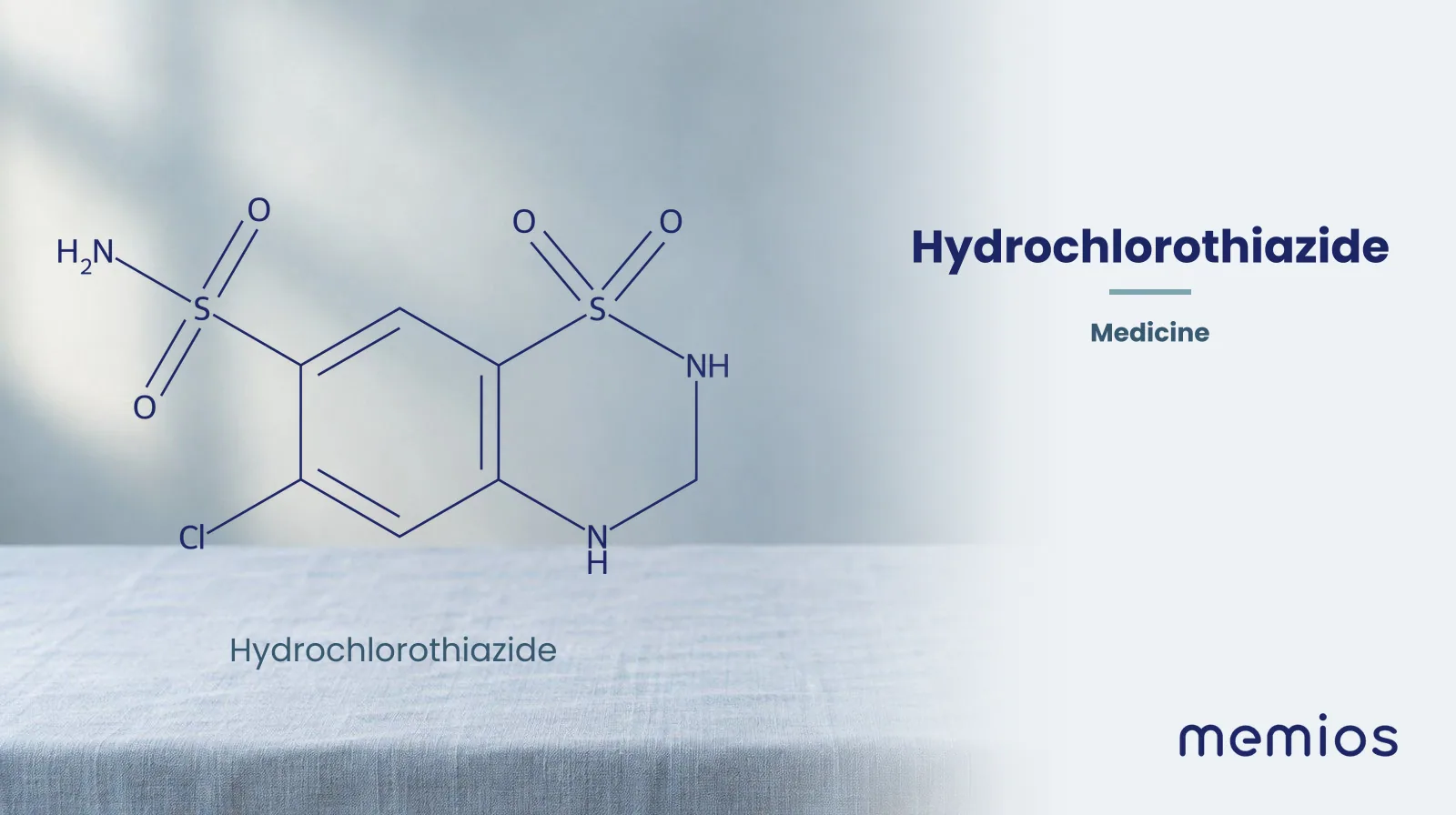
Hydrochlorothiazide
Hydrochlorothiazide lowers blood pressure, but the big outcome trial that made thiazides first-line, ALLHAT, used chlorthalidone, not hydrochlorothiazide.
TLDR
- Well established. Hydrochlorothiazide lowers blood pressure, but the big outcome trial that made thiazides first-line, ALLHAT, used chlorthalidone, not hydrochlorothiazide.
- What it is: Hydrochlorothiazide is a prescription thiazide diuretic (water pill) taken as a tablet or capsule, alone or combined with other blood pressure medicines.
- Main use: High blood pressure (well supported).
- Other approved uses: Oedema from heart failure, cirrhosis, or corticosteroid and oestrogen therapy (evidence not rated).
- Recommended dose (official position): Dosing is set by the prescriber. As a position, the generic label (revised April 2026) gives a usual starting dose of 25 mg daily for hypertension in adults.
- Studied dose (a trial dose, not a recommendation): The Diuretic Comparison Project compared hydrochlorothiazide 25 or 50 mg daily with chlorthalidone 12.5 or 25 mg daily (as reported in the AHA news release). Findings citing that trial: 1 on harm.
- Upper limit: As a position, the label says the hypertension dose may be increased to 50 mg daily.
- What goes wrong: 6 findings on harm. In the Diuretic Comparison Project, low potassium was somewhat more common with chlorthalidone than hydrochlorothiazide.
- Interactions: 4 recorded, including Lithium, NSAIDs (e.g. ibuprofen, naproxen), Alcohol (the label groups it with barbiturates and narcotics), Digoxin (digitalis), via low potassium.
- Common myth: ALLHAT proved hydrochlorothiazide is the best first blood pressure drug.
What it is
Hydrochlorothiazide is a prescription thiazide diuretic (water pill) taken as a tablet or capsule, alone or combined with other blood pressure medicines. It is one of the most prescribed blood pressure drugs in the world.
What the research says
Hydrochlorothiazide lowers blood pressure, but the big outcome trial that made thiazides first-line, ALLHAT, used chlorthalidone, not hydrochlorothiazide. A meta-analysis of 24-hour blood pressure found the usual 12.5-25 mg dose lowered pressure less than other drug classes. The 2022 Diuretic Comparison Project, a trial in about 13,500 older US veterans, found no difference in heart attacks, strokes, heart failure or non-cancer death between hydrochlorothiazide and chlorthalidone, and low potassium was a little more common with chlorthalidone. Harms include low sodium (about 3 in 10 continuing users in one cohort, highest in older women), low potassium, gout, a small rise in blood sugar, and, in Danish registry studies, a dose-related increase in non-melanoma skin cancer, mainly squamous cell carcinoma, which led to a 2020 FDA label change.
Evidence grade: Well established.
How it works
Drug class: Thiazide diuretic
Thiazides act on the kidney to increase the loss of salt and water in urine. The label states the exact way they lower blood pressure is not known. (Source 1)
What it is used for
- Thiazide-type diuretics prevent cardiovascular events (ALLHAT, using chlorthalidone), and HCTZ matched chlorthalidone for outcomes in the 2022 Diuretic Comparison Project; but at 12.5-25 mg HCTZ lowered 24-hour blood pressure less than other drug classes. Evidence: established. (Source 2)
- Approved on the label as add-on therapy; we did not reach trials for this use in this run. Evidence: unknown. (Source 1)
Interactions
- Lithium (label): Diuretics reduce lithium clearance, with a high risk of lithium toxicity. (Source 1)
- NSAIDs (e.g. ibuprofen, naproxen) (label): NSAIDs can blunt the diuretic and blood-pressure-lowering effects. (Source 1)
- Alcohol (the label groups it with barbiturates and narcotics) (label): Alcohol may worsen the drop in blood pressure on standing. (Source 1)
- Digoxin (digitalis), via low potassium (label): Thiazide-induced low potassium can cause abnormal heart rhythms and make the heart more sensitive to digitalis toxicity. (Source 1)
What goes wrong
In the Diuretic Comparison Project, low potassium was somewhat more common with chlorthalidone than hydrochlorothiazide. (Source 3)
- Randomized trial, Moderate certainty.
- Size: More than 13,500 veterans.
- Who: Older US veterans.
- How long: Median about 2.5 years.
- Result: Low potassium 6% chlorthalidone vs 4.4% HCTZ; hypokalaemia hospitalisation HR 1.35 (1.00 to 1.82)
- Funding: independent (VA Cooperative Studies Program)
in the chlorthalidone (6%) group vs. the hydrochlorothiazide group (4.4%)
In a Boston cohort, about 3 in 10 people who kept taking a thiazide developed low sodium, with a number needed to harm of about 15 over 5 years; hospitalisations for low sodium were not significantly increased. (Source 4)
- Cohort study, Low certainty.
- Size: 2,613 outpatients (220 on ongoing thiazide)
- Who: Adults newly treated for hypertension, 2 Boston teaching hospitals.
- How long: Up to 10 years.
- Result: 30% developed sodium ≤130 mmol/L; adjusted IRR 1.61 (1.15-2.25); NNH 15.02 over 5 years.
- Funding: not stated in the abstract we read.
Patients exposed to thiazides were more likely to develop hyponatremia (adjusted incidence rate ratio, 1.61; 95% confidence interval [CI], 1.15-2.25).
A 2026 Stockholm cohort of 159,080 adults found severe low sodium after starting a thiazide was concentrated in older women: 2.4% of women aged 80 or over developed severe hyponatraemia (reported via a university news release). (Source 5)
- Cohort study, Low certainty.
- Size: 159,080 adults.
- Who: Stockholm adults starting thiazides versus calcium channel blockers.
- How long: First 2 years of treatment.
- Result: Severe hyponatraemia 2.4% in women 80+; low risk in women under 65.
- Funding: not stated in the news release.
Limit of this finding: The release says 2.4% of women aged 80 or over developed severe low sodium and, in the next sentence, that this meant 'one in 53 people treated was affected'. Those two figures do not match: 2.4% is about 1 in 42. The '1 in 53' is most likely the extra risk compared with people given a calcium channel blocker (a number needed to harm), but the release does not say so. Read 2.4% as the share affected; do not read '1 in 53' as the absolute risk.
Among women aged 80 or over, 2.4 per cent developed severe hyponatraemia. For this group, this meant that one in 53 people treated was affected.
Current diuretic use was associated with more than double the risk of a first gout attack in people with hypertension (diuretics as a class, not HCTZ alone; association only). (Source 6)
- Case-control study, Low certainty.
- Size: 24,768 gout cases, 50,000 controls.
- Who: UK general practice patients aged 20-79.
- How long: 2000-2007.
- Result: Diuretics RR 2.36 (2.21 to 2.52)
- Funding: not stated in the text we captured.
0.81 (0.70 to 0.94) for losartan, 2.36 (2.21 to 2.52) for diuretics
In Danish national registries, high cumulative hydrochlorothiazide use was associated with a dose-related increase in non-melanoma skin cancer, both basal cell carcinoma (BCC) and, most strongly, squamous cell carcinoma (SCC); sun exposure was not measured. (Source 7)
- Case-control study, Low certainty.
- Size: Nationwide Danish NMSC cases 2004-2012 with 1:20 matched controls.
- Who: Danish adults.
- How long: HCTZ use 1995-2012.
- Result: ≥50,000 mg: OR 1.29 BCC, 3.98 SCC; ≥200,000 mg: OR 1.54 BCC, 7.38 SCC.
- Funding: not stated in the abstract we read.
the highest cumulative dose category (≥200,000 mg of HCTZ) had ORs of 1.54 (95% CI, 1.38-1.71) and 7.38 (95% CI, 6.32-8.60) for BCC and SCC, respectively
Position, 2020: the FDA asked that all hydrochlorothiazide-containing products add the non-melanoma skin cancer risk to their labeling (letter of April 7, 2020; Microzide approval August 20, 2020). (Source 8)
- Official position, Certainty not rated.
- Size: n/a.
- Who: n/a.
- How long: n/a.
- Result: n/a.
- Funding: n/a.
This information pertains to the risk of non-melanoma skin cancer associated with the use of hydrochlorothiazide.
What the evidence supports
In ALLHAT, the thiazide-type diuretic chlorthalidone was at least as good as amlodipine or lisinopril for heart attacks and better for some cardiovascular outcomes. This trial did not test hydrochlorothiazide. (Source 2)
- Randomized trial, High certainty.
- Size: 33,357 participants.
- Who: Adults 55+ with hypertension and another heart risk factor, North America.
- How long: Mean 4.9 years.
- Result: Primary outcome no different: RR 0.98 amlodipine and 0.99 lisinopril vs chlorthalidone; heart failure 10.2% vs 7.7% with amlodipine.
- Funding: independent (National Heart, Lung, and Blood Institute contract N01-HC-35130, per the Europe PMC grant record)
The primary outcome occurred in 2956 participants, with no difference between treatments.
What the evidence does not support
The 2022 Diuretic Comparison Project found no difference in major cardiovascular outcomes or non-cancer death between hydrochlorothiazide and chlorthalidone. (Source 9)
- Randomized trial, High certainty.
- Size: More than 13,500 US veterans aged 65+.
- Who: Older veterans already on hydrochlorothiazide, randomised to stay or switch.
- How long: Median about 2.5 years.
- Result: Primary composite 10.4% chlorthalidone vs 10.0% HCTZ (P=0.45)
- Funding: independent (VA Cooperative Studies Program)
The primary composite outcome occurred in 10.4% in the chlorthalidone group in comparison to 10.0% in the HCTZ group (P=0.45).
At the usual 12.5-25 mg dose, hydrochlorothiazide lowered 24-hour blood pressure less than ACE inhibitors, ARBs, beta-blockers and calcium antagonists. (Source 10)
- Meta-analysis, Moderate certainty.
- Size: 14 studies, 1,234 patients (12.5-25 mg); 5 studies, 229 patients (50 mg)
- Who: Adults with hypertension in head-to-head trials.
- How long: Trial durations.
- Result: HCTZ 12.5-25 mg: 6.5/4.5 mm Hg vs 11.0-13.3 systolic for other classes; 50 mg: 12.0/5.4 mm Hg.
- Funding: not stated in the abstract we read.
The antihypertensive efficacy of HCTZ in its daily dose of 12.5 to 25 mg as measured in head-to-head studies by ambulatory BP measurement is consistently inferior to that of all other drug classes.
A meta-analysis of 95 trials found thiazides raise fasting glucose only slightly, which the authors judged clinically unimportant. (Source 11)
- Meta-analysis, Moderate certainty.
- Size: 95 studies, 76,608 participants.
- Who: Adults in RCTs of thiazide or thiazide-like diuretics.
- How long: At least 4 weeks.
- Result: Weighted mean difference in fasting glucose 0.20 mmol/L (95% CI 0.15-0.25); I2 = 84%.
- Funding: not stated in the text we captured.
Thiazide diuretics have a small and clinically unimportant impact on FPG.
Where the research disagrees
Is hydrochlorothiazide a good first-line blood pressure drug?
- Messerli et al. 2011, meta-analysis of ambulatory blood pressure trials: Because outcome data at this dose are lacking, HCTZ is an inappropriate first-line drug for the treatment of hypertension. (Source 10)
- Diuretic Comparison Project (as summarised by NephJC), pragmatic RCT in about 13,500 older veterans: this study found no significant difference in major cardiovascular outcomes or non-cancer-related deaths between patients taking hydrochlorothiazide and those swapped to instead take chlorthalidone. (Source 9)
How much
- Reference intake: Dosing is set by the prescriber. As a position, the generic label (revised April 2026) gives a usual starting dose of 25 mg daily for hypertension in adults. (Source 1)
- Upper limit: As a position, the label says the hypertension dose may be increased to 50 mg daily. (Source 1)
- Studied: The Diuretic Comparison Project compared hydrochlorothiazide 25 or 50 mg daily with chlorthalidone 12.5 or 25 mg daily (as reported in the AHA news release). (Source 3)
- Studied: The ambulatory blood pressure meta-analysis compared HCTZ 12.5-25 mg and 50 mg daily with other drug classes. (Source 10)
A common belief, and what the research shows
The belief: ALLHAT proved hydrochlorothiazide is the best first blood pressure drug.
What the research shows: ALLHAT randomised people to 'chlorthalidone, 12.5 to 25 mg/d (n = 15 255)', not hydrochlorothiazide. As NephJC notes, 'Most of the trials which support the CV benefit of 'thiazides' have actually been with 'thiazide-like' diuretics'. The 2022 Diuretic Comparison Project later found no outcome difference between the two.
Questions and answers
What is it?
Hydrochlorothiazide (HCTZ) is a thiazide diuretic, or water pill, used mainly for high blood pressure. It is often combined in one tablet with other blood pressure drugs. (Source 12)
What does it do in the body?
It makes the kidneys pass more salt and water, which lowers blood pressure and reduces fluid build-up. The label says the exact way it lowers blood pressure is not known. (Source 1)
Is it good or bad for you?
It lowers blood pressure and matched chlorthalidone for heart outcomes in a 2022 trial, though at usual doses it lowers 24-hour pressure less than other drug classes. Harms include low sodium (especially in older women), low potassium, gout, a small glucose rise, and a dose-related rise in squamous cell skin cancer in Danish registry studies. (Source 7)
How do you get more of it?
Does not apply as a nutrient. It is a prescription medicine; as a position the label sets a usual starting dose, and dosing is decided by the prescriber. (Source 1)
If it is harmful, what reduces it?
The drug is cleared once stopped. Its unwanted effects on sodium are common: in one cohort about 3 in 10 continuing users developed low sodium, which is why blood tests are used to watch for it. We did not reach a study on stopping HCTZ. (Source 4)
Why might someone be low in it or missing it?
Does not apply: hydrochlorothiazide is not made by the body. It is prescribed for high blood pressure and fluid retention. (Source 1)
Which whole foods contain it or feed it?
No foods contain hydrochlorothiazide. The label's drug-interaction entry for alcohol, barbiturates or narcotics says they may worsen the drop in blood pressure on standing. (Source 1)
What happens if you do not have it?
Untreated high blood pressure raises heart and stroke risk; the ALLHAT trial found thiazide-type diuretics (chlorthalidone) prevented major cardiovascular disease at least as well as other first-step drugs. (Source 13)
How can you test for it?
There is no routine test for the drug itself; its effects are checked with blood tests for sodium and potassium. A cohort defined low sodium as a blood sodium of 130 mmol/L or less, and found it common in people who kept taking thiazides. (Source 4)
References
- DailyMed, US National Library of Medicine (FDA-approved generic label). Hydrochlorothiazide Tablets USP 12.5 mg, 25 mg and 50 mg, prescribing information (Revised April 1, 2026). 2026. Read the source
- JAMA. Major outcomes in high-risk hypertensive patients randomized to angiotensin-converting enzyme inhibitor or calcium channel blocker vs diuretic: The Antihypertensive and Lipid-Lowering Treatment to Prevent Heart Attack Trial (ALLHAT). 2002. PMID 12479763, DOI 10.1001/jama.288.23.2981. Read the source
- American Heart Association Newsroom. No difference in heart outcomes found in use of two diuretics to treat blood pressure (news release on the Diuretic Comparison Project). 2022. Read the source
- American Journal of Medicine. Risk of Thiazide-induced Hyponatremia in Patients with Hypertension. 2011. PMID 22017784, DOI 10.1016/j.amjmed.2011.06.031. Read the source
- Karolinska Institutet News. Thiazide diuretics increase the risk of low sodium levels in older people (news release on the Stockholm Sodium Cohort study, JAMA Network Open 2026). 2026. Read the source
- BMJ. Antihypertensive drugs and risk of incident gout among patients with hypertension: population based case-control study. 2012. DOI 10.1136/bmj.d8190. Read the source
- Journal of the American Academy of Dermatology. Hydrochlorothiazide use and risk of nonmelanoma skin cancer: A nationwide case-control study from Denmark. 2018. PMID 29217346, DOI 10.1016/j.jaad.2017.11.042. Read the source
- US Food and Drug Administration. Supplement approval letter, NDA 020504/S-026, Microzide (hydrochlorothiazide) 12.5 mg Tablets (dated August 20, 2020). 2020. Read the source
- NephJC. The Distal Convoluted Tubule Showdown: Chlorthalidone versus HCTZ (NephJC journal-club summary of the Diuretic Comparison Project, NEJM 2022). 2022. Read the source
- Journal of the American College of Cardiology. Antihypertensive Efficacy of Hydrochlorothiazide as Evaluated by Ambulatory Blood Pressure Monitoring: A Meta-Analysis of Randomized Trials. 2011. PMID 21272751, DOI 10.1016/j.jacc.2010.07.053. Read the source
- Journal of General Internal Medicine. Thiazide Diuretic–Induced Change in Fasting Plasma Glucose: a Meta-analysis of Randomized Clinical Trials. 2020. PMID 32157653, DOI 10.1007/s11606-020-05731-3. Read the source
- Journal of the American College of Cardiology. Antihypertensive Efficacy of Hydrochlorothiazide as Evaluated by Ambulatory Blood Pressure Monitoring: A Meta-Analysis of Randomized Trials. 2011. PMID 21272751, DOI 10.1016/j.jacc.2010.07.053. Read the source
- JAMA. Major outcomes in high-risk hypertensive patients randomized to angiotensin-converting enzyme inhibitor or calcium channel blocker vs diuretic: The Antihypertensive and Lipid-Lowering Treatment to Prevent Heart Attack Trial (ALLHAT). 2002. PMID 12479763, DOI 10.1001/jama.288.23.2981. Read the source