Supplements · September 29, 2026 · Memios · 13 min read
Horse chestnut
Horse chestnut seed extract is one of the better-supported herbal treatments for one narrow purpose: the leg symptoms of chronic venous insufficiency.
TLDR
- Limited evidence. Horse chestnut seed extract is one of the better-supported herbal treatments for one narrow purpose: the leg symptoms of chronic venous insufficiency.
- What it is: Horse chestnut is a large tree commonly planted along roads and in parks.
- Main use, supported: A Cochrane review found that horse chestnut seed extract reduced the signs and symptoms of chronic venous insufficiency compared with placebo. (low certainty)
- Other use, supported: Pooled data from six placebo-controlled trials showed a reduction in leg volume with horse chestnut seed extract. (low certainty)
- Claim NOT supported by research: For uses other than chronic venous insufficiency, such as male infertility and irritable bowel syndrome, NCCIH holds that the research does not allow conclusions.
- Recommended dose: not established. No dietary reference intake exists. Horse chestnut is not an essential nutrient; NCCIH describes it only as a supplement studied for chronic venous insufficiency.
- Studied dose (a trial dose, not a recommendation): The 2012 Cochrane review pooled 17 randomised trials of oral horse chestnut seed extract standardised to escin, given short-term against placebo or reference therapy. Findings citing that trial: 2 for, 1 mixed.
- Upper limit: No tolerable upper intake level or acceptable daily intake has been set.
- What goes wrong: 6 findings on harm. Adverse events reported across 14 trials of horse chestnut seed extract were mild and infrequent, and six of those trials listed gastrointestinal complaints, dizziness, nausea, headache and itching.
- Common myth: Conkers are just a kind of chestnut, so horse chestnut is a food you can eat.
What it is
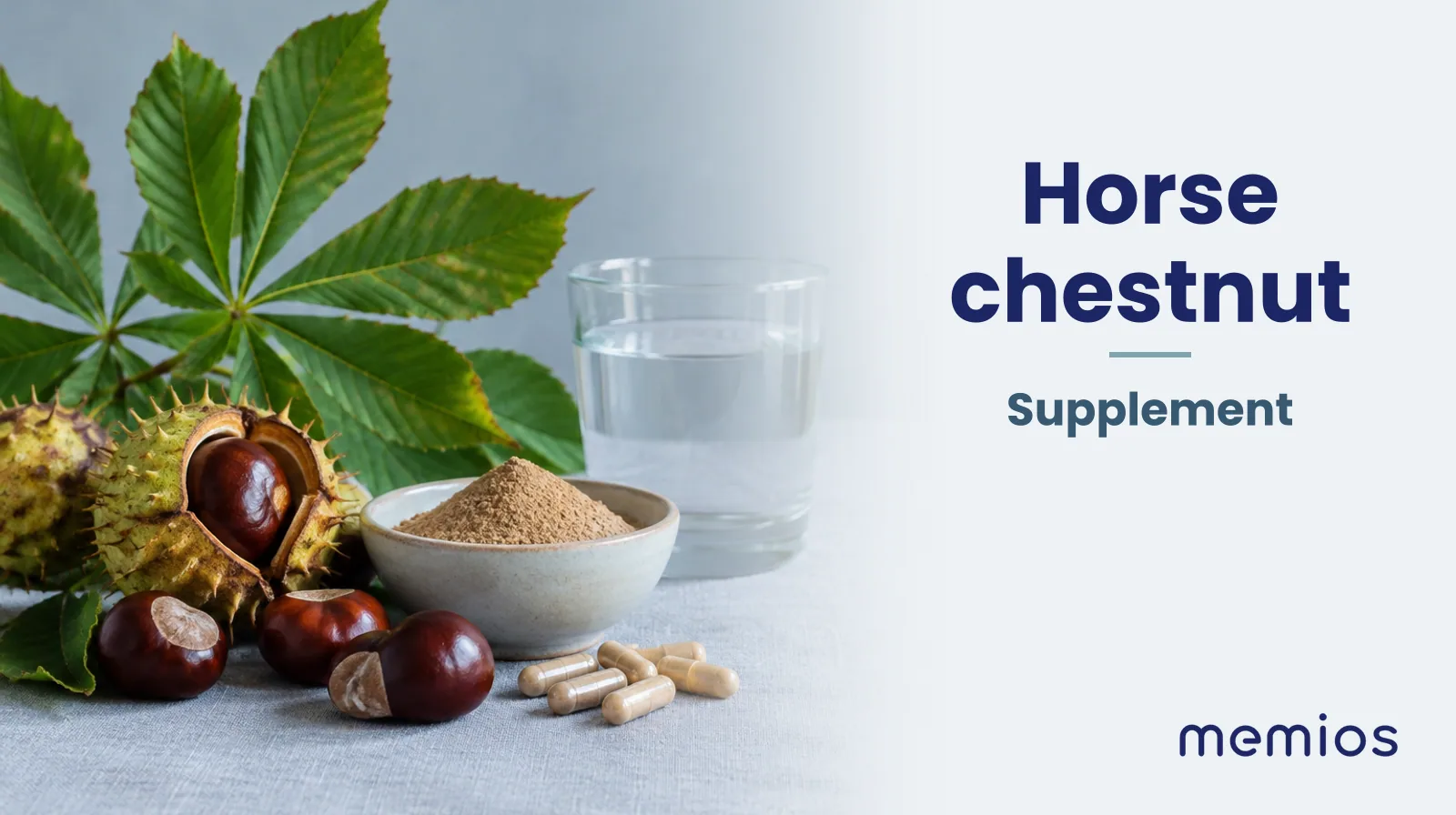
Horse chestnut is a large tree commonly planted along roads and in parks. Its seed, the conker, looks much like an edible sweet chestnut, which is how accidental poisonings happen. The supplement is an extract of the seed, standardised to a mixture of saponins called aescin or escin. NCCIH states that the raw seeds, bark, flowers and leaves are unsafe taken by mouth because they contain a toxic component, so the products studied in trials are processed extracts rather than the raw plant.
What the research says
Horse chestnut seed extract is one of the better-supported herbal treatments for one narrow purpose: the leg symptoms of chronic venous insufficiency. A Cochrane review of 17 randomised trials found reductions in leg pain and leg volume against placebo, and one trial suggested it may work about as well as compression stockings. The same reviewers said the trial base has caveats and that larger definitive trials are still needed. Adverse events across 14 trials were mild and infrequent. For anything else, including male infertility and irritable bowel syndrome, NCCIH says there is not enough information. The unprocessed seed is a different matter: eating conkers has caused gastrointestinal symptoms, raised liver and pancreatic enzymes and atrial fibrillation in a reported case.
Evidence grade: Limited evidence.
What goes wrong
Adverse events reported across 14 trials of horse chestnut seed extract were mild and infrequent, and six of those trials listed gastrointestinal complaints, dizziness, nausea, headache and itching. (Source 1)
- Systematic review, Low certainty.
- Size: 14 trials reporting adverse events.
- Who: people with chronic venous insufficiency taking oral HCSE.
- How long: short-term trials.
- Result: no rates given on the page retrieved; events characterised as mild and infrequent, with the symptom list drawn from six of the 14 trials that reported adverse events.
- Funding: not stated in the summary retrieved.
The adverse events reported (14 trials) were mild and infrequent. They included gastrointestinal complaints, dizziness, nausea, headache and pruritus, from six studies.
Eating the raw seed caused acute illness in a reported case, with abdominal symptoms, raised liver and pancreatic enzymes and atrial fibrillation. (Source 2)
- Case report, Very low certainty.
- Size: 1 patient.
- Who: a previously well 46-year-old man who ate horse chestnut seed mistaking it for Korean chestnut.
- How long: symptoms resolved by the following day.
- Result: epigastric pain, nausea and sweating; slight rises in liver enzymes, serum amylase and pancreatic amylase; atrial fibrillation on ECG; normal tests the next day after conservative treatment.
- Funding: not stated in the abstract retrieved.
He visited the emergency department (ED) with complaints of epigastric pain, nausea, and sweating. Blood tests showed a slight increase in the levels of liver enzymes, serum amylase, and pancreatic amylase. During the monitoring, he complained of palpitations, and electrocardiogram showed atrial fibrillation.
Serious toxicity from eating horse chestnut seed is reported only rarely in the literature. (Source 2)
- Case report, Very low certainty.
- Size: 1 case, with the authors' statement about the wider literature.
- Who: people who eat horse chestnut seed by mistake.
- How long: not applicable.
- Result: no incidence figure; the authors state such reports are very rare.
- Funding: not stated in the abstract retrieved.
However, reports of the side effects and toxicity from ingestion are very rare.
The European Medicines Agency's herbal assessment recorded only a handful of mild adverse effect reports across a very large number of dispensed daily doses. (Source 3)
- Official position, Certainty not rated.
- Size: post-marketing surveillance covering 447,681,250 daily doses, 1968-1988; plus three observational studies totalling 10,725 patients.
- Who: patients taking standardised horse chestnut seed extract preparations.
- How long: surveillance over two decades.
- Result: 15 cases of mild adverse effects reported in post-marketing surveillance; mild adverse event rate 1.51% (95% CI 1.29 to 1.76%) across the three observational studies, per the assessment report.
- Funding: European regulator.
Only 15 cases of mild adverse effects were reported
NCCIH states that the raw seeds, bark, flowers and leaves of horse chestnut are unsafe taken by mouth because they contain a toxic component. (Source 4)
- Official position, Certainty not rated.
- Size: not applicable; agency summary.
- Who: general public.
- How long: position current as of April 2025.
- Result: no rates given; a categorical statement that the unprocessed plant is unsafe orally.
- Funding: US government agency.
The raw seeds, bark, flowers, and leaves of horse chestnut are unsafe when used orally because they contain a toxic component.
Side effects attributed to horse chestnut seed extract in NCCIH's summary are dizziness, digestive upset, headache and itching. (Source 5)
- Official position, Certainty not rated.
- Size: not applicable; agency summary.
- Who: people taking standardised horse chestnut seed extract.
- How long: position current as of April 2025.
- Result: no rates given.
- Funding: US government agency.
dizziness, digestive upsets, headache, and itching in some people.
What the evidence supports
A Cochrane review found that horse chestnut seed extract reduced the signs and symptoms of chronic venous insufficiency compared with placebo. (Source 6)
- Systematic review, Low certainty.
- Size: 17 randomised controlled trials; leg pain assessed in seven placebo-controlled trials.
- Who: people with chronic venous insufficiency.
- How long: short-term treatment; the review's conclusion is limited to short-term use.
- Result: six of seven placebo-controlled trials reported significant leg pain reduction; one trial gave a weighted mean difference of 42.4 mm (95% CI 34.9 to 49.9) on a 100 mm visual analogue scale.
- Funding: not stated; the review notes manufacturers were contacted for published and unpublished material.
Overall, there appeared to be an improvement in CVI related signs and symptoms with HCSE compared with placebo.
Pooled data from six placebo-controlled trials showed a reduction in leg volume with horse chestnut seed extract. (Source 6)
- Meta-analysis, Low certainty.
- Size: six trials, 502 participants.
- Who: people with chronic venous insufficiency.
- How long: short-term trials.
- Result: weighted mean difference 32.1 ml, 95% CI 13.49 to 50.72, in favour of HCSE.
- Funding: not stated in the abstract retrieved.
Six trials (n = 502) suggested a WMD of 32.1ml (95% CI 13.49 to 50.72) in favour of HCSE compared with placebo.
What the evidence does not support
For uses other than chronic venous insufficiency, such as male infertility and irritable bowel syndrome, NCCIH holds that the research does not allow conclusions. (Source 7)
- Official position, Certainty not rated.
- Size: not applicable; agency summary.
- Who: general public.
- How long: position current as of April 2025.
- Result: no numbers; an explicit statement of insufficient information.
- Funding: US government agency.
there's not enough information to draw definite conclusions
Where the evidence is mixed
One trial in the Cochrane review suggested horse chestnut seed extract may be about as effective as compression stockings, and adverse events across the review were usually mild and infrequent. (Source 6)
- Systematic review, Low certainty.
- Size: one comparative trial within a review of 17 trials.
- Who: people with chronic venous insufficiency.
- How long: short-term.
- Result: no numbers reported for the stockings comparison in the abstract retrieved.
- Funding: not stated in the abstract retrieved.
One trial indicated that HCSE may be as effective as treatment with compression stockings. Adverse events were usually mild and infrequent.
The Cochrane reviewers qualified their own positive conclusion, saying caveats remain and larger definitive trials are needed to confirm efficacy. (Source 8)
- Systematic review, Low certainty.
- Size: 17 trials.
- Who: people with chronic venous insufficiency.
- How long: short-term treatment only.
- Result: no effect size; a statement about the limits of the evidence base.
- Funding: not stated in the abstract retrieved.
However, several caveats exist and larger, definitive RCTs are required to confirm the efficacy of this treatment option.
Where the research disagrees
How firm the case for horse chestnut seed extract in chronic venous insufficiency is
- Cochrane review authors (2012), systematic review of 17 randomised trials, most small and short: "Overall, there appeared to be an improvement in CVI related signs and symptoms with HCSE compared with placebo." (Source 6)
- The same Cochrane review authors, on their own evidence, systematic review; authors' stated limitation: "However, several caveats exist and larger, definitive RCTs are required to confirm the efficacy of this treatment option." (Source 8)
- NCCIH (April 2025), agency position citing the same review, while stressing the need for more rigorous large trials: "A 2012 systematic review of 17 studies suggested that horse chestnut seed extract can improve symptoms of CVI." (Source 9)
How much
- Reference intake: No dietary reference intake exists. Horse chestnut is not an essential nutrient; NCCIH describes it only as a supplement studied for chronic venous insufficiency. (Source 9)
- Upper limit: No tolerable upper intake level or acceptable daily intake has been set. NCCIH (April 2025) says standardised extracts with the toxic components removed have been used safely in research studies for up to 12 weeks, and that the raw seed, bark, flowers and leaves are unsafe by mouth. (Source 4)
- Studied: The 2012 Cochrane review pooled 17 randomised trials of oral horse chestnut seed extract standardised to escin, given short-term against placebo or reference therapy. (Source 6)
- Studied: The EMA herbal assessment (16 July 2009) covers standardised horse chestnut seed extract preparations in oral dosage forms for chronic venous insufficiency. (Source 3)
A common belief, and what the research shows
The belief: Conkers are just a kind of chestnut, so horse chestnut is a food you can eat.
What the research shows: They are not interchangeable, and confusing them causes poisoning. A case report notes that "The shape of the fruit is very similar to that of the edible Korean chestnut (Castanea crenata); thus, people can eat it by mistake." The man in that report developed "epigastric pain, nausea, and sweating" with raised liver and pancreatic enzymes and atrial fibrillation. NCCIH states that "The raw seeds, bark, flowers, and leaves of horse chestnut are unsafe when used orally because they contain a toxic component." Only processed, standardised seed extracts have been tested in trials.
Questions and answers
What is it?
Horse chestnut is a large tree common along roads and in parks, and its seed is the conker. The seed looks very like an edible chestnut, which is why people sometimes eat it by mistake. The supplement sold as horse chestnut is a processed extract of the seed, standardised to saponins called aescin or escin. (Source 2)
What does it do in the body?
In randomised trials in people with chronic venous insufficiency, the seed extract reduced leg pain and leg volume compared with placebo. Pooled leg volume across six trials fell by about 32 ml. The reviewers treated this as evidence for short-term symptom relief, not a cure for the underlying vein disease. (Source 6)
Is it good or bad for you?
It depends entirely on the form. Processed, standardised seed extract was judged efficacious and safe for short-term use in chronic venous insufficiency, with mild and infrequent side effects. The raw seed, bark, flowers and leaves are a different matter and are described as unsafe by mouth. (Source 8)
How do you get more of it?
Only as a manufactured extract. The trials in the Cochrane review used oral horse chestnut seed extract standardised to escin, taken short-term; the extract exists because the toxic components of the raw seed have to be removed first. This describes what was studied, not a recommendation. (Source 10)
If it is harmful, what reduces it?
In the reported poisoning case, no antidote or elimination treatment was used: the man was managed conservatively and his blood tests and ECG were normal the next day. For the extract, the recorded side effects were mild and infrequent, which implies they settle on stopping. (Source 2)
Why might someone be low in it or missing it?
Nobody is low in horse chestnut. It is not a nutrient and has no normal level in the body, so there is no deficiency to explain. A person simply has none unless they are taking a horse chestnut product. (Source 10)
Which whole foods contain it or feed it?
None. Unlike the sweet chestnut it resembles, the horse chestnut seed is not a food: NCCIH states the raw seeds, bark, flowers and leaves are unsafe taken by mouth because they contain a toxic component. The only forms with human trial evidence are processed extracts. (Source 4)
What happens if you do not have it?
Nothing happens, because it is not an essential substance. Not taking horse chestnut extract simply means forgoing whatever short-term leg symptom relief the trials suggest, and the reviewers themselves said larger definitive trials are still needed to confirm that effect. (Source 8)
How can you test for it?
There is no validated test of horse chestnut or aescin status in a person, and none would be meaningful since it is not a nutrient. What was measured in trials was the outcome instead: leg volume, leg circumference and pain scores on visual analogue scales. (Source 6)
We searched: WebSearch and WebFetch for aescin or escin biomarker and horse chestnut status testing, plus the 2012 Cochrane review, the EMA assessment report and the NCCIH horse chestnut page; only clinical outcome measures were described, no test of body levels
References
- Cochrane Database of Systematic Reviews / cochrane.org. Horse chestnut seed extract for long-term or chronic venous insufficiency (adverse events, review summary page). 2012. PMID 23152216, DOI 10.1002/14651858.CD003230.pub4. Read the source
- Clinical and Experimental Emergency Medicine. Poisoning due to consumption of horse chestnut seed. 2021. DOI 10.15441/ceem.20.004. Read the source
- Committee on Herbal Medicinal Products (HMPC), European Medicines Agency; document dated 16 July 2009, marked superseded. Assessment report on Aesculus hippocastanum L., semen (post-marketing surveillance of adverse effects). 2009. Read the source
- National Center for Complementary and Integrative Health, US National Institutes of Health. Horse Chestnut: Usefulness and Safety (raw seed toxicity). 2025. Read the source
- National Center for Complementary and Integrative Health, US National Institutes of Health. Horse Chestnut: Usefulness and Safety (side effects). 2025. Read the source
- Cochrane Database of Systematic Reviews (abstract retrieved via the Europe PMC REST API). Horse chestnut seed extract for chronic venous insufficiency (main results). 2012. PMID 23152216, DOI 10.1002/14651858.CD003230.pub4. Read the source
- National Center for Complementary and Integrative Health, US National Institutes of Health. Horse Chestnut: Usefulness and Safety (other uses). 2025. Read the source
- Cochrane Database of Systematic Reviews (abstract retrieved via the Europe PMC REST API). Horse chestnut seed extract for chronic venous insufficiency (authors' conclusions). 2012. PMID 23152216, DOI 10.1002/14651858.CD003230.pub4. Read the source
- National Center for Complementary and Integrative Health, US National Institutes of Health. Horse Chestnut: Usefulness and Safety (what the science says). 2025. Read the source
- Cochrane Database of Systematic Reviews (abstract retrieved via the Europe PMC REST API). Horse chestnut seed extract for chronic venous insufficiency (background and objectives). 2012. PMID 23152216, DOI 10.1002/14651858.CD003230.pub4. Read the source