Supplements · September 29, 2026 · Memios · 11 min read
HMB
Limited evidence. The evidence points in different directions depending on who takes it.
TLDR
- Limited evidence. The evidence points in different directions depending on who takes it.
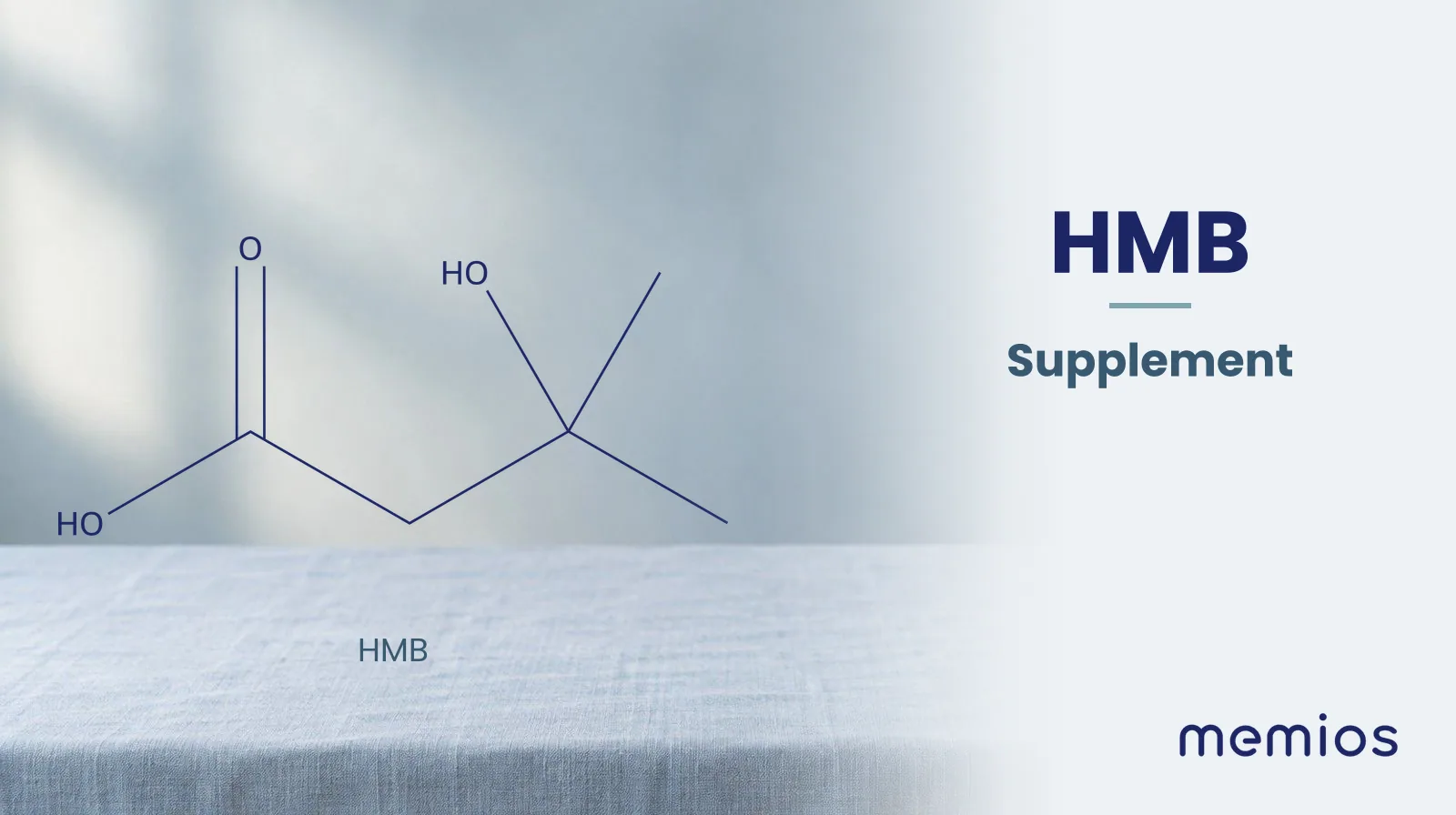
- What it is: HMB is a small molecule the body makes when it breaks down the amino acid leucine, and it occurs naturally in humans and other animals.
- Main use, supported: Pooled across 21 randomised trials in adults over 50, oral HMB produced small improvements in muscle mass, strength and physical function. (low certainty)
- Claim NOT supported by research: In trained and competitive athletes, a meta-analysis of six randomised trials found no effect of HMB on strength or body composition, with trivial effect sizes across every outcome. (low certainty)
- Another claim NOT supported: A GRADE-assessed meta-analysis of 10 randomised trials found no significant effect of HMB on any blood lipid fraction, and rated the certainty of that evidence as moderate to low. (low certainty)
- Recommended dose: not established. No reference intake exists. HMB is a metabolite the body produces from leucine rather than a nutrient that has to be eaten, so no body has set an RDA or adequate intake for it.
- Studied dose (a trial dose, not a recommendation): NIH ODS describes pooled safety data at daily intakes of 3 g for 3 to 8 weeks, and a randomised study giving about 3-6 g/day to untrained males aged 18-29. No finding here cites that trial.
- Upper limit: No upper limit has been set by any authority we could reach.
- Common myth: HMB is a proven muscle builder for anyone who lifts weights.
What it is
HMB is a small molecule the body makes when it breaks down the amino acid leucine, and it occurs naturally in humans and other animals. Supplements sell it in two forms: calcium HMB and a free acid form, which appear in the bloodstream at different rates. It is a metabolite rather than an essential nutrient, so there is no dietary requirement for it. Trials have typically given 3 g a day, or about 38 mg per kg of body weight.
What the research says
The evidence points in different directions depending on who takes it. Pooled across 21 randomised trials in people over 50, HMB produced small improvements in muscle mass, grip strength, chair-stand time and gait speed. Pooled across six randomised trials in trained and competitive athletes, it did nothing measurable to strength or body composition. A GRADE-assessed meta-analysis found no effect on blood lipids, on moderate-to-low certainty evidence. Safety data over months to a year have been reassuring in adults, but have not been collected in adolescents.
Evidence grade: Limited evidence.
What the evidence supports
Pooled across 21 randomised trials in adults over 50, oral HMB produced small improvements in muscle mass, strength and physical function. (Source 1)
- Meta-analysis, Low certainty.
- Size: 21 RCTs, 1935 participants.
- Who: Adults all over the age of 50.
- How long: Subgroup analysis favoured supplementation lasting more than 12 weeks.
- Result: Appendicular skeletal muscle mass WMD = 1.56 kg, 95% CI 0.03-3.09 kg; lean mass WMD = 0.28 kg, 95% CI 0.16-0.41 kg; handgrip strength WMD = 0.54 kg, 95% CI 0.04-1.04 kg; five-time chair stand WMD = -0.73 s, 95% CI -1.35 to -0.11 s; gait speed WMD = 0.06 m/s, 95% CI 0.01-0.10 m/s.
- Funding: not stated.
Limit of this finding: The headline muscle-mass number is much weaker than it looks. Appendicular skeletal muscle mass rose by 1.56 kg on average, but its 95% confidence interval runs from 0.03 kg to 3.09 kg, so the same data are also consistent with a gain of 30 grams, which would mean nothing to anyone. The other results are statistically significant but small in everyday terms: 0.28 kg of lean mass, 0.54 kg of grip strength, 0.06 m/s of walking speed. This is a modest average effect in people over 50, not a reason to expect a visible change.
A total of 21 RCTs were included, involving 1935 participants, all of them were > 50 years old.
What the evidence does not support
In trained and competitive athletes, a meta-analysis of six randomised trials found no effect of HMB on strength or body composition, with trivial effect sizes across every outcome. (Source 2)
- Meta-analysis, Low certainty.
- Size: 6 studies, 193 participants.
- Who: Trained and competitive athletes.
- How long: Varied; results unchanged when analysed by duration subgroup.
- Result: Bench press ES=0.00, leg press ES=0.09, body mass ES=-0.01, fat-free mass ES=0.16, fat mass ES=-0.20; all p>0.05, heterogeneity I2=0.0%.
- Funding: not stated.
HMB supplementation interventions present a trivial non-significant ES in all variables studied (bench press ES=0.00, leg press ES=0.09, body mass ES=-0.01, fat-free mass ES=0.16, and fat mass ES=-0.20
A GRADE-assessed meta-analysis of 10 randomised trials found no significant effect of HMB on any blood lipid fraction, and rated the certainty of that evidence as moderate to low. (Source 3)
- Meta-analysis, Low certainty.
- Size: 10 RCTs, 421 participants.
- Who: Adults.
- How long: not stated in the abstract.
- Result: Total cholesterol WMD -2.26 mg/dL, 95% CI -6.11 to 1.58, p = 0.25; triglyceride WMD -2.83 mg/dL, 95% CI -12.93 to 7.27, p = 0.58; LDL-C WMD 0.13 mg/dL, 95% CI -3.02 to 3.28, p = 0.94; HDL-C WMD -0.78 mg/dL, 95% CI -2.04 to 0.48, p = 0.22. Certainty moderate for LDL-C and HDL-C, low for TG and TC.
- Funding: not stated.
The GRADE analysis demonstrated that the quality of evidence about the effect of HMB supplementation on LDL-C and HDL-C levels was identified as moderate due to the presence of serious limitations in imprecision.
Where the evidence is mixed
The International Society of Sports Nutrition stated in its 2025 position stand that HMB's benefits in trained athletes are mixed, in contrast to untrained individuals. (Source 4)
- Official position, Certainty not rated.
- Size: Society position stand based on a literature analysis; 12 points approved by its Research Committee.
- Who: Exercising adults across age, sex and training status.
- How long: Position stand notes performance benefits increase with study duration longer than 6 weeks.
- Result: Daily supplementation of 38 mg/kg body weight with exercise training is the dose the society describes as improving body composition.
- Funding: International Society of Sports Nutrition.
Limit of this finding: This is a position stand from a sports nutrition society whose funding and membership overlap with the supplement industry, not an independent systematic review. Its more favourable point 7, on body composition at 38 mg/kg body weight a day, only reads honestly alongside this point 8, where the society itself concedes the performance evidence in trained athletes is mixed.
HMB may improve strength and power in untrained individuals, but its performance benefits in trained athletes are mixed and increase with an increase in study duration (>6 weeks).
What official bodies say
NIH Office of Dietary Supplements reports that a review of nine studies found HMB well tolerated at 3 g a day with no adverse effects on blood chemistry, haematology or emotional affect, but that its safety has not been studied in adolescents. (Source 5)
- Official position, Certainty not rated.
- Size: A review of safety data from nine studies, plus a randomised study of 37 untrained males aged 18-29.
- Who: Younger adults aged 18-47 and older adults aged 62-81, of both sexes, exercising and not exercising.
- How long: 3 to 8 weeks in the pooled safety data.
- Result: No adverse effects on blood chemistry, hematology or emotional affect; no alteration of hematologic, hepatic or renal-function parameters at about 3-6 g/day.
- Funding: US National Institutes of Health.
Although 3 g/day HMB appears to be safe for short-term use in adults, its safety profile (and efficacy) has not been studied in adolescents.
Where the research disagrees
Whether HMB helps trained athletes
- Authors of the 2018 athlete meta-analysis, meta-analysis of 6 randomised trials in 193 athletes: HMB supplementation interventions present a trivial non-significant ES in all variables studied (bench press ES=0.00, leg press ES=0.09, body mass ES=-0.01, fat-free mass ES=0.16, and fat mass ES=-0.20 (Source 2)
- International Society of Sports Nutrition, 2025 position stand, society position stand from a literature analysis: HMB may improve strength and power in untrained individuals, but its performance benefits in trained athletes are mixed and increase with an increase in study duration (>6 weeks). (Source 4)
How much
- Reference intake: No reference intake exists. HMB is a metabolite the body produces from leucine rather than a nutrient that has to be eaten, so no body has set an RDA or adequate intake for it. (Source 6)
- Upper limit: No upper limit has been set by any authority we could reach. The International Society of Sports Nutrition stated in 2025 that the available safety and toxicity data suggest chronic oral consumption of both forms is safe for up to at least one year, which is a safety statement rather than a limit. (Source 6)
- Studied: NIH ODS describes pooled safety data at daily intakes of 3 g for 3 to 8 weeks, and a randomised study giving about 3-6 g/day to untrained males aged 18-29. (Source 5)
- Studied: The ISSN 2025 position stand describes daily supplementation of 38 mg/kg body weight combined with exercise training. (Source 4)
A common belief, and what the research shows
The belief: HMB is a proven muscle builder for anyone who lifts weights.
What the research shows: The clearest signal is in people over 50, where 21 trials in 1935 participants produced small gains: lean mass WMD = 0.28 kg, 95% CI: 0.16–0.41 kg. In trained athletes the pooled result was nothing: "HMB supplementation interventions present a trivial non-significant ES in all variables studied (bench press ES=0.00, leg press ES=0.09, body mass ES=-0.01, fat-free mass ES=0.16, and fat mass ES=-0.20". Training status, not the supplement, is what changes the answer.
Questions and answers
What is it?
HMB is beta-hydroxy-beta-methylbutyrate, a substance the body makes when it breaks down the amino acid leucine. It occurs naturally in humans and other animals. Supplements come as calcium HMB or as a free acid form, which enter the bloodstream at somewhat different rates. (Source 6)
What does it do in the body?
The proposed mechanism is that HMB both increases the rate at which muscle protein is built and slows the rate at which it is broken down. The society describing this also attributes possible anti-inflammatory effects to it. These are mechanistic claims; whether they produce a measurable change depends heavily on the population studied. (Source 6)
Is it good or bad for you?
Context decides. In adults over 50, pooled trials show small improvements in muscle mass, grip strength, chair-stand time and walking speed. In trained athletes, pooled trials show no effect on strength or body composition. Reported safety over weeks to a year is good in adults, and untested in adolescents. (Source 1)
How do you get more of it?
The body makes HMB from leucine, so protein intake supplies the raw material. Trials have used supplements rather than food, typically 3 g a day for 3 to 8 weeks in the pooled safety data, or about 38 mg per kg of body weight alongside exercise training in the dose the sports nutrition society describes. This records what studies did; it is not advice. (Source 5)
If it is harmful, what reduces it?
Does not apply in the usual sense. HMB is a normal product of leucine metabolism and no source we found describes it as something to be reduced or removed. The bodies that have reviewed its safety report tolerability rather than a need to lower it; stopping a supplement simply returns intake to what the body makes itself. (Source 6)
Why might someone be low in it or missing it?
There is no recognised deficiency of HMB, because the body produces it continuously from dietary leucine and no intake requirement has been set. We looked in the 2025 society position stand, the NIH fact sheet and the meta-analyses for any description of low HMB status, its causes or how it would be identified, and none of them describes one. (Source 6)
We searched: Searched the ISSN 2025 position stand, the NIH ODS exercise and athletic performance fact sheet, and the 2025 and 2018 meta-analyses for any account of HMB deficiency or low status.
Which whole foods contain it or feed it?
No source we reached quantifies HMB in whole foods. What the literature does say is that the body produces HMB itself from the amino acid leucine, which comes from dietary protein, so protein-containing foods supply the precursor rather than HMB itself. The trials all used supplements, not food, so there is no food-based comparison to report. (Source 6)
We searched: Searched the ISSN 2025 position stand, the NIH ODS fact sheet and the included meta-analyses for HMB content of foods or dietary HMB intake figures; none reports them.
What happens if you do not have it?
Nothing identifiable. Because HMB is made in the body from leucine and no requirement has been established, the literature describes no consequence of going without supplemental HMB. What the trials measure is whether adding extra changes an outcome, and in trained athletes the pooled answer was that it did not. (Source 2)
How can you test for it?
No validated clinical test for HMB status exists in the literature we searched. Blood HMB can be measured in research settings, which is how the two supplement forms were compared for how much reaches the bloodstream, but that is a research measurement of a dose, not a test of whether someone is low or would benefit. (Source 6)
We searched: Searched the ISSN 2025 position stand, the NIH ODS fact sheet and the meta-analyses for a validated assay, reference range or diagnostic test for HMB status; only research-setting bloodstream appearance comparisons were found.
References
- Frontiers in Nutrition. Effects of oral supplementation of beta-hydroxy-beta-methylbutyrate on muscle mass and strength in individuals over the age of 50: a meta-analysis. 2025. DOI 10.3389/fnut.2025.1522287. Read the source
- Journal of Science and Medicine in Sport. Effects of beta-hydroxy-beta-methylbutyrate supplementation on strength and body composition in trained and competitive athletes: A meta-analysis of randomized controlled trials. 2018. PMID 29249685, DOI 10.1016/j.jsams.2017.11.003. Read the source
- Frontiers in Nutrition. Effects of beta-hydroxy-beta-methylbutyrate (HMB) supplementation on lipid profile in adults: a GRADE-assessed systematic review and meta-analysis of randomized controlled trials. 2024. DOI 10.3389/fnut.2024.1451282. Read the source
- Journal of the International Society of Sports Nutrition. International society of sports nutrition position stand: beta-hydroxy-beta-methylbutyrate (HMB), points 7 and 8. 2025. PMID 39699070, DOI 10.1080/15502783.2024.2434734. Read the source
- National Institutes of Health Office of Dietary Supplements. Dietary Supplements for Exercise and Athletic Performance: Fact Sheet for Health Professionals, beta-hydroxy-beta-methylbutyrate (HMB) safety section. not stated on the page as fetched. Read the source
- Journal of the International Society of Sports Nutrition. International society of sports nutrition position stand: beta-hydroxy-beta-methylbutyrate (HMB), points 1 to 5. 2025. PMID 39699070, DOI 10.1080/15502783.2024.2434734. Read the source