Supplements · September 30, 2026 · Memios · 13 min read
Gymnema
The best evidence is a handful of small, heterogeneous trials in people with type 2 diabetes.
TLDR
- Limited evidence. The best evidence is a handful of small, heterogeneous trials in people with type 2 diabetes, pooled in two 2021-2022 meta-analyses that both report reductions in fasting glucose and lipids but both describe the underlying studies as low quality.
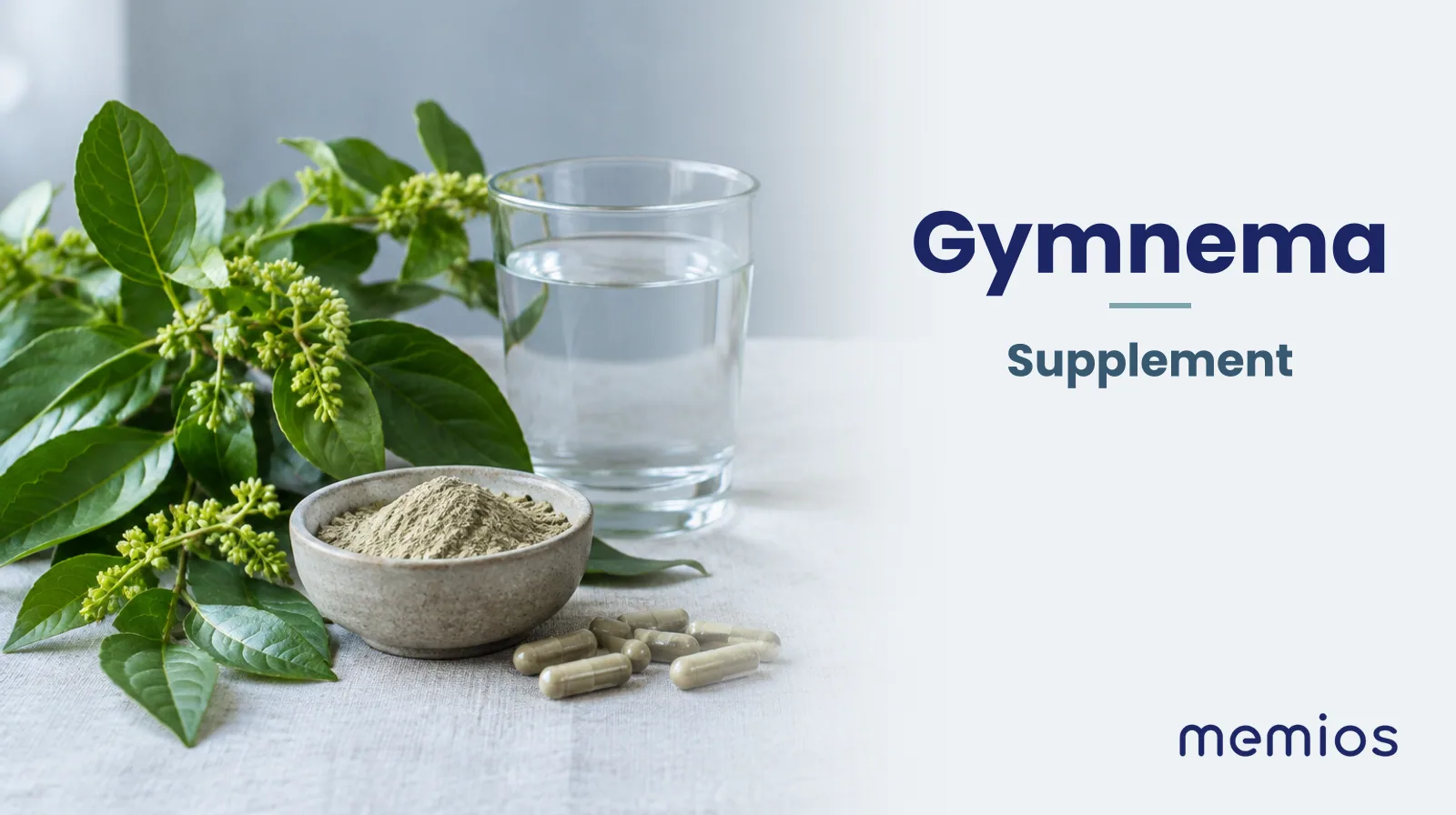
- What it is: Gymnema is a climbing vine whose leaves, fruits and seeds have a long history of use in traditional medicine in Asia, Africa and Australia.
- Main use, supported: A 2022 meta-analysis restricted to randomised controlled trials found statistically significant reductions in triglycerides, total cholesterol, LDL, fasting blood sugar and diastolic blood pressure. (low certainty)
- Other use, supported: A 2021 meta-analysis of 10 studies in type 2 diabetes reported reductions in fasting glucose, post-prandial glucose and HbA1c. (very low certainty)
- Claim NOT supported by research: In a three-month randomised comparison in adults with obesity, gymnema's significant changes were confined to fasting glucose and resistin gene expression. (low certainty)
- Another claim NOT supported: NIH's LiverTox review concludes that although human trials show mild falls in fasting plasma glucose.
- Recommended dose: not established. No reference intake (RDA or AI) exists anywhere for gymnema, because it is a botanical extract rather than an essential nutrient; NIH's LiverTox records that it has not been approved as a therapy for any medical condition in the United States (chapter updated 28 October 2024).
- Studied dose (a trial dose, not a recommendation): LiverTox records the typical recommended dose as 400 mg three times daily, with some commercial products recommending as much as several grams daily. Findings citing that trial: 1 against.
- Upper limit: No tolerable upper intake level or acceptable daily intake has been set.
- What goes wrong: 4 findings on harm. Gymnema is sold as an Ayurvedic botanical, and a survey of Ayurvedic medicines bought over the internet found that one in five contained detectable lead, mercury or arsenic.
- Common myth: Because gymnema blocks the taste of sugar on the tongue, it must block sugar in the body and so treat diabetes.
What it is
Gymnema is a climbing vine whose leaves, fruits and seeds have a long history of use in traditional medicine in Asia, Africa and Australia. Chemical analysis has identified more than fifty constituents, the most distinctive being a family of triterpene saponins called gymnemic acids. Supplements are sold over the counter as raw leaf powder, capsules, teas and combination products, and the concentration of active constituents is poorly standardised between products.
What the research says
The best evidence is a handful of small, heterogeneous trials in people with type 2 diabetes, pooled in two 2021-2022 meta-analyses that both report reductions in fasting glucose and lipids but both describe the underlying studies as low quality. NIH's LiverTox summarises the same literature more bluntly: human trials show mild fasting glucose decreases but overall effectiveness in treating diabetes has not been shown. In the laboratory gymnemic acids bind and block human sweet-taste receptors, and animal and human studies show the taste of sweetness is suppressed - this taste effect is the best-demonstrated action. Reported harms are mostly gastrointestinal and taste-related, with rare case reports of acute liver injury.
Evidence grade: Limited evidence.
What goes wrong
In that same randomised trial, gymnema produced frequent gastrointestinal and taste side effects, including loose stools in just over half and taste distortion in four in ten of the 25 people who took it. (Source 1)
- Randomized trial, Low certainty.
- Size: 25 adults in the gymnema arm (of 50 randomised)
- Who: adult Mexican patients with obesity.
- How long: 3 months.
- Result: dysgeusia 40%, diarrhea 28%, nausea 20%, reflux 28%, decreased stool consistency 52%, polydipsia 36%; symptoms decreased within the first month.
- Funding: Instituto Politecnico Nacional and Consejo Nacional de Ciencia y Tecnologia grants.
dysgeusia, 40%; diarrhea, 28%; nausea, 20%; reflux, 28%; decreased consistency of stools, 52%; and polydipsia, 36%
A published case describes a 60-year-old woman with type 2 diabetes who developed severe acute hepatocellular injury with jaundice about a week after starting a gymnema herbal tea. (Source 2)
- Case report, Very low certainty.
- Size: 1 patient.
- Who: 60-year-old woman with type 2 diabetes and glaucoma taking acetazolamide.
- How long: symptoms began 7 days after starting the tea; liver tests normal 6 months later.
- Result: bilirubin 15.6 mg/dL (direct 9.0), ALT 760 U/L, AST 657 U/L, alkaline phosphatase 160 U/L, GGT 273 U/L (R=16); biopsy showed acute hepatitis interpreted as drug induced liver injury.
- Funding: independent (US federal agency publication)
Laboratory tests revealed a bilirubin of 15.6 (direct 9.0) mg/dL, ALT 760 U/L, AST 657 U/L, alkaline phosphatase 160 U/L, and GGT 273 U/L (R=16).
LiverTox rates gymnema a possible rare cause of clinically apparent liver injury, while noting that short clinical studies found no changes in liver enzymes and that long-term and high-dose use has not been assessed in humans. (Source 3)
- Official position, Low certainty.
- Size: not applicable - agency assessment of the published literature.
- Who: people taking Gymnema sylvestre products.
- How long: reports accumulated over the last 25 years.
- Result: Likelihood score D (possible rare cause of clinically apparent liver injury); LiverTox chapter last updated 28 October 2024.
- Funding: independent (NIDDK/NIH)
Over the last 25 years, there have been rare, isolated reports of clinically apparent liver injury in patients taking Gymnema sylvestre (Case 1).
Gymnema is sold as an Ayurvedic botanical, and a survey of Ayurvedic medicines bought over the internet found that one in five contained detectable lead, mercury or arsenic. (Source 4)
- Survey study, Moderate certainty.
- Size: 193 of 230 purchased products analysed.
- Who: Ayurvedic medicines sold for oral use on 25 internet sites, purchased August-October 2005.
- How long: not applicable.
- Result: 20.7% contained detectable metals (95% CI 15.2%-27.1%); US-made 21.7% vs Indian-made 19.5% (P=.86); all metal-containing products exceeded at least one acceptable daily intake standard.
- Funding: not stated in the abstract.
The prevalence of metal-containing products was 20.7% (95% confidence interval [CI], 15.2%–27.1%).
What the evidence supports
A 2021 meta-analysis of 10 studies in type 2 diabetes reported reductions in fasting glucose, post-prandial glucose and HbA1c, but pooled post-intervention values against each study's own baseline rather than against a control group, with extreme statistical heterogeneity. (Source 5)
- Meta-analysis, Very low certainty.
- Size: 419 participants across 10 studies.
- Who: adults with type 2 diabetes mellitus.
- How long: not stated in the abstract; trials searched from inception to June 2020.
- Result: FBG SMD 1.57 mg/dl (95% CI 2.22 to -0.93, p < .0001, I2 90%); PPBG SMD 1.04 mg/dl (95% CI 1.53 to -0.54, p < .0001, I2 80%); HbA1c SMD 3.91 (95% CI 7.35 to -0.16%, p < .0001, I2 99%)
- Funding: not stated.
Our meta-analysis consisting of 10 studies with a total of 419 participants showed that GS supplementation significantly reduces fasting blood glucose (FBG) (SMD 1.57 mg/dl, 95% CI 2.22 to -0.93, p < .0001, I2 90%)
A 2022 meta-analysis restricted to randomised controlled trials found statistically significant reductions in triglycerides, total cholesterol, LDL, fasting blood sugar and diastolic blood pressure. (Source 6)
- Meta-analysis, Low certainty.
- Size: 6 randomised controlled trials.
- Who: adults taking a gymnema supplement for more than one week.
- How long: more than 1 week per trial; search to November 2021.
- Result: significant decreases in triglyceride (p < .001), total cholesterol (p < .001), LDL (p < .001), fasting blood sugar (p < .001) and diastolic blood pressure (p = .003)
- Funding: not stated.
Outcomes revealed that GS supplementation significantly decreased triglyceride (p < .001), total cholesterol (p < .001), low-density lipoprotein (p < .001), fasting blood sugar (p < .001), and diastolic blood pressure (p = .003).
What the evidence does not support
NIH's LiverTox review concludes that although human trials show mild falls in fasting plasma glucose, overall effectiveness of gymnema in treating diabetes has not been demonstrated and it is not an approved therapy in the United States. (Source 7)
- Expert review, not systematic, Certainty not rated.
- Size: not stated - narrative summary of several human trials.
- Who: people taking gymnema extracts.
- How long: not stated.
- Result: mild decreases in fasting plasma glucose accompanied by increases in HbA1c levels.
- Funding: independent (US federal agency publication)
Several trials of Gymnema extracts in humans have shown mild decreases in fasting plasma glucose levels accompanied by increases in hemoglobin A1c levels, but the overall effectiveness in the treatment of diabetes has not been shown
In a three-month randomised comparison in adults with obesity, gymnema's significant changes were confined to fasting glucose and resistin gene expression; body weight and blood pressure fell significantly only in the berberine arm. (Source 8)
- Randomized trial, Low certainty.
- Size: 50 adults.
- Who: adult Mexican patients with obesity.
- How long: 3 months.
- Result: GS: significant decrease in fasting glucose and resistin gene expression (p < 0.05) only; BBR: significant decreases in body weight, blood pressure, visfatin and apelin expression (p < 0.05)
- Funding: Instituto Politecnico Nacional and Consejo Nacional de Ciencia y Tecnologia grants (public funders, as stated by the authors)
BBR significantly decreased (p < 0.05) body weight, blood pressure and Vis and Ap gene expression and increased Ome, while GS decreased fasting glucose and Res gene expression (p < 0.05).
Where the evidence is mixed
The authors of the 2022 meta-analysis state their own pooled result is undermined by heterogeneity and by the low quality of the included studies, and that the clinical efficacy of the plant is not yet firmly established. (Source 6)
- Meta-analysis, Low certainty.
- Size: 6 randomised controlled trials.
- Who: adults.
- How long: more than 1 week per trial.
- Result: no pooled estimate offered for this statement; authors call for large high-quality RCTs.
- Funding: not stated.
Some limitations, including notable heterogeneity, low quality of studies, and lack of diversity among research participants, should be considered when interpreting our results.
Where the research disagrees
Whether gymnema meaningfully improves diabetes control
- Devangan and colleagues, Phytotherapy Research 2021, meta-analysis of 10 studies, pooled against baseline rather than control, I2 up to 99%: Our study shows that GS supplementation is effective in improving glycemic control and reducing lipid levels in T2DM patients (Source 5)
- NIH LiverTox (NIDDK), chapter updated 28 October 2024, narrative review of the same human trial literature: the overall effectiveness in the treatment of diabetes has not been shown, and Gymnema has not been approved as therapy of any medical condition in the United States (Source 7)
How much
- Reference intake: No reference intake (RDA or AI) exists anywhere for gymnema, because it is a botanical extract rather than an essential nutrient; NIH's LiverTox records that it has not been approved as a therapy for any medical condition in the United States (chapter updated 28 October 2024). (Source 7)
- Upper limit: No tolerable upper intake level or acceptable daily intake has been set. LiverTox notes that products are poorly standardised, so the amount of gymnemic acid in a labelled dose varies between brands (chapter updated 28 October 2024). (Source 7)
- Studied: LiverTox records the typical recommended dose as 400 mg three times daily, with some commercial products recommending as much as several grams daily. (Source 7)
- Studied: A randomised trial gave 50 adults with obesity either gymnema or berberine for three months and measured biochemistry, body composition, blood pressure and safety parameters. (Source 8)
A common belief, and what the research shows
The belief: Because gymnema blocks the taste of sugar on the tongue, it must block sugar in the body and so treat diabetes.
What the research shows: The taste effect is real and well described - LiverTox records that "In vitro, gymnemic acids have been shown to bind to and inhibit human, sweet taste receptors, and both animal and human studies indicate the ingredients can suppress taste response to sweet substances." That is a receptor effect in the mouth, not a demonstrated treatment effect. The same review concludes that "the overall effectiveness in the treatment of diabetes has not been shown", and the most recent meta-analysis of randomised trials cautions that "Some limitations, including notable heterogeneity, low quality of studies, and lack of diversity among research participants, should be considered when interpreting our results."
Questions and answers
What is it?
Gymnema sylvestre is a perennial climbing vine native to Asia, Africa and Australia. Its leaves, fruits and seeds have been used in traditional medicine for a long list of conditions. Supplements are made from leaf extracts and contain gymnemic acids, a group of triterpene saponins, alongside flavones, alkaloids, resins and tannins. (Source 9)
What does it do in the body?
The action shown most clearly is on taste: gymnemic acids bind to and block human sweet-taste receptors, so sweet things briefly stop tasting sweet. Laboratory and animal work also suggests effects on insulin secretion and glucose absorption. Whether those translate into clinically useful glucose lowering in people is much less certain. (Source 9)
Is it good or bad for you?
It depends on the setting. Pooled trial data in people with type 2 diabetes show falls in fasting glucose and lipids, but the trials are small and rated low quality, and the US National Institutes of Health's LiverTox review says overall effectiveness in diabetes has not been shown. Against that, gastrointestinal and taste side effects were common in a randomised trial, and rare cases of serious liver injury have been reported. (Source 7)
How do you get more of it?
Gymnema is not made by the body and is not part of an ordinary diet outside regions where the plant grows. In studies and on the market it is taken as an over-the-counter leaf powder, capsule, tea or combination supplement. LiverTox notes that concentration and purity vary widely between products. (Source 7)
If it is harmful, what reduces it?
Because gymnema only enters the body when a product containing it is taken, exposure stops when the product is stopped. In the published case of liver injury the patient stopped the herbal tea and her liver tests eventually returned to normal. Common side effects reported with conventional doses are gastrointestinal and usually mild. (Source 7)
Why might someone be low in it or missing it?
This question does not apply in the usual sense. Gymnema is not a nutrient the body needs or makes, so there is no deficiency state and nothing to be low in. Someone simply has none in their body unless they take a product made from the plant, which is described as a traditional medicine rather than a dietary requirement. (Source 9)
Which whole foods contain it or feed it?
There is no ordinary food that supplies gymnemic acids. The plant parts themselves are the source: the leaves, fruits and seeds of the vine, used as a herbal tea or dried leaf powder in the regions where it grows. The liver-injury case in the LiverTox record involved a herbal tea made from the leaf. (Source 9)
What happens if you do not have it?
Nothing happens. There is no gymnema deficiency, no symptom caused by not taking it, and no recognised medical use for which it is required. It is not an approved treatment for any condition in the United States. (Source 7)
How can you test for it?
No validated clinical test for gymnema or gymnemic acid levels in a person exists in the literature we searched. There is not even reliable standardisation of how much active material a given product contains, so the amount someone is exposed to cannot be inferred from the label with confidence. (Source 7)
We searched: Searched PubMed, Crossref and NIH LiverTox for Gymnema sylvestre assay, biomarker and pharmacokinetic studies in humans; found no validated human test, and LiverTox itself records the lack of product standardisation.
References
- Nutrients. Comparative Effects of Gymnema sylvestre and Berberine on Adipokines, Body Composition, and Metabolic Parameters in Obese Patients: A Randomized Study (adverse effects passage). 2024. PMID 39064727, DOI 10.3390/nu16142284. Read the source
- National Institute of Diabetes and Digestive and Kidney Diseases (NIDDK), NCBI Bookshelf. Gymnema - LiverTox: Clinical and Research Information on Drug-Induced Liver Injury (Case Report, Case 1). 2024. Read the source
- National Institute of Diabetes and Digestive and Kidney Diseases (NIDDK), NCBI Bookshelf. Gymnema - LiverTox: Clinical and Research Information on Drug-Induced Liver Injury (Hepatotoxicity section). 2024. Read the source
- JAMA. Lead, Mercury, and Arsenic in US- and Indian-Manufactured Ayurvedic Medicines Sold via the Internet. 2008. PMID 18728265, DOI 10.1001/jama.300.8.915. Read the source
- Phytotherapy Research. The effect of Gymnema sylvestre supplementation on glycemic control in type 2 diabetes patients: A systematic review and meta-analysis. 2021. PMID 34467577, DOI 10.1002/ptr.7265. Read the source
- Phytotherapy Research. The effects of Gymnema Sylvestre supplementation on lipid profile, glycemic control, blood pressure, and anthropometric indices in adults: A systematic review and meta-analysis. 2022. PMID 36580574, DOI 10.1002/ptr.7585. Read the source
- National Institute of Diabetes and Digestive and Kidney Diseases (NIDDK), NCBI Bookshelf. Gymnema - LiverTox: Clinical and Research Information on Drug-Induced Liver Injury (Background section, second half). 2024. Read the source
- Nutrients. Comparative Effects of Gymnema sylvestre and Berberine on Adipokines, Body Composition, and Metabolic Parameters in Obese Patients: A Randomized Study. 2024. PMID 39064727, DOI 10.3390/nu16142284. Read the source
- National Institute of Diabetes and Digestive and Kidney Diseases (NIDDK), NCBI Bookshelf. Gymnema - LiverTox: Clinical and Research Information on Drug-Induced Liver Injury (Background section). 2024. Read the source