Supplements · September 29, 2026 · Memios · 12 min read
Goldenseal
What goldenseal has actually been shown to do in people is interfere with drug metabolism, not treat disease.
TLDR
- Not enough research to say. What goldenseal has actually been shown to do in people is interfere with drug metabolism, not treat disease.
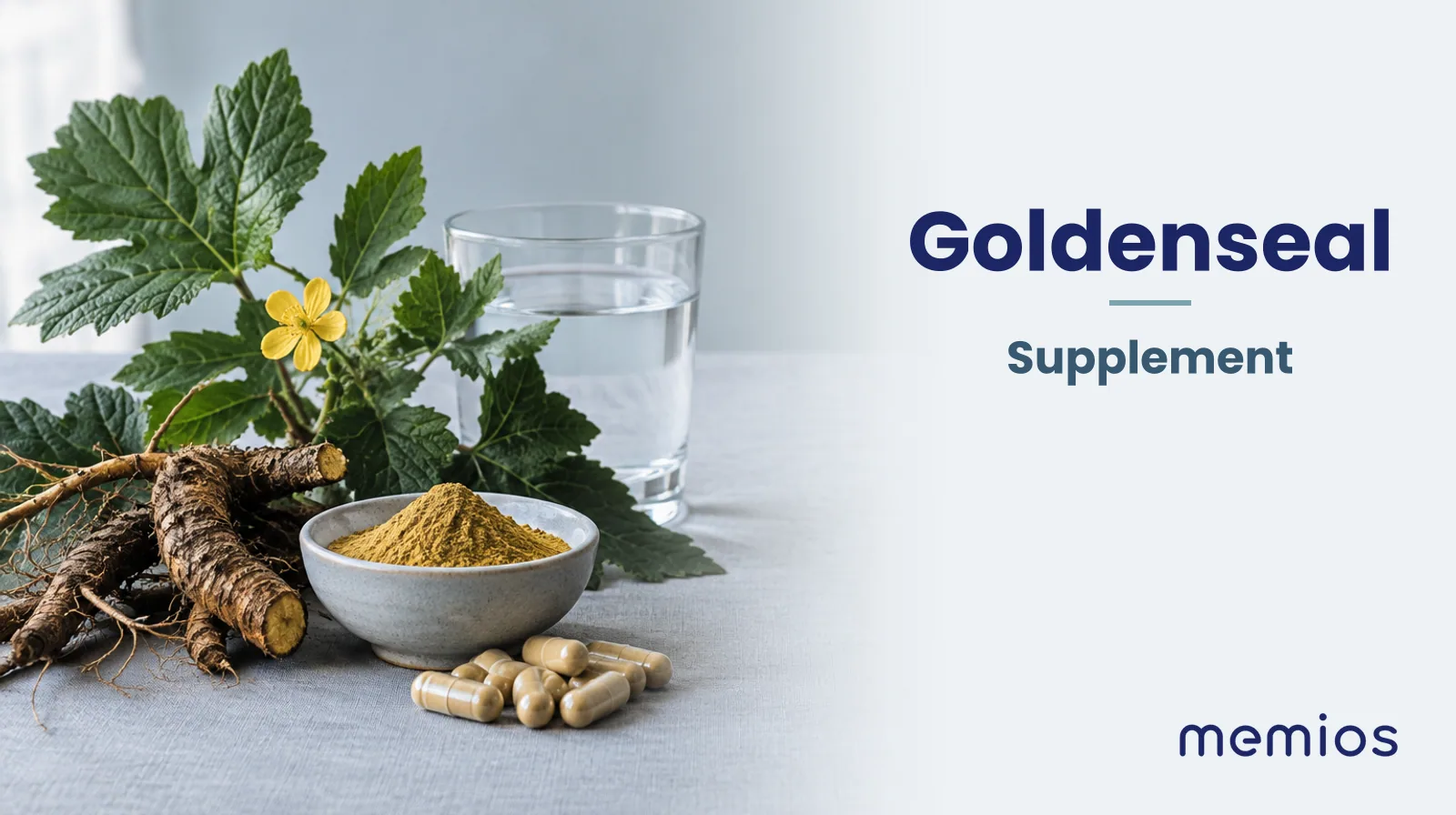
- What it is: Goldenseal is a small woodland plant native to the northeastern United States and southeastern Canada, with a bright yellow underground stem, the rhizome, which is the part sold as a supplement.
- Main use, supported: A clinical probe-cocktail study confirmed that goldenseal inhibits CYP3A in people, raising exposure to the probe drug midazolam. (moderate certainty)
- Other use, supported: Short-term dosing of goldenseal at around 3 g a day in small studies did not produce serious harmful effects, but longer-term safety is untested.
- Claim NOT supported by research: The same study found no effect of goldenseal on the pharmacokinetics of rosuvastatin or furosemide, contradicting what the in vitro models had predicted. (moderate certainty)
- Another claim NOT supported: NCCIH's position is that no rigorous human studies have assessed goldenseal for any health condition.
- Recommended dose: not established. No dietary reference intake exists. Goldenseal is a plant rhizome used as a supplement, not an essential nutrient, and no body has set an RDA or AI for it.
- Studied dose (a trial dose, not a recommendation): Gurley and colleagues gave healthy volunteers a standardised goldenseal extract for 14 days, with a 30-day washout between supplementation phases, before and after a 5 mg debrisoquine probe dose. Findings citing that trial: 2 on harm.
- Upper limit: No tolerable upper intake level or acceptable daily intake has been set.
- What goes wrong: 6 findings on harm. In healthy volunteers, goldenseal supplementation inhibited CYP2D6 activity by around half, while five other botanicals did not.
- Common myth: Goldenseal is a natural antibiotic and immune booster, and taking it is harmless.
What it is
Goldenseal is a small woodland plant native to the northeastern United States and southeastern Canada, with a bright yellow underground stem, the rhizome, which is the part sold as a supplement. Its yellow colour comes from isoquinoline alkaloids, chiefly berberine, which is what commercial extracts are standardised to. Native American groups used it historically for digestive problems, wounds and skin and eye conditions. Because wild goldenseal has been overharvested and cultivation is costly, goldenseal products are among the herbal supplements most often found substituted with cheaper berberine-containing species.
What the research says
What goldenseal has actually been shown to do in people is interfere with drug metabolism, not treat disease. Controlled studies in healthy volunteers found it inhibited the liver enzymes CYP2D6 by roughly half and CYP3A enough to raise midazolam exposure by 43%, and it lowered metformin exposure by 23%. NCCIH's position is that no rigorous studies have tested goldenseal for any health condition in people, and that evidence about its main alkaloid berberine may not transfer, because very little berberine is absorbed when goldenseal is taken by mouth. Adulteration with related species is a documented problem in goldenseal products.
Evidence grade: Not enough research to say.
What goes wrong
In healthy volunteers, goldenseal supplementation inhibited CYP2D6 activity by around half, while five other botanicals did not. (Source 1)
- Blood level study, Moderate certainty.
- Size: 16 healthy volunteers in the study arm that included goldenseal, within a three-study programme of 48 volunteers.
- Who: healthy adult volunteers, eight women per study.
- How long: 14 days of supplementation, with a 30-day washout between phases.
- Result: significant inhibition of about 50% of CYP2D6 activity measured by 8-hour debrisoquine urinary recovery ratios after a 5 mg debrisoquine probe dose.
- Funding: not stated in the abstract retrieved.
Comparisons of pre‐ and post‐supplementation DURR revealed significant inhibition (∼50%) of CYP2D6 activity for goldenseal, but not for the other extracts.
The same investigators concluded that taking goldenseal with medicines cleared by CYP2D6 may produce adverse interactions. (Source 1)
- Blood level study, Moderate certainty.
- Size: 16 healthy volunteers.
- Who: healthy adult volunteers.
- How long: 14 days.
- Result: CYP2D6 accounts for the metabolism of about 30% of all medications, per the paper's own framing.
- Funding: not stated in the abstract retrieved.
Accordingly, adverse herb–drug interactions may result with concomitant ingestion of goldenseal supplements and drugs that are CYP2D6 substrates.
In the same study goldenseal reduced metformin exposure, which the authors said could work against blood glucose control. (Source 2)
- Blood level study, Moderate certainty.
- Size: 16 healthy volunteers.
- Who: healthy adults.
- How long: short-term dosing study.
- Result: metformin area under the curve geometric mean ratio 0.77 (90% CI 0.71 to 0.83), with no change in metformin half-life or renal clearance.
- Funding: not stated in the abstract retrieved.
Results indicated that goldenseal altered intestinal permeability, transport, and/or other processes involved in metformin absorption, which may have unfavorable effects on glucose control.
NCCIH advises that goldenseal should not be used in pregnancy or breastfeeding, nor given to infants. (Source 3)
- Official position, Certainty not rated.
- Size: not applicable; agency summary.
- Who: pregnant and breastfeeding women, and infants.
- How long: position current as of February 2025.
- Result: no incidence data; a categorical avoidance statement.
- Funding: US government agency.
Women who are pregnant or breastfeeding should not use goldenseal, and it should not be given to infants.
Across a large review of chemically authenticated commercial herbal products, more than a quarter were adulterated; goldenseal was among the products examined. (Source 4)
- Systematic review, Low certainty.
- Size: 2,386 commercial herbal products sold in 37 countries.
- Who: commercial herbal products, including goldenseal capsules, tinctures, powders and tea bags.
- How long: not applicable; product analyses.
- Result: 73% authentic, 27% adulterated overall; by country, 37% (United Kingdom), 31% (Italy), 27% (United States), 21% (China)
- Funding: not stated in the abstract retrieved.
The majority of the analyzed products were reported to be authentic (73%) but more than a quarter proved to be adulterated (27%).
Laboratory work using goldenseal deliberately mixed with a cheaper look-alike species shows adulteration of goldenseal material is detectable, and treats it as a known problem in the supplement trade. (Source 5)
- Lab study in cells, Low certainty.
- Size: a training set of goldenseal spiked with Coptis chinensis at 5% to 95% adulteration.
- Who: not applicable; botanical material and dietary supplement samples.
- How long: not applicable.
- Result: targeted quantification of palmatine was the most sensitive method; untargeted metabolomics with SIMCA also detected adulteration.
- Funding: not stated in the abstract retrieved.
Adulteration remains an issue in the dietary supplement industry, including botanical supplements.
What the evidence supports
A clinical probe-cocktail study confirmed that goldenseal inhibits CYP3A in people, raising exposure to the probe drug midazolam. (Source 2)
- Blood level study, Moderate certainty.
- Size: 16 healthy volunteers.
- Who: healthy adults given a goldenseal product standardised to berberine plus a cocktail of probe drugs.
- How long: short-term dosing study.
- Result: midazolam area under the curve geometric mean ratio 1.43 (90% CI 1.35 to 1.53)
- Funding: not stated in the abstract retrieved.
with a geometric mean ratio (GMR) (90% confidence interval (CI)) of 1.43 (1.35–1.53)
Short-term dosing of goldenseal at around 3 g a day in small studies did not produce serious harmful effects, but longer-term safety is untested. (Source 6)
- Official position, Certainty not rated.
- Size: not applicable; agency summary of small studies.
- Who: participants in small goldenseal research studies.
- How long: short periods; longer use uncharacterised.
- Result: about 3 g per day without serious harmful effects; safety of longer use described as uncertain.
- Funding: US government agency.
In small research studies, goldenseal has been administered at doses of about 3 g per day for short periods of time without serious harmful effects. The safety of taking goldenseal for longer periods is uncertain.
What the evidence does not support
The same study found no effect of goldenseal on the pharmacokinetics of rosuvastatin or furosemide, contradicting what the in vitro models had predicted. (Source 2)
- Blood level study, Moderate certainty.
- Size: 16 healthy volunteers.
- Who: healthy adults.
- How long: short-term dosing study.
- Result: no change in rosuvastatin (BCRP, OATP1B1/3) or furosemide (OAT1/3) pharmacokinetics, despite basic models predicting inhibition of BCRP and OATP1B1/3.
- Funding: not stated in the abstract retrieved.
However, goldenseal had no effects on the pharmacokinetics of rosuvastatin (BCRP and OATP1B1/3) and furosemide (OAT1/3)
NCCIH's position is that no rigorous human studies have assessed goldenseal for any health condition. (Source 7)
- Official position, Certainty not rated.
- Size: not applicable; agency summary.
- Who: general public.
- How long: position current as of February 2025.
- Result: no numbers; an explicit statement that rigorous efficacy studies in people do not exist.
- Funding: US government agency.
No rigorous studies have been done to evaluate the effects of goldenseal on health conditions in people.
Evidence about berberine cannot be assumed to apply to goldenseal, because very little berberine is absorbed when goldenseal is taken by mouth. (Source 8)
- Official position, Certainty not rated.
- Size: not applicable; agency summary.
- Who: people taking oral goldenseal.
- How long: position current as of February 2025.
- Result: no absorption figures given on the page retrieved.
- Funding: US government agency.
when people take goldenseal orally (by mouth), very little berberine may be absorbed by the body, so study results on berberine may not apply to goldenseal.
Where the research disagrees
Whether research on berberine can be used to judge goldenseal
- NCCIH (February 2025), agency position on absorption: "when people take goldenseal orally (by mouth), very little berberine may be absorbed by the body, so study results on berberine may not apply to goldenseal." (Source 8)
- Clinical pharmacology investigators (2020), clinical probe-cocktail pharmacokinetic study of a berberine-standardised goldenseal extract, which did produce measurable systemic effects on drug handling: "The botanical natural product goldenseal can precipitate clinical drug interactions by inhibiting cytochrome P450 (CYP) 3A and CYP2D6." (Source 2)
How much
- Reference intake: No dietary reference intake exists. Goldenseal is a plant rhizome used as a supplement, not an essential nutrient, and no body has set an RDA or AI for it. (Source 9)
- Upper limit: No tolerable upper intake level or acceptable daily intake has been set. NCCIH (February 2025) notes only that about 3 g per day has been given for short periods in small studies without serious harmful effects, and that longer-term safety is uncertain. (Source 6)
- Studied: Gurley and colleagues gave healthy volunteers a standardised goldenseal extract for 14 days, with a 30-day washout between supplementation phases, before and after a 5 mg debrisoquine probe dose. (Source 1)
- Studied: The transporter probe-cocktail study used a goldenseal product standardised to the major alkaloid berberine in 16 healthy volunteers. (Source 2)
- Studied: NCCIH reports small research studies administering about 3 g per day for short periods. (Source 6)
A common belief, and what the research shows
The belief: Goldenseal is a natural antibiotic and immune booster, and taking it is harmless.
What the research shows: There is no rigorous human trial evidence for any such use: "No rigorous studies have been done to evaluate the effects of goldenseal on health conditions in people." What has been demonstrated in controlled human studies is interference with drug handling. Goldenseal produced "significant inhibition (∼50%) of CYP2D6 activity", raised midazolam exposure "with a geometric mean ratio (GMR) (90% confidence interval (CI)) of 1.43 (1.35–1.53)", and lowered metformin exposure, which the authors warned "may have unfavorable effects on glucose control." So the best-established effect of goldenseal is on other medicines, not on illness.
Questions and answers
What is it?
Goldenseal is a small woodland plant native to the northeastern United States and southeastern Canada. The part used is its bright yellow rhizome, an underground stem. Its yellow colour comes from alkaloids, chiefly berberine, and extracts are usually standardised to berberine content. (Source 9)
What does it do in the body?
In people, the clearly demonstrated effect of goldenseal is on drug-metabolising enzymes rather than on any disease. Controlled studies show it inhibits CYP3A and CYP2D6, two of the main liver enzymes that clear medicines. That is a pharmacological effect on how other drugs behave, not a treatment effect. (Source 2)
Is it good or bad for you?
On the evidence available, mainly a risk rather than a benefit. Short courses of about 3 g a day have been given in small studies without serious harm, but no rigorous trial has shown goldenseal helps any condition, and it measurably changes the levels of other medicines in the body. That combination means the known effects are on drug safety rather than on health. (Source 6)
How do you get more of it?
Goldenseal is not part of any normal diet; it is taken as the dried rhizome, a capsule, a tincture or a tea. Human studies used standardised extracts, for example a berberine-standardised product in 16 volunteers, and about 3 g a day for short periods. This describes what studies gave, not a recommendation. (Source 2)
If it is harmful, what reduces it?
Stopping it is what has been studied. The interaction studies built in a 30-day washout between supplementation phases, on the assumption that the enzyme effects reverse once goldenseal is discontinued. No specific removal treatment for goldenseal exists in the literature we found. (Source 1)
Why might someone be low in it or missing it?
Nobody is deficient in goldenseal. It is a plant used as a supplement, not a nutrient, so there is no normal body level to fall short of. A person has none unless they take a goldenseal product, and supply is limited because the wild plant has been overharvested. (Source 9)
Which whole foods contain it or feed it?
None. Goldenseal is not a food, and no whole food contains it or feeds it. The only part used is the rhizome of the plant itself, sold as powder, capsules, tinctures or tea. Berberine, its main alkaloid, occurs in other plants such as barberry and Coptis, which is also why those species turn up as adulterants. (Source 9)
What happens if you do not have it?
Nothing happens. There is no deficiency state, and no rigorous study has shown that goldenseal does anything for a health condition in people, so not taking it means forgoing an unproven product rather than losing a benefit. (Source 7)
How can you test for it?
There is no validated test of goldenseal in a person, and none would be meaningful, as it is not a nutrient with a normal range. Laboratory tests do exist for the product rather than the person: targeted measurement of alkaloids such as palmatine, and untargeted metabolomics, can detect whether goldenseal material has been adulterated with cheaper species. (Source 5)
We searched: WebSearch and WebFetch for goldenseal or berberine status testing in people, plus the Gurley CYP2D6 study, the transporter probe-cocktail study, the NCCIH goldenseal page and two product-authentication papers; only product-authentication assays were found, not a test on people
References
- Molecular Nutrition & Food Research (abstract as deposited with Crossref). Clinical assessment of CYP2D6‐mediated herb–drug interactions in humans: Effects of milk thistle, black cohosh, goldenseal, kava kava, St. John's wort, and Echinacea. 2008. DOI 10.1002/mnfr.200600300. Read the source
- Clinical Pharmacology & Therapeutics (abstract as deposited with Crossref). Assessing Transporter‐Mediated Natural Product‐Drug Interactions Via In vitro‐In Vivo Extrapolation: Clinical Evaluation With a Probe Cocktail. 2020. DOI 10.1002/cpt.2107. Read the source
- National Center for Complementary and Integrative Health, US National Institutes of Health. Goldenseal: Usefulness and Safety (pregnancy, breastfeeding and infants). 2025. Read the source
- Frontiers in Pharmacology. Chemical Authentication of Botanical Ingredients: A Review of Commercial Herbal Products. 2021. PMID 33935790, DOI 10.3389/fphar.2021.666850. Read the source
- Analytical and Bioanalytical Chemistry (Springer). Identification of adulteration in botanical samples with untargeted metabolomics. 2020. DOI 10.1007/s00216-020-02678-6. Read the source
- National Center for Complementary and Integrative Health, US National Institutes of Health. Goldenseal: Usefulness and Safety (safety). 2025. Read the source
- National Center for Complementary and Integrative Health, US National Institutes of Health. Goldenseal: Usefulness and Safety (what the science says). 2025. Read the source
- National Center for Complementary and Integrative Health, US National Institutes of Health. Goldenseal: Usefulness and Safety (berberine absorption). 2025. Read the source
- National Center for Complementary and Integrative Health, US National Institutes of Health. Goldenseal: Usefulness and Safety (what goldenseal is). 2025. Read the source