Supplements · September 29, 2026 · Memios · 9 min read
Ginger
Ginger is best supported for nausea in pregnancy, where pooled trials show it eases nausea, though it did not significantly reduce vomiting and the evidence is low quality.
TLDR
- Limited evidence. Ginger is best supported for nausea in pregnancy, where pooled trials show it eases nausea, though it did not significantly reduce vomiting and the evidence is low quality.
- What it is: Ginger is the underground stem (rhizome) of Zingiber officinale, native to warm parts of Asia and now grown widely.
- Main use, supported: A meta-analysis of five placebo-controlled trials in osteoarthritis found small but statistically significant reductions in pain and in disability with oral ginger compared with placebo. (moderate certainty)
- Other use, supported: A meta-analysis of 12 trials found ginger improved nausea in pregnancy compared with placebo, with low-quality evidence. (low certainty)
- Claim NOT supported by research: The same meta-analysis found ginger did not significantly reduce vomiting episodes in pregnancy. (low certainty)
- Another claim NOT supported: A systematic review of 23 randomised trials found ginger did not significantly change acute or delayed nausea or vomiting from chemotherapy overall. (low certainty)
- Recommended dose: not established. No recommended intake exists; ginger is not an essential nutrient.
- Studied dose (a trial dose, not a recommendation): Pregnancy trials: a subgroup analysis favoured daily doses below 1,500 mg for nausea. Findings citing that trial: 1 for, 1 against, 1 mixed.
- Upper limit: No tolerable upper limit was found in the sources reviewed.
- What goes wrong: 2 findings on harm. In the same osteoarthritis meta-analysis, people taking ginger were more than twice as likely to stop treatment as those on placebo, though the confidence interval only just excluded no difference.
- Common myth: Ginger is proven to stop nausea from any cause.
What it is
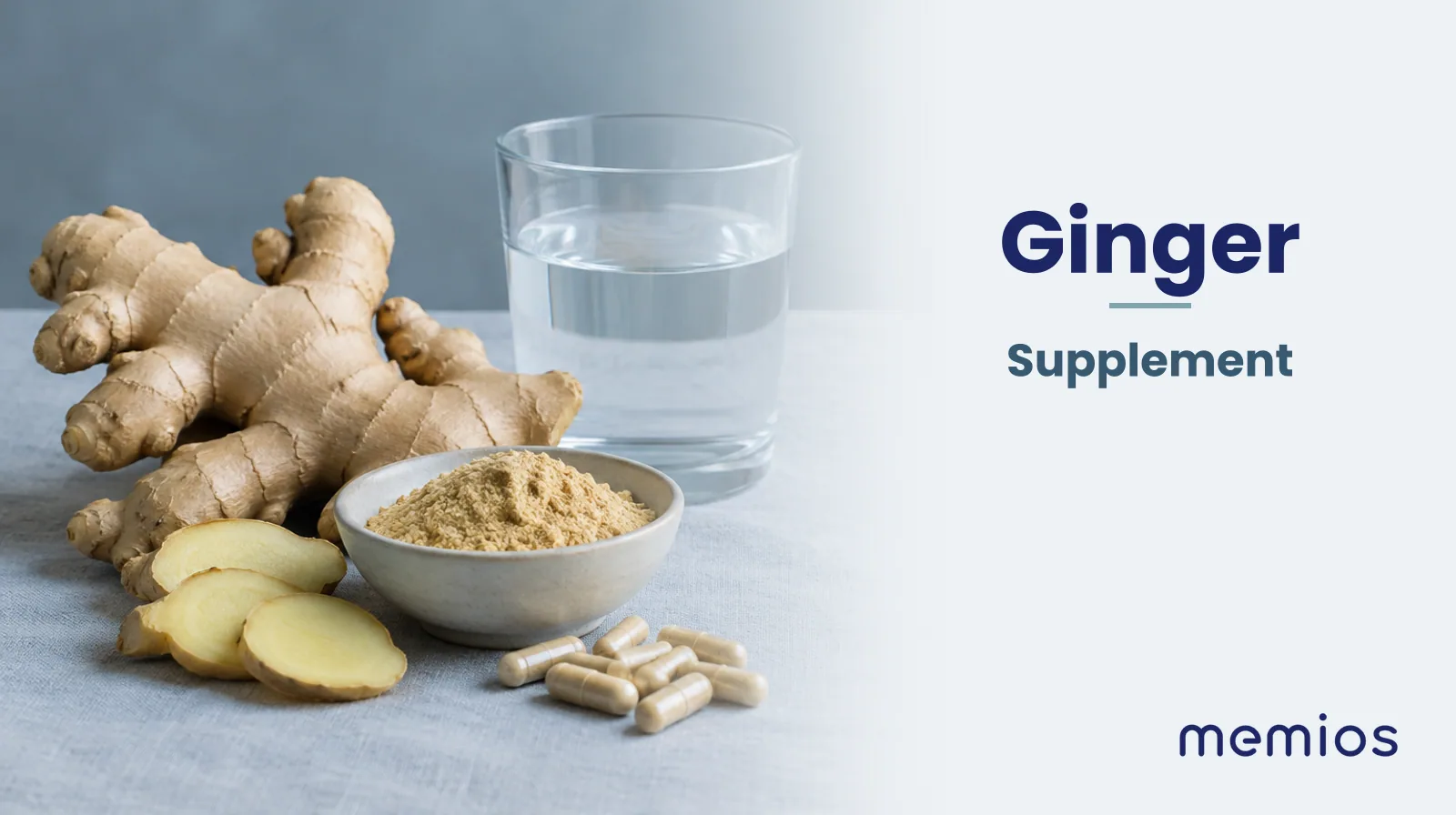
Ginger is the underground stem (rhizome) of Zingiber officinale, native to warm parts of Asia and now grown widely. It is eaten as a spice and taken as powder, capsules or extract.
What the research says
Ginger is best supported for nausea in pregnancy, where pooled trials show it eases nausea, though it did not significantly reduce vomiting and the evidence is low quality. For nausea from chemotherapy, a review of 23 trials found no overall difference, with a possible benefit only in one subgroup. For knee and hip osteoarthritis, trials show a small reduction in pain, rated moderate quality, but people on ginger were more than twice as likely to stop treatment. Whether ginger affects blood clotting is unresolved: half the trials found an effect on platelets and half did not.
Evidence grade: Limited evidence.
What goes wrong
In the same osteoarthritis meta-analysis, people taking ginger were more than twice as likely to stop treatment as those on placebo, though the confidence interval only just excluded no difference. (Source 1)
- Meta-analysis, Moderate certainty.
- Size: 593 patients in 5 RCTs.
- Who: Adults with osteoarthritis.
- How long: Trial durations varied.
- Result: Discontinuation RR 2.33 (95% CI 1.04 to 5.22; P = 0.04; I2 = 0%) - the lower bound of 1.04 means this harm signal is only marginally statistically significant.
- Funding: not stated.
Patients given ginger were more than twice as likely to discontinue treatment compared to placebo ([RR = 2.33; 95% CI: (1.04, 5.22)]; P = 0.04; I2 = 0%]).
NCCIH (a position, 2025) lists abdominal discomfort, heartburn, diarrhoea and mouth and throat irritation as side effects of oral ginger, and says most motion sickness studies have not shown benefit. (Source 2)
- Official position, Certainty not rated.
- Size: Not applicable.
- Who: People taking oral ginger.
- How long: Not applicable.
- Result: Qualitative.
- Funding: independent (NIH)
abdominal discomfort, heartburn, diarrhea, and mouth and throat irritation
What the evidence supports
A meta-analysis of 12 trials found ginger improved nausea in pregnancy compared with placebo, with low-quality evidence. (Source 3)
- Meta-analysis, Low certainty.
- Size: 1,278 pregnant women in 12 RCTs.
- Who: Pregnant women with nausea and vomiting.
- How long: Trial durations varied.
- Result: Nausea MD 1.20 (95% CI 0.56-1.84, p = 0.0002, I2 0%)
- Funding: not stated.
Ginger significantly improved the symptoms of nausea when compared to placebo (MD 1.20, 95% CI 0.56-1.84, p = 0.0002, I² = 0%).
In a subgroup of that review, people taking no more than 1 g of ginger a day for more than four days had less acute vomiting. (Source 4)
- Systematic review, Low certainty.
- Size: Subgroup of 23 RCTs.
- Who: People receiving chemotherapy.
- How long: More than four days.
- Result: Acute vomiting OR 0.30 (95% CI 0.12 to 0.79; p = 0.02; I2 36%)
- Funding: industry/government-funded (Korea Food Research Institute; Ministry of Food and Drug Safety)
had significantly less acute vomiting than the control group (OR 0.30; 95% CI 0.12 to 0.79; p = 0.02; I2 = 36%)
A meta-analysis of five placebo-controlled trials in osteoarthritis found small but statistically significant reductions in pain and in disability with oral ginger compared with placebo. (Source 1)
- Meta-analysis, Moderate certainty.
- Size: 593 patients in 5 RCTs.
- Who: Adults with osteoarthritis.
- How long: Trial durations varied.
- Result: Pain SMD −0.30 (95% CI −0.50 to −0.09, P = 0.005, I2 = 27%); disability SMD −0.22 (95% CI −0.39 to −0.04, P = 0.01, I2 = 0%)
- Funding: not stated.
Following ginger intake, a statistically significant pain reduction SMD = −0.30 ([95% CI: [(−0.50, −0.09)], P = 0.005]) with a low degree of inconsistency among trials (I2 = 27%), and a statistically significant reduction in disability SMD = −0.22 ([95% CI: ([−0.39, −0.04)]; P = 0.01; I2 = 0%]) were seen, both in favor of ginger.
What the evidence does not support
The same meta-analysis found ginger did not significantly reduce vomiting episodes in pregnancy. (Source 3)
- Meta-analysis, Low certainty.
- Size: 1,278 pregnant women in 12 RCTs.
- Who: Pregnant women with nausea and vomiting.
- How long: Trial durations varied.
- Result: Vomiting MD 0.72 (95% CI -0.03 to 1.46, p = 0.06, I2 71%)
- Funding: not stated.
Ginger did not significantly reduce the number of vomiting episodes during NVP, when compared to placebo, although there was a trend towards improvement (MD 0.72, 95% CI -0.03-1.46, p = 0.06, I² = 71%).
A systematic review of 23 randomised trials found ginger did not significantly change acute or delayed nausea or vomiting from chemotherapy overall. (Source 4)
- Systematic review, Low certainty.
- Size: 23 RCTs.
- Who: People receiving chemotherapy.
- How long: Trial durations varied.
- Result: Acute nausea p = 0.53; delayed nausea p = 0.31; acute vomiting p = 0.09; delayed vomiting p = 0.89.
- Funding: industry/government-funded (Korea Food Research Institute; Ministry of Food and Drug Safety)
The results showed that the incidence of acute nausea (p = 0.53), the incidence of delayed nausea (p = 0.31), the incidence of acute vomiting (p = 0.09), and the incidence of delayed vomiting (p = 0.89) were not significantly different between the ginger supplement intake group and the control group.
Where the evidence is mixed
In pregnancy trials, ginger was not associated with a significant increase in miscarriage, although the confidence interval was wide. (Source 3)
- Meta-analysis, Low certainty.
- Size: 12 RCTs.
- Who: Pregnant women.
- How long: Trial durations varied.
- Result: Spontaneous abortion vs placebo RR 3.14 (95% CI 0.65-15.11, p = 0.15)
- Funding: not stated.
Ginger did not pose a significant risk for spontaneous abortion compared to placebo (RR 3.14, 95% CI 0.65-15.11, p = 0.15; I² = 0%)
The same review authors called the benefit modest and rated their own evidence only moderate quality, because the trials were small and their intention-to-treat analyses inadequate. (Source 5)
- Meta-analysis, Moderate certainty.
- Size: 593 patients in 5 RCTs.
- Who: Adults with osteoarthritis.
- How long: Trial durations varied.
- Result: Authors' own GRADE-style judgement: moderate quality evidence.
- Funding: not stated.
Ginger was modestly efficacious and reasonably safe for treatment of OA. We judged the evidence to be of moderate quality, based on the small number of participants and inadequate ITT populations.
A systematic review of ginger and platelet aggregation found half of eight clinical trials showed reduced platelet aggregation and half showed no effect, so the bleeding concern is unresolved. (Source 6)
- Systematic review, Low certainty.
- Size: 10 studies (8 clinical trials, 2 observational)
- Who: Adults, healthy and with chronic disease.
- How long: Varied.
- Result: 4 of 8 trials reported reduced aggregation; 4 reported no effect.
- Funding: independent (no specific funding)
The evidence that ginger affects platelet aggregation and coagulation is equivocal and further study is needed to definitively address this question.
Where the research disagrees
Whether ginger increases bleeding risk
- Marx et al., PLOS ONE 2015, Systematic review of 10 studies: Of the eight clinical trials, four reported that ginger reduced platelet aggregation, while the remaining four reported no effect. (Source 6)
- Marx et al., on the state of concern, Systematic review: The potential effect of ginger on platelet aggregation is a widely-cited concern both within the published literature and to clinicians (Source 6)
How much
- Reference intake: No recommended intake exists; ginger is not an essential nutrient. (Source 2)
- Upper limit: No tolerable upper limit was found in the sources reviewed. (Source 2)
- Studied: Pregnancy trials: a subgroup analysis favoured daily doses below 1,500 mg for nausea. (Source 3)
- Studied: Chemotherapy trials: the subgroup with benefit took not more than 1 g a day for more than four days. (Source 4)
A common belief, and what the research shows
The belief: Ginger is proven to stop nausea from any cause.
What the research shows: It helps nausea in pregnancy but not significantly vomiting, and overall did not beat control for chemotherapy nausea. Choi et al. found acute and delayed nausea and vomiting 'were not significantly different between the ginger supplement intake group and the control group.' NCCIH notes 'Most studies of ginger for motion sickness haven't shown it to be helpful.'
Questions and answers
What is it?
Ginger is the rhizome (underground stem) of Zingiber officinale, a plant native to warm parts of Asia. It is used as a spice and as a supplement. (Source 2)
What does it do in the body?
In pregnancy trials it eased nausea, but did not significantly reduce vomiting. It has a small effect on osteoarthritis pain, and no overall effect on chemotherapy nausea. (Source 3)
Is it good or bad for you?
As food it is widely eaten. As a supplement it shows modest benefits for pregnancy nausea and osteoarthritis pain. Stomach upset and heartburn are the usual side effects, and whether it affects blood clotting is unresolved. (Source 5)
How do you get more of it?
It is eaten as fresh or dried ginger, or taken as capsules, powder or extract. Pregnancy trials gave oral ginger, with lower daily doses under 1,500 mg looking better for nausea. (Source 3)
If it is harmful, what reduces it?
Does not apply as a harmful substance. Its common side effects are digestive and mild. (Source 2)
Why might someone be low in it or missing it?
Does not apply. Ginger is not an essential nutrient, so there is no deficiency; people simply eat more or less of it. (Source 2)
Which whole foods contain it or feed it?
Fresh ginger root and dried ground ginger are the food sources. (Source 2)
What happens if you do not have it?
Nothing is known to happen; ginger is not essential. Its studied effects are modest benefits when added, not problems when it is missing. (Source 3)
How can you test for it?
No clinical test for ginger intake or status exists in the literature we searched. (Source 2)
We searched: Europe PMC, MDPI and journal pages for ginger trials and reviews; no status biomarker described.
References
- Osteoarthritis and Cartilage. Efficacy and safety of ginger in osteoarthritis patients: a meta-analysis of randomized placebo-controlled trials. 2015. DOI 10.1016/j.joca.2014.09.024. Read the source
- National Center for Complementary and Integrative Health (NIH). Ginger (NCCIH Health Topic). 2025. Read the source
- Nutrition Journal. A systematic review and meta-analysis of the effect and safety of ginger in the treatment of pregnancy-associated nausea and vomiting. 2014. PMID 24642205, DOI 10.1186/1475-2891-13-20. Read the source
- Nutrients. Effects of Ginger Intake on Chemotherapy-Induced Nausea and Vomiting: A Systematic Review of Randomized Clinical Trials. 2022. PMID 36501010, DOI 10.3390/nu14234982. Read the source
- Osteoarthritis and Cartilage. Efficacy and safety of ginger in osteoarthritis patients: a meta-analysis of randomized placebo-controlled trials. 2015. DOI 10.1016/j.joca.2014.09.024. Read the source
- PLOS ONE. The Effect of Ginger (Zingiber officinale) on Platelet Aggregation: A Systematic Literature Review. 2015. DOI 10.1371/journal.pone.0141119. Read the source