Supplements · September 29, 2026 · Memios · 12 min read
Gelatin
Gelatin is digested into amino acids and small peptides, and blood levels of glycine, proline, hydroxyproline and hydroxylysine rise within an hour of taking it.
TLDR
- Limited evidence. Gelatin is digested into amino acids and small peptides, and blood levels of glycine, proline, hydroxyproline and hydroxylysine rise within an hour of taking it.
- What it is: Gelatin is a protein made by partly breaking down collagen from animal skin, bone and connective tissue with acid or alkali and heat, which turns insoluble collagen into a soluble, gelling protein. Most commercial gelatin comes from pig skin, bovine hides and cattle and pig bones, with fish skin also used.
- Main use, supported: A trial sequential meta-analysis of 35 randomised trials found collagen derivatives reduced osteoarthritis pain and improved function compared with control. (moderate certainty)
- Other use, supported: The osteoarthritis meta-analysis reported that collagen derivatives did not increase withdrawals or adverse events compared with control. (moderate certainty)
- Claim NOT supported by research: A meta-analysis of collagen peptides added to structured exercise found the great majority of performance measures unchanged and no significant effect on strength. (moderate certainty)
- Another claim NOT supported: The same meta-analysis concluded collagen peptide supplementation on top of exercise is ineffective for musculoskeletal performance, noting the underlying studies were methodologically homogeneous and at low risk of bias. (moderate certainty)
- Recommended dose: not established. No reference intake such as an RDA or AI exists for gelatin. It is a food ingredient and protein source rather than an essential nutrient, defined in food regulation by how it is manufactured from collagen.
- Studied dose (a trial dose, not a recommendation): Shaw and colleagues gave 5 g or 15 g of vitamin C-enriched gelatin, or placebo, three times a day for three days around rope-skipping bouts in eight healthy men. Findings citing that trial: 1 for.
- Upper limit: No tolerable upper intake level or acceptable daily intake for gelatin was found at the bodies we could reach.
- What goes wrong: 2 findings on harm. Gelatin is a documented cause of IgE-mediated anaphylaxis, shown in a case where anaphylaxis to MMR vaccine was traced to its gelatin stabiliser rather than to egg.
- Common myth: Eating gelatin or collagen sends collagen straight to your joints and skin.
What it is
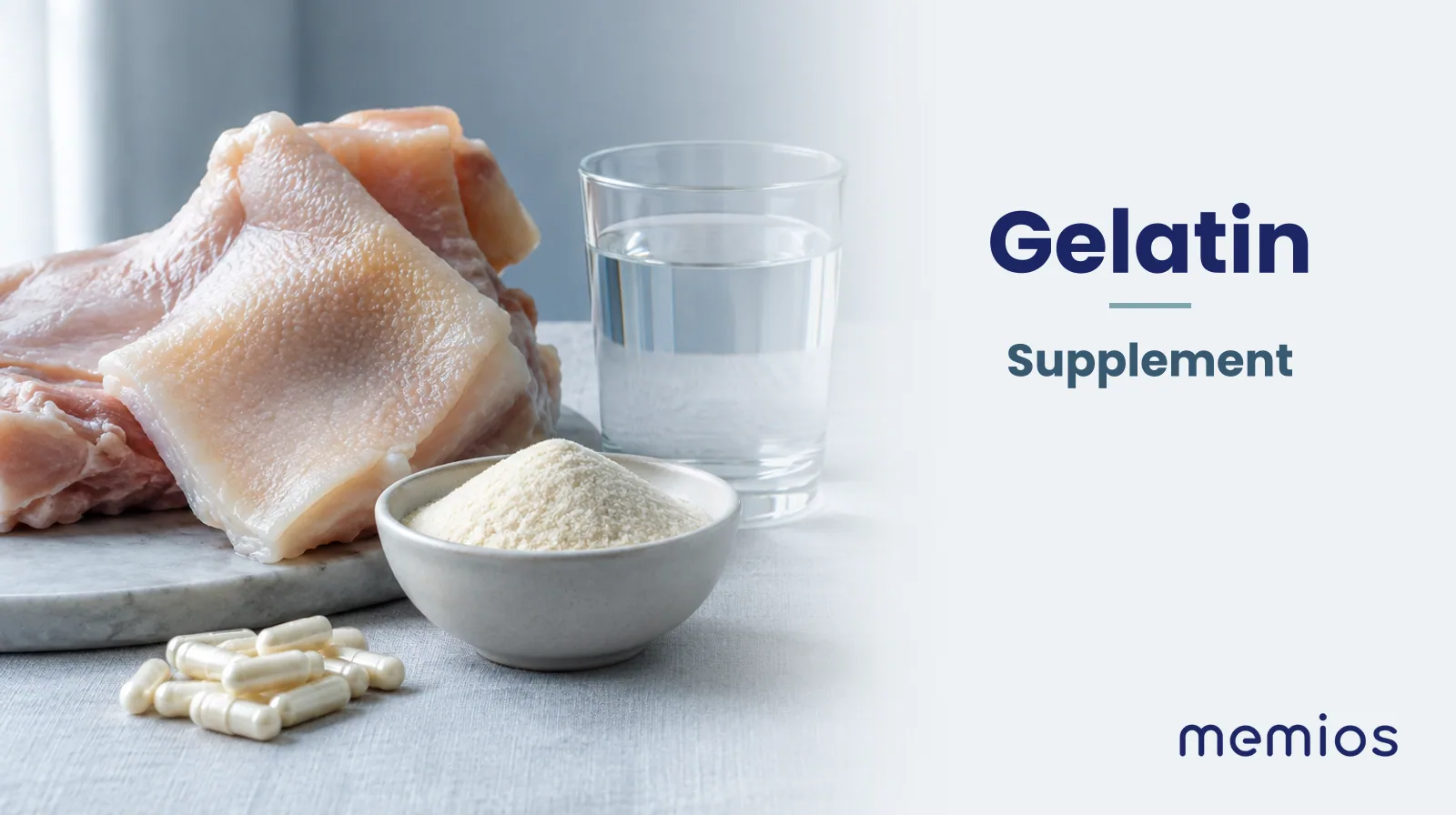
Gelatin is a protein made by partly breaking down collagen from animal skin, bone and connective tissue with acid or alkali and heat, which turns insoluble collagen into a soluble, gelling protein. Most commercial gelatin comes from pig skin, bovine hides and cattle and pig bones, with fish skin also used. It contains nineteen amino acids and is dominated by glycine, proline and hydroxyproline. Collagen peptides are the same material broken down further so it no longer gels.
What the research says
Gelatin is digested into amino acids and small peptides, and blood levels of glycine, proline, hydroxyproline and hydroxylysine rise within an hour of taking it. Whether that changes anything useful depends on the outcome. A 2024 meta-analysis of 35 randomised trials in osteoarthritis found small-to-moderate reductions in pain at moderate certainty and improvement in function at high certainty. In contrast, a meta-analysis of collagen peptides added to exercise training found 48 of 55 performance measures unaffected and no effect on strength. Tendon reviews sit in between, with signals for tendon size and stiffness at higher doses but explicit strong evidence against a strength effect. The main safety issue is that gelatin is a documented food allergen that has caused anaphylaxis, including to gelatin-stabilised vaccines.
Evidence grade: Limited evidence.
What goes wrong
Gelatin is a documented cause of IgE-mediated anaphylaxis, shown in a case where anaphylaxis to MMR vaccine was traced to its gelatin stabiliser rather than to egg. (Source 1)
- Case report, Very low certainty.
- Size: 1 patient.
- Who: 17-year-old girl with symptoms after eating gelatin, not allergic to eggs.
- How long: Single exposure.
- Result: Positive prick skin tests to 1:10 dilutions of MMR vaccine and gelatin, negative to egg; raised serum IgE to vaccine and gelatin; IgE binding inhibited by gelatin from several animal sources.
- Funding: not stated.
We conclude that the patient has an anaphylactic sensitivity to gelatin, and that her anaphylaxis to MMR vaccine was caused by the gelatin component.
In the same report, gelatin allergy was confirmed by skin testing and immunoassay and was not specific to one animal species of gelatin. (Source 1)
- Case report, Very low certainty.
- Size: 1 patient.
- Who: Adolescent with gelatin food reactions.
- How long: Single episode plus laboratory follow-up.
- Result: IgE binding to the gelatin carrier inhibited dose-dependently by MMR vaccine and by gelatin from a variety of animal sources.
- Funding: not stated.
Prick skin tests were positive to 1 : 10 wt/vol dilutions of MMR vaccine and gelatin but negative to egg.
What the evidence supports
A trial sequential meta-analysis of 35 randomised trials found collagen derivatives reduced osteoarthritis pain and improved function compared with control. (Source 2)
- Meta-analysis, Moderate certainty.
- Size: 35 RCTs involving 3165 patients; main analysis 25 RCTs, 2856 patients.
- Who: Patients with osteoarthritis.
- How long: Varied across trials, searched to June 2023.
- Result: Pain SMD −0.35, 95% CI −0.48 to −0.22 (moderate certainty); function SMD −0.31, 95%CI −0.41 to −0.22 (high certainty)
- Funding: not stated.
Collagen derivatives exerted small-to-moderate effects on pain alleviation (standardized mean difference [SMD] −0.35, 95% confidence interval [CI] −0.48 to −0.22, moderate certainty) and function improvement (SMD −0.31, 95%CI −0.41 to −0.22, high certainty) compared with the control.
In a small randomised crossover study, vitamin C-enriched gelatin raised blood collagen-building amino acids and doubled a blood marker of collagen synthesis at the higher dose. (Source 3)
- Randomized trial, Very low certainty.
- Size: 8 healthy male subjects.
- Who: Healthy men.
- How long: Supplement three times a day for 3 days around rope-skipping bouts.
- Result: PINP baseline 27.9 ± 4 ng/mL; +53.9% placebo and +59.2% with 5 g gelatin; further significant increase of 153% at 4 h with 15 g gelatin.
- Funding: Independent and government-supported: National Institute on Aging grant R01AG045375, University of California Davis, and an Australian Institute of Sport sport nutrition research grant.
Subjects who took 15 g gelatin 1 h before exercise showed double the amino-terminal propeptide of collagen I in their blood, indicating increased collagen synthesis.
The osteoarthritis meta-analysis reported that collagen derivatives did not increase withdrawals or adverse events compared with control. (Source 2)
- Meta-analysis, Moderate certainty.
- Size: 35 RCTs, 3165 patients.
- Who: Patients with osteoarthritis.
- How long: Varied.
- Result: No increase in risk of withdrawal or adverse events versus control.
- Funding: not stated.
Collagen derivatives were safe; they did not increase the risk of withdrawal or adverse events compared with the control.
What the evidence does not support
A meta-analysis of collagen peptides added to structured exercise found the great majority of performance measures unchanged and no significant effect on strength. (Source 4)
- Meta-analysis, Moderate certainty.
- Size: 13 studies reviewed; 9 pooled in meta-analysis.
- Who: Healthy adults following structured exercise programmes.
- How long: Varied across trials.
- Result: 48 of 55 performance parameters unaffected; strength SMD=0.079 [-0.120 to 0.273], p=0.445.
- Funding: not stated.
Of the 55 performance parameters extracted, 48 were unaffected by additional CP intake. Furthermore, the meta-analysis revealed no significant effect of CP on strength-related performance parameters (SMD=0.079 [-0.120 to 0.273], p=0.445).
The same meta-analysis concluded collagen peptide supplementation on top of exercise is ineffective for musculoskeletal performance, noting the underlying studies were methodologically homogeneous and at low risk of bias. (Source 4)
- Meta-analysis, Moderate certainty.
- Size: 13 studies, 9 pooled.
- Who: Healthy adults.
- How long: Varied.
- Result: No added benefit over exercise alone.
- Funding: not stated.
The qualitative and quantitative analysis of the available studies suggests the ineffectiveness of CP supplementation in addition to exercise to further improve musculoskeletal performance.
Where the evidence is mixed
A systematic review of eight randomised trials found collagen supplementation with resistance training increased tendon cross-sectional area and stiffness but graded the evidence as strong against any effect on muscle strength. (Source 5)
- Systematic review, Moderate certainty.
- Size: 8 RCTs, 257 participants (246 men, 11 women), ages 18 to 52.
- Who: Healthy adults doing resistance or plyometric training.
- How long: 3 to 15 weeks.
- Result: GRADE A for increases in tendon cross-sectional area and stiffness; GRADE A against an effect on muscle strength; GRADE C (conflicting) for muscle cross-sectional area and physical performance.
- Funding: not stated.
The current literature suggests strong evidence (GRADE A) for increases in tendon CSA and stiffness, strong evidence (GRADE A) against an effect on muscle strength, and conflicting evidence (GRADE C) for muscle cross-sectional area and physical performance.
What official bodies say
The US Food and Drug Administration's 2016 BSE final rule defined gelatin and confirmed it is not a prohibited cattle material when made by the customary industry processes. (Source 6)
- Official position, Certainty not rated.
- Size: Not applicable.
- Who: US food, dietary supplement and cosmetic supply.
- How long: Rule announced 17 March 2016, finalising interim rules from 2004, 2005 and 2008.
- Result: Gelatin excluded from prohibited cattle materials; FDA states the risk of human exposure to the BSE agent from regulated human food and cosmetics is negligible.
- Funding: Not applicable.
Gelatin was never considered a prohibited cattle material, but FDA had never specifically defined gelatin in past IFRs.
Where the research disagrees
Whether gelatin and collagen peptides do anything measurable for musculoskeletal outcomes
- Authors of the 2024 trial sequential meta-analysis in osteoarthritis, meta-analysis: Strong evidence supports the efficacy and safety of collagen derivatives for osteoarthritis treatment. (Source 2)
- Authors of the 2024 German Journal of Sports Medicine meta-analysis on performance, meta-analysis: The qualitative and quantitative analysis of the available studies suggests the ineffectiveness of CP supplementation in addition to exercise to further improve musculoskeletal performance. (Source 4)
How much
- Reference intake: No reference intake such as an RDA or AI exists for gelatin. It is a food ingredient and protein source rather than an essential nutrient, defined in food regulation by how it is manufactured from collagen. (Source 7)
- Upper limit: No tolerable upper intake level or acceptable daily intake for gelatin was found at the bodies we could reach. The FDA's 2016 BSE final rule addresses gelatin as a manufacturing and safety definition rather than setting an intake limit, and states the risk of human exposure to the BSE agent from regulated food and cosmetics is negligible. (Source 6)
- Studied: Shaw and colleagues gave 5 g or 15 g of vitamin C-enriched gelatin, or placebo, three times a day for three days around rope-skipping bouts in eight healthy men. (Source 3)
- Studied: The tendon review found the trials showing between-group stiffness improvements used 15 to 30 g/day of collagen with at least 50 mg vitamin C, alongside high-intensity resistance training. (Source 5)
A common belief, and what the research shows
The belief: Eating gelatin or collagen sends collagen straight to your joints and skin.
What the research shows: Gelatin is digested first. In the crossover study that is usually cited for the opposite claim, what the researchers actually measured was that supplementation with increasing amounts of gelatin increased circulating glycine, proline, hydroxyproline, and hydroxylysine, peaking 1 h after the supplement was given. Downstream effects are uneven: in the performance meta-analysis, of the 55 performance parameters extracted, 48 were unaffected by additional CP intake, while osteoarthritis pain and function did improve modestly in pooled trials.
Questions and answers
What is it?
Gelatin is what you get when collagen from animal skin, bone and connective tissue is partly broken down with acid or alkali and heat. That turns insoluble collagen into a soluble protein that sets into a gel when it cools. Collagen peptides are the same material hydrolysed further, so they dissolve without gelling. (Source 7)
What does it do in the body?
Gelatin is digested like other dietary protein, and its unusual amino acid profile shows up in the blood within about an hour. Those amino acids are the raw material the body uses to make its own collagen. Whether supplying more of them changes tissue outcomes is what the trials disagree about. (Source 3)
Is it good or bad for you?
It depends entirely on the outcome. Pooled randomised trials in osteoarthritis show small-to-moderate improvements in pain and function with no excess of adverse events. Pooled trials of collagen peptides added to training show essentially nothing for strength and performance. For people allergic to gelatin it is genuinely dangerous. (Source 2)
How do you get more of it?
Gelatin is eaten in jellies, gummy sweets, aspic and stock made from bones and skin, and taken as powdered gelatin or collagen peptides. In the tendon trials where between-group differences appeared, participants took 15 to 30 g a day with at least 50 mg of vitamin C alongside heavy resistance training. That is what the trials gave, not a recommendation. (Source 5)
If it is harmful, what reduces it?
Gelatin is not stored in the body, so there is nothing to clear; it is digested into amino acids. The one situation where reducing exposure matters is gelatin allergy, where reactions can be severe and gelatin is present in some vaccines and many sweets and capsules as well as in food. (Source 1)
Why might someone be low in it or missing it?
You cannot be deficient in gelatin. It is one protein source among many, and the amino acids that dominate it are made by the body or obtained from other proteins. Someone eating little connective tissue, bone stock or gelatin-based food simply gets those amino acids elsewhere. (Source 7)
Which whole foods contain it or feed it?
Gelatin comes from animal skin and bone, so it appears in stock and broth made from bones, in the gelatinous parts of slow-cooked meat, in jellies and aspic, and in gummy sweets and capsule shells. Commercially it is made mainly from pig skin, cattle hides and the skeletons of both. (Source 7)
What happens if you do not have it?
Nothing identifiable. There is no deficiency state for gelatin, and the largest pooled analysis of adding it to training found almost every performance measure unchanged, so not taking it costs nothing measurable in that setting. (Source 4)
How can you test for it?
There is no test of gelatin status, because there is no deficiency to detect. The testing that does exist is for gelatin allergy: skin prick testing and specific IgE immunoassay, which in the reported case were positive to gelatin and negative to egg. Those tests identify sensitisation, not nutritional adequacy. (Source 1)
We searched: Searched for gelatin biomarkers, collagen peptide status testing and hydroxyproline as a status marker alongside the osteoarthritis meta-analysis, the collagen peptide performance meta-analysis, the tendon systematic review and the gelatin crossover trial; none describes a validated test of an individual's gelatin status.
References
- Journal of Allergy and Clinical Immunology. Anaphylaxis to measles, mumps, and rubella vaccine mediated by IgE to gelatin. 1993. PMID 8473675, DOI 10.1016/0091-6749(93)90344-F. Read the source
- Osteoarthritis and Cartilage. Efficacy and safety of collagen derivatives for osteoarthritis: A trial sequential meta-analysis. 2024. PMID 38218227, DOI 10.1016/j.joca.2023.12.010. Read the source
- The American Journal of Clinical Nutrition. Vitamin C–enriched gelatin supplementation before intermittent activity augments collagen synthesis. 2017. PMID 27852613, DOI 10.3945/ajcn.116.138594. Read the source
- Deutsche Zeitschrift für Sportmedizin (German Journal of Sports Medicine). Collagen Peptide Supplementation and Musculoskeletal Performance: A Systematic Review and Meta-Analysis. 2024. DOI 10.5960/dzsm.2024.605. Read the source
- Journal of Functional Morphology and Kinesiology (MDPI). Collagen Supplementation on Tendon-Related Structural and Performance Outcomes: A Systematic Review. 2026. DOI 10.3390/jfmk11010130. Read the source
- US Food and Drug Administration, Constituent Update. FDA Announces Final Rule on Bovine Spongiform Encephalopathy. 2016. Read the source
- Elsevier ScienceDirect Topics. Gelatin - an overview (ScienceDirect Topics, Agricultural and Biological Sciences). 2026. Read the source