Supplements · September 29, 2026 · Memios · 15 min read
Garcinia cambogia
Limited evidence. It is sold for weight loss.
TLDR
- Limited evidence. It is sold for weight loss.
- What it is: Garcinia cambogia is a fruit from a tree of southern Asia: "Garcinia cambogia is an herbal product derived from the fruit of the Malabar tamarind tree native to Southeastern Asia which is used as a food preservative and flavoring agent and has recently been used increasingly in herbal weight loss products."
- Main use, supported: A 2011 systematic review and meta-analysis of randomised trials found a small weight difference favouring hydroxycitric acid over placebo, with the confidence interval touching zero. (low certainty)
- Other use, supported: A 2020 dose-response meta-analysis reported statistically significant reductions in weight and BMI with Garcinia cambogia versus placebo. (low certainty)
- Claim NOT supported by research: A 2025 meta-analysis of nine publications found no effect of Garcinia cambogia on fasting blood sugar, insulin, ALT or AST. (low certainty)
- Another claim NOT supported: The 2011 review's own authors judged the weight effect too small to be clearly meaningful and the trials poorly reported. (low certainty)
- Recommended dose: not established. No dietary reference intake exists. Garcinia cambogia is a fruit used as "a food preservative and flavoring agent", not an essential nutrient, and no body has set an RDA or adequate intake for it or for hydroxycitric acid.
- Studied dose (a trial dose, not a recommendation): LiverTox describes a trial regimen of "HCA [1500 mg daily] or placebo for 12 weeks", and case reports involving "Garcinia cambogia [1000 mg daily]". No finding here cites that trial.
- Upper limit: No tolerable upper intake level or acceptable daily intake has been set by any body we could reach.
- What goes wrong: 6 findings on harm. LiverTox records at least a dozen published reports of Garcinia-associated liver injury, typically hepatocellular and appearing one to four weeks after starting the product, with some cases severe enough to cause death or require urgent transplantation.
- Common myth: Garcinia cambogia blocks fat, so it is a reliable and harmless way to lose weight.
What it is
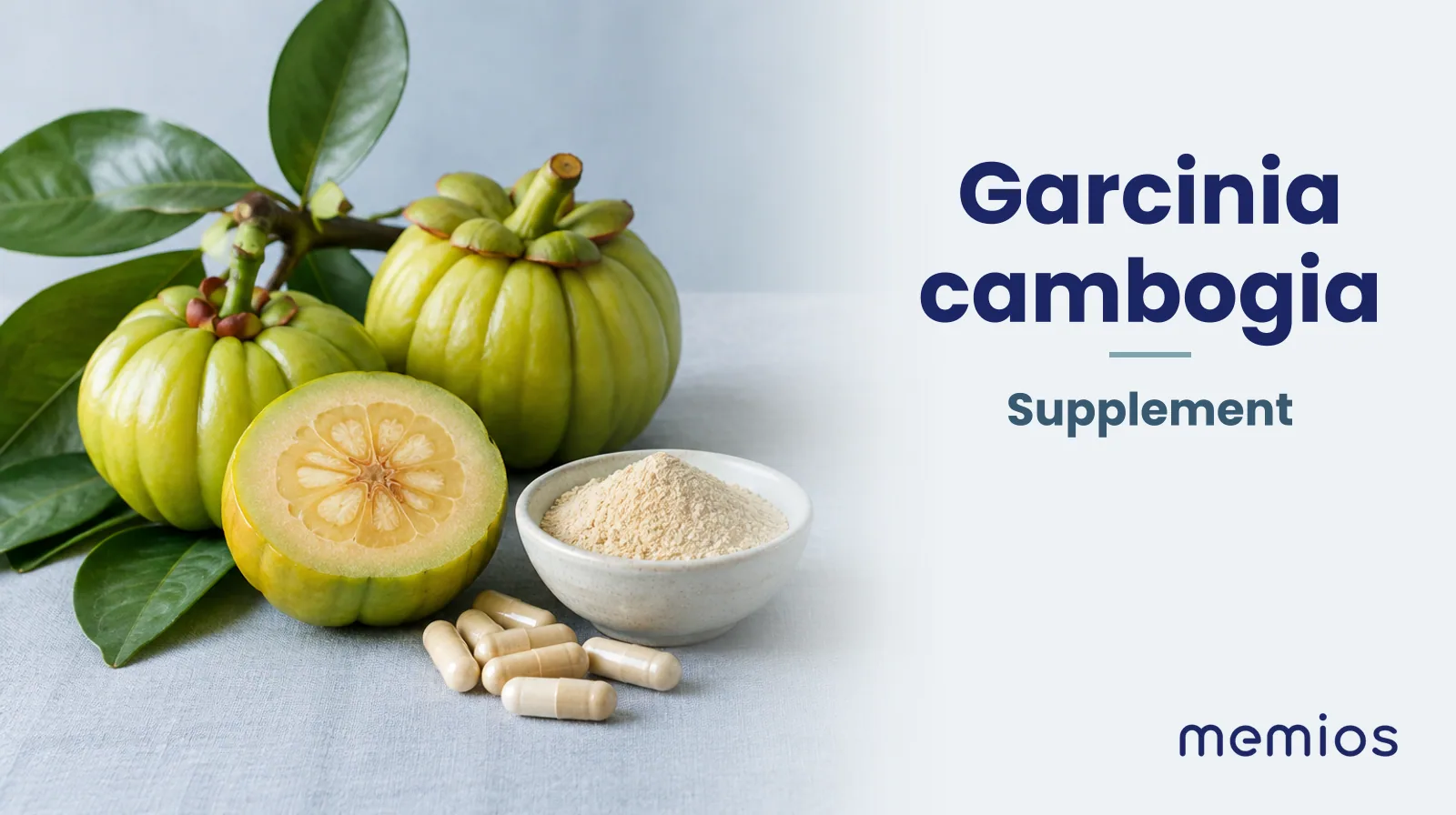
Garcinia cambogia is a fruit from a tree of southern Asia: "Garcinia cambogia is an herbal product derived from the fruit of the Malabar tamarind tree native to Southeastern Asia which is used as a food preservative and flavoring agent and has recently been used increasingly in herbal weight loss products." Its supposed active constituent is hydroxycitric acid, and "Garcinia fruit is 10% to 30% HCA by weight, and extracts can contain between 20% and 60% of the tricarboxylic acid." In laboratory terms, "HCA inhibits ATP citrate lyase an enzyme involved in fatty acid synthesis." It is most often sold inside multi-ingredient weight-loss products.
What the research says
It is sold for weight loss. The trials that exist are small and short, and the pooled effect is around one kilogram, which the reviewers themselves call of uncertain clinical relevance. A separate 2025 meta-analysis found no effect at all on blood sugar, insulin or liver enzymes. The serious concern is the liver: published case reports and case series describe acute liver injury, including acute liver failure, in people taking Garcinia cambogia products, often multi-ingredient ones.
Evidence grade: Limited evidence.
What goes wrong
A case series in Internal and Emergency Medicine reported four cases of acute liver failure in women taking Garcinia cambogia extract for weight loss. (Source 1)
- Case series, Low certainty.
- Size: four cases.
- Who: women taking Garcinia cambogia extract for weight loss.
- How long: not stated in the abstract.
- Result: four cases of acute liver failure; individual outcomes not given in the abstract.
- Funding: not stated.
Here, we present four cases of acute liver failure in women taking GC extract for weight loss, and a literature review of clinical evidences about hepatic toxicity in patients taking dietary supplements containing GC extract.
LiverTox records at least a dozen published reports of Garcinia-associated liver injury, typically hepatocellular and appearing one to four weeks after starting the product, with some cases severe enough to cause death or require urgent transplantation. (Source 2)
- Case series, Moderate certainty.
- Size: "at least a dozen reports"
- Who: individuals taking multi-ingredient dietary supplements containing Garcinia.
- How long: latency of 1 to 4 weeks after starting.
- Result: "The frequency of hepatic adverse reactions to Garcinia cambogia is not known but is likely uncommon and in less than 1:10,000 persons." Likelihood score B.
- Funding: US government resource (NIDDK)
Some cases have been severe, resulting in acute liver failure and either death or need for urgent liver transplantation.
Attribution is complicated because Garcinia is usually one ingredient among several, including products with other suspected hepatotoxins such as Hydroxycut. (Source 3)
- Case series, Low certainty.
- Size: "at least a dozen reports" of multi-ingredient supplement cases.
- Who: users of multi-ingredient dietary supplements.
- How long: not applicable.
- Result: no rate; a caveat about causal attribution.
- Funding: US government resource (NIDDK)
In some instances, other known or suspected hepatotoxins were present in the MIDS products (such as with Exilis, Herbalife and Hydroxycut products).
Three case reports describe mania emerging in previously stable adults after they started Garcinia cambogia, with the authors stating causation cannot be established. (Source 4)
- Case series, Very low certainty.
- Size: 3 stable, euthymic adults.
- Who: adults with psychiatric histories who began dieting and taking Garcinia cambogia.
- How long: onset within weeks; one case after 4-6 weeks of use.
- Result: three cases of mania; no rate and no control group.
- Funding: not stated.
We report 3 stable, euthymic adults whose mania emerged when they began taking G.cambogia.
Gastrointestinal side effects were more frequent on hydroxycitric acid than placebo in one of the pooled trials. (Source 5)
- Meta-analysis, Very low certainty.
- Size: one included study within a twelve-trial review.
- Who: trial participants taking hydroxycitric acid.
- How long: short-term.
- Result: "twice as common in the HCA group compared with placebo"
- Funding: not stated.
Gastrointestinal adverse events were twice as common in the HCA group compared with placebo in one included study.
NCCIH's position, updated February 2025, is that the weight-loss evidence is unclear, that several cases of liver damage have been reported, and that interactions with liver-affecting and serotonin-affecting drugs have been described. (Source 6)
- Official position, Certainty not rated.
- Size: not applicable.
- Who: US consumers.
- How long: not applicable.
- Result: no numbers given.
- Funding: US government agency.
Interactions between garcinia cambogia and some drugs affecting the liver and some drugs affecting serotonin (a chemical made by nerve cells) have been reported, and there are theoretical reasons to suspect that garcinia cambogia might interact with other drugs as well.
What the evidence supports
A 2011 systematic review and meta-analysis of randomised trials found a small weight difference favouring hydroxycitric acid over placebo, with the confidence interval touching zero. (Source 7)
- Meta-analysis, Low certainty.
- Size: "Twenty-three eligible trials were identified and twelve were included." Nine had data suitable for pooling.
- Who: overweight and obese adults in randomised placebo-controlled trials.
- How long: short-term trials.
- Result: "MD: −0.88 kg; 95% CI: −1.75, −0.00"
- Funding: not stated.
The meta-analysis revealed a small, statistically significant difference in weight loss favouring HCA over placebo (MD: −0.88 kg; 95% CI: −1.75, −0.00).
A 2020 dose-response meta-analysis reported statistically significant reductions in weight and BMI with Garcinia cambogia versus placebo. (Source 8)
- Meta-analysis, Low certainty.
- Size: eight trials, 530 participants (as reported by the review)
- Who: adults in randomised placebo-controlled trials of Garcinia cambogia.
- How long: varied; a nonlinear dose relationship was reported.
- Result: weight "-1.34 kg (95% CI: -2.62 to -0.07, P = 0.03)"; BMI "-0.99 kg/m² (95% CI: -1.48 to -0.49, P < 0.001)"
- Funding: not stated.
Garcinia cambogia supplement had a significant effect on the body weight, BMI, PFA, and WC as compared with the placebo.
What the evidence does not support
A 2025 meta-analysis of nine publications found no effect of Garcinia cambogia on fasting blood sugar, insulin, ALT or AST. (Source 9)
- Meta-analysis, Low certainty.
- Size: nine publications with 444 participants.
- Who: adults in randomised controlled trials.
- How long: varied; longer interventions showed a trend on insulin only.
- Result: "FBS (weighted mean difference (WMD): 1.02 mg/dl, 95% CI: −1.29, 3.33), insulin (WMD: −0.12 mU/L, 95% CI: −1.50, 1.25), AST (Hedges' g: −0.08, 95% CI: −0.43, 0.26), and ALT (Hedges' g: 0.27, 95% CI: −0.20, 0.73)"
- Funding: not stated.
Garcinia cambogia has no significant effect on FBS (weighted mean difference (WMD): 1.02 mg/dl, 95% CI: −1.29, 3.33), insulin (WMD: −0.12 mU/L, 95% CI: −1.50, 1.25), AST (Hedges' g: −0.08, 95% CI: −0.43, 0.26), and ALT (Hedges' g: 0.27, 95% CI: −0.20, 0.73).
The 2011 review's own authors judged the weight effect too small to be clearly meaningful and the trials poorly reported. (Source 10)
- Meta-analysis, Low certainty.
- Size: twelve trials included.
- Who: overweight and obese adults.
- How long: short-term.
- Result: no separate numbers; a qualitative judgement about clinical relevance.
- Funding: not stated.
The magnitude of the effect is small, and the clinical relevance is uncertain. Future trials should be more rigorous and better reported.
Where the evidence is mixed
A 2024 meta-analysis of eight trials found lower serum leptin with Garcinia cambogia, but with extreme heterogeneity and half the trials rated poor quality. (Source 11)
- Meta-analysis, Very low certainty.
- Size: eight eligible trials with 330 participants.
- Who: adults in randomised controlled trials.
- How long: not stated in the extracted text.
- Result: "WMD: −5.01 ng/ml; 95 % CI [−9.22, −0.80], p = 0.02", with I2 = 93.5%.
- Funding: not stated.
significant heterogeneity was detected between studies (I2 = 93.5 %, p < 0.001).
Where the research disagrees
Whether Garcinia cambogia produces a weight loss worth having
- Golzarand and colleagues, Complementary Therapies in Medicine 2020, dose-response meta-analysis of randomised trials: "Garcinia cambogia supplement had a significant effect on the body weight, BMI, PFA, and WC as compared with the placebo." (Source 8)
- Onakpoya and colleagues, Journal of Obesity 2011, systematic review and meta-analysis of randomised trials: "The magnitude of the effect is small, and the clinical relevance is uncertain. Future trials should be more rigorous and better reported." (Source 10)
- NCCIH, February 2025, agency position summarising the literature: "It's unclear whether garcinia cambogia products help with weight loss. Some evidence suggests a modest effect, while other evidence shows no effect." (Source 12)
Whether Garcinia itself causes the liver injuries reported
- Crescioli and colleagues, Internal and Emergency Medicine 2018, case series and literature review: "Here, we present four cases of acute liver failure in women taking GC extract for weight loss, and a literature review of clinical evidences about hepatic toxicity in patients taking dietary supplements containing GC extract." (Source 1)
- LiverTox, NIDDK, February 2019, review of published case reports: "In some instances, other known or suspected hepatotoxins were present in the MIDS products (such as with Exilis, Herbalife and Hydroxycut products)." (Source 3)
How much
- Reference intake: No dietary reference intake exists. Garcinia cambogia is a fruit used as "a food preservative and flavoring agent", not an essential nutrient, and no body has set an RDA or adequate intake for it or for hydroxycitric acid. (Source 13)
- Upper limit: No tolerable upper intake level or acceptable daily intake has been set by any body we could reach. LiverTox states only that "The frequency of hepatic adverse reactions to Garcinia cambogia is not known but is likely uncommon and in less than 1:10,000 persons." (Source 14)
- Studied: LiverTox describes a trial regimen of "HCA [1500 mg daily] or placebo for 12 weeks", and case reports involving "Garcinia cambogia [1000 mg daily]". (Source 15)
- Studied: The 2020 dose-response meta-analysis reported that the relationship between dose and effect was not linear: "Dose-response analysis revealed that there is a nonlinear association between Garcinia cambogia dosage and changes in the body weight (Pnonlinearity = 0.04) and BMI (Pnonlinearity < 0.001) not PFM (Pnonlinearity = 0.68)." (Source 16)
A common belief, and what the research shows
The belief: Garcinia cambogia blocks fat, so it is a reliable and harmless way to lose weight.
What the research shows: The measured effect is about a kilogram and the reviewers who found it wrote that "The magnitude of the effect is small, and the clinical relevance is uncertain." A 2025 meta-analysis found that "Garcinia cambogia has no significant effect on FBS, insulin, ALT, or AST levels compared with control groups". Harmless is also not established: LiverTox records that "Some cases have been severe, resulting in acute liver failure and either death or need for urgent liver transplantation."
Questions and answers
What is it?
Garcinia cambogia, also called Malabar tamarind or Garcinia gummi-gutta, is a fruit from a tree of southern Asia used in cooking as a souring and preserving agent. Supplements use an extract of the rind standardised for hydroxycitric acid. It is frequently sold as one ingredient inside multi-ingredient weight-loss products. (Source 13)
What does it do in the body?
Hydroxycitric acid, the compound supplements are standardised for, blocks an enzyme the body uses in building fatty acids, which is the laboratory rationale for the weight-loss claim. It has also been described as affecting serotonin release, which is the proposed explanation for reported mood effects. Neither mechanism has translated into a large clinical effect. (Source 17)
Is it good or bad for you?
On current evidence it is at best marginally useful and carries a real, if uncommon, liver risk. Meta-analyses find weight differences around 0.9 to 1.3 kg that the reviewers call of uncertain clinical relevance, and no effect on blood sugar or liver enzymes. Against that, published case reports include acute liver failure requiring transplantation. (Source 2)
How do you get more of it?
It comes from the fruit rind and from extracts sold as capsules, usually standardised to hydroxycitric acid. Trials recorded in the literature have used regimens such as 1500 mg of hydroxycitric acid a day for 12 weeks, and case reports describe products taken at 1000 mg a day. These are the amounts studied, not a recommendation. (Source 15)
If it is harmful, what reduces it?
The literature we reached does not describe a treatment to clear hydroxycitric acid from the body. What it does describe is the pattern of injury to watch for when exposure has happened: symptoms and raised liver enzymes appearing one to four weeks after starting the product, in a hepatocellular pattern. Stopping the product is what case reports describe as the intervention. (Source 18)
Why might someone be low in it or missing it?
This question does not apply in the usual sense. Garcinia cambogia is a fruit used as a flavouring and preservative, not a nutrient the body needs or stores, so there is no deficiency. A person has none unless they eat the fruit or take a supplement containing the extract. (Source 13)
Which whole foods contain it or feed it?
The whole food is the Malabar tamarind fruit itself, used in South Asian cooking, especially the dried rind. Hydroxycitric acid makes up a substantial share of the fruit by weight, and much more in concentrated extracts. (Source 19)
What happens if you do not have it?
Nothing identified in the literature happens if you never consume it. There is no described deficiency state, no requirement and no health consequence of absence; the research question has always been whether adding it does anything, and the 2011 review concluded the effect is small and of uncertain clinical relevance. (Source 10)
We searched: We searched the systematic reviews and meta-analyses, LiverTox and NCCIH for any requirement, reference intake or deficiency syndrome for Garcinia cambogia or hydroxycitric acid; none is described.
How can you test for it?
There is no validated clinical test for Garcinia cambogia or hydroxycitric acid status. What is tested in practice is liver function, because that is where the recognised harm shows: case reports describe raised serum aminotransferases in a hepatocellular pattern. A pooled analysis of trials, however, found no average change in ALT or AST, so normal liver tests in a group do not rule out injury in an individual. (Source 20)
References
- Internal and Emergency Medicine. Acute liver injury following Garcinia cambogia weight-loss supplementation: case series and literature review. 2018. PMID 29802521, DOI 10.1007/s11739-018-1880-4. Read the source
- National Institute of Diabetes and Digestive and Kidney Diseases (NIDDK). Garcinia Cambogia - LiverTox: Clinical and Research Information on Drug-Induced Liver Injury. 2019. PMID 31643417. Read the source
- National Institute of Diabetes and Digestive and Kidney Diseases (NIDDK). Garcinia Cambogia - LiverTox: Clinical and Research Information on Drug-Induced Liver Injury. 2019. PMID 31643417. Read the source
- The Primary Care Companion for CNS Disorders. Mania Induced by Garcinia cambogia: A Case Series. 2016. DOI 10.4088/PCC.15l01890. Read the source
- Journal of Obesity. The Use of Garcinia Extract (Hydroxycitric Acid) as a Weight loss Supplement: A Systematic Review and Meta-Analysis of Randomised Clinical Trials. 2011. PMID 21197150, DOI 10.1155/2011/509038. Read the source
- National Center for Complementary and Integrative Health (NCCIH), NIH. Garcinia Cambogia: Usefulness and Safety. 2025. Read the source
- Journal of Obesity. The Use of Garcinia Extract (Hydroxycitric Acid) as a Weight loss Supplement: A Systematic Review and Meta-Analysis of Randomised Clinical Trials. 2011. PMID 21197150, DOI 10.1155/2011/509038. Read the source
- Complementary Therapies in Medicine. Effect of Garcinia cambogia supplement on obesity indices: A systematic review and dose-response meta-analysis. 2020. PMID 32951714, DOI 10.1016/j.ctim.2020.102451. Read the source
- Journal of Nutritional Science (Cambridge University Press). The effects of Garcinia cambogia on glycaemic control and liver enzymes in adults: a systematic review and meta-analysis of randomised controlled trials. 2025. DOI 10.1017/jns.2024.91. Read the source
- Journal of Obesity. The Use of Garcinia Extract (Hydroxycitric Acid) as a Weight loss Supplement: A Systematic Review and Meta-Analysis of Randomised Clinical Trials. 2011. PMID 21197150, DOI 10.1155/2011/509038. Read the source
- Complementary Therapies in Medicine. The effects of Garcinia cambogia (hydroxycitric acid) on serum leptin concentrations: A systematic review and meta-analysis of randomized controlled trials. 2024. PMID 38876392, DOI 10.1016/j.ctim.2024.103060. Read the source
- National Center for Complementary and Integrative Health (NCCIH), NIH. Garcinia Cambogia: Usefulness and Safety. 2025. Read the source
- National Institute of Diabetes and Digestive and Kidney Diseases (NIDDK). Garcinia Cambogia - LiverTox: Clinical and Research Information on Drug-Induced Liver Injury. 2019. PMID 31643417. Read the source
- National Institute of Diabetes and Digestive and Kidney Diseases (NIDDK). Garcinia Cambogia - LiverTox: Clinical and Research Information on Drug-Induced Liver Injury. 2019. PMID 31643417. Read the source
- National Institute of Diabetes and Digestive and Kidney Diseases (NIDDK). Garcinia Cambogia - LiverTox: Clinical and Research Information on Drug-Induced Liver Injury. 2019. PMID 31643417. Read the source
- Complementary Therapies in Medicine. Effect of Garcinia cambogia supplement on obesity indices: A systematic review and dose-response meta-analysis. 2020. PMID 32951714, DOI 10.1016/j.ctim.2020.102451. Read the source
- National Institute of Diabetes and Digestive and Kidney Diseases (NIDDK). Garcinia Cambogia - LiverTox: Clinical and Research Information on Drug-Induced Liver Injury. 2019. PMID 31643417. Read the source
- National Institute of Diabetes and Digestive and Kidney Diseases (NIDDK). Garcinia Cambogia - LiverTox: Clinical and Research Information on Drug-Induced Liver Injury. 2019. PMID 31643417. Read the source
- National Institute of Diabetes and Digestive and Kidney Diseases (NIDDK). Garcinia Cambogia - LiverTox: Clinical and Research Information on Drug-Induced Liver Injury. 2019. PMID 31643417. Read the source
- National Institute of Diabetes and Digestive and Kidney Diseases (NIDDK). Garcinia Cambogia - LiverTox: Clinical and Research Information on Drug-Induced Liver Injury. 2019. PMID 31643417. Read the source