Supplements · September 29, 2026 · Memios · 12 min read
Folate and folic acid
Folic acid taken around conception has high-quality Cochrane evidence for preventing neural tube defects.
TLDR
- Well established. Folic acid taken around conception has high-quality Cochrane evidence for preventing neural tube defects.
- What it is: Folate is a water-soluble B vitamin that occurs naturally in some foods, is added to others, and is sold as a supplement.
- Main use, supported: Daily folic acid around conception prevents neural tube defects (high-quality evidence). (high certainty)
- Other use, supported: Compared with placebo, the same review found a small reduction in stroke with homocysteine-lowering interventions (high-quality evidence). (high certainty)
- Claim NOT supported by research: Compared with placebo, homocysteine-lowering interventions (folic acid-based B vitamins) made no difference to heart attacks, deaths from any cause or serious adverse events (high-quality evidence). (high certainty)
- Another claim NOT supported: Lowering homocysteine with B vitamins had no significant effect on cognitive function or cognitive ageing. (moderate certainty)
- Recommended dose (official position): RDA 400 mcg DFE/day for adults, 600 mcg DFE in pregnancy, 500 mcg DFE in lactation (US Food and Nutrition Board, Institute of Medicine, 1998). 1 mcg DFE = 1 mcg food folate = 0.6 mcg folic acid from fortified food or with food.
- Studied dose (a trial dose, not a recommendation): Folic acid 0.8 mg/day combined with enalapril 10 mg in adults with hypertension in China. Findings citing that trial: 1 for.
- Upper limit: UL 1,000 mcg/day for adults, applying only to folic acid from supplements and fortified foods, not food folate (US Food and Nutrition Board, 1998), set because of the folate-B12 interaction.
- What goes wrong: 2 findings on harm. An American Family Physician summary reports that the trial's authors concluded high-dose B vitamins (including 2.5 mg folic acid) lowered homocysteine but worsened diabetic kidney disease and increased cerebrovascular and cardiovascular events in people...
- Common myth: Lowering homocysteine with folic acid protects the heart and the brain.
What it is
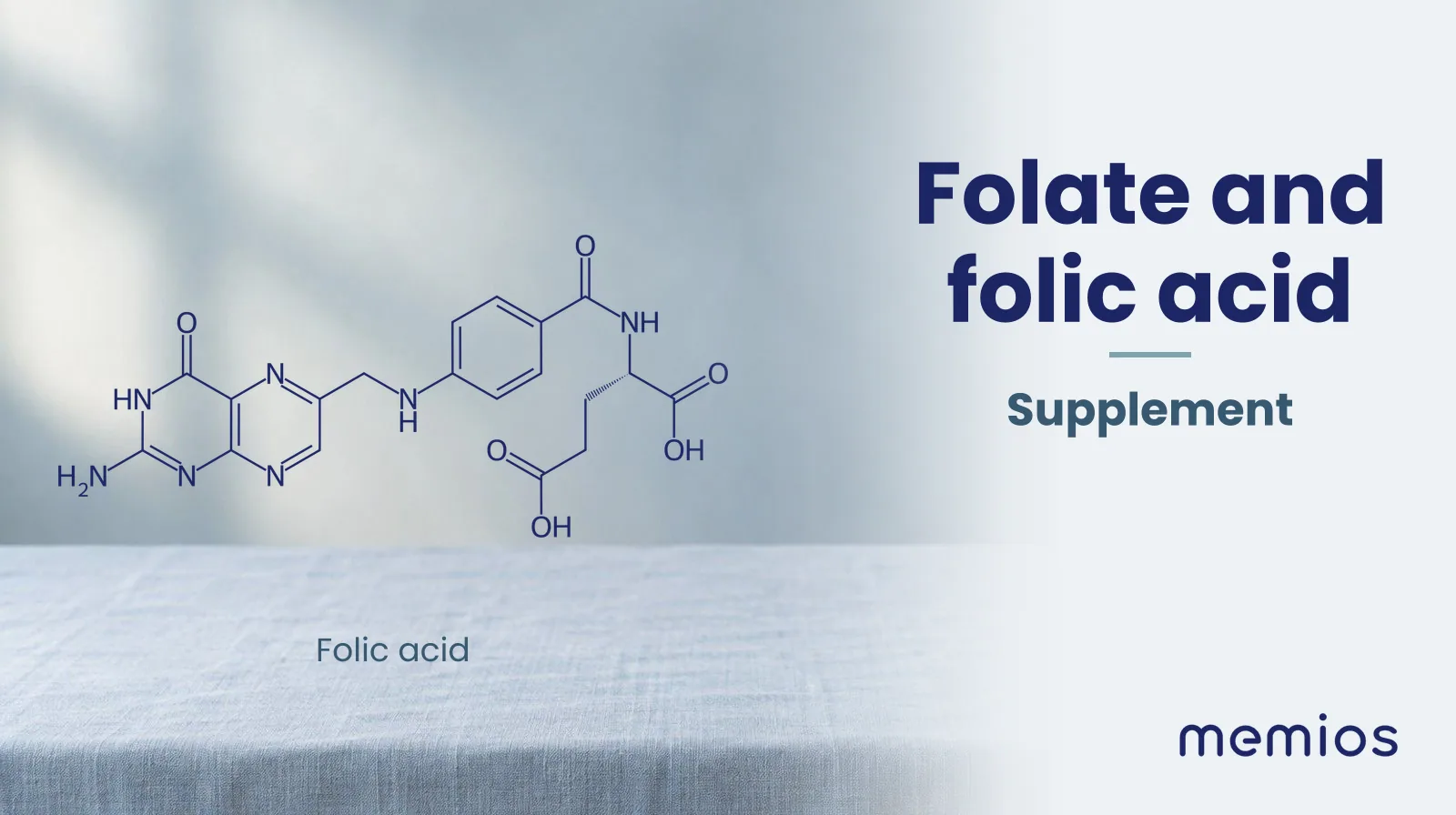
Folate is a water-soluble B vitamin that occurs naturally in some foods, is added to others, and is sold as a supplement. The word folate covers the natural food folates and the forms used in supplements and fortified foods, including folic acid.
What the research says
Folic acid taken around conception has high-quality Cochrane evidence for preventing neural tube defects. Folic acid-based homocysteine-lowering trials show no effect on heart attacks or deaths, a small reduction in stroke, and no effect on cognitive ageing. An earlier cancer signal from Norwegian trials was not borne out in a 13-trial individual-patient meta-analysis over about 5 years. High folic acid intake can hide B12 deficiency by correcting the anemia while nerve damage continues.
Evidence grade: Well established.
What goes wrong
High folate intake can correct the megaloblastic anemia of B12 deficiency without correcting the neurological damage. (Source 1)
- Official position, Certainty not rated.
- Size: not applicable.
- Who: People with B12 deficiency.
- How long: not applicable.
- Result: not applicable.
- Funding: Government.
Large amounts of folate can correct the megaloblastic anemia, but not the neurological damage, that can result from vitamin B12 deficiency.
An American Family Physician summary reports that the trial's authors concluded high-dose B vitamins (including 2.5 mg folic acid) lowered homocysteine but worsened diabetic kidney disease and increased cerebrovascular and cardiovascular events in people with diabetes. (Source 2)
- Randomized trial, Moderate certainty.
- Size: 238 randomised.
- Who: Adults with diabetes and known renal disease.
- How long: Follow-up every six months for up to 36 months.
- Result: Greater fall in GFR with B vitamins (16.5 vs 10.7 mL/min; P = .02); combined secondary outcomes higher (P = .04)
- Funding: not stated in the fetched summary.
Limit of this finding: This trial is known here only through a journal summary (American Family Physician, 2011), not the original JAMA 2010 paper. The summary says 238 patients were randomised but also says enrolment stopped after 252 patients, without explaining the difference, and it prints the placebo group's kidney-function figure in different units (per m2) from the treatment group's (per 1.73 m2), which looks like a typing slip. The direction of the result is not affected, but exact numbers should be checked against the original paper.
The authors conclude that supplementation with high doses of B vitamins lowers plasma homocysteine levels but worsens diabetic nephropathy and increases the risk of cerebrovascular and cardiovascular events in patients with diabetes.
What the evidence supports
Daily folic acid around conception prevents neural tube defects (high-quality evidence). (Source 3)
- Systematic review, High certainty.
- Size: 7,391 women in 5 trials (6,708 births for NTD outcome)
- Who: Women planning pregnancy, with or without a previous NTD-affected pregnancy.
- How long: Periconceptional.
- Result: RR 0.31 (95% CI 0.17 to 0.58); five studies; high quality evidence.
- Funding: not stated.
The results of the first comparison involving 6708 births with information on NTDs and other infant outcomes, show a protective effect of daily folic acid supplementation (alone or in combination with other vitamins and minerals) in preventing NTDs compared with no interventions/placebo or vitamins and minerals without folic acid (risk ratio (RR) 0.31, 95% confidence interval (CI) 0.17 to 0.58); five studies; 6708 births; high quality evidence).
Compared with placebo, the same review found a small reduction in stroke with homocysteine-lowering interventions (high-quality evidence). (Source 4)
- Systematic review, High certainty.
- Size: 44,224 participants in 10 trials.
- Who: People at risk of or with cardiovascular disease.
- How long: not recorded.
- Result: Stroke 4.3% vs 5.1%; RR 0.90 (95% CI 0.82 to 0.99)
- Funding: not stated.
Compared with placebo, homocysteine-lowering interventions were associated with reduced stroke outcome (homocysteine-lowering = 4.3% versus comparator = 5.1%, RR 0.90, 95% CI 0.82 to 0.99, I2 = 8%, 10 trials, N = 44,224; high-quality evidence).
In Chinese adults with hypertension, enalapril plus folic acid 0.8 mg reduced first stroke compared with enalapril alone. (Source 5)
- Randomized trial, Moderate certainty.
- Size: 20,702 adults.
- Who: Adults with hypertension in China, without prior stroke or MI.
- How long: not recorded in fetched text.
- Result: First stroke 2.7% vs 3.4%; HR 0.79 (95% CI 0.68-0.93)
- Funding: not stated in the fetched text.
Among adults with hypertension in China without a history of stroke or MI, the combined use of enalapril and folic acid, compared with enalapril alone, significantly reduced the risk of first stroke.
What the evidence does not support
Compared with placebo, homocysteine-lowering interventions (folic acid-based B vitamins) made no difference to heart attacks, deaths from any cause or serious adverse events (high-quality evidence). (Source 6)
- Systematic review, High certainty.
- Size: 46,699 participants in 12 trials (review total 71,422 in 15 RCTs)
- Who: People at risk of or with cardiovascular disease.
- How long: not recorded.
- Result: MI 7.1% vs 6.0%, RR 1.02 (95% CI 0.95 to 1.10); death 11.7% vs 12.3%, RR 1.01 (0.96 to 1.06); serious adverse events 8.3% vs 8.5%, RR 1.07 (1.00 to 1.14)
- Funding: not stated.
Compared with placebo, there were no differences in effects of homocysteine-lowering interventions on myocardial infarction (homocysteine-lowering = 7.1% versus placebo = 6.0%; RR 1.02, 95% confidence interval (CI) 0.95 to 1.10, I2 = 0%, 12 trials; N = 46,699; Bayes factor 1.04, high-quality evidence), death from any cause (homocysteine-lowering = 11.7% versus placebo = 12.3%, RR 1.01, 95% CI 0.96 to 1.06, I2 = 0%, 11 trials, N = 44,817; Bayes factor = 1.05, high-quality evidence)
Lowering homocysteine with B vitamins had no significant effect on cognitive function or cognitive ageing. (Source 7)
- Meta-analysis, Moderate certainty.
- Size: 22,000 participants in 11 trials.
- Who: Older adults in large homocysteine-lowering trials.
- How long: not recorded.
- Result: Homocysteine lowered 28%; no significant effect on domain or global cognitive z scores.
- Funding: not stated.
Homocysteine lowering by using B vitamins had no significant effect on individual cognitive domains or global cognitive function or on cognitive aging.
In an individual-participant meta-analysis of 13 trials, folic acid did not substantially increase or decrease site-specific cancer over the first 5 years. (Source 8)
- Meta-analysis, Moderate certainty.
- Size: 49,621 participants in 13 trials.
- Who: Participants in cardiovascular and colorectal adenoma prevention trials.
- How long: Weighted average 5.2 years.
- Result: Overall cancer 1904 vs 1809; RR 1.06 (95% CI 0.99-1.13), p=0.10.
- Funding: not stated.
Folic acid supplementation does not substantially increase or decrease incidence of site-specific cancer during the first 5 years of treatment.
Where the evidence is mixed
The Cochrane review concluded folic acid prevents NTDs but has no clear effect on other birth defects. (Source 9)
- Systematic review, High certainty.
- Size: 5 trials, 7,391 women.
- Who: Women of reproductive age.
- How long: Periconceptional.
- Result: No clear effect on other birth defects.
- Funding: not stated.
Folic acid, alone or in combination with vitamins and minerals, prevents NTDs, but does not have a clear effect on other birth defects.
Where the research disagrees
Whether folic acid supplementation raises cancer risk
- Vollset et al., B-Vitamin Treatment Trialists' Collaboration (Lancet 2013), Individual-participant meta-analysis of 13 RCTs including the Norwegian trials: Folic acid supplementation does not substantially increase or decrease incidence of site-specific cancer during the first 5 years of treatment. (Source 8)
- Ebbing et al., JAMA 2009 (combined Norwegian NORVIT and WENBIT trials), Post-trial follow-up of two RCTs: Reported higher cancer incidence and mortality in participants given folic acid plus B12; the abstract could not be fetched for this batch, so no quote is recorded (see notes). (Source 10)
Whether homocysteine-lowering folic acid prevents cardiovascular disease
- Martí-Carvajal et al., Cochrane (2017), Systematic review of 15 RCTs: Compared with placebo, there were no differences in effects of homocysteine-lowering interventions on myocardial infarction (homocysteine-lowering = 7.1% versus placebo = 6.0%; RR 1.02, 95% confidence interval (CI) 0.95 to 1.10, I2 = 0%, 12 trials; N = 46,699; Bayes factor 1.04, high-quality evidence) (Source 6)
- Huo et al., CSPPT (2015), RCT in a population without folic acid fortification: Among adults with hypertension in China without a history of stroke or MI, the combined use of enalapril and folic acid, compared with enalapril alone, significantly reduced the risk of first stroke. (Source 5)
How much
- Reference intake: RDA 400 mcg DFE/day for adults, 600 mcg DFE in pregnancy, 500 mcg DFE in lactation (US Food and Nutrition Board, Institute of Medicine, 1998). 1 mcg DFE = 1 mcg food folate = 0.6 mcg folic acid from fortified food or with food. (Source 11)
- Upper limit: UL 1,000 mcg/day for adults, applying only to folic acid from supplements and fortified foods, not food folate (US Food and Nutrition Board, 1998), set because of the folate-B12 interaction. (Source 12)
- Studied: Folic acid 0.8 mg/day combined with enalapril 10 mg in adults with hypertension in China. (Source 5)
- Studied: US mandatory fortification since January 1998: 140 mcg folic acid per 100 g of enriched grain products. (Source 13)
A common belief, and what the research shows
The belief: Lowering homocysteine with folic acid protects the heart and the brain.
What the research shows: The Cochrane review found 'there were no differences in effects of homocysteine-lowering interventions on myocardial infarction', and a meta-analysis of 11 trials found 'Homocysteine lowering by using B vitamins had no significant effect on individual cognitive domains or global cognitive function or on cognitive aging.' A small stroke reduction was seen.
Questions and answers
What is it?
Folate is a water-soluble B vitamin, sometimes called vitamin B9. The term covers natural food folates and the forms in supplements and fortified foods, including synthetic folic acid. (Source 11)
What does it do in the body?
Folate works as a coenzyme in single-carbon transfers, which the body uses to make DNA and RNA and to process amino acids. (Source 14)
Is it good or bad for you?
Folic acid, alone or with other vitamins and minerals, prevents neural tube defects, but a Cochrane review found no clear effect on other birth defects. (Source 9)
How do you get more of it?
From food, from supplements, and in the US from fortified grain products: since January 1998 manufacturers must add 140 mcg folic acid per 100 g of enriched grain products. (Source 13)
If it is harmful, what reduces it?
Does not apply to food folate. US authorities set an upper limit only for the synthetic forms in supplements and fortified foods, because of folate's interaction with vitamin B12. (Source 12)
Why might someone be low in it or missing it?
People with alcohol use disorder often have poor-quality diets that contain too little folate. (Source 15)
Which whole foods contain it or feed it?
Vegetables (especially dark green leafy ones), fruits and juices, nuts, beans, peas, seafood, eggs, dairy, meat, poultry and grains. Spinach, liver, asparagus and brussels sprouts are among the highest. (Source 16)
What happens if you do not have it?
The main clinical sign of folate (or B12) deficiency is megaloblastic anemia, with large, abnormal red blood cells. Its symptoms include weakness, fatigue, difficulty concentrating, irritability, headache, heart palpitations and shortness of breath. (Source 17)
How can you test for it?
Serum folate is commonly used, with a value above 3 ng/mL indicating adequacy, but it is sensitive to recent intake and might not reflect long-term status. Red blood cell (erythrocyte) folate gives a longer-term measure, with above 140 ng/mL indicating adequate status. (Source 18)
References
- NIH Office of Dietary Supplements. Folate - Fact Sheet for Health Professionals. n.d. (fetched 2026-09-21). Read the source
- American Family Physician. High Doses of B Vitamins May Worsen Diabetic Nephropathy (POEM summary of House AA et al., JAMA 2010;303(16):1603-1609). 2011. Read the source
- Cochrane Database of Systematic Reviews. Effects and safety of periconceptional oral folate supplementation for preventing birth defects. 2015. PMID 26662928, DOI 10.1002/14651858.CD007950.pub3. Read the source
- Cochrane Database of Systematic Reviews. Homocysteine-lowering interventions for preventing cardiovascular events. 2017. PMID 28816346, DOI 10.1002/14651858.CD006612.pub5. Read the source
- JAMA. Efficacy of Folic Acid Therapy in Primary Prevention of Stroke Among Adults With Hypertension in China: The CSPPT Randomized Clinical Trial. 2015. PMID 25771069, DOI 10.1001/jama.2015.2274. Read the source
- Cochrane Database of Systematic Reviews. Homocysteine-lowering interventions for preventing cardiovascular events. 2017. PMID 28816346, DOI 10.1002/14651858.CD006612.pub5. Read the source
- American Journal of Clinical Nutrition. Effects of homocysteine lowering with B vitamins on cognitive aging: meta-analysis of 11 trials with cognitive data on 22,000 individuals. 2014. PMID 24965307, DOI 10.3945/ajcn.113.076349. Read the source
- The Lancet. Effects of folic acid supplementation on overall and site-specific cancer incidence during the randomised trials: meta-analyses of data on 50,000 individuals. 2013. PMID 23352552, DOI 10.1016/S0140-6736(12)62001-7. Read the source
- Cochrane Database of Systematic Reviews. Effects and safety of periconceptional oral folate supplementation for preventing birth defects. 2015. PMID 26662928, DOI 10.1002/14651858.CD007950.pub3. Read the source
- The Lancet. Effects of folic acid supplementation on overall and site-specific cancer incidence during the randomised trials: meta-analyses of data on 50,000 individuals. 2013. PMID 23352552, DOI 10.1016/S0140-6736(12)62001-7. Read the source
- NIH Office of Dietary Supplements. Folate - Fact Sheet for Health Professionals. n.d. (fetched 2026-09-21). Read the source
- NIH Office of Dietary Supplements. Folate - Fact Sheet for Health Professionals. n.d. (fetched 2026-09-21). Read the source
- NIH Office of Dietary Supplements. Folate - Fact Sheet for Health Professionals. n.d. (fetched 2026-09-21). Read the source
- NIH Office of Dietary Supplements. Folate - Fact Sheet for Health Professionals. n.d. (fetched 2026-09-21). Read the source
- NIH Office of Dietary Supplements. Folate - Fact Sheet for Health Professionals. n.d. (fetched 2026-09-21). Read the source
- NIH Office of Dietary Supplements. Folate - Fact Sheet for Health Professionals. n.d. (fetched 2026-09-21). Read the source
- NIH Office of Dietary Supplements. Folate - Fact Sheet for Health Professionals. n.d. (fetched 2026-09-21). Read the source
- NIH Office of Dietary Supplements. Folate - Fact Sheet for Health Professionals. n.d. (fetched 2026-09-21). Read the source