Supplements · September 29, 2026 · Memios · 13 min read
Exogenous ketones
Limited evidence. The evidence is limited and mixed.
TLDR
- Limited evidence. The evidence is limited and mixed.
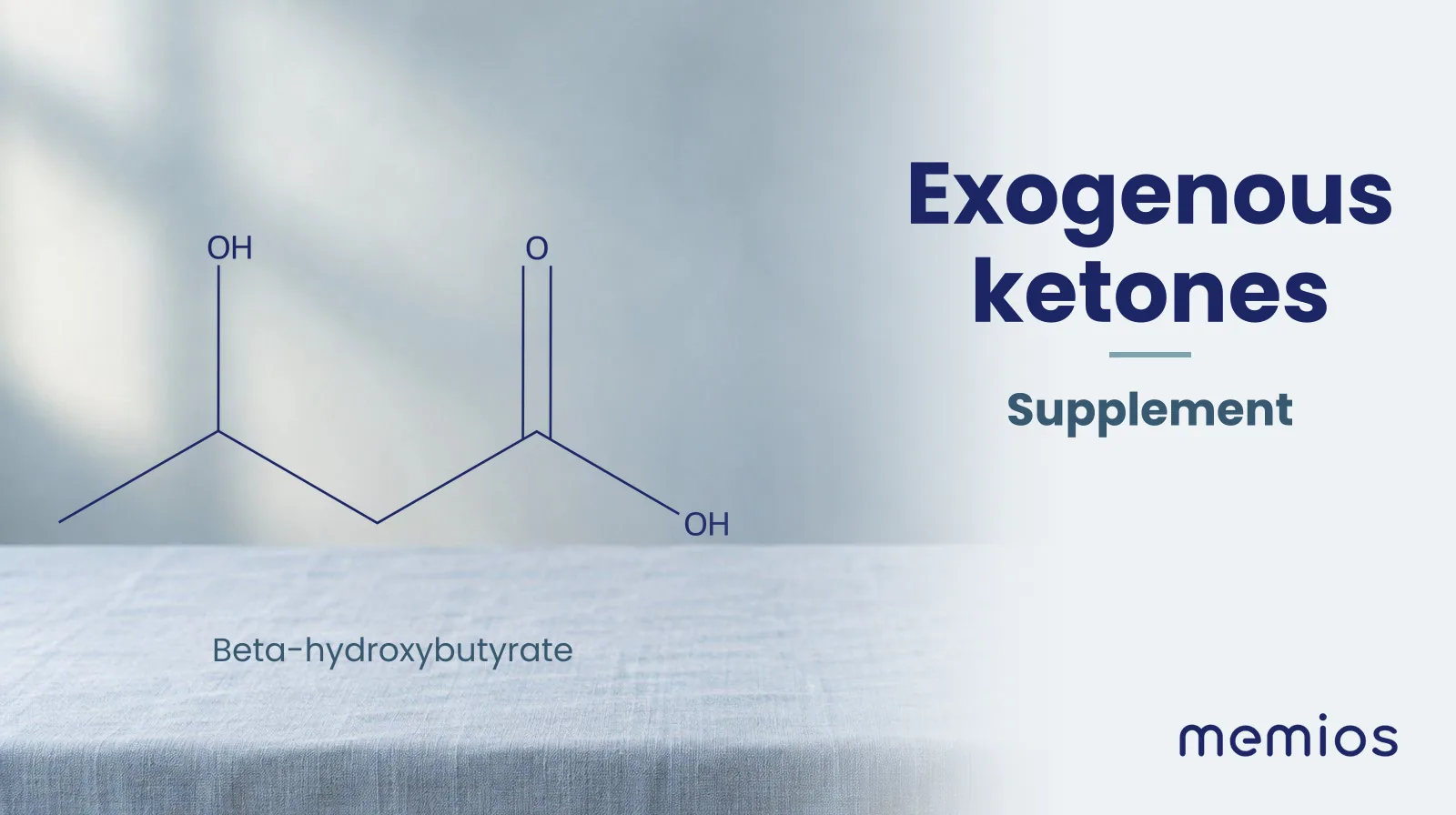
- What it is: Exogenous ketones are manufactured products that raise the blood concentration of the ketone body beta-hydroxybutyrate (BHB) without fasting or carbohydrate restriction. Two chemical families are sold: BHB bound to minerals as a salt, and esters or precursors such as (R)-1,3-butanediol that the liver converts to BHB.
- Main use, supported: An acute human pharmacokinetic study showed a (R)-1,3-butanediol beverage raised blood beta-hydroxybutyrate roughly ninefold above fasting baseline, peaking at about two and a quarter hours. (moderate certainty)
- Other use, supported: A 2026 systematic review and meta-analysis of randomised trials found a small but statistically significant average improvement in cognitive performance with exogenous ketones compared with placebo. (low certainty)
- Claim NOT supported by research: Pooled across eight randomised trials, ketone monoesters and precursors did not improve endurance exercise performance. (low certainty)
- Recommended dose: not established. No reference intake exists. Ketone bodies are fuels the body makes itself, and BHB salts are regulated in the European Union as a novel food ingredient rather than as a nutrient with a recommended intake.
- Studied dose (a trial dose, not a recommendation): 26 healthy adults drank three beverages each containing 11.5 g of (R)-1,3-butanediol at 0, 30 and 60 min, a total of 34.5 g. No finding here cites that trial.
- Upper limit: No upper limit has been set.
- What goes wrong: 3 findings on harm. In the same review, six of the seven trials that measured it reported more gastrointestinal distress on ketone supplements than on control, and vomiting, heartburn and stitches appeared only in the ketone arms.
- Common myth: Drinking ketones gives athletes an endurance edge because it mimics being in ketosis.
What it is
Exogenous ketones are manufactured products that raise the blood concentration of the ketone body beta-hydroxybutyrate (BHB) without fasting or carbohydrate restriction. Two chemical families are sold: BHB bound to minerals as a salt, and esters or precursors such as (R)-1,3-butanediol that the liver converts to BHB. EFSA describes the salt form as sodium, magnesium and calcium BHB salts sold as a food ingredient and as a food supplement. Ketone bodies themselves are normal human fuels that the body makes during fasting or a very low carbohydrate intake.
What the research says
The evidence is limited and mixed. A pooled analysis of eight randomised trials found no improvement in endurance exercise performance, while a much larger 2026 meta-analysis of cognitive outcomes found a small average improvement. Human studies consistently show the products do what they claim biochemically, raising blood BHB within a couple of hours. Gastrointestinal symptoms are the most commonly reported problem, and EFSA concluded in 2022 that the safety of BHB salts as a novel food had not been established.
Evidence grade: Limited evidence.
What goes wrong
In the same review, six of the seven trials that measured it reported more gastrointestinal distress on ketone supplements than on control, and vomiting, heartburn and stitches appeared only in the ketone arms. (Source 1)
- Systematic review, Low certainty.
- Size: 7 of the 8 included studies assessed gastrointestinal symptoms.
- Who: Trial participants given ketone monoesters or precursors before endurance exercise.
- How long: Acute; symptoms usually recorded within 10 minutes of each trial.
- Result: Six of seven studies reported higher GI distress in the ketone arm; one found no significant difference. Symptoms ranged from belching, cramps, flatulence, reflux, urge to defecate and nausea in both arms, to stitches, heartburn and vomiting in ketone arms only. Rates per participant were not pooled.
- Funding: not stated.
Six of the seven studies reported higher levels of GI distress in the ketone trial compared to the control
In an acute tolerability study of a 34.5 g (R)-1,3-butanediol beverage, mild headache was reported by five of 26 participants and judged possibly product-related in two. (Source 2)
- Blood level study, Low certainty.
- Size: 26 healthy adults.
- Who: Healthy fasted adults.
- How long: Single day.
- Result: 5 of 26 participants reported mild headache; 2 judged possibly related to the product. GI symptoms were absent or mild in most participants.
- Funding: not stated in the abstract.
Limit of this finding: There was no placebo group, so these headache reports have nothing to be compared against: five of 26 people reporting mild headache during a day of fasting and repeated blood sampling could reflect the day as much as the drink. The study's verdict that the beverage was 'generally well-tolerated' is the authors' own summary of an uncontrolled single-day study and says nothing about repeated or longer use.
Mild headaches were reported as an adverse event by five participants and judged possibly related to the study product in two of the participants.
EFSA's Panel on Nutrition, Novel Foods and Food Allergens concluded in 2022 that the safety of beta-hydroxybutyrate salts as a novel food had not been established and that no safe intake level could be set. (Source 3)
- Official position, Certainty not rated.
- Size: Regulatory dossier assessment, not a trial.
- Who: Adults, proposed food ingredient and food supplement uses in the European Union.
- How long: Opinion adopted 2022.
- Result: No safe intake level established; the applicant's identity, production and compositional data were judged unsatisfactory and the test item in the subchronic toxicity and human studies was inconsistently reported.
- Funding: European Food Safety Authority, at the request of the European Commission.
Owing to these deficiencies, the Panel cannot establish a safe intake level of the NF. The Panel concludes that the safety of the NF has not been established.
What the evidence supports
A 2026 systematic review and meta-analysis of randomised trials found a small but statistically significant average improvement in cognitive performance with exogenous ketones compared with placebo. (Source 4)
- Meta-analysis, Low certainty.
- Size: 38 studies comprising 41 protocols (1,602 participants) reviewed; 29 protocols (1,117 participants) pooled.
- Who: Healthy adults and people with neuropsychiatric conditions, including Alzheimer's disease.
- How long: Acute and intermediate-duration protocols.
- Result: SMD = 0.29, 95% CI 0.16-0.41; p < 0.001. Subgroup differences by supplement type (p = 0.083), duration (p = 0.11), population (p = 0.077) and cognitive stressor (p = 0.89) were not significant.
- Funding: not stated in the abstract; the competing-interests declaration accompanying this work (medRxiv preprint 2025.09.17.25335999) states that two authors were employed by Component Health Ltd, which commercialises ketone ester products, and that another author has an equity interest in HVMN Inc. and stock options in BHB Therapeutics Ltd, both of which market ketone products.
Limit of this finding: Who wrote this matters. The competing-interests declaration accompanying this review states that two of its five authors were employed by a company that commercialises ketone ester products, and that another author holds an equity interest in one ketone company and stock options in a second. The effect itself is small: a standardised mean difference of 0.29 is a fraction of a standard deviation, the certainty is low, and none of the subgroup comparisons reached significance. Treat it as a signal worth following, not as evidence that ketone drinks make people think better.
EK supplementation was associated with a statistically significant improvement in cognitive performance compared with placebo (SMD = 0.29, 95% CI 0.16–0.41; p < 0.001).
An acute human pharmacokinetic study showed a (R)-1,3-butanediol beverage raised blood beta-hydroxybutyrate roughly ninefold above fasting baseline, peaking at about two and a quarter hours. (Source 5)
- Blood level study, Moderate certainty.
- Size: 26 healthy adults.
- Who: Healthy adults after a 12-hour overnight fast.
- How long: Single day, measurements to 300 minutes.
- Result: Baseline BHB 0.23 +/- 0.21 mmol/L, maximal 2.10 +/- 0.97 mmol/L, Tmax 133.85 +/- 57.07 min, iAUC 376.73 +/- 156.76 mmol/L*min, after a total intake of 34.5 g.
- Funding: not stated in the abstract; the product is named by trade name, which suggests commercial involvement.
Limit of this finding: This was an open-label, single-arm trial of a named commercial product: every participant drank the same beverage and there was no placebo or control group. It therefore shows only that the drink raises blood ketones for a few hours, and nothing about whether raising them does anybody any good. The same abstract reports that in women the ketone peak arrived later than in men (p = 0.046); that is a difference in timing, not a larger ketone response.
The mean (±SD) BHB fasting baseline level, maximal concentration, time at maximal concentration, and incremental area under the curve over 300 min were 0.23 ± 0.21 mmol/L, 2.10 ± 0.97 mmol/L, 133.85 ± 57.07 min, and 376.73 ± 156.76 mmol/L*min, respectively.
What the evidence does not support
Pooled across eight randomised trials, ketone monoesters and precursors did not improve endurance exercise performance. (Source 6)
- Meta-analysis, Low certainty.
- Size: 8 studies, 80 participants (77 men and three women)
- Who: Humans in randomised controlled trials of endurance performance, overwhelmingly men.
- How long: Acute ingestion.
- Result: Hedges g = 0.136; 95% CI [-0.195, 0.467]; p = .419 overall. Time to exhaustion Hedge's g = -0.002; 95% CI [-0.312, 0.308]; p = .989. Time trial Hedge's g = 0.057; 95% CI [-0.282, 0.395]; p = .744.
- Funding: not stated.
When comparing endurance performance among all studies, no significant differences were found between ketone and control trials (Hedges g = 0.136; 95% CI [-0.195, 0.467]; p = .419).
Where the research disagrees
Whether exogenous ketones do anything useful for people who are not fasting
- Authors of the 2026 cognition meta-analysis, meta-analysis of 29 randomised protocols: EK supplementation was associated with a statistically significant improvement in cognitive performance compared with placebo (SMD = 0.29, 95% CI 0.16–0.41; p < 0.001). (Source 4)
- Authors of the 2022 endurance meta-analysis, meta-analysis of 8 randomised trials: Based on these findings, exogenous ketone precursors and monoesters do not exert significant improvements on endurance exercise performance. (Source 6)
How much
- Reference intake: No reference intake exists. Ketone bodies are fuels the body makes itself, and BHB salts are regulated in the European Union as a novel food ingredient rather than as a nutrient with a recommended intake. (Source 3)
- Upper limit: No upper limit has been set. EFSA stated in 2022 that it could not establish a safe intake level for BHB salts. (Source 3)
- Studied: 26 healthy adults drank three beverages each containing 11.5 g of (R)-1,3-butanediol at 0, 30 and 60 min, a total of 34.5 g. (Source 7)
- Studied: The endurance meta-analysis pooled eight acute-ingestion trials of ketone monoesters and precursors in 80 participants. (Source 6)
A common belief, and what the research shows
The belief: Drinking ketones gives athletes an endurance edge because it mimics being in ketosis.
What the research shows: The supplements do raise blood ketones, but the pooled randomised evidence in endurance athletes shows no performance benefit: "Based on these findings, exogenous ketone precursors and monoesters do not exert significant improvements on endurance exercise performance." The same review noted that "Six of the seven studies reported higher levels of GI distress in the ketone trial compared to the control".
Questions and answers
What is it?
Exogenous ketones are manufactured products that put the ketone body beta-hydroxybutyrate, or a chemical the liver turns into it, into a drink or capsule. The salt versions are beta-hydroxybutyrate bound to sodium, magnesium or calcium. They are sold as food ingredients and as supplements. In the European Union they are treated as a novel food, not as a nutrient. (Source 3)
What does it do in the body?
Ketone bodies are an alternative fuel the brain and muscle can burn when glucose is scarce, and they may also act as signalling molecules. Exogenous ketones are a way of raising the amount circulating in blood without cutting carbohydrate. Whether that translates into useful effects is what the trials disagree about. (Source 8)
Is it good or bad for you?
It depends entirely on what is being asked of them. Pooled across randomised trials of cognition, the average effect was positive but small. Pooled across randomised endurance trials, there was no effect at all, and more stomach upset in the ketone arms. EFSA has not accepted that the salt form is safe as sold. (Source 6)
How do you get more of it?
Studies raise blood ketones by giving a measured drink. In one acute study, 26 adults drank a total of 34.5 g of (R)-1,3-butanediol as three servings half an hour apart, which took blood beta-hydroxybutyrate from about 0.23 mmol/L to a peak around 2.10 mmol/L. The body also makes ketones on its own during fasting or very low carbohydrate intake. This describes what one trial did, not a recommendation. (Source 7)
If it is harmful, what reduces it?
Nothing needs to be done to remove them. Blood levels after a single dose peak at roughly two and a quarter hours on average and fall again over the following hours, so stopping the product is what ends the exposure. The literature we searched describes no procedure for clearing exogenous ketones. (Source 5)
Why might someone be low in it or missing it?
Low blood ketones are the normal state for someone eating carbohydrate; they are not a deficiency. Fasting or carbohydrate restriction raises them, and exogenous ketone products are marketed as a way of raising them without doing either. In the pharmacokinetic study above, fasted healthy adults started at about 0.23 mmol/L. (Source 8)
Which whole foods contain it or feed it?
No whole food supplies beta-hydroxybutyrate salts or ketone esters in meaningful amounts. They are manufactured and added to foods and supplements, which is why the European Union assessed them as a novel food. The body's own supply comes from the liver during fasting or low carbohydrate intake, not from eating ketones. (Source 3)
What happens if you do not have it?
Nothing is known to happen, because there is no deficiency state for exogenous ketones. We searched the systematic reviews and the EFSA novel food opinion for any description of a requirement, a deficiency syndrome or a consequence of not taking them, and found none; these products are an addition to normal physiology rather than a nutrient the body needs supplied. (Source 3)
We searched: Searched the 2026 cognition meta-analysis, the 2022 endurance meta-analysis and the EFSA 2022 novel food opinion for any statement of requirement or deficiency.
How can you test for it?
Blood beta-hydroxybutyrate can be measured with a handheld finger-prick meter, which is what the pharmacokinetic study used. It measures whether a dose raised blood ketones; it says nothing about whether the product helps anything. No test tells you whether you personally would benefit. (Source 9)
References
- International Journal of Sport Nutrition and Exercise Metabolism. Acute Ingestion of Ketone Monoesters and Precursors Do Not Enhance Endurance Exercise Performance: A Systematic Review and Meta-Analysis (gastrointestinal distress section of the full text). 2022. PMID 35042186, DOI 10.1123/ijsnem.2021-0280. Read the source
- Frontiers in Physiology. An open-label, acute clinical trial in adults to assess ketone levels, gastrointestinal tolerability, and sleepiness following consumption of (R)-1,3-butanediol (Avela™) (abstract, Discussion section: tolerability and adverse events). 2023. DOI 10.3389/fphys.2023.1195702. Read the source
- EFSA Journal, EFSA Panel on Nutrition, Novel Foods and Food Allergens (NDA). Safety of beta-hydroxybutyrate salts as a novel food pursuant to Regulation (EU) 2015/2283. 2022. DOI 10.2903/j.efsa.2022.7449. Read the source
- Frontiers in Nutrition. The effect of exogenous ketone bodies on cognition across health and disease: a systematic review and meta-analysis. 2026. DOI 10.3389/fnut.2026.1802531. Read the source
- Frontiers in Physiology. An open-label, acute clinical trial in adults to assess ketone levels, gastrointestinal tolerability, and sleepiness following consumption of (R)-1,3-butanediol (Avela™) (abstract, Results section: blood ketone levels). 2023. DOI 10.3389/fphys.2023.1195702. Read the source
- International Journal of Sport Nutrition and Exercise Metabolism. Acute Ingestion of Ketone Monoesters and Precursors Do Not Enhance Endurance Exercise Performance: A Systematic Review and Meta-Analysis. 2022. PMID 35042186, DOI 10.1123/ijsnem.2021-0280. Read the source
- Frontiers in Physiology. An open-label, acute clinical trial in adults to assess ketone levels, gastrointestinal tolerability, and sleepiness following consumption of (R)-1,3-butanediol (Avela™) (abstract, Methods section: design and dosing). 2023. DOI 10.3389/fphys.2023.1195702. Read the source
- Frontiers in Nutrition. The effect of exogenous ketone bodies on cognition across health and disease: a systematic review and meta-analysis (Introduction section of the abstract). 2026. DOI 10.3389/fnut.2026.1802531. Read the source
- Frontiers in Physiology. An open-label, acute clinical trial in adults to assess ketone levels, gastrointestinal tolerability, and sleepiness following consumption of (R)-1,3-butanediol (Avela™) (abstract, Introduction section: what was measured). 2023. DOI 10.3389/fphys.2023.1195702. Read the source