Medications · September 29, 2026 · Memios · 14 min read
Ergocalciferol
The literature is clear on what ergocalciferol does to a blood test and much less flattering about what it does to outcomes.
TLDR
- Disputed. The literature is clear on what ergocalciferol does to a blood test and much less flattering about what it does to outcomes.
- What it is: Ergocalciferol is the plant- and fungus-derived form of vitamin D, given as a prescription capsule (commonly 1.25 mg, equivalent to 50,000 USP Units) and also used to fortify foods.
- Main use: Hypoparathyroidism (limited evidence).
- Other approved uses: Vitamin D resistant (refractory) rickets and familial hypophosphatemia (limited evidence).
- Off-label uses (not on the FDA label): Correcting low serum 25-hydroxyvitamin D (vitamin D deficiency) (well supported).
- Uses NOT supported by research: Preventing fractures or falls in older adults; Preventing cancer or cardiovascular disease.
- Recommended dose: not established. There is no reader dose here: dosing of prescription ergocalciferol is set by the prescriber.
- Studied dose (a trial dose, not a recommendation): A population trial gave 300,000 IU of intramuscular ergocalciferol or matching placebo every autumn over 3 years to people aged 75 and over. No finding here cites that trial.
- Upper limit: The label states no numerical upper limit but warns in capitals that the gap between a therapeutic and a toxic dose is narrow, and that progress on high doses should be followed with frequent blood calcium measurements.
- What goes wrong: 2 findings on harm. An annual 300,000 IU intramuscular dose of ergocalciferol was associated with more hip fractures than placebo.
- Interactions: 4 recorded, including Mineral oil, Thiazide diuretics, Calcium (dietary and supplemental), Other vitamin D from fortified food and supplements.
- Common myth: Vitamin D2 and vitamin D3 are interchangeable, and more vitamin D is always better for bones.
What it is
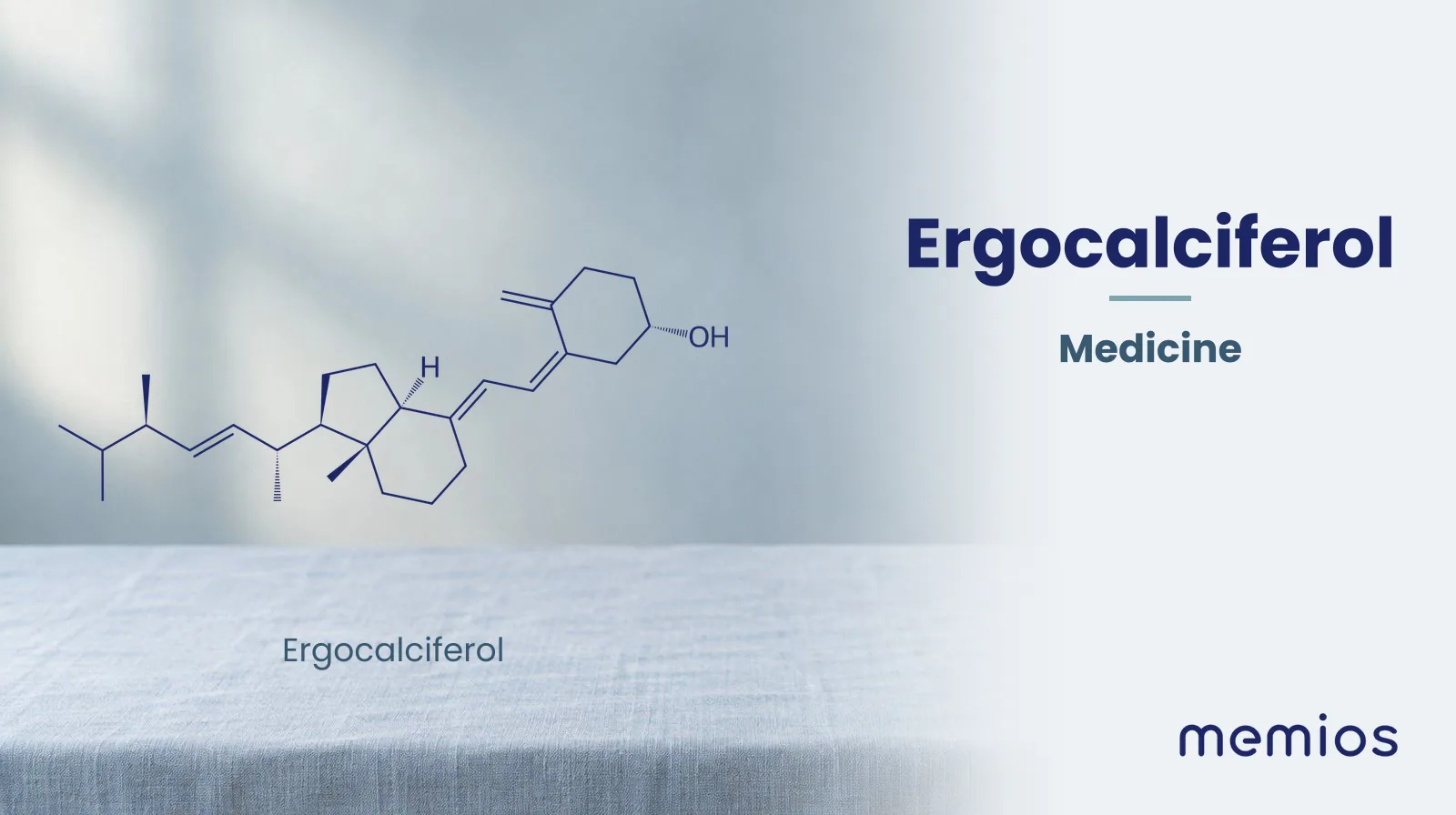
Ergocalciferol is the plant- and fungus-derived form of vitamin D, given as a prescription capsule (commonly 1.25 mg, equivalent to 50,000 USP Units) and also used to fortify foods. It is a pro-hormone, not an active drug: it is hydroxylated first in the liver and then in the kidney before it does anything. The FDA-approved label restricts it to hypoparathyroidism, vitamin D resistant (refractory) rickets and familial hypophosphatemia, although in practice it is widely prescribed for ordinary vitamin D deficiency.
What the research says
The literature is clear on what ergocalciferol does to a blood test and much less flattering about what it does to outcomes. Randomised comparisons show it raises serum 25-hydroxyvitamin D, but less efficiently than cholecalciferol (vitamin D3). Large trials and a 2018 meta-analysis of 81 randomised trials found vitamin D supplementation did not reduce fractures, falls or improve bone density, and the VITAL trial found no reduction in cancer or cardiovascular events. One large population trial of annual high-dose intramuscular ergocalciferol reported more hip fractures in the treated group. Its established role is in the specific deficiency and metabolic bone conditions on the label, not as a general preventive.
Evidence grade: Disputed.
How it works
Drug class: Secosteroid vitamin D analogue (vitamin D2 prohormone)
Ergocalciferol itself is inactive. The liver converts it to 25-hydroxyvitamin D and the kidney converts that to the active hormone 1,25-dihydroxyvitamin D, which increases absorption of calcium and phosphate from the gut, mobilises calcium and phosphate from bone, and increases their reabsorption in the kidney, so that bone can mineralise. Because the active metabolites have to be made first, there is a delay of roughly half a day to a day before any effect begins. (Source 1)
What it is used for
- This is an approved indication and long-standing clinical practice, but we found no modern randomised outcome trial of ergocalciferol in hypoparathyroidism; the support is the regulator's position and the drug's known physiology, with the label itself warning that dosing must be individualised and calcium monitored. Evidence: limited. (Source 2)
- Approved indications. The label itself is the position; the dose range stated for resistant rickets is very wide and the label warns explicitly that the gap between a working dose and a toxic dose is narrow. Evidence: limited. (Source 2)
- Randomised evidence pooled from 24 studies shows ergocalciferol raises serum 25-hydroxyvitamin D, but less than an equivalent amount of cholecalciferol (mean difference favouring D3 of 15.69 nmol/L, 95%CI 9.46 to 21.93). This is a blood-test outcome, not a clinical one. Evidence: established. (Source 3)
- A 2018 systematic review and meta-analysis of 81 randomised trials (53,537 participants) found no effect on total fracture, hip fracture, falls or bone density; a 9,440-person trial of annual intramuscular ergocalciferol reported a higher hip fracture rate in the treated group. Evidence: not-supported. (Source 4)
- The VITAL randomised trial (25,871 participants, median 5.3 years, vitamin D3 2000 IU daily) found no reduction in invasive cancer or major cardiovascular events. This tested D3 rather than D2, so it constrains the vitamin D hypothesis rather than ergocalciferol specifically. Evidence: not-supported. (Source 5)
Interactions
- Mineral oil (label): Mineral oil reduces how much vitamin D is absorbed from the gut. (Source 6)
- Thiazide diuretics (label): In people with hypoparathyroidism taking ergocalciferol, adding a thiazide diuretic can push blood calcium too high. (Source 6)
- Calcium (dietary and supplemental) (label): Vitamin D only works on bone if there is enough calcium to move; conversely, combining vitamin D with calcium is what raises blood calcium, which is the route to toxicity. (Source 6)
- Other vitamin D from fortified food and supplements (label): Vitamin D stacks. Fortified foods, over-the-counter supplements and prescription vitamin D add up, and the label says all sources should be counted before dosing. (Source 6)
Stopping it
- No withdrawal syndrome or dependence is described for ergocalciferol in what we read. The label's position is the opposite of open-ended use: the dose is meant to be brought down as soon as the person improves, and blood calcium followed while high doses are being given. (Source 6)
- Stopping matters most after toxicity: vitamin D is fat-soluble and clears slowly, so hypercalcaemia can persist for months after the supplement is stopped. In the reported case, 25-hydroxyvitamin D was still 80 ng/mL six months after admission. (Source 7)
What goes wrong
An annual 300,000 IU intramuscular dose of ergocalciferol was associated with more hip fractures than placebo. (Source 8)
- Randomized trial, Moderate certainty.
- Size: 9,440 people (4,354 men and 5,086 women); 585 had incident non-spine fractures.
- Who: people aged 75 and over recruited from general practice registers in Wessex, England.
- How long: annual injection each autumn over 3 years.
- Result: hip fracture hazard ratio 1.49 (95% CI 1.02-2.18, P = 0.04); any first fracture 1.09 (0.93-1.28, P = 0.29); wrist 1.22 (0.85-1.76); falls HR 0.98 (0.93-1.04). A single trial, and the hip result is one of several outcomes tested.
- Funding: not stated in the abstract.
Hazard ratios (HRs) for fracture in the vitamin D group were: 1.09 [95% confidence interval (CI) 0.93–1.28, P = 0.29] for any first fracture, 1.49 (95% CI 1.02–2.18, P = 0.04) for hip
High-dose over-the-counter vitamin D can cause hypercalcaemia and acute renal failure. (Source 7)
- Case report, Very low certainty.
- Size: 1 patient.
- Who: a young male service member taking high-dose over-the-counter vitamin supplements to try to boost testosterone.
- How long: not stated; 25-hydroxyvitamin D still 80 ng/mL six months after admission.
- Result: peak serum calcium 13.7 mg/dL; initial 25-hydroxyvitamin D above 200 ng/mL (too high to quantify). A single case, so it establishes that this can happen, not how often.
- Funding: not stated.
Here we present the case of acute renal failure with hypercalcemia that was found to be secondary to unrecognized high-dose over-the-counter vitamin supplementation and subsequent vitamin D hypervitaminosis
What the evidence supports
The FDA-approved label position is that ergocalciferol is for hypoparathyroidism, vitamin D resistant rickets and familial hypophosphatemia. (Source 2)
- Official position, Certainty not rated.
- Size: not applicable.
- Who: not applicable.
- How long: label revision 1/2025.
- Result: no effect size; a regulatory position.
- Funding: not applicable.
Ergocalciferol Capsules are indicated for use in the treatment of hypoparathyroidism, refractory rickets, also known as vitamin D resistant rickets, and familial hypophosphatemia.
In a large randomised trial at 2000 IU per day, no excess hypercalcaemia or other adverse events was seen, so harm appears to be a dose problem rather than an inherent one. (Source 5)
- Randomized trial, High certainty.
- Size: 25,871 participants.
- Who: US older adults.
- How long: median 5.3 years.
- Result: no excess hypercalcaemia or other adverse events reported at 2000 IU daily of cholecalciferol.
- Funding: National Institutes of Health and others.
No excess risks of hypercalcemia or other adverse events were identified.
What the evidence does not support
Pooled randomised evidence found vitamin D supplementation had no effect on fractures, falls or bone mineral density. (Source 4)
- Meta-analysis, Moderate certainty.
- Size: 53,537 participants across 81 randomised controlled trials.
- Who: adults over 18, mostly older community-dwelling people.
- How long: bone density outcomes measured over 1-5 years.
- Result: total fracture RR 1.00 (95% CI 0.93-1.07); hip fracture RR 1.11 (0.97-1.26); falls RR 0.97 (0.93-1.02); bone density differences ranged -0.16% to 0.76%.
- Funding: Health Research Council of New Zealand (independent)
In pooled analyses, vitamin D had no effect on total fracture (36 trials; n=44 790, relative risk 1·00, 95% CI 0·93-1·07), hip fracture (20 trials; n=36 655, 1·11, 0·97-1·26), or falls (37 trials; n=34 144, 0·97, 0·93-1·02).
Vitamin D supplementation did not lower the incidence of invasive cancer or major cardiovascular events. (Source 5)
- Randomized trial, High certainty.
- Size: 25,871 participants.
- Who: US men aged 50 and over and women aged 55 and over, including 5,106 black participants.
- How long: median follow-up 5.3 years.
- Result: cancer hazard ratio 0.96 (95% CI 0.88 to 1.06, P=0.47); major cardiovascular event hazard ratio 0.97 (95% CI 0.85 to 1.12, P=0.69); all-cause death hazard ratio 0.99 (0.87 to 1.12). Tested cholecalciferol 2000 IU daily, not ergocalciferol.
- Funding: National Institutes of Health and others (independent of the supplement maker for the primary funding)
Supplementation with vitamin D did not result in a lower incidence of invasive cancer or cardiovascular events than placebo.
Where the evidence is mixed
Ergocalciferol raises serum 25-hydroxyvitamin D, but less than the same amount of cholecalciferol. (Source 3)
- Meta-analysis, Moderate certainty.
- Size: 1,277 participants across 24 studies.
- Who: apparently healthy human participants.
- How long: varied across included studies; not stated in the abstract.
- Result: mean difference favouring cholecalciferol for total 25(OH)D 15.69 nmol/L, 95%CI 9.46 to 21.93; meta-regression found smaller differences at lower doses, and average daily dose was the single significant predictor of effect size.
- Funding: not stated.
The quantitative analysis suggested higher efficacy of cholecalciferol than ergocalciferol in improving total 25(OH)D (mean difference: 15.69, 95%CI: 9.46 to 21.93 nmol/L)
Where the research disagrees
Whether vitamin D supplementation is worth taking for bone health
- Bolland, Grey and Avenell (2018 meta-analysis of 81 trials), systematic review, meta-analysis and trial sequential analysis of randomised trials: In pooled analyses, vitamin D had no effect on total fracture (36 trials; n=44 790, relative risk 1·00, 95% CI 0·93-1·07), hip fracture (20 trials; n=36 655, 1·11, 0·97-1·26), or falls (37 trials; n=34 144, 0·97, 0·93-1·02). (Source 4)
- FDA-approved ergocalciferol label (revision 1/2025), regulatory position, not an outcome trial: Ergocalciferol Capsules are indicated for use in the treatment of hypoparathyroidism, refractory rickets, also known as vitamin D resistant rickets, and familial hypophosphatemia. (Source 2)
How much
- Reference intake: There is no reader dose here: dosing of prescription ergocalciferol is set by the prescriber. The FDA label's position (revision 08/2021) is that dose must be individualised under close medical supervision, and it states 12,000 to 500,000 USP Units daily for vitamin D resistant rickets and 50,000 to 200,000 USP Units daily with calcium lactate for hypoparathyroidism. (Source 9)
- Upper limit: The label states no numerical upper limit but warns in capitals that the gap between a therapeutic and a toxic dose is narrow, and that progress on high doses should be followed with frequent blood calcium measurements. (Source 6)
- Studied: A population trial gave 300,000 IU of intramuscular ergocalciferol or matching placebo every autumn over 3 years to people aged 75 and over. (Source 10)
- Studied: The VITAL trial gave 2000 IU per day of cholecalciferol (vitamin D3), not ergocalciferol, for a median of 5.3 years. (Source 5)
A common belief, and what the research shows
The belief: Vitamin D2 and vitamin D3 are interchangeable, and more vitamin D is always better for bones.
What the research shows: Pooled randomised data show they are not interchangeable at the same dose: "The quantitative analysis suggested higher efficacy of cholecalciferol than ergocalciferol in improving total 25(OH)D (mean difference: 15.69, 95%CI: 9.46 to 21.93 nmol/L)". And more is not better: in a trial of 9,440 older people given 300,000 IU of ergocalciferol by injection once a year, "Hazard ratios (HRs) for fracture in the vitamin D group were: 1.09 [95% confidence interval (CI) 0.93–1.28, P = 0.29] for any first fracture, 1.49 (95% CI 1.02–2.18, P = 0.04) for hip".
Questions and answers
What is it?
Ergocalciferol is vitamin D2, the form made from plant and fungal sterols. It is a prohormone rather than an active drug: the liver turns it into 25-hydroxyvitamin D and the kidney turns that into the active hormone. It is sold as a prescription capsule, most often 1.25 mg (50,000 USP Units), and is also used to fortify food. (Source 1)
What does it do in the body?
Its active metabolites increase absorption of calcium and phosphate from the gut, move calcium and phosphate out of bone when needed, and increase their reabsorption in the kidney. The point of all this is to keep blood calcium and phosphate high enough for bone to mineralise. Because the active forms have to be made first, nothing happens for 10 to 24 hours after a dose. (Source 1)
Is it good or bad for you?
It depends entirely on the situation. In the deficiency and metabolic bone conditions on the label it is a treatment. As a general supplement for bone health in adults, the pooled randomised evidence is negative, and at very high intermittent doses one large trial found more hip fractures. Very high sustained intake causes hypercalcaemia. (Source 4)
How do you get more of it?
Blood levels of vitamin D rise with sunlight, fortified food, and supplements of either D2 or D3. Pooled trial data show that at the same dose, cholecalciferol (D3) raises total 25-hydroxyvitamin D more than ergocalciferol (D2) does, and the difference narrows at lower doses. This is a description of what trials found, not advice. (Source 3)
If it is harmful, what reduces it?
Vitamin D becomes harmful when there is too much of it, and the treatment described in the literature is to stop the source and treat the resulting high blood calcium; the drug is formally contraindicated once hypercalcaemia or hypervitaminosis D is present. Because it is fat-soluble, levels fall slowly over months rather than days. (Source 2)
Why might someone be low in it or missing it?
Low vitamin D reflects how much is coming in from sun, food and supplements, and how well it is absorbed. Fat malabsorption is a recognised problem, and mineral oil reduces absorption of fat-soluble vitamins. The label's own framing is that all sources have to be totalled up before judging someone's intake. (Source 6)
Which whole foods contain it or feed it?
The sources we fetched for this drug do not list the food sources of vitamin D2; they discuss it as a medicine and as a fortificant. What they do say is that vitamin D cannot work on bone without enough dietary calcium alongside it. (Source 6)
We searched: We searched for ergocalciferol and vitamin D2 trials, meta-analyses and the FDA label; food-composition data for D2 (mushrooms, fortified foods) was outside the papers we retrieved.
What happens if you do not have it?
Severe or resistant deficiency produces the conditions the drug is approved to treat: rickets in children and the related bone-mineralisation disorders, along with the calcium and phosphate problems of hypoparathyroidism and familial hypophosphatemia. What the trials do NOT show is that topping up a normal adult prevents fractures or falls. (Source 2)
How can you test for it?
The standard test is serum total 25-hydroxyvitamin D, which is the measure every trial in this area uses as its outcome. One caveat the D2-versus-D3 literature exposes: some assays report 25(OH)D2 and 25(OH)D3 separately, and D2 supplementation can lower measured 25(OH)D3 while raising 25(OH)D2, so which fraction an assay captures changes the answer. (Source 3)
References
- DailyMed, US National Library of Medicine (FDA-approved labelling; a POSITION, not evidence; label page shows Revised: 4/2017). VITAMIN D (Ergocalciferol Capsules, USP) 1.25 mg (50,000 USP Units) - CLINICAL PHARMACOLOGY. 2017. Read the source
- DailyMed, US National Library of Medicine (FDA-approved labelling; a POSITION, not evidence; label page shows Revised: 1/2025). ERGOCALCIFEROL CAPSULES, capsule - INDICATIONS AND USAGE, CONTRAINDICATIONS, WARNINGS. 2025. Read the source
- Nutrients (MDPI). Relative Efficacy of Vitamin D2 and Vitamin D3 in Improving Vitamin D Status: Systematic Review and Meta-Analysis. 2021. DOI 10.3390/nu13103328. Read the source
- The Lancet Diabetes and Endocrinology (abstract record retrieved from the Semantic Scholar Graph API). Effects of vitamin D supplementation on musculoskeletal health: a systematic review, meta-analysis, and trial sequential analysis.. 2018. PMID 30293909, DOI 10.1016/S2213-8587(18)30265-1. Read the source
- New England Journal of Medicine (abstract record retrieved from the Semantic Scholar Graph API). Vitamin D Supplements and Prevention of Cancer and Cardiovascular Disease. 2018. PMID 30415629, DOI 10.1056/NEJMoa1809944. Read the source
- DailyMed, US National Library of Medicine (FDA-approved labelling; a POSITION, not evidence; label page shows Revised: 1/2025). ERGOCALCIFEROL CAPSULES, capsule - PRECAUTIONS and Drug Interactions. 2025. Read the source
- Military Medicine (Oxford University Press); authors as printed: Nicholas Mason, Lauren M Sweet, Zachary Wills, Sarah Schall. Vitamin D Abuse in Pursuit of "Gains" Resulting in Acute Kidney Injury (Military Medicine 2024;189(1-2):e417-e419). 2024. DOI 10.1093/milmed/usad237. Read the source
- Rheumatology (Oxford University Press). Effect of annual intramuscular vitamin D on fracture risk in elderly men and women - a population-based, randomized, double-blind, placebo-controlled trial. 2007. PMID 17998225, DOI 10.1093/rheumatology/kem240. Read the source
- DailyMed, US National Library of Medicine (FDA-approved labelling; a POSITION, not evidence; label page shows Revised: 03/2019 in the prescribing information and a later Revised: 6/2026 line after the establishment information). VITAMIN D - ergocalciferol capsule - DOSAGE AND ADMINISTRATION. 2019. Read the source
- Rheumatology (Oxford University Press). Effect of annual intramuscular vitamin D on fracture risk in elderly men and women - a population-based, randomized, double-blind, placebo-controlled trial (Methods). 2007. PMID 17998225, DOI 10.1093/rheumatology/kem240. Read the source