Supplements · September 30, 2026 · Memios · 14 min read
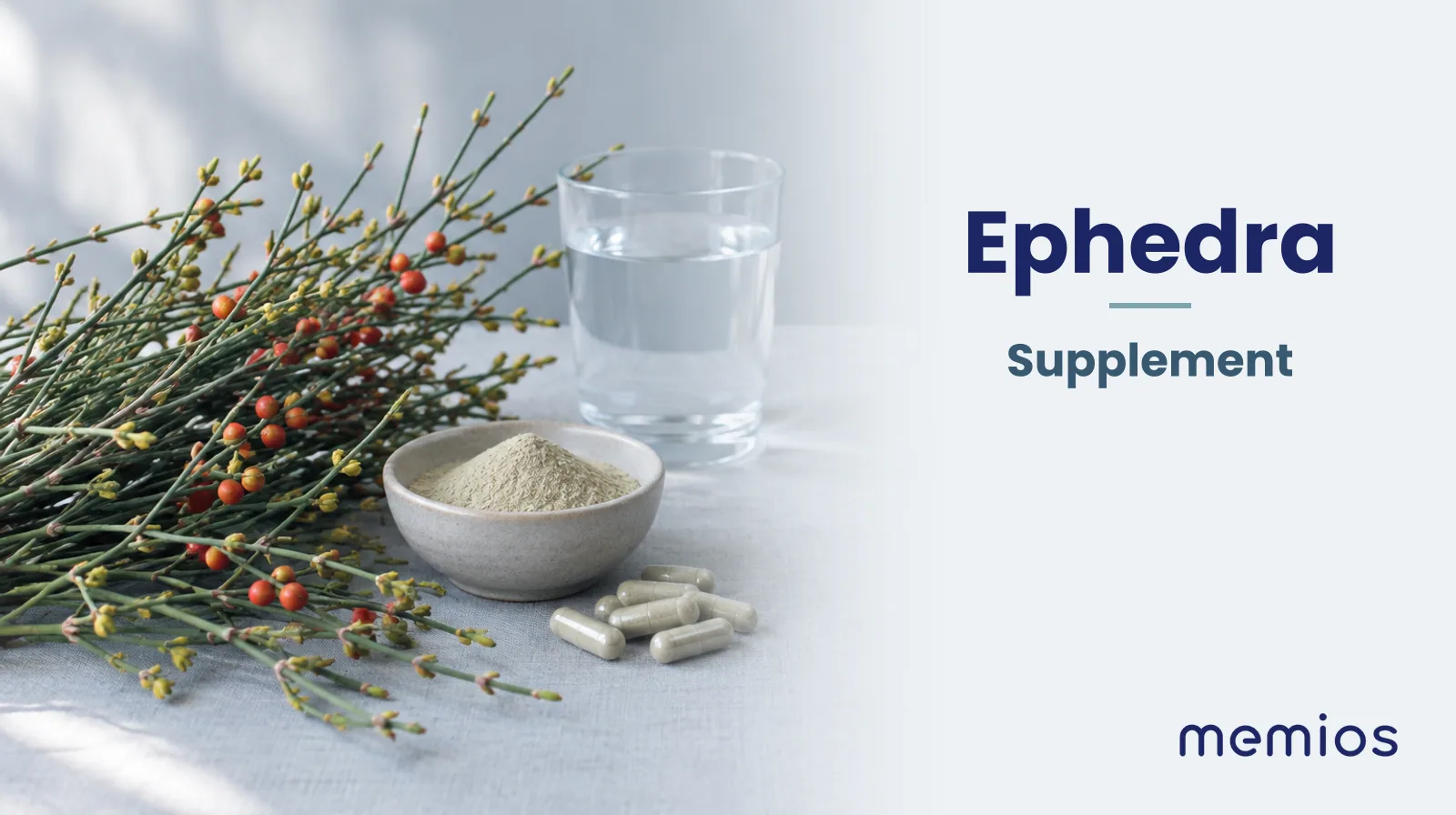
Ephedra
Ephedrine is a mixed sympathomimetic: it releases noradrenaline and stimulates alpha and beta receptors, raising heart rate and cardiac output, constricting blood vessels.
TLDR
- Limited evidence. Ephedrine is a mixed sympathomimetic: it releases noradrenaline and stimulates alpha and beta receptors, raising heart rate and cardiac output, constricting blood vessels, relaxing airway muscle and acting as a central stimulant.
- What it is: Ephedra, or ma-huang, is a Chinese botanical whose stems contain phenylalanine-derived alkaloids: ephedrine, pseudoephedrine, norephedrine and norpseudoephedrine.
- Main use, supported: Pooled randomised trial data show ephedrine plus caffeine produced about 2.2 pounds per month more weight loss than placebo. (low certainty)
- Other use, supported: Herbal ephedra plus caffeine-containing herbs gave a similar modest result, about 2.1 pounds per month more than placebo. (low certainty)
- Claim NOT supported by research: No study has assessed long-term weight outcomes for ephedra or ephedrine. (moderate certainty)
- Another claim NOT supported: Trials of ephedrine for athletic performance were small and mostly null, and no trial has tested herbal ephedra products for athletic performance at all. (low certainty)
- Recommended dose: not established. No reference intake exists. Ephedra is a botanical stimulant sold as a supplement, not a nutrient, so no body has set an RDA or AI.
- Studied dose (a trial dose, not a recommendation): Weight-loss trials ran for up to 6 months of treatment. Findings citing that trial: 1 on harm.
- Upper limit: No upper limit was set.
- What goes wrong: 4 findings on harm. Pooled trial data show two to three times the risk of psychiatric, autonomic, palpitation and upper gastrointestinal symptoms with ephedra or ephedrine.
- Common myth: Ephedra was banned because it did not work.
What it is
Ephedra, or ma-huang, is a Chinese botanical whose stems contain phenylalanine-derived alkaloids: ephedrine, pseudoephedrine, norephedrine and norpseudoephedrine. Three species supply most commercial material, and alkaloid content varies widely with species and growing conditions, from roughly 0.5% to 2.3% of the stem. Ephedrine is the most potent of the alkaloids and can make up as much as 90% of the total. North American species sold as Mormon tea contain little or none of it. Since April 2004 the US FDA has treated dietary supplements containing ephedrine alkaloids as adulterated.
What the research says
Ephedrine is a mixed sympathomimetic: it releases noradrenaline and stimulates alpha and beta receptors, raising heart rate and cardiac output, constricting blood vessels, relaxing airway muscle and acting as a central stimulant. The systematic review evidence is that ephedra or ephedrine, especially with caffeine, produces modest short-term weight loss - about 2 pounds a month more than placebo for up to four to six months - with no data at all beyond six months. Evidence for athletic performance is thin and limited to very short-term effects in small samples of fit young men. The same trials show two to three times the rate of nausea, vomiting, psychiatric symptoms, autonomic hyperactivity and palpitations, and the case-report literature contains deaths, myocardial infarctions, strokes and seizures, about half in people aged 30 or younger.
Evidence grade: Limited evidence.
What goes wrong
Pooled trial data show two to three times the risk of psychiatric, autonomic, palpitation and upper gastrointestinal symptoms with ephedra or ephedrine. (Source 1)
- Meta-analysis, Moderate certainty.
- Size: 52 controlled trials contributed to the adverse event review; pooled analyses used 8 to 13 trials per symptom group.
- Who: adults in controlled trials of ephedra, ephedrine or ephedrine plus caffeine.
- How long: trial durations up to 6 months.
- Result: psychiatric symptoms OR 3.64 (95% CI 1.91, 7.31); autonomic hyperactivity OR 3.37 (95% CI 2.19, 5.31); heart palpitations OR 2.29 (95% CI 1.27, 4.32); upper gastrointestinal symptoms OR 2.15 (95% CI 1.39, 3.38)
- Funding: AHRQ-commissioned evidence report.
The pooled estimates showed that the treatment groups experienced significantly higher rates of psychiatric symptoms (8 trials; OR 3.64, 95% CI: 1.91, 7.31), autonomic hyperactivity (13 trials; OR 3.37, 95% CI: 2.19, 5.31), heart palpitations (11 trials; OR 2.29, 95% CI: 1.27, 4.32) and upper gastrointestinal symptoms (10 trials; OR 2.15, 95% CI: 1.39, 3.38).
The evidence report identified sentinel adverse events after ephedra or ephedrine use, including deaths, myocardial infarctions, strokes and seizures, about half of them in people aged 30 or younger. (Source 2)
- Case series, Very low certainty.
- Size: 65 case reports or case series within a review of 117 studies, plus FDA and manufacturer complaint files.
- Who: users of ephedra-containing supplements or ephedrine products.
- How long: not applicable.
- Result: ephedra: 2 deaths, 3 myocardial infarctions, 9 cerebrovascular accidents, 3 seizures, 5 psychiatric cases; ephedrine: 3 deaths, 2 myocardial infarctions, 2 cerebrovascular accidents, 1 seizure, 3 psychiatric cases; plus 43 and 7 possible sentinel events respectively.
- Funding: AHRQ-commissioned evidence report.
For prior consumption of ephedra-containing products, we identified two deaths, three myocardial infarctions, nine cerebrovascular accidents, three seizures, and five psychiatric cases as sentinel events; for prior consumption of ephedrine, we identified three deaths, two myocardial infarctions, two cerebrovascular accidents, one seizure, and three psychiatric cases as sentinel events.
Measured alkaloid content of ephedra supplements varied enormously between products and between lots of the same product. (Source 3)
- Survey study, Moderate certainty.
- Size: 20 ephedra-containing supplements.
- Who: commercially sold supplements, not people.
- How long: single analysis, published 2000.
- Result: total alkaloid content 0.0 to 18.5 mg per dosage unit; (-)-ephedrine 1.1-15.3 mg and (+)-pseudoephedrine 0.2-9.5 mg; significant lot-to-lot variation in four products.
- Funding: not stated.
Total alkaloid content ranged from 0.0 to 18.5 mg per dosage unit.
The FDA's position, in a final rule effective 12 April 2004, is that dietary supplements containing ephedrine alkaloids are adulterated because they present an unreasonable risk. (Source 4)
- Official position, Certainty not rated.
- Size: not applicable.
- Who: US dietary supplement market.
- How long: rule effective 12 April 2004.
- Result: no effect estimate; regulatory determination based on pharmacology, literature and adverse event reports.
- Funding: US government agency.
The Food and Drug Administration (FDA, we, our) is issuing a final regulation declaring dietary supplements containing ephedrine alkaloids adulterated under the Federal Food, Drug, and Cosmetic Act (the act) because they present an unreasonable risk of illness or injury
What the evidence supports
Pooled randomised trial data show ephedrine plus caffeine produced about 2.2 pounds per month more weight loss than placebo. (Source 5)
- Meta-analysis, Low certainty.
- Size: 12 trials of ephedrine plus caffeine versus placebo, within a review of 20 weight-loss trials assessing 678 people who consumed ephedra or ephedrine.
- Who: adults taking ephedrine or ephedra for weight loss.
- How long: up to 6 months of treatment.
- Result: effect size -0.85 (95% CI -1.1, -0.61), equivalent to 2.2 pounds per month more than placebo; no evidence of publication bias; heterogeneity chi-squared P=0.073.
- Funding: AHRQ/NIH-commissioned RAND evidence report; independent of industry.
The pooled estimate of the rate of weight loss was an effect size of -0.85 (95% CI: -1.1, -0.61), which translated to a loss of 2.2 pounds more in the treatment group than in the placebo group.
Herbal ephedra plus caffeine-containing herbs gave a similar modest result, about 2.1 pounds per month more than placebo. (Source 5)
- Meta-analysis, Low certainty.
- Size: 4 trials.
- Who: adults taking ephedra plus caffeine-containing herbs.
- How long: up to 6 months.
- Result: effect size -0.81 (95% CI -1.12, -0.51), equivalent to 2.1 pounds per month more than placebo; no publication bias, no statistical heterogeneity (P=0.689)
- Funding: AHRQ/NIH-commissioned RAND evidence report.
The pooled estimate of the rate of weight loss was an effect size of -0.81 (95% CI: -1.12, -0.51), which translated to a weight loss of 2.1 pounds more in the treatment group than in the placebo group.
What the evidence does not support
No study has assessed long-term weight outcomes for ephedra or ephedrine. (Source 6)
- Systematic review, Moderate certainty.
- Size: 44 controlled trials identified; 20 pooled.
- Who: adults in weight-loss trials.
- How long: longest duration of treatment in a published study was 6 months.
- Result: no long-term estimate exists.
- Funding: AHRQ-commissioned evidence report.
No studies have assessed the long-term effects of ephedra-containing dietary supplements or ephedrine on weight loss; the longest duration of treatment in a published study was 6 months.
Trials of ephedrine for athletic performance were small and mostly null, and no trial has tested herbal ephedra products for athletic performance at all. (Source 1)
- Systematic review, Low certainty.
- Size: 8 trials in the athletic performance assessment, six with fewer than 24 participants.
- Who: healthy young men, including military recruits.
- How long: very short term, typically effects 1-2 hours after a single dose.
- Result: one trial found improved muscle endurance during the first of three repetitions; no other statistically significant differences; a further trial in 21 healthy young men found none.
- Funding: AHRQ-commissioned evidence report.
One trial assessed the effects of ephedrine versus placebo or no treatment on 21 healthy young men. No statistical differences in athletic performance were identified.
Where ephedrine was compared with another active weight-loss therapy rather than placebo, it showed no advantage. (Source 5)
- Meta-analysis, Low certainty.
- Size: 2 trials.
- Who: adults in weight-loss trials.
- How long: up to 6 months.
- Result: no statistically significant differences between groups in either trial.
- Funding: AHRQ-commissioned evidence report.
Two trials compared ephedrine with another active weight loss therapy. There were no statistically significant differences between the groups in either trial.
Where the evidence is mixed
The same evidence report states that the underlying trials were methodologically weak, particularly for attrition, and that nothing is known beyond six months. (Source 6)
- Systematic review, Low certainty.
- Size: 20 trials, 678 people consuming ephedra or ephedrine.
- Who: adults in weight-loss trials.
- How long: longest published treatment 6 months.
- Result: approximately 2 pounds per month greater than placebo for up to 4 to 6 months; no long-term data.
- Funding: AHRQ-commissioned evidence report.
The majority of studies of both ephedra and ephedrine are plagued by methodological problems (particularly, high attrition rates) that might contribute to bias.
The reviewers were explicit that a sentinel event does not prove that ephedra caused it, and that the trials were far too small to detect rare serious outcomes. (Source 2)
- Systematic review, Low certainty.
- Size: aggregate clinical trial population.
- Who: trial participants and case report subjects.
- How long: not applicable.
- Result: trials could only detect a serious adverse event rate of at least 1.0 per 1,000.
- Funding: AHRQ-commissioned evidence report.
Classification as a sentinel event does not imply a proven cause and effect relationship.
Where the research disagrees
Whether the serious harms seen in case reports are caused by ephedra
- RAND/AHRQ evidence report authors, 2003, systematic review of 65 case reports and case series alongside 52 controlled trials: Classification as a sentinel event does not imply a proven cause and effect relationship. (Source 2)
- US Food and Drug Administration, final rule effective 12 April 2004, regulatory determination citing pharmacology, peer-reviewed literature and adverse event reports: because they present an unreasonable risk of illness or injury under the conditions of use recommended or suggested in labeling (Source 4)
How much
- Reference intake: No reference intake exists. Ephedra is a botanical stimulant sold as a supplement, not a nutrient, so no body has set an RDA or AI. (Source 7)
- Upper limit: No upper limit was set. Instead the FDA declared, in a final rule effective 12 April 2004, that dietary supplements containing ephedrine alkaloids are adulterated because they present an unreasonable risk of illness or injury. (Source 4)
- Studied: Weight-loss trials ran for up to 6 months of treatment. The sources we reached did not state the milligram doses used in those trials; analysis of marketed products found 0.0 to 18.5 mg total alkaloid per dosage unit. (Source 3)
- Studied: Trials of ephedrine or ephedra for weight loss involved up to 6 months of treatment. (Source 5)
A common belief, and what the research shows
The belief: Ephedra was banned because it did not work.
What the research shows: The opposite: the pooled trial evidence found it did produce modest short-term weight loss, about "2 pounds per month greater than that with placebo, for up to 4 to 6 months." It was removed from the US supplement market on safety grounds - the FDA rule says supplements containing ephedrine alkaloids are adulterated "because they present an unreasonable risk of illness or injury". A second misconception is that all ephedra is the same plant chemistry: "North American ephedra species, such as E. nevadensis (known as Mormon tea), contain little or no ephedrine or other alkaloids."
Questions and answers
What is it?
Ephedra, or ma-huang, is a Chinese botanical sold in the United States as a dietary supplement until it was banned. Three species supply most material, and the active compounds are alkaloids in the stem: ephedrine, pseudoephedrine, norephedrine and cathine. North American species sold as Mormon tea contain little or none of these. (Source 7)
What does it do in the body?
Ephedrine, the main alkaloid, is a mixed sympathomimetic. It releases noradrenaline and stimulates alpha and beta receptors, which raises heart rate and cardiac output and constricts blood vessels, and it relaxes airway muscle. It also acts as a central nervous system stimulant and is the most thermogenic of the ephedra alkaloids, which is the basis of the weight-loss claim. (Source 8)
Is it good or bad for you?
Both, and the balance is why it was removed from the market. Pooled trials found real but small short-term weight loss of roughly 2 pounds a month more than placebo, with nothing known past six months. The same trials found two to three times the rate of nausea, vomiting, anxiety and mood change, autonomic overactivity and palpitations, and the case literature contains deaths, heart attacks, strokes and seizures. (Source 2)
How do you get more of it?
In the United States you cannot legally buy it as a dietary supplement: since a final rule effective 12 April 2004 the FDA treats supplements containing ephedrine alkaloids as adulterated. This is a description of the regulation, not advice. Where products did exist, the amount per dose was unreliable, ranging from none to 18.5 mg of total alkaloid. (Source 4)
If it is harmful, what reduces it?
The literature we reached describes no antidote or elimination treatment; the regulatory response was to take the products off the market rather than to manage exposure. The FDA rule removing ephedrine-alkaloid supplements from sale took effect on 12 April 2004. (Source 4)
Why might someone be low in it or missing it?
The question does not apply. Ephedra is a stimulant botanical, not a nutrient the body requires or produces, so there is no deficiency state. A person has ephedra alkaloids in them only if they have taken a product containing them, or a related medicine. (Source 7)
Which whole foods contain it or feed it?
No ordinary food contains ephedrine alkaloids. They occur in the stems of Asian Ephedra species, used as the herb ma-huang, where total alkaloid content varies from about 0.5% to 2.3% by species and growing conditions. North American ephedra, sold as Mormon tea, contains little or none. (Source 7)
What happens if you do not have it?
Nothing goes wrong. There is no ephedra deficiency. What is forgone is a small short-term weight-loss effect of about 2 pounds a month more than placebo that has never been shown to persist, since no study has looked beyond six months. (Source 6)
How can you test for it?
No validated clinical test of a person's ephedra status exists in the literature we searched, and none would be meaningful for a non-nutrient. Products can be assayed: high-performance liquid chromatography has been used to measure the five ephedra alkaloids in supplements, which is how the content and labelling problems were documented. (Source 3)
We searched: Searched PubMed, NIH Office of Dietary Supplements and the AHRQ/RAND evidence report for a validated human biomarker or clinical assay; only product assays and forensic/clinical toxicology measurements of ephedrine appeared.
References
- Database of Abstracts of Reviews of Effects (DARE), Centre for Reviews and Dissemination, NCBI Bookshelf. Ephedra and ephedrine for weight loss and athletic performance enhancement: clinical efficacy and side effects (DARE structured abstract) - athletic performance and adverse events. 2003. Read the source
- Agency for Healthcare Research and Quality (AHRQ), Evidence Report/Technology Assessment, prepared by the Southern California Evidence-based Practice Center (RAND). Ephedra and Ephedrine for Weight Loss and Athletic Performance Enhancement: Clinical Efficacy and Side Effects: Summary - Safety Issues. 2003. Read the source
- American Journal of Health-System Pharmacy. Content versus label claims in ephedra-containing dietary supplements. 2000. PMID 10832496. Read the source
- US Food and Drug Administration, Federal Register 69 FR 6788. Final Rule Declaring Dietary Supplements Containing Ephedrine Alkaloids Adulterated Because They Present an Unreasonable Risk. 2004. Read the source
- Database of Abstracts of Reviews of Effects (DARE), Centre for Reviews and Dissemination, NCBI Bookshelf. Ephedra and ephedrine for weight loss and athletic performance enhancement: clinical efficacy and side effects (DARE structured abstract) - weight loss results. 2003. Read the source
- Agency for Healthcare Research and Quality (AHRQ), Evidence Report/Technology Assessment, prepared by the Southern California Evidence-based Practice Center (RAND). Ephedra and Ephedrine for Weight Loss and Athletic Performance Enhancement: Clinical Efficacy and Side Effects: Summary - Efficacy for Weight Loss. 2003. Read the source
- NIH Office of Dietary Supplements. Ephedra and Ephedrine Alkaloids for Weight Loss and Athletic Performance - Health Professional Fact Sheet (botanical description). 2004. Read the source
- NIH Office of Dietary Supplements. Ephedra and Ephedrine Alkaloids for Weight Loss and Athletic Performance - Health Professional Fact Sheet (pharmacology). 2004. Read the source