Supplements · September 29, 2026 · Memios · 10 min read
Eleuthero
Not supported by the research. It is sold as an 'adaptogen' for stress, fatigue and stamina.
TLDR
- Not supported by the research. It is sold as an 'adaptogen' for stress, fatigue and stamina.
- What it is: Eleuthero is a prickly shrub in the ginseng family (Araliaceae), 2-7 m tall.
- Main use, supported: A very small crossover trial in 9 recreationally trained young men reported that 800 mg/day eleuthero for 8 weeks raised peak oxygen uptake by 12% and endurance time by 23% versus placebo. (very low certainty)
- Claim NOT supported by research: In a randomized trial of 144 people with stress-related fatigue, adding eleuthero extract to stress-management training added little or no benefit. (moderate certainty)
- Another claim NOT supported: A placebo-controlled RCT of Siberian ginseng for chronic fatigue found no overall benefit; a possible effect in people with moderate fatigue came from unadjusted subgroup analyses. (low certainty)
- Recommended dose: not established. No RDA or AI exists: eleuthero is an herb, not a nutrient. The EMA (2016) accepts it only as a traditional herbal medicine for adults and adolescents over 12, for no more than 2 months.
- Studied dose (a trial dose, not a recommendation): Stress-fatigue RCT: 120 mg/day root extract for 8 weeks. Findings citing that trial: 1 against.
- Upper limit: No upper limit has been set by any body we found.
- What goes wrong: 3 findings on harm. Case report: a 74-year-old man on digoxin had high serum digoxin readings twice while taking Siberian ginseng, and levels fell when he stopped.
- Common myth: Siberian ginseng is a kind of ginseng and works the same way.
What it is
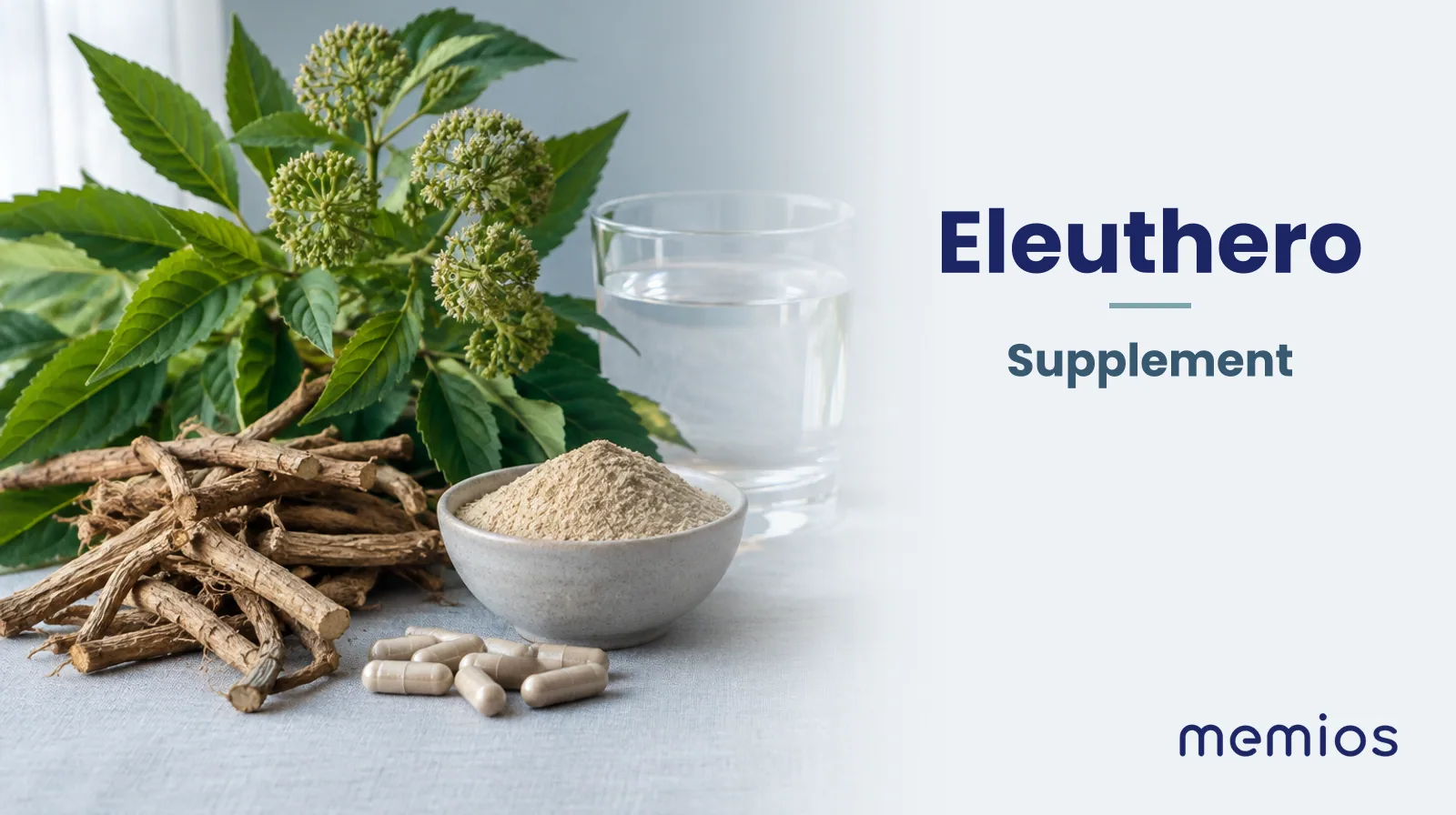
Eleuthero is a prickly shrub in the ginseng family (Araliaceae), 2-7 m tall. Its root has been used in traditional medicine for centuries. Despite the name 'Siberian ginseng', it is not true ginseng: it contains eleutherosides, not ginsenosides.
What the research says
It is sold as an 'adaptogen' for stress, fatigue and stamina. The best trials do not support this. A 144-person randomized trial found no benefit from adding it to stress-management training, and a 96-person trial in chronic fatigue found no overall effect versus placebo. The EU medicines regulator allows it only as a 'traditional use' remedy for tiredness, meaning approval rests on history of use, not proof. Side effects include insomnia and rapid heartbeat. Products are often mislabelled, and one case report linked it to falsely high digoxin blood tests.
Evidence grade: Not supported by the research.
What goes wrong
Case report: a 74-year-old man on digoxin had high serum digoxin readings twice while taking Siberian ginseng, and levels fell when he stopped. Whether this was a true interaction or a false lab result is unclear. (Source 1)
- Case report, Very low certainty.
- Size: 1 patient.
- Who: 74-year-old man on long-term digoxin.
- How long: Months (dechallenge and rechallenge)
- Result: Elevated serum digoxin without toxicity; normalised after stopping the herb, rose again on restarting.
- Funding: not stated.
It is unclear whether some component of the ginseng was converted to digoxin in vivo, interfered with digoxin elimination or caused a false serum assay result.
Adulteration: a reported case of neonatal androgenization linked to 'eleuthero' turned out to involve Periploca sepium, a toxic plant containing cardiac glycosides. DNA studies find other species in about a third of products. (Source 2)
- Case report, Very low certainty.
- Size: Case report plus DNA-barcoding market surveys.
- Who: Pregnant woman and newborn; commercial products.
- How long: Not applicable.
- Result: One Japanese market survey found E. senticosus in only 68% of samples; about 36% of 25 UK supplements contained other species of the genus.
- Funding: not stated.
Subsequent analysis demonstrated that the implicated material was from Periploca sepium Bunge, a toxic plant containing cardiac glycosides and pregnane-type steroids (Awang, 1996).
The EMA herbal committee (position, public summary dated 2 February 2016) lists insomnia, irritability, rapid heartbeat and headache as side effects, with frequency unknown. (Source 3)
- Official position, Certainty not rated.
- Size: Not applicable.
- Who: Not applicable.
- How long: Not applicable.
- Result: Frequency not known.
- Funding: EU regulator.
Insomnia, irritability, tachycardia (rapid heartbeat) and headaches have been reported as side effects with eleutherococcus root medicines, although their frequency is not known.
What the evidence supports
A very small crossover trial in 9 recreationally trained young men reported that 800 mg/day eleuthero for 8 weeks raised peak oxygen uptake by 12% and endurance time by 23% versus placebo. It is a single tiny trial, and other endurance trials cited in reviews found no effect. (Source 4)
- Randomized trial, Very low certainty.
- Size: 9 participants (crossover)
- Who: Recreationally trained male college students.
- How long: 8 weeks per arm, 4-week washout.
- Result: VO2 peak +12% (P<0.05), endurance time +23% (P<0.05), peak heart rate +4% (P<0.05); higher plasma free fatty acids and lower glucose at 30 min of cycling.
- Funding: not stated.
Limit of this finding: Only 9 people took part. The authors call it 'the first well-conducted study', which is their own description, not an independent quality rating. A result this small has not been confirmed, and it should not be read as showing eleuthero improves fitness in general.
shows that 8-week ES supplementation enhances endurance capacity, elevates cardiovascular functions and alters the metabolism for sparing glycogen in recreationally trained males.
What the evidence does not support
In a randomized trial of 144 people with stress-related fatigue, adding eleuthero extract to stress-management training added little or no benefit. (Source 5)
- Randomized trial, Moderate certainty.
- Size: 144 participants.
- Who: Adults with asthenia and reduced work capacity from chronic stress.
- How long: 8 weeks.
- Result: Almost all outcomes improved over time with no between-group differences; COM not superior to SMT at week 8.
- Funding: not stated in abstract; registered DRKS00000692.
Almost all parameters improved significantly over time without group differences.
A placebo-controlled RCT of Siberian ginseng for chronic fatigue found no overall benefit; a possible effect in people with moderate fatigue came from unadjusted subgroup analyses. (Source 6)
- Randomized trial, Low certainty.
- Size: 96 randomized, 76 followed at 2 months.
- Who: Adults with fatigue of 6 months or more with no identified cause.
- How long: 2 months.
- Result: Group differences not statistically significant in the full sample; subgroup P=0.04 unadjusted for multiple comparisons.
- Funding: not stated.
Overall efficacy was not demonstrated. However, the findings of possible efficacy for patients with moderate fatigue suggests that further research may be of value.
A 2025 review concluded that robust clinical evidence for eleuthero as an adaptogen for tiredness is lacking. (Source 2)
- Expert review, not systematic, Low certainty.
- Size: Narrative review of literature.
- Who: Not applicable.
- How long: Not applicable.
- Result: Qualitative.
- Funding: not stated.
The main issue is the lack of robust clinical evidence for the treatment of symptoms of asthenia as an adaptogen.
In 12 healthy volunteers, 14 days of standardized eleuthero did not change CYP2D6 or CYP3A4 activity, so interactions through these liver enzymes are unlikely. (Source 7)
- Randomized trial, Low certainty.
- Size: 12 volunteers.
- Who: Healthy adults.
- How long: 14 days (485 mg twice daily)
- Result: No significant change in dextromethorphan metabolic ratio or alprazolam pharmacokinetics (P > 0.05)
- Funding: not stated.
Our results indicate that standardized extracts of SG at generally recommended doses for over-the-counter use are unlikely to alter the disposition of coadministered medications primarily dependent on the CYP2D6 or CYP3A4 pathways for elimination.
Where the evidence is mixed
The EMA (position, 2016) accepts eleuthero only as a traditional-use remedy for tiredness and weakness, based on long use rather than clinical proof. It restricts use to people aged 12 and over and to no more than 2 months. (Source 3)
- Official position, Certainty not rated.
- Size: Not applicable.
- Who: Adults and adolescents over 12.
- How long: Maximum 2 months.
- Result: Not applicable.
- Funding: EU regulator.
conclusions on the use of eleutherococcus root medicines for relieving symptoms of asthenia are based on their 'traditional use' in this condition.
Where the research disagrees
Whether eleuthero relieves fatigue
- European Medicines Agency HMPC (2016), traditional use, not clinical efficacy: eleutherococcus root can be used for the relief of symptoms of asthenia (abnormal loss of strength and energy) such as tiredness and weakness. (Source 3)
- Schaffler et al. RCT (2013), randomized controlled trial, 144 participants: Effects of adding ES to SMT are, if any, negligible. (Source 5)
How much
- Reference intake: No RDA or AI exists: eleuthero is an herb, not a nutrient. The EMA (2016) accepts it only as a traditional herbal medicine for adults and adolescents over 12, for no more than 2 months. (Source 3)
- Upper limit: No upper limit has been set by any body we found. The EMA limits the duration of use to 2 months. (Source 3)
- Studied: Stress-fatigue RCT: 120 mg/day root extract for 8 weeks. (Source 5)
- Studied: Interaction study: 485 mg twice daily for 14 days. (Source 7)
A common belief, and what the research shows
The belief: Siberian ginseng is a kind of ginseng and works the same way.
What the research shows: It is a different plant. A systematic review of ginseng notes it 'is not true ginseng as it contains eleutherosides rather than ginsenosides', and a controlled trial of Siberian ginseng for chronic fatigue found 'Overall efficacy was not demonstrated.'
Questions and answers
What is it?
Eleuthero is a thorny shrub whose root is used as an herbal remedy. It is often sold as 'Siberian ginseng', but it is a different plant from true ginseng. (Source 8)
What does it do in the body?
It is marketed as an 'adaptogen' to help with stress and tiredness. Controlled trials have not shown a meaningful benefit. In one trial, adding it to stress-management training made little or no difference. (Source 5)
Is it good or bad for you?
Trials have not shown it helps with fatigue or stress. Reported side effects include insomnia, irritability, a fast heartbeat and headache. Products are sometimes adulterated with other plants, including a toxic one. (Source 3)
How do you get more of it?
It is only available as a root extract, tea, tincture or capsule. Studies gave 120 mg a day of extract, or 485 mg twice a day. This is not advice. Checking identity matters, because some products contain other species. (Source 2)
If it is harmful, what reduces it?
Does not apply as such: the body does not make it and it is only present if taken. In one case report, stopping the herb brought abnormal digoxin readings back to normal. (Source 1)
Why might someone be low in it or missing it?
Does not apply. Eleuthero is not a nutrient, so no one is deficient in it. (Source 3)
We searched: EMA public summary, systematic review of ginseng for CFS, 2025 pharmacology review
Which whole foods contain it or feed it?
No everyday food contains eleuthero. It is used only as an herbal preparation. (Source 2)
We searched: EMA public summary and 2025 review; no food sources described
What happens if you do not have it?
Nothing is known to happen. Eleuthero is not essential to the body. (Source 3)
We searched: EMA summary and reviews
How can you test for it?
No clinical test measures eleuthero in the body. It matters for testing in one way: in one patient taking it, a standard blood test showed falsely high or truly raised digoxin levels. (Source 1)
References
- Canadian Medical Association Journal. Elevated serum digoxin levels in a patient taking digoxin and Siberian ginseng. 1996. PMID 8705908. Read the source
- Frontiers in Pharmacology. Eleutherococcus root: a comprehensive review of its phytochemistry and pharmacological potential in the context of its adaptogenic effect. 2025. DOI 10.3389/fphar.2025.1683795. Read the source
- European Medicines Agency, Committee on Herbal Medicinal Products. Eleutherococcus root: Summary for the public (EMA/283374/2014). 2016. Read the source
- The Chinese Journal of Physiology 53(2):105-111. The Effect of Eight Weeks of Supplementation with Eleutherococcus senticosus on Endurance Capacity and Metabolism in Human. 2010. PMID 21793317, DOI 10.4077/CJP.2010.AMK018. Read the source
- Pharmacopsychiatry. No benefit adding eleutherococcus senticosus to stress management training in stress-related fatigue/weakness, impaired work or concentration, a randomized controlled study. 2013. PMID 23740477, DOI 10.1055/s-0033-1347178. Read the source
- Psychological Medicine. Randomized controlled trial of Siberian ginseng for chronic fatigue. 2004. PMID 14971626, DOI 10.1017/S0033291703008791. Read the source
- Drug Metabolism and Disposition. Siberian ginseng (Eleutheroccus senticosus) effects on CYP2D6 and CYP3A4 activity in normal volunteers. 2003. PMID 12695337, DOI 10.1124/dmd.31.5.519. Read the source
- Global Advances in Integrative Medicine and Health (SAGE). Ginseng for the Treatment of Chronic Fatigue Syndrome: A Systematic Review of Clinical Studies. 2022. DOI 10.1177/2164957X221079790. Read the source