Supplements · September 29, 2026 · Memios · 13 min read
Echinacea
Disputed. The evidence is disputed rather than settled.
TLDR
- Disputed. The evidence is disputed rather than settled.
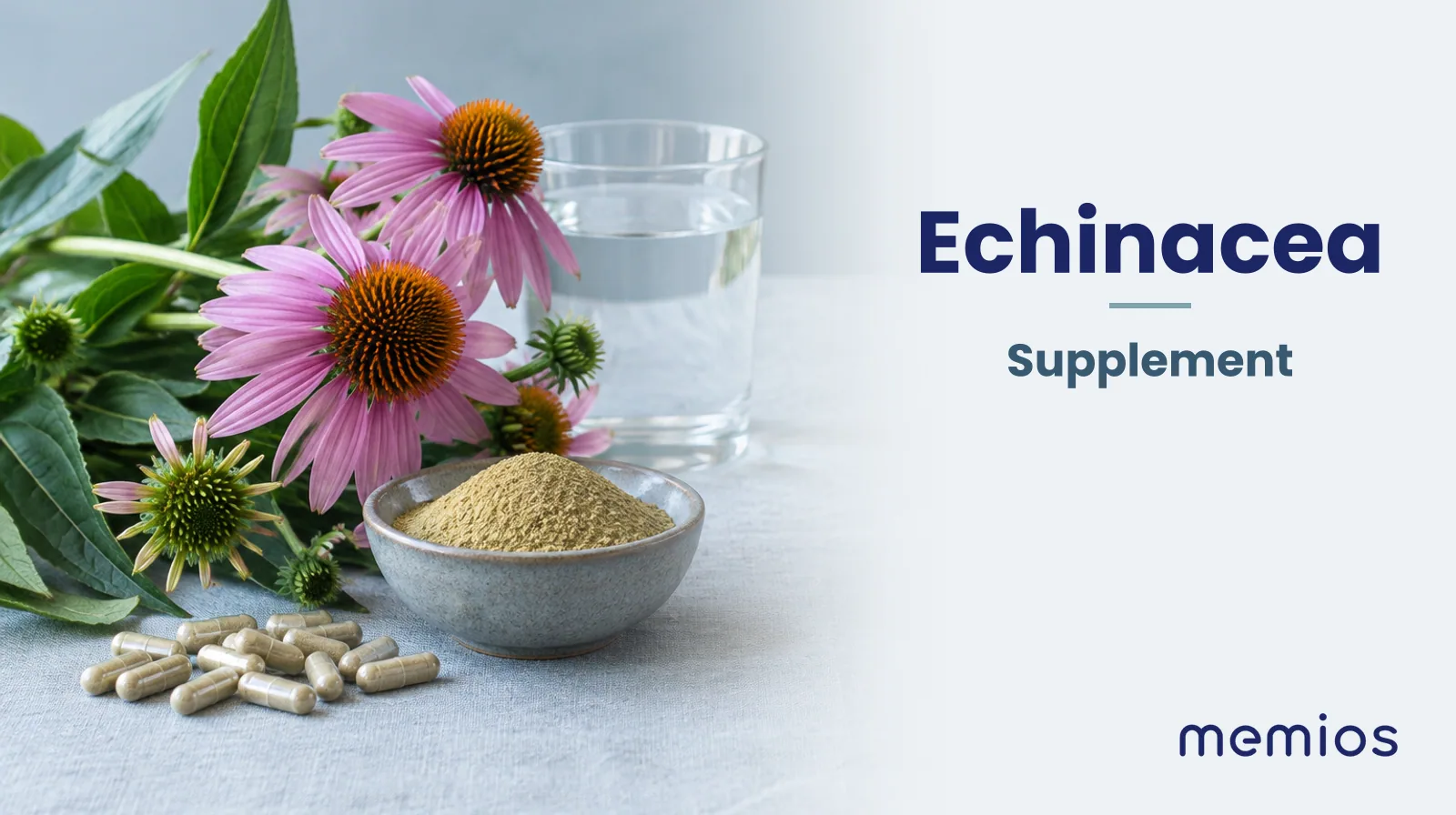
- What it is: Echinacea is a group of flowering plants in the daisy family (Asteraceae) whose roots and above-ground parts are dried or extracted and sold as capsules, tablets, drops, lozenges and sprays.
- Main use, supported: A 2024 meta-analysis covering a wider set of trials reported that echinacea reduced respiratory tract infections and the need for antibiotics.
- Claim NOT supported by research: In the Cochrane review, not one prevention trial showed a statistically significant reduction in the number of people catching at least one cold.
- Another claim NOT supported: Only one of the seven Cochrane treatment trials that reported cold duration found any significant benefit of echinacea over placebo.
- Recommended dose: not established. No dietary reference intake or recommended daily amount has been set for echinacea by any body we could reach; it is a herbal preparation rather than a nutrient, and the Cochrane review notes that products sold under the name differ considerably from one another.
- Studied dose (a trial dose, not a recommendation): A 2023 randomised trial gave adults 16,800 mg/day of Echinacea extract on days 1-3 and 2,240-3,360 mg/day afterwards, compared with conventional formulations delivering 2,400 mg/day. Findings citing that trial: 1 mixed, 1 on harm.
- Upper limit: No tolerable upper intake level or acceptable daily intake has been set.
- What goes wrong: 4 findings on harm. One participant in that trial had a severe adverse event with a suspected hypersensitivity reaction to an echinacea spray.
- Common myth: Taking echinacea at the first sign of a cold shortens the illness.
What it is
Echinacea is a group of flowering plants in the daisy family (Asteraceae) whose roots and above-ground parts are dried or extracted and sold as capsules, tablets, drops, lozenges and sprays. Products sold under the single name "Echinacea" are not one substance: the Cochrane review records that they "differ appreciably in their composition, mainly due to the use of variable plant material, extraction methods and the addition of other components". Trials have used preparations built from different species and different parts of the plant, so results from one product do not automatically transfer to another. Laboratory authentication work on retail products has found that most contained plant species that were not on the label.
What the research says
The evidence is disputed rather than settled. The 2014 Cochrane review of 24 double-blind trials in 4,631 people found that no individual prevention trial reached statistical significance and that only one of seven treatment trials shortened colds; a 2024 meta-analysis using a wider trial set reported clear reductions in respiratory infections. NCCIH records that some children in a clinical trial of echinacea developed rashes that may have been an allergic reaction. Echinacea is not a nutrient, there is no deficiency state, and the main documented harms are allergic reactions (including rash in children and isolated severe hypersensitivity), digestive symptoms and rare reports of liver injury.
Evidence grade: Disputed.
What goes wrong
One participant in that trial had a severe adverse event with a suspected hypersensitivity reaction to an echinacea spray. (Source 1)
- Randomized trial, Certainty not rated.
- Size: 246 treated participants.
- Who: healthy adults with an acute respiratory infection.
- How long: up to 10 days of treatment.
- Result: Adverse events 12 vs. 6% between the new and conventional formulation groups (p = 0.19), which the authors describe as good and similar between formulations; one severe adverse event with a potential hypersensitivity reaction.
- Funding: industry-funded (A. Vogel AG Switzerland and the Swiss Innovation Agency)
There was one severe adverse event with a potential hypersensitivity reaction in a recipient of the novel spray formulation.
The Cochrane review found no overall excess of adverse effects, but a trend towards more dropouts for adverse events in echinacea arms of prevention trials. (Source 2)
- Systematic review, Certainty not rated.
- Size: 4,631 participants across 24 trials.
- Who: adults and children in prevention and treatment trials.
- How long: varied by trial.
- Result: No significant difference in dropouts or reported adverse effects overall; a non-significant trend to more dropouts for adverse events in prevention trials.
- Funding: not stated in the abstract.
However, in prevention trials there was a trend towards a larger number of patients dropping out due to adverse events in the treatment groups.
The NIH LiverTox monograph records isolated case reports of clinically apparent liver injury with jaundice attributed to echinacea, and grades it a possible rare cause. (Source 3)
- Official position, Certainty not rated.
- Size: isolated published case reports plus national adverse reaction registry summaries.
- Who: people taking echinacea extracts.
- How long: jaundice arose 1 to 3 weeks after starting echinacea in two published reports.
- Result: Likelihood score D (possible rare cause of clinically apparent liver injury); rapid and complete recovery on stopping in the published cases.
- Funding: US government (National Institute of Diabetes and Digestive and Kidney Diseases); last update 10 April 2019.
Nevertheless, there have been isolated case reports of clinically apparent liver injury with jaundice, and summary reports from national registries of adverse reactions have reported elevated serum aminotransferase levels and toxic hepatitis attributed to echinacea.
An unrefereed 2017 bioRxiv preprint reported that most retail echinacea products it tested contained plant species other than those on the label. (Source 4)
- Survey study, Certainty not rated.
- Size: 27 analysed products labelled as containing Echinacea as the single ingredient.
- Who: commercial herbal products bought on the market, tested by DNA metabarcoding and HPTLC.
- How long: not applicable.
- Result: 24 of 27 (89%) contained at least one Echinacea species, but only 7 (26%) contained exclusively Echinacea species; overall ingredient fidelity across all products was 43%.
- Funding: not stated in the text we retrieved; this is a preprint.
Limit of this finding: This work is a preprint posted to bioRxiv in 2017 and has not been peer reviewed, so its methods and numbers have had no independent journal scrutiny. It tested products, not people: it says nothing about whether echinacea works, only that products labelled echinacea often contained other species.
However only seven (26 %) contained exclusively Echinacea species, whereas the other 20 contained several other species, likely contaminants.
What the evidence supports
A 2024 meta-analysis covering a wider set of trials reported that echinacea reduced respiratory tract infections and the need for antibiotics. (Source 5)
- Meta-analysis, Certainty not rated.
- Size: 5,652 subjects in 30 clinical trials (39 comparisons)
- Who: adults and children taking echinacea for prevention or treatment of respiratory tract infections.
- How long: varied by trial.
- Result: Monthly RTI occurrence RR 0.68 (95% CI 0.61-0.77); patients with at least one RTI RR 0.75 (95% CI 0.69-0.81); recurrent infections RR 0.60 (95% CI 0.46-0.80); complications RR 0.44 (95% CI 0.36-0.54); need for antibiotics RR 0.60 (95% CI 0.39-0.93)
- Funding: not stated in the text we were able to retrieve; the authorship of this line of echinacea meta-analyses has included consultants to an echinacea manufacturer, which a reviewer should check.
Echinacea significantly reduced the monthly RTI occurrence, risk ratio (RR) 0.68 (95% CI 0.61–0.77) and number of patients with ≥1 RTI, RR = 0.75 [95% CI 0.69–0.81] corresponding to an odds ratio 0.53 [95% CI 0.42–0.67].
What the evidence does not support
In the Cochrane review, not one prevention trial showed a statistically significant reduction in the number of people catching at least one cold. (Source 2)
- Systematic review, Certainty not rated.
- Size: 4,631 participants across 24 double-blind trials (33 comparisons)
- Who: adults and children taking Echinacea mono-preparations or placebo for cold prevention or treatment.
- How long: varied by trial; prevention trials ran weeks to months.
- Result: None of the 12 prevention comparisons was statistically significant; a post hoc pooling suggested a relative risk reduction of 10% to 20%.
- Funding: not stated in the abstract.
None of the 12 prevention comparisons reporting the number of patients with at least one cold episode found a statistically significant difference.
Only one of the seven Cochrane treatment trials that reported cold duration found any significant benefit of echinacea over placebo. (Source 2)
- Systematic review, Certainty not rated.
- Size: seven treatment trials reporting duration, within a review of 24 trials and 4,631 participants.
- Who: people treating an existing cold.
- How long: length of a cold episode.
- Result: 1 of 7 treatment trials significant; the review declined to pool because of clinical heterogeneity.
- Funding: not stated in the abstract.
Of the seven treatment trials reporting data on the duration of colds, only one showed a significant effect of Echinacea over placebo.
Where the evidence is mixed
A third of the trials in the Cochrane review were judged to be at high risk of bias, so the underlying trial base is uneven in quality. (Source 2)
- Systematic review, Certainty not rated.
- Size: 24 double-blind trials.
- Who: trial-level quality assessment, not participants.
- How long: not applicable.
- Result: 10 trials low risk of bias, 6 unclear, 8 high risk of bias.
- Funding: not stated in the abstract.
Ten trials were considered to have a low risk of bias, six to have an unclear risk of bias and eight to have a high risk of bias.
An industry-funded 2023 trial of higher-dose echinacea formulations did not meet its primary endpoint: more patients recovered by day 10 on the new formulations, but the difference was not statistically significant. (Source 1)
- Randomized trial, Certainty not rated.
- Size: 409 randomised; 246 treated for at least one respiratory infection.
- Who: healthy adults, median age 32 years, 78% female.
- How long: taken for up to 10 days per infection episode.
- Result: Recovery by day 10 in 56 and 44% of patients on the new and conventional formulations, with median time to recovery of 10 and 11 days; not statistically significant on either analysis (p = 0.10 intention-to-treat, p = 0.07 per-protocol)
- Funding: industry-funded: funded by the Swiss Innovation Agency and A. Vogel AG Switzerland, with one author employed by A. Vogel AG.
Recovery by day 10 (complete absence of symptoms) was achieved in 56 and 44% of patients with the new and conventional formulations, respectively, showing a median time to recovery of 10 and 11 days, respectively (p = 0.10 in intention-to-treat analysis, p = 0.07 in per-protocol analysis).
NCCIH's current position is that echinacea may slightly reduce the chance of catching a cold, with allergic reactions the main safety concern. (Source 6)
- Official position, Certainty not rated.
- Size: not applicable.
- Who: general public.
- How long: page last updated November 2024.
- Result: No numbers given; effect described qualitatively as slight and uncertain for cold duration.
- Funding: US government agency (National Center for Complementary and Integrative Health)
Taking echinacea may slightly reduce your chances of catching a cold. It's still unclear whether echinacea can shorten the length of a cold.
Where the research disagrees
Whether echinacea prevents or shortens respiratory infections
- Cochrane review authors (Karsch-Volk and colleagues, 2014), systematic review of 24 double-blind randomised trials, no pooling for the main analysis: Echinacea products have not here been shown to provide benefits for treating colds, although, it is possible there is a weak benefit from some Echinacea products: the results of individual prophylaxis trials consistently show positive (if non-significant) trends, although potential effects are of questionable clinical relevance. (Source 7)
- ERA-PRIMA meta-analysis authors (Antibiotics, 2024), meta-analysis pooling 30 trials and 39 comparisons in 5,652 subjects, including trials Cochrane excluded or declined to pool: Echinacea can safely prevent RTIs and associated complications, thereby decreasing the demand for antibiotics. (Source 5)
How much
- Reference intake: No dietary reference intake or recommended daily amount has been set for echinacea by any body we could reach; it is a herbal preparation rather than a nutrient, and the Cochrane review notes that products sold under the name differ considerably from one another. (Source 7)
- Upper limit: No tolerable upper intake level or acceptable daily intake has been set. NCCIH frames safety by duration of use rather than by a maximum amount, describing short-term use of certain extracts as likely safe for most adults (page updated November 2024). (Source 6)
- Studied: A 2023 randomised trial gave adults 16,800 mg/day of Echinacea extract on days 1-3 and 2,240-3,360 mg/day afterwards, compared with conventional formulations delivering 2,400 mg/day. (Source 1)
- Studied: The 2003 children's trial gave Echinacea purpurea at the onset of symptoms and continued it through the illness for a maximum of 10 days. (Source 8)
A common belief, and what the research shows
The belief: Taking echinacea at the first sign of a cold shortens the illness.
What the research shows: The trials that measured this mostly did not find it. Cochrane reports that "Of the seven treatment trials reporting data on the duration of colds, only one showed a significant effect of Echinacea over placebo." NCCIH's summary is that "It's still unclear whether echinacea can shorten the length of a cold."
Questions and answers
What is it?
Echinacea is a group of daisy-family flowering plants whose roots and above-ground parts are dried or extracted for supplements. Products sold under the one word "Echinacea" are not a single substance: different species and different parts of the plant are used, and extraction methods differ. That variability is one reason trial results are hard to compare. (Source 2)
What does it do in the body?
Echinacea is taken in the hope of preventing or shortening colds and other respiratory infections. The Cochrane review found no prevention trial reached significance on its own, and only one of seven treatment trials shortened colds. It is not a nutrient and has no known role in normal body function. (Source 2)
Is it good or bad for you?
The benefit is disputed and, where reported, small. Two meta-analyses of the same field disagree: Cochrane found no clear benefit for treating colds, while a 2024 meta-analysis reported fewer infections. On the harm side, allergic reactions are the main documented risk, rash was more common than placebo in children, and liver injury has been reported rarely. NCCIH describes short-term use of certain extracts as likely safe for most adults. (Source 6)
How do you get more of it?
Echinacea is not present in ordinary food; intake comes only from herbal preparations. Trials have used very different amounts. A 2023 industry-funded trial gave adults 16,800 mg a day of extract for three days, then 2,240-3,360 mg a day, against conventional formulations giving 2,400 mg a day. This describes what trials gave, not a recommendation. (Source 1)
If it is harmful, what reduces it?
Echinacea is not stored in the body, so the question is really what happens when someone stops. In the published reports of echinacea-associated liver injury, the abnormalities resolved after the product was stopped. Allergic reactions can be severe, which is the harm that most often prompts stopping. (Source 3)
Why might someone be low in it or missing it?
There is no such thing as echinacea deficiency, because it is not an essential nutrient. What does vary is whether a product actually contains it: a laboratory survey found that only 26% of products labelled as echinacea contained echinacea species alone, and overall ingredient fidelity was 43%. (Source 4)
Which whole foods contain it or feed it?
No whole food contains echinacea. It reaches people only as a herbal preparation made from the roots or the above-ground parts of the plant, and which species and plant part is used differs between products. (Source 2)
What happens if you do not have it?
Nothing is known to go wrong from not taking echinacea. It is not a nutrient, so there is no deficiency state and no symptoms of lacking it. In the prevention trials Cochrane examined, people given placebo did not catch significantly more colds than people given echinacea. (Source 2)
How can you test for it?
There is no blood or other clinical test for a person's echinacea status, because there is no deficiency state to measure. Testing in this field is applied to products, not people: DNA metabarcoding and thin-layer chromatography are used to check whether a product contains the species on its label, and that testing has repeatedly found it does not. (Source 4)
References
- Frontiers in Medicine. Novel Echinacea formulations for the treatment of acute respiratory tract infections in adults - A randomized blinded controlled trial. 2023. DOI 10.3389/fmed.2023.948787. Read the source
- Cochrane Database of Systematic Reviews. Echinacea for preventing and treating the common cold. 2014. PMID 24554461, DOI 10.1002/14651858.CD000530.pub3. Read the source
- National Institute of Diabetes and Digestive and Kidney Diseases (NIH). Echinacea - LiverTox: Clinical and Research Information on Drug-Induced Liver Injury. 2019. Read the source
- bioRxiv (preprint). What's in the box? Authentication of Echinacea herbal products using DNA metabarcoding and HPTLC. 2017. DOI 10.1101/202721. Read the source
- Antibiotics. Echinacea Reduces Antibiotics by Preventing Respiratory Infections: A Meta-Analysis (ERA-PRIMA). 2024. DOI 10.3390/antibiotics13040364. Read the source
- National Center for Complementary and Integrative Health (NIH). Echinacea: Usefulness and Safety. 2024. Read the source
- Cochrane Database of Systematic Reviews. Echinacea for preventing and treating the common cold (background and authors' conclusions). 2014. PMID 24554461, DOI 10.1002/14651858.CD000530.pub3. Read the source
- JAMA. Efficacy and safety of echinacea in treating upper respiratory tract infections in children: a randomized controlled trial. 2003. PMID 14657066, DOI 10.1001/jama.290.21.2824. Read the source