Supplements · September 29, 2026 · Memios · 10 min read
Cordyceps
Limited evidence. Evidence is limited and inconsistent.
TLDR
- Limited evidence. Evidence is limited and inconsistent.
- What it is: Cordyceps is the common name for insect-parasitising fungi, mainly Ophiocordyceps sinensis (formerly Cordyceps sinensis) and Cordyceps militaris.
- Main use, supported: A meta-analysis of athlete trials reported improvements with Cordyceps sinensis in ventilatory threshold and VO2peak, and a borderline (p = 0.05) improvement in endurance performance. (low certainty)
- Other use, supported: A small placebo-controlled trial of a Cordyceps militaris drink reported higher NK-cell activity and no liver, kidney or blood safety changes. (low certainty)
- Claim NOT supported by research: Five weeks of CordyMax Cs-4 did not improve aerobic capacity or endurance performance in trained male cyclists. (low certainty)
- Recommended dose: not established. No recommended intake exists; cordyceps is not an essential nutrient, and none was found in the sources searched, including LiverTox.
- Studied dose (a trial dose, not a recommendation): Fermented Cordyceps militaris beverage containing 2.85 mg cordycepin daily for 8 weeks (Scientific Reports 2024). Findings citing that trial: 1 for.
- Upper limit: No tolerable upper limit has been set by any body in the sources searched.
- What goes wrong: 4 findings on harm. Two people developed lead poisoning after taking Cordyceps powder contaminated with lead at up to 20,000 ppm.
- Common myth: Cordyceps is a proven natural energy and endurance booster.
What it is
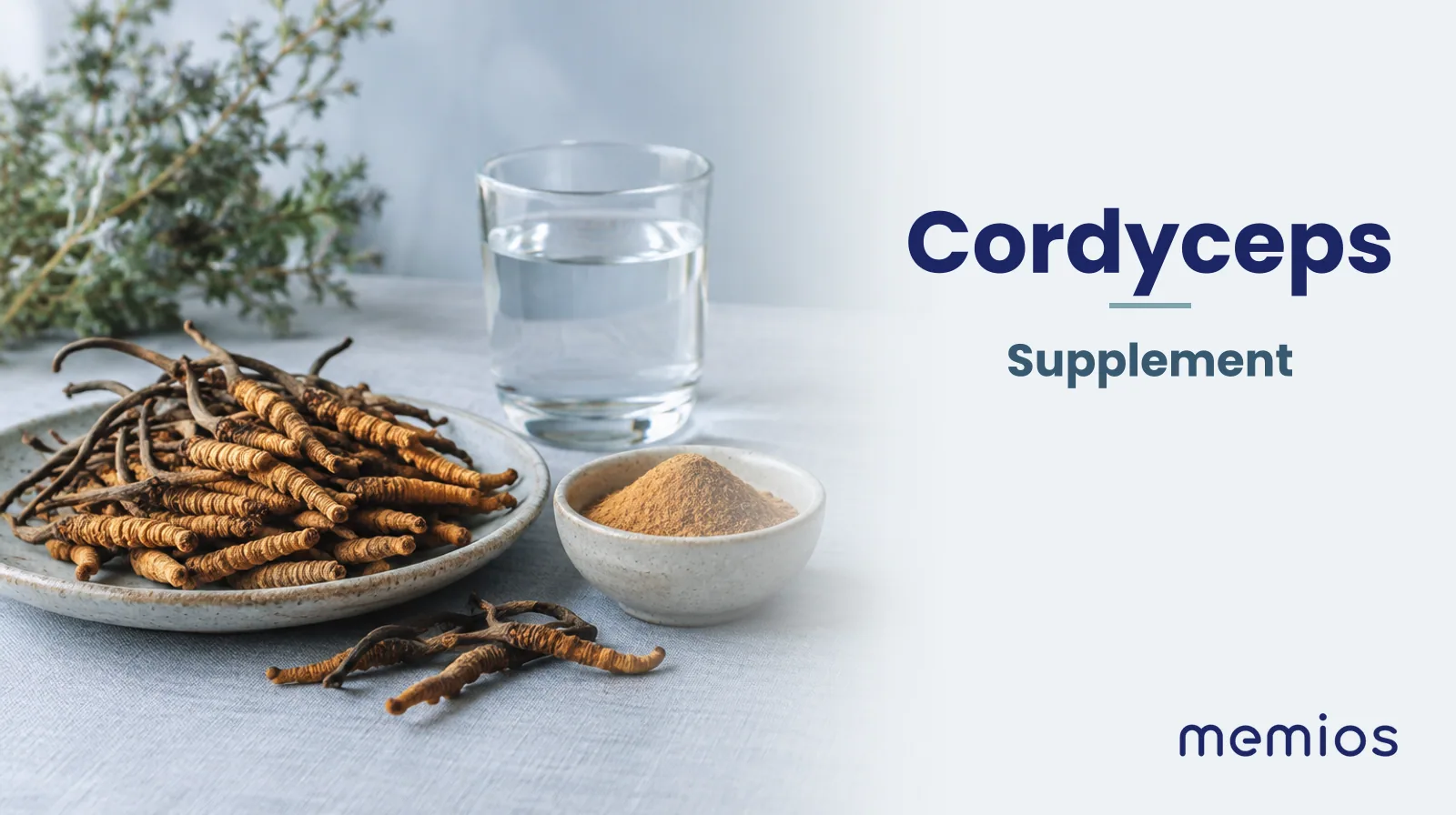
Cordyceps is the common name for insect-parasitising fungi, mainly Ophiocordyceps sinensis (formerly Cordyceps sinensis) and Cordyceps militaris. Wild O. sinensis is rare and expensive, so supplements are usually cultured mycelium or C. militaris. Analyses of wild caterpillar fungus have found arsenic, cadmium and lead.
What the research says
Evidence is limited and inconsistent. A 2025 meta-analysis of athlete trials found small improvements in endurance and VO2peak with Cordyceps sinensis, but the authors warned that 13 of 14 trials were positive, pointing to publication bias, and an earlier trial of CordyMax Cs-4 in trained cyclists found no effect. A Cochrane review of kidney disease trials from China found possible improvements in kidney blood tests but called the evidence low quality. Harms include lead poisoning from contaminated products, arsenic in wild material, and a possible anti-platelet effect relevant to blood thinners.
Evidence grade: Limited evidence.
What goes wrong
Two people developed lead poisoning after taking Cordyceps powder contaminated with lead at up to 20,000 ppm. (Source 1)
- Case report, Very low certainty.
- Size: 2 patients.
- Who: Adults taking Cordyceps herbal medicine in Taiwan.
- How long: not stated.
- Result: Blood lead 130 μg/dl (symptomatic, anaemia and appetite loss) and 46 μg/dl; normalised after stopping and chelation.
- Funding: not stated.
The lead content in the Cordyceps powder was found to be as high as 20 000 ppm.
Metal profiling of wild Cordyceps sinensis found arsenic of 3.0 to 32 ppm in the caterpillar body, attributed to soil contamination. (Source 2)
- Lab study in cells, Certainty not rated.
- Size: 5 samples.
- Who: Wild C. sinensis samples.
- How long: not applicable.
- Result: Arsenic 3.0-32 ppm; lead below 2.0 ppm in all five.
- Funding: not stated.
Arsenic level in C. sinensis caterpillar is significantly higher than that in its mycelium and varies from 3.0 to 32 ppm likely due to soil contamination.
Memorial Sloan Kettering reports a case of excessive bleeding after tooth extraction linked to daily cordyceps use, and says laboratory studies suggest cordyceps may add to the effects of anticoagulant and antiplatelet drugs. (Source 3)
- Official position, Very low certainty.
- Size: 1 case report plus lab data.
- Who: Cordyceps users.
- How long: not applicable.
- Result: No rates.
- Funding: independent.
Laboratory studies suggest cordyceps inhibits platelet aggregation and may increase the effects of these drugs.
LiverTox (updated July 2026) says clinical trials of cordyceps described side effects as uncommon and minimal with no liver injury reported; its only liver case is a single 2023 case report of hepatoportal sclerosis. (Source 4)
- Official position, Certainty not rated.
- Size: not applicable.
- Who: Cordyceps users.
- How long: long-term.
- Result: Likelihood score E (unlikely cause)
- Funding: independent (NIH)
Limit of this finding: LiverTox itself says it is uncertain whether cordyceps caused the liver condition in that single case report.
Few prospective studies have included monitoring of liver tests, but those that did reported no change in serum aminotransferase levels.
What the evidence supports
A meta-analysis of athlete trials reported improvements with Cordyceps sinensis in ventilatory threshold and VO2peak, and a borderline (p = 0.05) improvement in endurance performance. (Source 5)
- Meta-analysis, Low certainty.
- Size: 14 RCTs with 528 athletes (8 trials, n = 288 pooled across all fungi)
- Who: Adult athletes.
- How long: weeks (varied by trial)
- Result: Endurance p = 0.05; ventilatory threshold p = 0.03; VO2peak p = 0.04; low heterogeneity.
- Funding: independent (Hunan provincial social science fund; Soonchunhyang University)
Limit of this finding: The paper calls the endurance result 'significant' at p = 0.05, which sits exactly on the usual cut-off for significance, so it is borderline at best. Read it as a weak hint of an endurance benefit, not a demonstrated one; the ventilatory threshold and VO2peak results are also only just below the cut-off, and the authors themselves warn that publication bias may inflate these effects.
Meta-analysis showed that Cordyceps sinensis supplementation significantly improved endurance performance (p = 0.05), ventilatory threshold (p = 0.03), and VO2peak (p = 0.04)
A small placebo-controlled trial of a Cordyceps militaris drink reported higher NK-cell activity and no liver, kidney or blood safety changes. (Source 6)
- Randomized trial, Low certainty.
- Size: reported as n = 10 for each gender per arm (about 40 adults)
- Who: Healthy Thai adults.
- How long: 8 weeks.
- Result: NK activity up in women vs placebo (p = 0.023); in men within-group (p = 0.049); safety indices unchanged.
- Funding: government-funded (National Innovation Agency, Thailand)
the NK activity in women who received FCM for 8 weeks significantly increased (p = 0.023) from baseline.
What the evidence does not support
Five weeks of CordyMax Cs-4 did not improve aerobic capacity or endurance performance in trained male cyclists. (Source 7)
- Randomized trial, Low certainty.
- Size: 22 male cyclists.
- Who: Endurance-trained male cyclists.
- How long: 5 weeks.
- Result: No effect on VO2peak or time trial performance.
- Funding: not stated in the fetched text.
It is concluded that 5 weeks of CordyMax Cs-4 supplementation has no effect on aerobic capacity or endurance exercise performance in endurance-trained male cyclists.
Where the evidence is mixed
The same review warned that nearly all included trials were positive, so benefits may be overestimated. (Source 8)
- Meta-analysis, Low certainty.
- Size: 14 RCTs.
- Who: Adult athletes.
- How long: not applicable.
- Result: 13 of 14 trials favourable.
- Funding: independent.
Among the 14 included trials, 13 reported favorable outcomes, suggesting that the true effect size may be overestimated.
A Cochrane review of Chinese trials found Cordyceps added to conventional treatment may improve kidney function tests in chronic kidney disease, but the evidence was low quality. (Source 9)
- Systematic review, Low certainty.
- Size: 22 studies, 1,746 people.
- Who: People with chronic kidney disease in China.
- How long: varied.
- Result: Lower serum creatinine, higher creatinine clearance, less proteinuria; firm conclusions not possible.
- Funding: not stated.
Limit of this finding: The review's summary says 'creatine clearance'. This is almost certainly a typo for creatinine clearance, the standard kidney-function measure; it is quoted as written. The benefits come from low-quality trials, so they are possibilities, not established effects.
However, definitive conclusions could not be made because of the low quality of evidence.
Where the research disagrees
Whether cordyceps improves endurance exercise performance
- 2025 meta-analysis of athlete trials, meta-analysis: Meta-analysis showed that Cordyceps sinensis supplementation significantly improved endurance performance (p = 0.05), ventilatory threshold (p = 0.03), and VO2peak (p = 0.04) (Source 5)
- Parcell et al. 2004, RCT in 22 cyclists: 5 weeks of CordyMax Cs-4 supplementation has no effect on aerobic capacity or endurance exercise performance in endurance-trained male cyclists. (Source 7)
How much
- Reference intake: No recommended intake exists; cordyceps is not an essential nutrient, and none was found in the sources searched, including LiverTox. (Source 10)
- Upper limit: No tolerable upper limit has been set by any body in the sources searched. (Source 10)
- Studied: Fermented Cordyceps militaris beverage containing 2.85 mg cordycepin daily for 8 weeks (Scientific Reports 2024). (Source 6)
- Studied: CordyMax Cs-4 for 5 weeks in trained cyclists (Parcell et al. 2004). (Source 7)
A common belief, and what the research shows
The belief: Cordyceps is a proven natural energy and endurance booster.
What the research shows: The pooled benefits are small and borderline, and the review authors themselves noted "Among the 14 included trials, 13 reported favorable outcomes, suggesting that the true effect size may be overestimated." A controlled cyclist trial found "5 weeks of CordyMax Cs-4 supplementation has no effect on aerobic capacity or endurance exercise performance".
Questions and answers
What is it?
Cordyceps is a group of fungi that grow on insects. The two used in supplements are Ophiocordyceps sinensis (the Himalayan caterpillar fungus) and Cordyceps militaris. (Source 10)
What does it do in the body?
It is claimed to raise energy and exercise capacity. Small athlete trials suggest a modest effect on endurance and oxygen uptake, but the evidence may be inflated by publication bias and one controlled cyclist trial found no effect. (Source 8)
Is it good or bad for you?
Short-term use appears well tolerated in trials, but reporting of side effects is poor. Contaminated products have caused lead poisoning, and it may add to the effect of blood thinners. (Source 11)
How do you get more of it?
It is taken as capsules of cultured mycelium or as extracts. One trial gave a fermented C. militaris drink with 2.85 mg cordycepin daily for 8 weeks. (Source 6)
If it is harmful, what reduces it?
Cordyceps is not something the body makes or needs removing. Where contaminated cordyceps caused lead poisoning, stopping it (plus chelation in one case) brought blood lead back to normal. (Source 1)
Why might someone be low in it or missing it?
Does not apply. Cordyceps is not a nutrient or part of the body, so no one is deficient in it. (Source 10)
Which whole foods contain it or feed it?
No everyday whole food in the sources searched contains it. It is sourced as the wild fungus or as cultured material. (Source 10)
We searched: LiverTox, MSKCC and a 2025 meta-analysis; none list common foods containing cordyceps.
What happens if you do not have it?
Nothing is known to happen. It is not essential, and no study links not taking it to disease. (Source 10)
We searched: LiverTox and the reviews cited; no deficiency concept exists.
How can you test for it?
There is no clinical test for cordyceps in the body. Laboratory mass spectrometry of the product itself can detect toxic metals such as lead and arsenic and help flag abnormal or adulterated samples. (Source 2)
References
- Science of The Total Environment. Lead poisoning caused by contaminated Cordyceps, a Chinese herbal medicine: two case reports. 1996. PMID 8854946, DOI 10.1016/0048-9697(96)05054-1. Read the source
- Analytical Methods. Profiling metals in Cordyceps sinensis by using inductively coupled plasma mass spectrometry. 2017. DOI 10.1039/C6AY02524B. Read the source
- Memorial Sloan Kettering Cancer Center. Cordyceps (About Herbs). 2022. Read the source
- National Institute of Diabetes and Digestive and Kidney Diseases (NCBI Bookshelf). Cordyceps - LiverTox: Clinical and Research Information on Drug-Induced Liver Injury. 2026. Read the source
- Frontiers in Nutrition. Effects of fungal supplementation on endurance, immune function, and hematological profiles in adult athletes: a systematic review and meta-analysis. 2025. DOI 10.3389/fnut.2025.1670416. Read the source
- Scientific Reports. A randomized controlled clinical trial examining the effects of Cordyceps militaris beverage on the immune response in healthy adults. 2024. DOI 10.1038/s41598-024-58742-z. Read the source
- International Journal of Sport Nutrition and Exercise Metabolism. Cordyceps Sinensis (CordyMax Cs-4) Supplementation Does Not Improve Endurance Exercise Performance. 2004. PMID 15118196, DOI 10.1123/ijsnem.14.2.236. Read the source
- Frontiers in Nutrition. Effects of fungal supplementation on endurance, immune function, and hematological profiles in adult athletes: a systematic review and meta-analysis. 2025. DOI 10.3389/fnut.2025.1670416. Read the source
- Cochrane Database of Systematic Reviews. Cordyceps sinensis (a traditional Chinese medicine) for treating chronic kidney disease. 2014. DOI 10.1002/14651858.CD008353.pub2. Read the source
- National Institute of Diabetes and Digestive and Kidney Diseases (NCBI Bookshelf). Cordyceps - LiverTox: Clinical and Research Information on Drug-Induced Liver Injury. 2026. Read the source
- Frontiers in Nutrition. Effects of fungal supplementation on endurance, immune function, and hematological profiles in adult athletes: a systematic review and meta-analysis. 2025. DOI 10.3389/fnut.2025.1670416. Read the source