Supplements · September 30, 2026 · Memios · 10 min read
Chaga
Chaga is claimed to help with inflammation, immunity, blood sugar and cancer, but these effects come from laboratory and animal studies.
TLDR
- Not enough research to say. Chaga is claimed to help with inflammation, immunity, blood sugar and cancer, but these effects come from laboratory and animal studies.
- What it is: Chaga is a fungal growth (conk) found on birch trees in cold climates.
- Main use, mixed evidence: A 1973 Russian trial of a chaga preparation (Befungin) in 50 people with psoriasis, summarised in the review's table as not randomised, controlled or blinded, reported clearing in 38. (very low certainty)
- Claim NOT supported by research: A review of human clinical trials found only two human studies of chaga in the peer-reviewed literature, both more than 30 years old. (very low certainty)
- Another claim NOT supported: No controlled studies designed to test chaga's safety were found. (very low certainty)
- Recommended dose: not established. No RDA or Adequate Intake exists. Chaga is not a nutrient, and the sources searched record no body setting a reference intake.
- Studied dose (a trial dose, not a recommendation): No controlled trial dose exists. Findings citing that trial: 1 on harm.
- Upper limit: No tolerable upper limit has been set by any body in the sources searched.
- What goes wrong: 6 findings on harm. A 49-year-old man who took chaga powder long term for eczema developed end-stage kidney disease with oxalate crystals on biopsy; the leftover chaga contained 14.2 g oxalate per 100 g.
- Common myth: Chaga is a natural folk remedy, so it is safe to take every day.
What it is
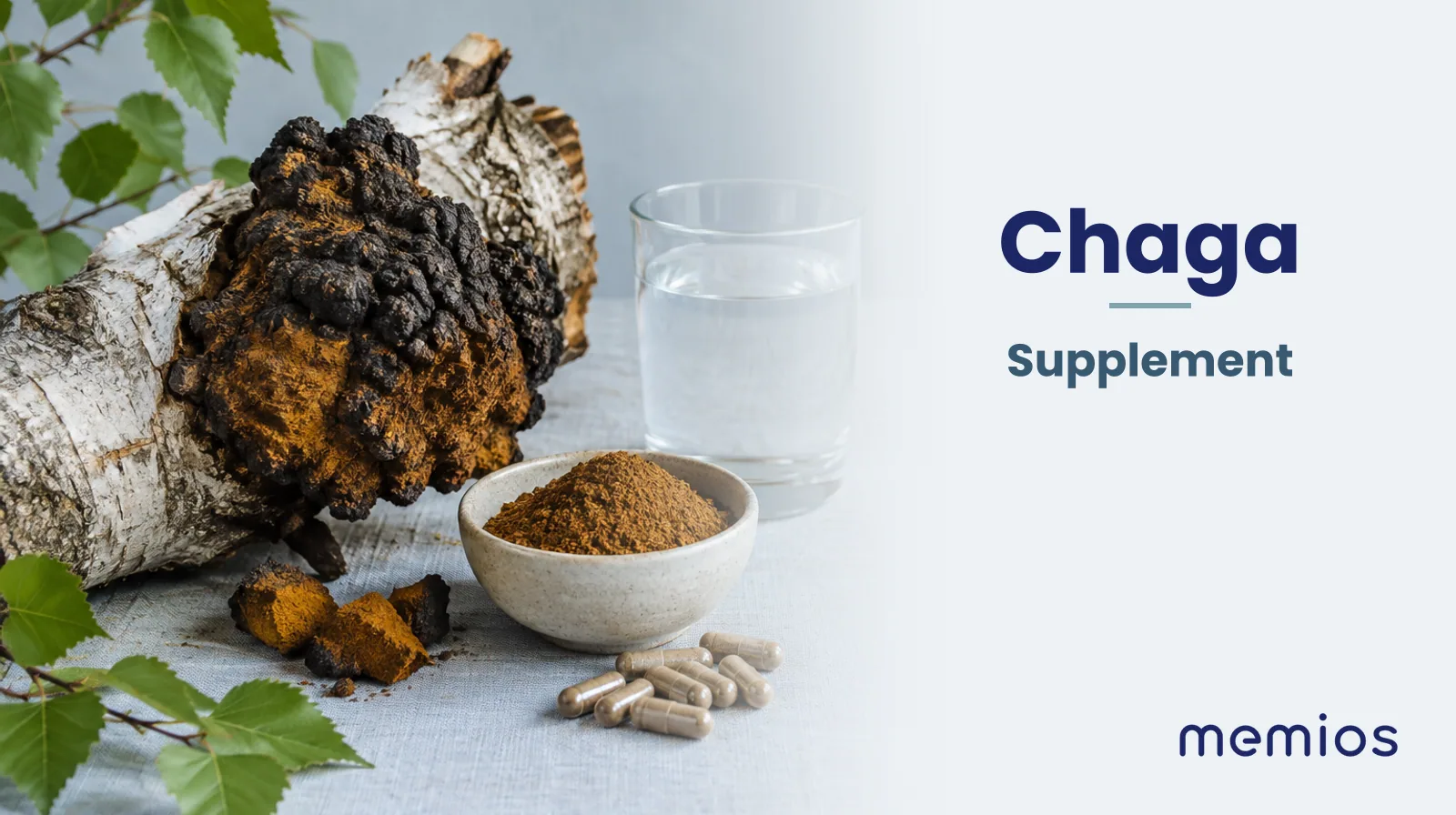
Chaga is a fungal growth (conk) found on birch trees in cold climates. The material used medicinally is a mix of wood from the host tree and the fungus's mycelium. It has long been used as a folk remedy in Russia and northern Europe.
What the research says
Chaga is claimed to help with inflammation, immunity, blood sugar and cancer, but these effects come from laboratory and animal studies. Memorial Sloan Kettering's review states its safety and efficacy have yet to be evaluated in clinical studies, and a review of human trials found only two old, uncontrolled Russian studies. The best-documented human finding is harm: case reports of serious kidney injury from its very high oxalate content.
Evidence grade: Not enough research to say.
What goes wrong
A 49-year-old man who took chaga powder long term for eczema developed end-stage kidney disease with oxalate crystals on biopsy; the leftover chaga contained 14.2 g oxalate per 100 g. (Source 1)
- Case report, Very low certainty.
- Size: 1 patient.
- Who: 49-year-old Korean man with atopic dermatitis.
- How long: About five years of use.
- Result: End-stage renal disease; chaga oxalate content 14.2 g/100 g; estimated oxalate intake 2 to 5 times usual diet.
- Funding: not stated.
The Chaga mushroom had extremely high oxalate content (14.2 g/100 g).
The authors of that case concluded chaga is a potential risk factor for chronic kidney disease because of its high oxalate content. (Source 1)
- Case report, Very low certainty.
- Size: 1 patient.
- Who: 49-year-old man.
- How long: Long-term use.
- Result: Hemodialysis-dependent kidney failure.
- Funding: not stated.
Chaga mushroom is a potential risk factor of chronic kidney disease considering high oxalate content.
A 69-year-old man taking 10 to 15 g chaga powder a day plus 500 mg vitamin C for 3 months developed acute kidney injury from oxalate nephropathy; kidney function recovered after dialysis and high-dose steroids. (Source 2)
- Case report, Very low certainty.
- Size: 1 patient.
- Who: 69-year-old man.
- How long: 3 months of use.
- Result: Acute oxalate nephropathy with minimal change disease; recovery within 1 month of treatment.
- Funding: not stated.
A 69-year-old man who ingested Chaga mushroom powder (10-15 g per day) and vitamin C (500 mg per day) for the past 3 months developed acute kidney injury (AKI) with the clinical manifestations of nephrotic syndrome (NS).
Memorial Sloan Kettering lists two cases of oxalate kidney damage after chaga powder. A 72-year-old woman with liver cancer who took 4 to 5 teaspoons daily for 6 months needed dialysis and did not regain kidney function. A 69-year-old man who took 10 to 15 g a day with 500 mg vitamin C for 3 months recovered kidney function after dialysis and high-dose steroids. (Source 3)
- Case report, Very low certainty.
- Size: 2 patients (case reports)
- Who: 72-year-old woman with liver cancer; 69-year-old man.
- How long: 6 months (4 to 5 teaspoons powder daily); 3 months (10 to 15 g powder daily plus 500 mg vitamin C)
- Result: Oxalate nephropathy in both; dialysis in both; the woman did not recover kidney function, the man improved after dialysis and high-dose steroids.
- Funding: independent (academic cancer centre)
In a 72-year-old woman with liver cancer after ingesting chaga mushroom powder (4-5 teaspoons daily for 6 months). Hemodialysis was required but renal function did not recover. In a 69-year-old man after consuming chaga mushroom powder (10-15 g per day) and vitamin C (500 mg per day) for 3 months. Kidney function improved after hemodialysis and high-dose steroids.
Chaga may add to the effect of blood thinners: an extract reduced platelet clumping in mice, and clinical relevance is unknown. (Source 4)
- Animal study, Very low certainty.
- Size: not stated.
- Who: Mice.
- How long: not stated.
- Result: Inhibited platelet aggregation; possible synergy with anticoagulant or antiplatelet drugs.
- Funding: independent (academic cancer centre summary)
Chaga extract inhibited platelet aggregation in a murine model. It may also have synergistic effects when used with anticoagulant/antiplatelet drugs, but clinical relevance is not known.
In laboratory work chaga added to blood-sugar lowering, so it could in theory add to diabetes medicines; this has not been shown in people. (Source 4)
- Lab study in cells, Very low certainty.
- Size: not applicable.
- Who: Laboratory study.
- How long: not applicable.
- Result: Additive glucose-lowering in vitro; clinical significance unknown.
- Funding: independent (academic cancer centre summary)
In vitro, chaga had additive effects in lowering blood sugar levels. Clinical significance is yet unknown.
What the evidence does not support
A review of human clinical trials found only two human studies of chaga in the peer-reviewed literature, both more than 30 years old. (Source 5)
- Expert review, not systematic, Very low certainty.
- Size: 2 human studies identified.
- Who: Published human studies of I. obliquus up to 2015.
- How long: Literature through 2015.
- Result: Only two human studies found; no controlled safety studies; no registered trials on clinicaltrials.gov.
- Funding: not stated.
only two human studies were found in the peer-reviewed literature, and both are over 30 years old
No controlled studies designed to test chaga's safety were found. (Source 5)
- Expert review, not systematic, Very low certainty.
- Size: not applicable.
- Who: Published and registered studies of I. obliquus.
- How long: Literature through 2015.
- Result: Zero controlled safety studies; zero registered trials.
- Funding: not stated.
No controlled studies designed to assess the safety of I. obliquus were found and no studies were reported on clinicaltrials.gov (2015).
Memorial Sloan Kettering's clinical summary states that chaga's safety and efficacy have not been evaluated in clinical studies; reported benefits come from preclinical work. (Source 6)
- Expert review, not systematic, Very low certainty.
- Size: not applicable.
- Who: Summary of the chaga literature.
- How long: Page last updated 20 February 2023.
- Result: No clinical evaluation of safety or efficacy.
- Funding: independent (academic cancer centre)
But the safety and efficacy of chaga have yet to be evaluated in clinical studies.
Where the evidence is mixed
A 1973 Russian trial of a chaga preparation (Befungin) in 50 people with psoriasis, summarised in the review's table as not randomised, controlled or blinded, reported clearing in 38, considerable improvement in 8 and no effect in 4. Without a control group it cannot show that chaga caused the change. (Source 7)
- Case series, Very low certainty.
- Size: 50 patients (38 cleared, 8 improved, 4 no effect)
- Who: People with psoriasis, 1973 report (Dosychev and Bystrova), summarised in the review's Table 2.
- How long: Group 1: 3 to 6 months; group 2: up to 12 months; group 3: more than 2 years (per the review's Table 2)
- Result: Complete clearing in 38 patients; considerable improvement in 8; no effect in 4.
- Funding: not stated.
Complete disappearance of psoriatic eruptions were observed in 38 patients and considerable improvement in 8 patients. No therapeutic effect was achieved in 4 patients.
How much
- Reference intake: No RDA or Adequate Intake exists. Chaga is not a nutrient, and the sources searched record no body setting a reference intake. (Source 8)
- Upper limit: No tolerable upper limit has been set by any body in the sources searched. Case reports link kidney injury to 10 to 15 g powder a day for 3 months and to long-term use. (Source 2)
- Studied: No controlled trial dose exists. In a case report of kidney injury the patient took 10 to 15 g chaga powder per day with 500 mg vitamin C for 3 months. (Source 2)
A common belief, and what the research shows
The belief: Chaga is a natural folk remedy, so it is safe to take every day.
What the research shows: No controlled safety study exists, and case reports tie long-term use to kidney failure. The case authors wrote: "Chaga mushroom is a potential risk factor of chronic kidney disease considering high oxalate content."
Questions and answers
What is it?
Chaga is a fungus that grows as a dark, crusty conk on birch trees in cold climates. The part used is a mix of birch wood and fungal mycelium, traditionally used as a folk remedy in Russia and northern Europe. (Source 8)
What does it do in the body?
In laboratory and animal studies chaga extracts show anti-inflammatory, blood-sugar and anti-tumour effects. None of this has been confirmed in people: its safety and efficacy have not been tested in clinical studies. (Source 6)
Is it good or bad for you?
No benefit has been shown in controlled human studies. The clearest human evidence is harm: chaga is extremely high in oxalate, and several people taking it regularly developed serious kidney injury, some permanently. (Source 1)
How do you get more of it?
Chaga is taken as powders, teas and extracts. No trial has established an amount that helps; the people harmed in case reports were taking powder daily for months to years. (Source 1)
If it is harmful, what reduces it?
Chaga is not something the body makes or carries. In the kidney-injury case reports, the harm came from taking it. In one man, kidney function did not improve with fluids and blood pressure control, and recovered about a month after treatment with dialysis and high-dose steroids. (Source 2)
Why might someone be low in it or missing it?
Does not apply. Chaga is not a nutrient or a gut organism, so there is no deficiency state described in the literature we searched. (Source 8)
We searched: WebSearch for chaga human evidence reviews; Memorial Sloan Kettering monograph; review of human clinical trials
Which whole foods contain it or feed it?
Chaga is not an ordinary food. It grows on birch trees, and the part used is a woody conk rather than a cap-and-stem mushroom. (Source 8)
What happens if you do not have it?
Nothing is known to happen. Chaga is not an essential nutrient and no literature we searched describes any effect of not taking it. (Source 8)
We searched: WebSearch for chaga clinical reviews and case reports; Memorial Sloan Kettering monograph
How can you test for it?
There is no test for chaga itself. In the kidney-injury cases, doctors found the problem through a kidney biopsy that showed oxalate crystals, and then traced it to chaga through the medication history. (Source 1)
References
- Journal of Korean Medical Science. Development of End Stage Renal Disease after Long-Term Ingestion of Chaga Mushroom: Case Report and Review of Literature. 2020. PMID 32419395, DOI 10.3346/jkms.2020.35.e122. Read the source
- Medicine (Baltimore). Chaga mushroom-induced oxalate nephropathy that clinically manifested as nephrotic syndrome: A case report. 2022. PMID 35451393, DOI 10.1097/MD.0000000000028997. Read the source
- Memorial Sloan Kettering Cancer Center. Chaga Mushroom (About Herbs). 2023. Read the source
- Memorial Sloan Kettering Cancer Center. Chaga Mushroom (About Herbs). 2023. Read the source
- McIlvainea (North American Mycological Association). Three Popular Medicinal Mushroom Supplements: A Review of Human Clinical Trials. Read the source
- Memorial Sloan Kettering Cancer Center. Chaga Mushroom (About Herbs). 2023. Read the source
- McIlvainea (North American Mycological Association). Three Popular Medicinal Mushroom Supplements: A Review of Human Clinical Trials. Read the source
- Memorial Sloan Kettering Cancer Center. Chaga Mushroom (About Herbs). 2023. Read the source