Supplements · September 30, 2026 · Memios · 10 min read
Cat's claw
Limited evidence. It is promoted for arthritis, cancer, viral infections and immunity.
TLDR
- Limited evidence. It is promoted for arthritis, cancer, viral infections and immunity.
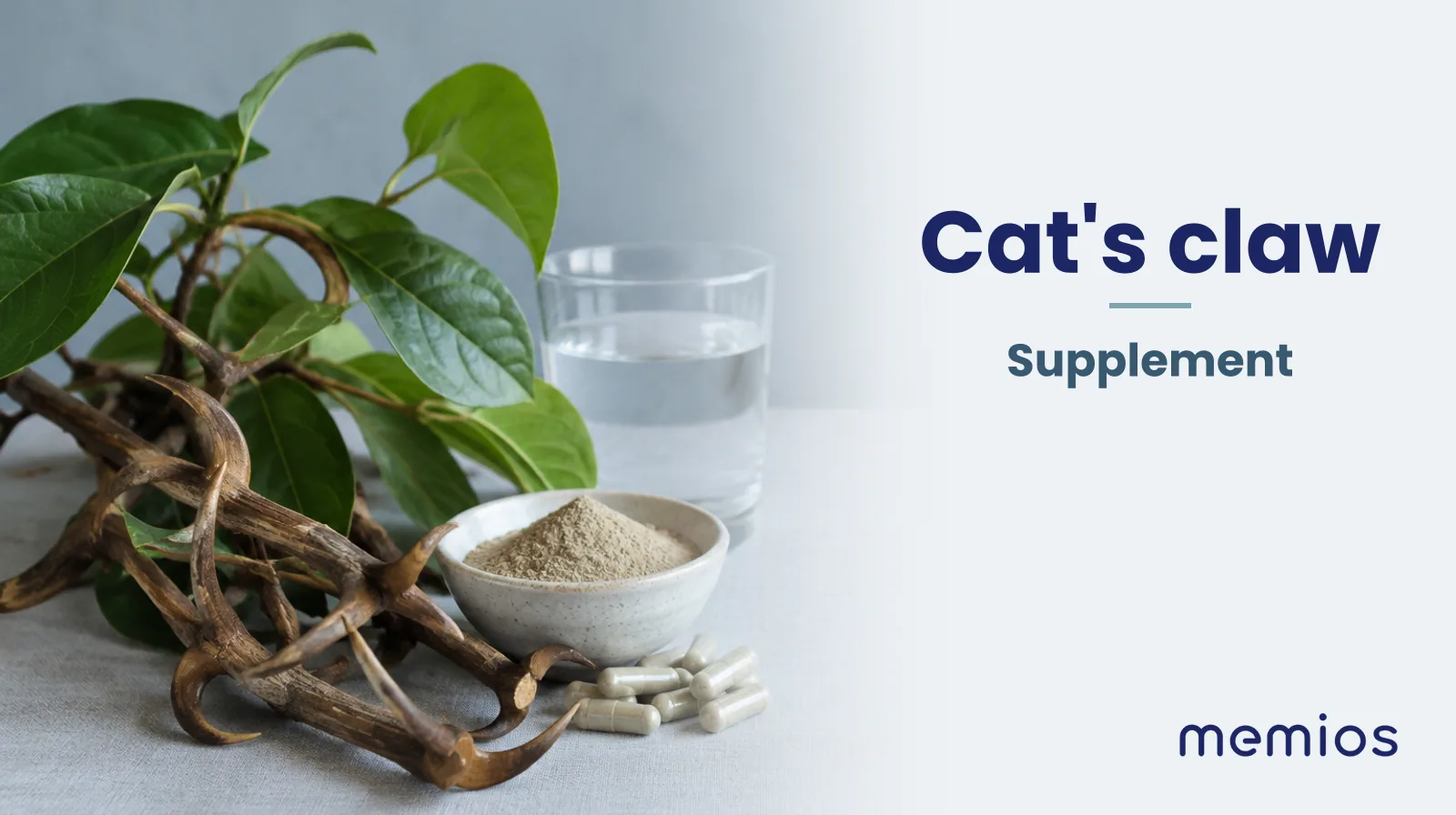
- What it is: Cat's claw is a woody vine that grows wild in the Amazon rainforest and other tropical parts of Central and South America. The two common species are Uncaria tomentosa and Uncaria guianensis, and most US products contain U. tomentosa.
- Main use, supported: In a small randomised trial in people with rheumatoid arthritis already on sulfasalazine or hydroxychloroquine, a cat's claw extract reduced the number of painful joints more than placebo over 24 weeks. (low certainty)
- Other use, supported: In a four-week randomised trial of knee osteoarthritis, freeze-dried Uncaria guianensis reduced pain with activity and assessment scores compared with placebo. (very low certainty)
- Claim NOT supported by research: In the same osteoarthritis trial, knee pain at rest or at night and knee swelling (circumference) did not improve. (very low certainty)
- Another claim NOT supported: The same animal meta-analysis found no significant change in IL-1, IL-10 or TNF-alpha. (very low certainty)
- Recommended dose: not established. No reference intake exists. Cat's claw is a herbal product, not a nutrient.
- Studied dose (a trial dose, not a recommendation): A 52-week rheumatoid arthritis trial gave a purified extract of the pentacyclic chemotype of U. tomentosa versus placebo for 24 weeks, then to all patients for 28 weeks. Findings citing that trial: 1 for.
- Upper limit: No upper limit has been set by any body.
- What goes wrong: 4 findings on harm. Laboratory analysis of bark and market products found total alkaloid content varied roughly six-fold between products, so labels do not guarantee what is inside.
- Common myth: Cat's claw is a proven immune booster or cancer treatment.
What it is
Cat's claw is a woody vine that grows wild in the Amazon rainforest and other tropical parts of Central and South America. The two common species are Uncaria tomentosa and Uncaria guianensis, and most US products contain U. tomentosa. Its bark contains oxindole alkaloids, and the amount in commercial products varies several-fold.
What the research says
It is promoted for arthritis, cancer, viral infections and immunity. NCCIH says there have been very few high-quality trials and no conclusive evidence in people for any health use. Two small trials report modest benefits: fewer painful joints in rheumatoid arthritis and less activity-related knee pain in osteoarthritis, while other outcomes did not improve. Animal studies show some anti-inflammatory markers fall and others do not. It appears safe orally for up to six months, but it may slow blood clotting, may interact with medicines, and a case report links it to raised levels of HIV drugs.
Evidence grade: Limited evidence.
What goes wrong
NCCIH (November 2024) warns that cat's claw may slow blood clotting and increase bleeding risk during surgery. (Source 1)
- Official position, Certainty not rated.
- Size: Not applicable.
- Who: People having surgery.
- How long: Not applicable.
- Result: Not applicable.
- Funding: independent (US government)
may slow blood clotting, and this might increase the risk of bleeding during surgery.
NCCIH (November 2024) notes theoretical interactions with anticoagulant, antiplatelet and blood pressure drugs and with other supplements, and that it might worsen autoimmune disease. (Source 1)
- Official position, Certainty not rated.
- Size: Not applicable.
- Who: People on medicines or with autoimmune disease.
- How long: Not applicable.
- Result: Not applicable.
- Funding: independent (US government)
might interact with anticoagulant, antiplatelet, and blood pressure drugs, and other supplements as well.
A case report describes raised trough levels of the HIV drugs atazanavir and saquinavir while a patient took cat's claw, which fell after it was stopped. (Source 2)
- Case report, Very low certainty.
- Size: 1 patient.
- Who: 45-year-old woman with HCV-related cirrhosis on boosted atazanavir and saquinavir.
- How long: 15 days after stopping.
- Result: Atazanavir trough 1.22 to 0.3 microg/ml; saquinavir 3.4 to 0.64 microg/ml after stopping cat's claw.
- Funding: not stated.
trough concentrations for atazanavir and saquinavir decreased to 0.3 and 0.64
Laboratory analysis of bark and market products found total alkaloid content varied roughly six-fold between products, so labels do not guarantee what is inside. (Source 3)
- Lab study in cells, Low certainty.
- Size: Several bark samples and market products.
- Who: Commercial cat's claw products.
- How long: Not applicable.
- Result: Total alkaloid content 0.156% to 0.962%.
- Funding: not stated.
showed variations in the total alkaloid content in products from 0.156 to 0.962%.
What the evidence supports
In a small randomised trial in people with rheumatoid arthritis already on sulfasalazine or hydroxychloroquine, a cat's claw extract reduced the number of painful joints more than placebo over 24 weeks. (Source 4)
- Randomized trial, Low certainty.
- Size: 40 patients.
- Who: Adults with active rheumatoid arthritis on sulfasalazine or hydroxychloroquine.
- How long: 24 weeks double-blind, then 28 weeks open.
- Result: Painful joints reduced 53.2% vs 24.1% with placebo, p = 0.044.
- Funding: not stated; authors call it a small preliminary study.
Twenty-four weeks of treatment with the UT extract resulted in a reduction of the number of painful joints compared to placebo (by 53.2% vs 24.1%; p = 0.044).
In a four-week randomised trial of knee osteoarthritis, freeze-dried Uncaria guianensis reduced pain with activity and assessment scores compared with placebo. (Source 5)
- Randomized trial, Very low certainty.
- Size: 45 patients (30 cat's claw, 15 placebo)
- Who: Adults with knee osteoarthritis.
- How long: 4 weeks.
- Result: Pain with activity, medical and patient assessment scores significantly reduced (figures not given in abstract)
- Funding: not stated.
Pain associated with activity, medical and patient assessment scores were all significantly reduced, with benefits occurring within the first week of therapy.
A meta-analysis of 24 animal studies found U. tomentosa extracts lowered the inflammatory markers IL-6 and NF-kB. (Source 6)
- Animal study, Very low certainty.
- Size: 24 preclinical studies.
- Who: Animals.
- How long: Varied.
- Result: IL-6 SMD -0.72 (95% CI -1.15 to -0.29); NF-kB SMD -1.19 (95% CI -1.89 to -0.48)
- Funding: not stated.
U. tomentosa extracts decreased the cytokines interleukin (IL)-6 (SMD: -0.72, 95%CI: -1.15, -0.29, p = 0.001) and transcription factor nuclear factor kappa-B (NF-κB) (SMD: -1.19, 95%CI: -1.89, -0.48, p = 0.001).
In the four-week osteoarthritis trial, cat's claw had no harmful effects on blood or liver tests compared with placebo. (Source 5)
- Randomized trial, Very low certainty.
- Size: 45 patients.
- Who: Adults with knee osteoarthritis.
- How long: 4 weeks.
- Result: No deleterious effects on blood or liver function versus placebo.
- Funding: not stated.
had no deleterious effects on blood or liver function or other significant side-effects compared to placebo.
What the evidence does not support
In the same osteoarthritis trial, knee pain at rest or at night and knee swelling (circumference) did not improve. (Source 5)
- Randomized trial, Very low certainty.
- Size: 45 patients.
- Who: Adults with knee osteoarthritis.
- How long: 4 weeks.
- Result: Not significantly reduced.
- Funding: not stated.
Knee pain at rest or at night, and knee circumference were not significantly reduced
NCCIH (November 2024) states that many human studies of cat's claw lacked rigour and were too small to reach definite conclusions. (Source 7)
- Official position, Certainty not rated.
- Size: Not applicable.
- Who: General.
- How long: Not applicable.
- Result: Not applicable.
- Funding: independent (US government)
many of the studies did not use rigorous methods and did not include enough study participants to allow definite conclusions to be reached.
The same animal meta-analysis found no significant change in IL-1, IL-10 or TNF-alpha. (Source 6)
- Animal study, Very low certainty.
- Size: 24 preclinical studies.
- Who: Animals.
- How long: Varied.
- Result: IL-1 SMD -0.16 (95% CI -0.87 to +0.56, p = 0.67); IL-10 SMD -0.05 (reported 95% CI -0.35 to 0.45, p = 0.80); TNF-alpha SMD 0.18 (95% CI -0.25 to 0.62, p = 0.41)
- Funding: not stated.
Limit of this finding: The IL-10 figures in the source do not fit together: an effect of -0.05 should sit in the middle of its confidence range, but the published range of -0.35 to 0.45 is centred on +0.05, so a sign has probably been misprinted. Either way the range spans zero and the p-value is 0.80, so the conclusion that IL-10 did not change is unaffected; the exact IL-10 numbers should not be relied on.
However, the extracts did not significantly alter IL-1 (SMD: -0.16, 95%CI: -0.87, +0.56, p = 0.67), IL-10 (SMD: -0.05, 95%CI:-0.35, 0.45, p = 0.80), or tumor necrosis factor-alpha (TNF-α) levels (SMD: 0.18, 95%CI: -0.25, 0.62, p = 0.41).
Where the research disagrees
Whether cat's claw works for arthritis
- Authors of the 2001 osteoarthritis trial, 4-week RCT, 45 patients: "Pain associated with activity, medical and patient assessment scores were all significantly reduced, with benefits occurring within the first week of therapy." (Source 5)
- NCCIH, November 2024, government position: "many of the studies did not use rigorous methods and did not include enough study participants to allow definite conclusions to be reached." (Source 7)
How much
- Reference intake: No reference intake exists. Cat's claw is a herbal product, not a nutrient. (Source 8)
- Upper limit: No upper limit has been set by any body. NCCIH describes oral use as appearing safe for up to 6 months. (Source 1)
- Studied: A 52-week rheumatoid arthritis trial gave a purified extract of the pentacyclic chemotype of U. tomentosa versus placebo for 24 weeks, then to all patients for 28 weeks. (Source 4)
- Studied: A 4-week knee osteoarthritis trial gave freeze-dried U. guianensis to 30 patients and placebo to 15. (Source 9)
A common belief, and what the research shows
The belief: Cat's claw is a proven immune booster or cancer treatment.
What the research shows: NCCIH states "There have been very few high-quality clinical trials (studies done in people)" and warns that it "might make the immune system more active, which could increase symptoms of autoimmune diseases."
Questions and answers
What is it?
Cat's claw is a woody climbing vine from the Amazon rainforest and other tropical parts of Central and South America. Supplements are made mostly from Uncaria tomentosa bark, sometimes Uncaria guianensis. (Source 8)
What does it do in the body?
It is promoted for arthritis, cancer, infections and immunity. Animal studies show some inflammatory markers fall, but human trials are few and small, and NCCIH finds no conclusive evidence for any health use. (Source 7)
Is it good or bad for you?
Short-term oral use appears safe in most adults, and small trials suggest modest arthritis benefits. It may slow blood clotting, may interact with medicines, may stimulate the immune system in autoimmune disease, and some studies suggest it is unsafe in pregnancy. (Source 1)
How do you get more of it?
It is only obtained from supplements or bark teas. Trials used a purified bark extract from a particular chemical type of U. tomentosa, or freeze-dried U. guianensis; alkaloid content varies widely between commercial products. (Source 4)
If it is harmful, what reduces it?
Does not apply. It is not made by the body and is present only if someone takes it. (Source 8)
We searched: NCCIH fact sheet and the included trials; none address removal
Why might someone be low in it or missing it?
Does not apply. Cat's claw is not a nutrient, so no one is deficient in it. (Source 8)
We searched: NCCIH fact sheet and the 2024 in vivo meta-analysis; neither describes a deficiency state
Which whole foods contain it or feed it?
No whole foods contain cat's claw. It is a medicinal vine, not a food. (Source 8)
We searched: NCCIH fact sheet; no dietary source is listed
What happens if you do not have it?
Nothing is known to go wrong from not taking it. It is not an essential nutrient. (Source 8)
We searched: NCCIH fact sheet and the included trials
How can you test for it?
There is no test for cat's claw in a person. Laboratories can measure its alkaloids in bark and products by HPLC, which is how product-to-product variation has been shown. (Source 3)
References
- National Center for Complementary and Integrative Health (NIH). Cat's Claw: Usefulness and Safety. 2024. Read the source
- HIV i-Base, HIV Treatment Bulletin. Possible interaction between cat's claw and protease inhibitors (HIV Treatment Bulletin summary of Lopez-Galera RM et al., Eur J Clin Pharmacol 2008;64:1235-1236). 2009. PMID 18712519. Read the source
- Planta Medica 2001;67(5):447-450. Improved Method for the Determination of Oxindole Alkaloids in Uncaria tomentosa by High Performance Liquid Chromatography. 2001. PMID 11488460, DOI 10.1055/s-2001-15824. Read the source
- The Journal of Rheumatology. Randomized double blind trial of an extract from the pentacyclic alkaloid-chemotype of uncaria tomentosa for the treatment of rheumatoid arthritis. 2002. PMID 11950006. Read the source
- Inflammation Research. Efficacy and safety of freeze-dried cat's claw in osteoarthritis of the knee: mechanisms of action of the species Uncaria guianensis. 2001. PMID 11603848, DOI 10.1007/PL00000268. Read the source
- Frontiers in Pharmacology. Anti-inflammatory and/or immunomodulatory activities of Uncaria tomentosa (cat's claw) extracts: A systematic review and meta-analysis of in vivo studies. 2024. PMID 38881881, DOI 10.3389/fphar.2024.1378408. Read the source
- National Center for Complementary and Integrative Health (NIH). Cat's Claw: Usefulness and Safety. 2024. Read the source
- National Center for Complementary and Integrative Health (NIH). Cat's Claw: Usefulness and Safety. 2024. Read the source
- Inflammation Research. Efficacy and safety of freeze-dried cat's claw in osteoarthritis of the knee: mechanisms of action of the species Uncaria guianensis. 2001. PMID 11603848, DOI 10.1007/PL00000268. Read the source