Supplements · September 29, 2026 · Memios · 8 min read
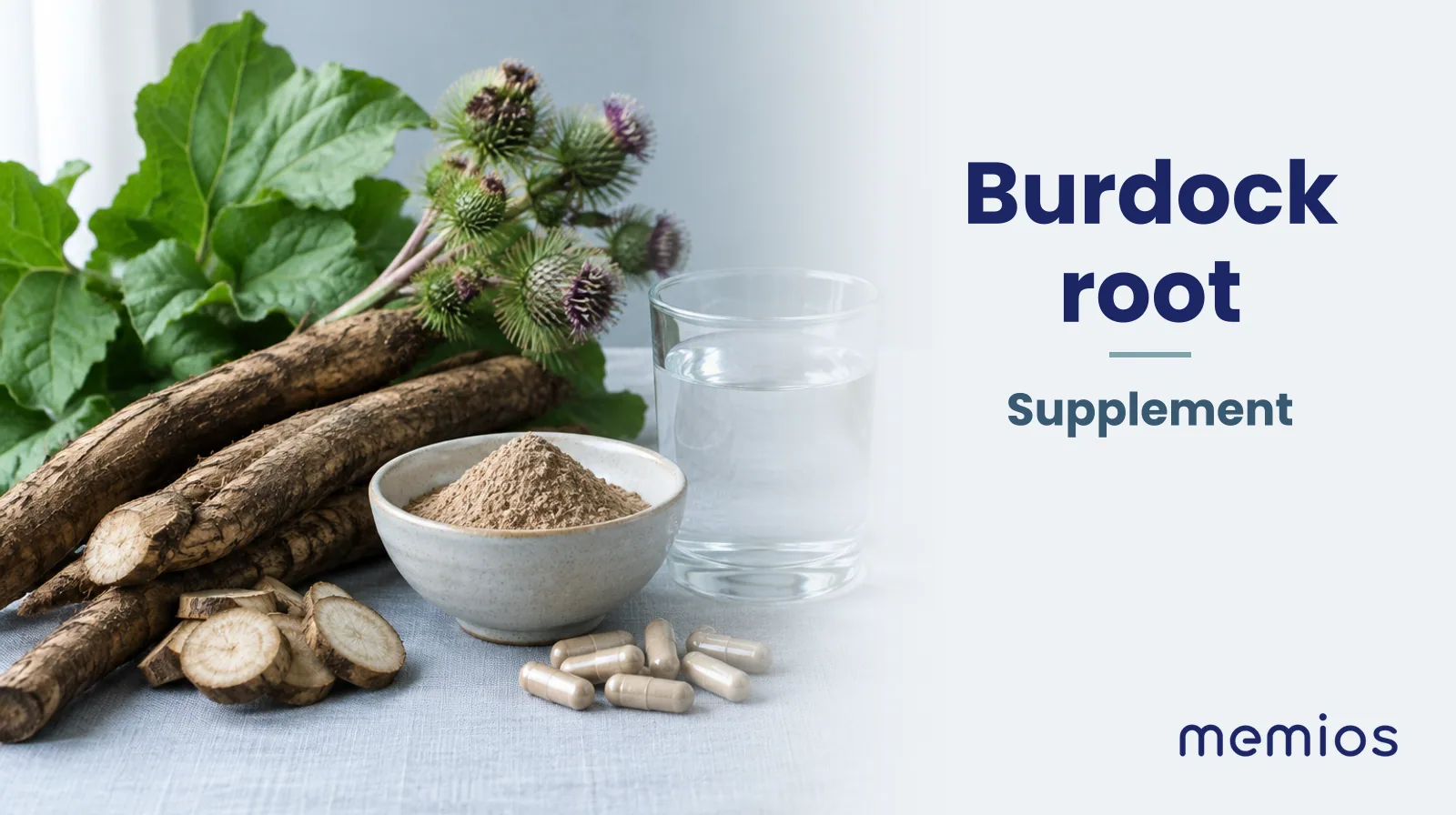
Burdock root
Limited evidence. It is sold as a detox or 'blood purifier' tea and for skin, joints and blood sugar.
TLDR
- Limited evidence. It is sold as a detox or 'blood purifier' tea and for skin, joints and blood sugar.
- What it is: The root of burdock, a perennial daisy-family plant used in traditional Chinese medicine and eaten as a vegetable in parts of Asia.
- Main use, supported: In a 42-day randomised trial of 36 knee-osteoarthritis patients, three cups a day of burdock root tea lowered IL-6, hs-CRP and malondialdehyde compared with hot water. (low certainty)
- Other use, supported: A review of burdock root reports that the extract protected against liver damage from metals and acetaminophen, but this work is preclinical, not human. (very low certainty)
- Claim NOT supported by research: In that trial, glutathione peroxidase activity did not change significantly. (low certainty)
- Another claim NOT supported: Memorial Sloan Kettering (2023) states there is no evidence to support using burdock for cancer, infections, diabetes or other conditions.
- Recommended dose: not established. There is no RDA or AI: burdock root is an herb and vegetable, not an essential nutrient. No reference intake was found.
- Studied dose (a trial dose, not a recommendation): Three cups a day of burdock root tea (2 g in 150 mL boiled water per cup), after meals, for 42 days, alongside acetaminophen and glucosamine. Findings citing that trial: 1 for, 1 against.
- Upper limit: No upper limit has been set.
- What goes wrong: 4 findings on harm. A 1984 report described anticholinergic poisoning from a commercial burdock root tea that was contaminated with atropine; it was the second lab-confirmed case.
- Common myth: Burdock root tea is a safe, natural detox.
What it is
The root of burdock, a perennial daisy-family plant used in traditional Chinese medicine and eaten as a vegetable in parts of Asia. The root contains flavonoids and fructo-oligosaccharides.
What the research says
It is sold as a detox or 'blood purifier' tea and for skin, joints and blood sugar. Most evidence comes from lab and animal work. In people, the main trials are two reports from one small 6-week study of 36 knee-osteoarthritis patients. It reported lower inflammatory markers and some lipid changes, but not every marker changed. A cancer centre summary says there is no evidence it treats any medical condition. Known harms include commercial burdock teas contaminated with atropine that caused poisoning, anaphylaxis after eating burdock, and allergic contact dermatitis. Pregnancy is flagged as a concern.
Evidence grade: Limited evidence.
What goes wrong
A 1984 report described anticholinergic poisoning from a commercial burdock root tea that was contaminated with atropine; it was the second lab-confirmed case. (Source 1)
- Case report, Very low certainty.
- Size: 1 patient (second confirmed case reported)
- Who: adult tea drinker, Arizona.
- How long: acute.
- Result: Estimated atropine dose 2.28 mg, above the usual adult oral antispasmodic dose of 0.3 to 1.2 mg.
- Funding: not stated.
The patient experienced mild anticholinergic symptoms which were caused by an atropine contaminant in the commercial preparation.
The authors could not trace the source of the atropine and noted an earlier 1978 FDA recall of burdock root tea. (Source 1)
- Case report, Very low certainty.
- Size: 1 patient.
- Who: adult tea drinker.
- How long: acute.
- Result: Contamination source unconfirmed.
- Funding: not stated.
Our efforts to retrieve specific details on the 1978 FDA recall action dealing with Burdock root tea failed after repeated attempts.
A cancer centre summary lists anaphylaxis in a man one hour after eating boiled burdock. (Source 2)
- Case report, Very low certainty.
- Size: 1 patient.
- Who: 53-year-old man.
- How long: acute.
- Result: Whole-body redness and difficulty breathing.
- Funding: independent (hospital)
Anaphylaxis characterized by redness over the entire body and dyspnea: In a 53-year-old man after one hour of consuming boiled burdock.
The same summary lists acute liver injury after a multi-herb liver detox tea that contained burdock; burdock was not shown to be the cause. (Source 2)
- Case report, Very low certainty.
- Size: 1 patient.
- Who: 36-year-old woman.
- How long: not stated.
- Result: Acute liver injury; multi-ingredient product.
- Funding: independent (hospital)
Acute liver injury: In a 36-year-old woman following intake of an herbal liver detox tea containing burdock.
What the evidence supports
In a 42-day randomised trial of 36 knee-osteoarthritis patients, three cups a day of burdock root tea lowered IL-6, hs-CRP and malondialdehyde compared with hot water. (Source 3)
- Randomized trial, Low certainty.
- Size: 36 patients (10 men, 26 women)
- Who: adults aged 50-70 with knee osteoarthritis, Tabriz, Iran.
- How long: 42 days.
- Result: IL-6 P = 0.002; hs-CRP P = 0.003; MDA P < 0.001; TAC and SOD increased.
- Funding: not stated.
The results showed that burdock root tea significantly decreased the levels of serum IL-6 (P = 0.002), hs-CRP (P = 0.003) and malondialdehyde (P < 0.001)
A review of burdock root reports that the extract protected against liver damage from metals and acetaminophen, but this work is preclinical, not human. (Source 4)
- Animal study, Very low certainty.
- Size: not applicable.
- Who: animal and laboratory models.
- How long: not applicable.
- Result: Not quantified in the abstract.
- Funding: not stated.
The utilization of Arctium lappa root extract has exhibited encouraging outcomes in addressing hepatotoxicity induced by cadmium, lead, chromium, and acetaminophen
What the evidence does not support
In that trial, glutathione peroxidase activity did not change significantly. (Source 3)
- Randomized trial, Low certainty.
- Size: 36 patients.
- Who: adults aged 50-70 with knee osteoarthritis.
- How long: 42 days.
- Result: GPX increased, not significant.
- Funding: not stated.
GPX activities increased but not significantly.
Memorial Sloan Kettering (2023) states there is no evidence to support using burdock for cancer, infections, diabetes or other conditions. (Source 2)
- Official position, Certainty not rated.
- Size: not applicable.
- Who: not applicable.
- How long: not applicable.
- Result: Position statement.
- Funding: independent (hospital)
There is no evidence to support use of burdock to treat cancer, infections, diabetes, or other medical conditions.
Where the evidence is mixed
A second report from the same single-blind trial found between-group differences in LDL, HDL, cholesterol ratios and diastolic pressure, but not in total cholesterol or systolic pressure. (Source 5)
- Randomized trial, Low certainty.
- Size: 36 patients.
- Who: adults aged 50-70 with bilateral knee osteoarthritis.
- How long: 6 weeks.
- Result: Between-group differences in LDL-C, HDL-C, TC/HDL-C, LDL-C/HDL-C and diastolic BP; total cholesterol and systolic BP fell only within the tea group.
- Funding: not stated.
Limit of this finding: The paper calls this trial 'placebo-controlled', but the comparison group drank plain boiled water, which is not a true placebo, and the trial was single-blind. This is also the same 36 patients as the authors' 2016 report, so the two papers are not independent evidence.
At the end of the study, there was a significant difference in LDL-C, HDL-C, TC/HDL-C, LDL-C/HDL-C ratios and diastolic blood pressure between the two groups.
Where the research disagrees
Whether burdock has any proven clinical benefit
- Maghsoumi-Norouzabad et al. (2016), one RCT, 36 patients, 42 days: The results suggested that Arctium lappa L. root tea improves inflammatory status and oxidative stress in patients with knee osteoarthritis. (Source 3)
- Memorial Sloan Kettering Cancer Center (updated March 2023), evidence summary: There is no evidence to support use of burdock to treat cancer, infections, diabetes, or other medical conditions. (Source 2)
How much
- Reference intake: There is no RDA or AI: burdock root is an herb and vegetable, not an essential nutrient. No reference intake was found. (Source 2)
- Upper limit: No upper limit has been set. Memorial Sloan Kettering (2023) flags pregnancy and chrysanthemum allergy as reasons for caution. (Source 2)
- Studied: Three cups a day of burdock root tea (2 g in 150 mL boiled water per cup), after meals, for 42 days, alongside acetaminophen and glucosamine. (Source 3)
A common belief, and what the research shows
The belief: Burdock root tea is a safe, natural detox.
What the research shows: Commercial burdock teas have caused poisoning through contamination: "The patient experienced mild anticholinergic symptoms which were caused by an atropine contaminant in the commercial preparation." There is no human evidence for detox.
Questions and answers
What is it?
Burdock (Arctium lappa) is a perennial plant used in traditional Chinese medicine. Its root contains flavonoids and fructo-oligosaccharides, a type of fibre. (Source 4)
What does it do in the body?
In lab and animal work, root extracts act as antioxidants and protect the liver. In one small trial in people, root tea lowered inflammatory markers over six weeks. Other human effects are unproven. (Source 3)
Is it good or bad for you?
As a cooked vegetable it is part of normal diets. As a supplement the benefit is unproven. Harms include contaminated teas, allergy and possible risk in pregnancy. (Source 2)
How do you get more of it?
People eat the root cooked or drink it as tea. The one trial gave three cups of root tea a day. This describes what was studied, not a suggestion. (Source 3)
If it is harmful, what reduces it?
Does not apply to burdock itself. The documented poisoning came from atropine contamination of a commercial tea, not from burdock. (Source 1)
Why might someone be low in it or missing it?
Does not apply. Burdock is not an essential nutrient, so there is no deficiency state. (Source 2)
Which whole foods contain it or feed it?
The root itself is eaten as a vegetable, usually boiled (gobo in Japanese cooking). The root's fructo-oligosaccharides are a fermentable fibre. (Source 4)
What happens if you do not have it?
Nothing is known to happen. It is not essential. (Source 2)
How can you test for it?
No test for burdock intake exists in the literature we searched. Lab testing identified atropine contamination in a poisoning case. (Source 1)
We searched: WebSearch for burdock trials, reviews, case reports and contamination; the Rhoads 1984 report and the MSKCC summary
References
- Journal of Toxicology: Clinical Toxicology 22(6). Anticholinergic poisonings associated with commercial burdock root tea. 1984. PMID 6535850, DOI 10.3109/15563658408992587. Read the source
- Memorial Sloan Kettering Cancer Center. Burdock (About Herbs). 2023. Read the source
- International Journal of Rheumatic Diseases. Effects of Arctium lappa L. (Burdock) root tea on inflammatory status and oxidative stress in patients with knee osteoarthritis. 2016. PMID 25350500, DOI 10.1111/1756-185X.12477. Read the source
- Natural Products and Bioprospecting 14:49. Harnessing the power of Arctium lappa root: a review of its pharmacological properties and therapeutic applications. 2024. DOI 10.1007/s13659-024-00466-8. Read the source
- Journal of Herbal Medicine. Effect of Arctium lappa linne (Burdock) root tea consumption on lipid profile and blood pressure in patients with knee osteoarthritis. 2019. DOI 10.1016/j.hermed.2019.100266. Read the source